Palace of Culture in Iași: A Neo-Gothic Museum and Civic Building
Site at a Glance
- Country
- Romania
- Primary era
- Modern
- Eras represented
- Modern
- Civilizations
- Kingdom of Romania, Ottoman, Principality of Moldavia
- Site type
- Civic
- Remains
- Palace
On this page17 sections
History
The medieval court and earlier palace
The Palace of Culture is a Neo-Gothic public building in Iași, Romania. Neo-Gothic architecture revives medieval Gothic forms. Construction began in 1906-1907, and the building was conceived as a replacement and expansion of the earlier Princely Palace of Moldavia. Moldavia was a historical principality in eastern Europe. The Palace stands within the perimeter of its medieval Princely Court, dated to 1434.
The earlier palace was built in the early nineteenth century under Prince Alexandru Moruzi and designed by Johann Freywald. Prince Mihail Sturdza arranged its renovation in 1841-1843, with architect Nicolai Sungurov, and another renovation followed in 1880-1883. The building was demolished between 1904 and 1906. A story associated with it claimed that it had 365 rooms, one for every day of the year.
Construction and opening
Romanian architect I. D. Berindei led the Palace’s design, choosing a flamboyant Neo-Gothic style in contrast to the earlier palace’s Neoclassical, or classical-inspired, design. Filip Xenopol and Grigore Cerchez were also associated with the architecture. Shortages of materials and other resources halted construction during the First World War. While unfinished, the building housed Romanian and Russian troops, public institutions, and military hospitals. It was completed on 11 October 1925 and formally inaugurated the next year by King Ferdinand I of Romania, who reigned from 1914 to 1927.
Administrative and cultural use
Until 1955, the Palace served as the Administrative and Justice Palace, including the County Law Court and other public institutions. During the Second World War it housed German troops, followed later by Soviet troops.
From 1955, the building was given a cultural role and accommodated four museums, later brought together in the Moldavia National Museum Complex. The Art Museum dates to 1860. The history museum traces its institutional roots to the Antiquity Museum, established in 1916 by archaeologist and historian Orest Tafrali. The Ethnographic Museum of Moldavia was founded in 1943. The science and technology museum began in 1955 as the Polytechnical Museum and was renamed in 1994 for physicist Ștefan Procopiu. The Palace also housed the main branch of the Iași County Library from 1955 to 2010. It now accommodates a Cultural Heritage Conservation-Restoration Centre and hosts exhibitions and other events.
Earthquake damage and restoration
Between 1975 and 1977, workers replaced the timber floor structure at the uppermost level with cement construction reinforced by steel mesh. The 1977 earthquake damaged the first-floor structure, walls, ornaments, and reliefs. A major restoration began in 2008, with its principal works completed in April 2016. The Palace is included in Romania’s National Register of Historic Monuments.
Remains
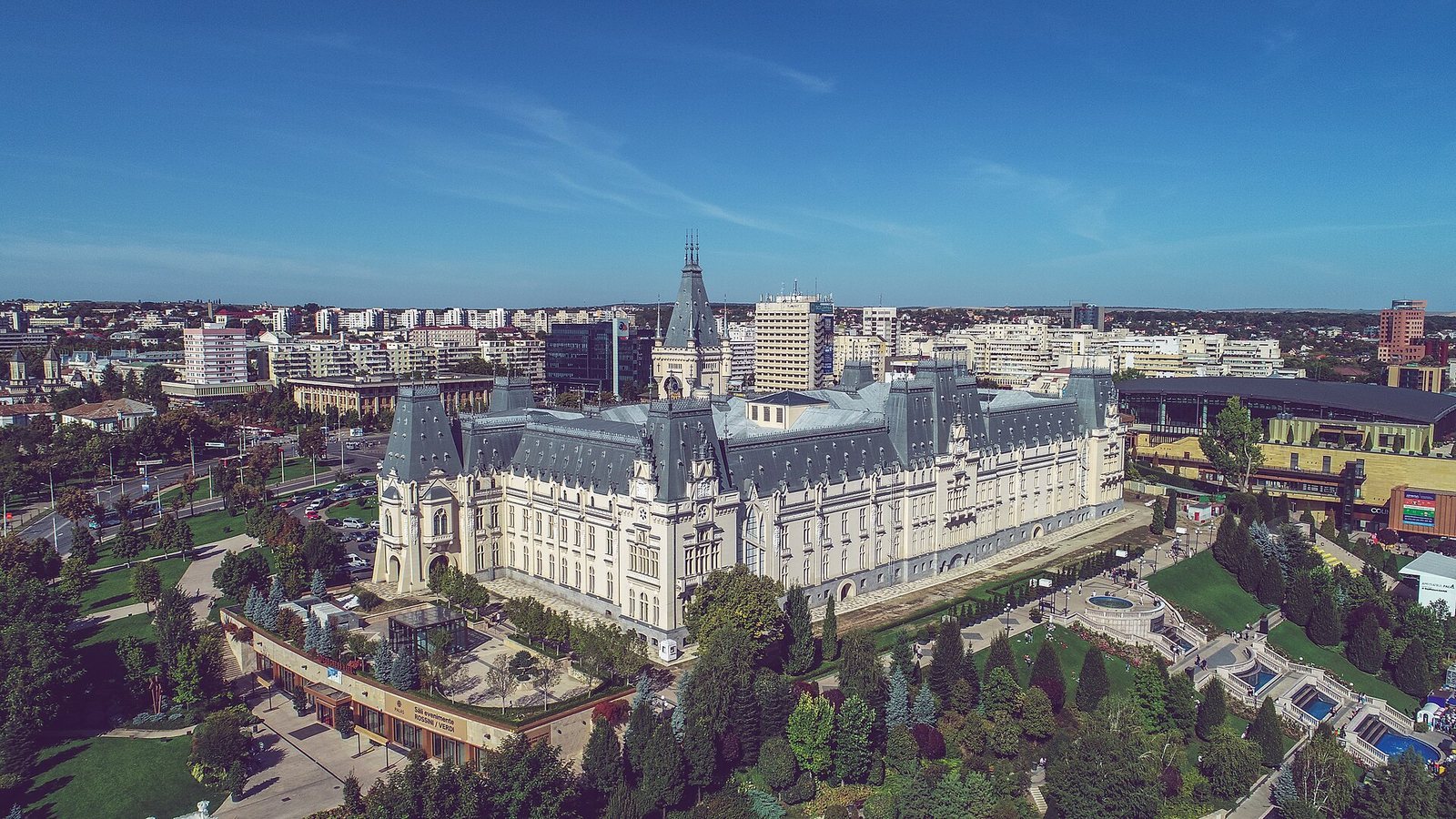
The Palace is a large Neo-Gothic building with a central tower and an inner courtyard. It rises 55 metres and contains 298 rooms across 34,236 square metres. Its construction incorporates parts of earlier structures on the site, while its interiors combine decorative features with modern systems devised for the building.
Building and architectural features
Structure and materials
The Palace was built partly over the remains of the medieval Princely Court and partly on foundations and first-floor sections retained from the nineteenth-century Princely Palace. Its front facade has 92 windows, with another 36 facing the inner courtyard. Lighter, less costly materials were used in place of stone blocks. Some rooms feature a cement-based material made to imitate oak. The doors of the Voivodes’ Room are notable for their decorative ironwork.
Central clock tower
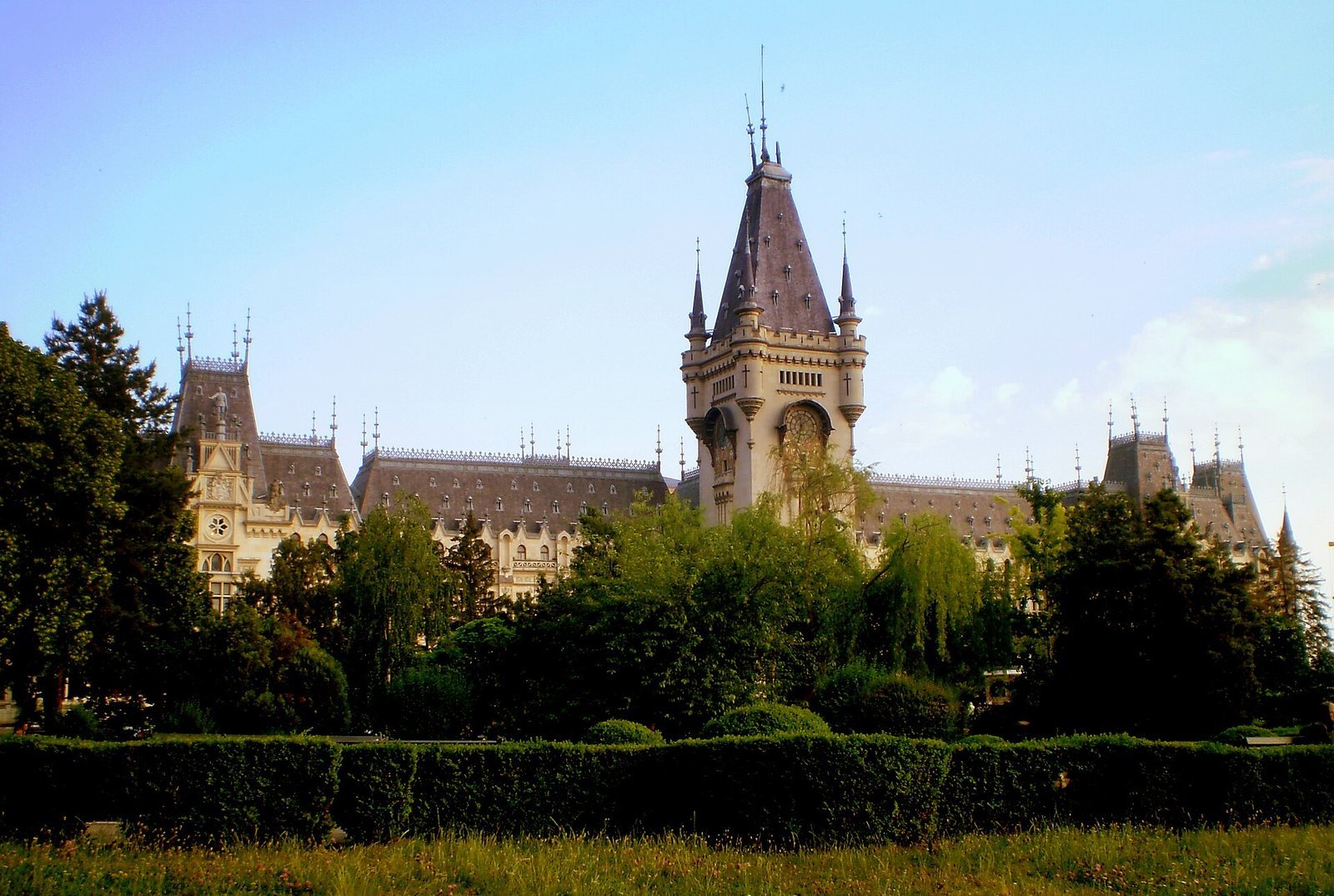
The main entrance passes through the central clock tower, which resembles a fortified keep. Crenellations, alcoves, a spire, and an eagle with outstretched wings form its exterior. Each of its three exposed sides carries a clock face 3.25 metres across, with stained glass depicting the twelve signs of the zodiac. Painted figures of two young men in national dress flank the clock faces, in a design inspired by Peleș Castle. The glass and cross-shaped crenellations are lit at night. Eight bells form a mechanism that plays the Romanian song and circle dance “Hora Unirii,” associated with national union, every hour. A drum fitted with 69 pins controls the tune.
Halls and decorated rooms
A large mosaic in the central hall arranges images of a Gothic bestiary, a collection of animal depictions that includes mythical creatures, in concentric patterns. Its creatures include two-headed eagles, dragons, griffins, and lions. An adjoining room, originally arranged as a greenhouse, has a glass ceiling. The Gothic Room contains another bestiary mosaic, with griffins, two-headed eagles, and lions.
On the first floor, the Voivodes’ Room contains portraits of Moldavian rulers and Romanian kings, beginning with Decebalus, a king of ancient Dacia, and Trajan, a Roman emperor. The room also displays paintings by Ștefan Dimitrescu and his pupils. In the Henri Coandă Room, carvings and reliefs were made by Romanian inventor and engineer Henri Coandă.
Other architectural features
In the right wing, the Watch Tower recalls the former Princely Court, while galleries run beneath the Palace courtyard. The left wing contains a display of architectural capitals and other stone fragments. Electric lighting, air heating, ventilation, a thermostat, and vacuum cleaners were supplied from an underground machinery room. To address the risk of fire, the attic’s wooden structure was treated with a fire-retardant product, and eternite was used on the roof.
Museums and collections
Art Museum
The Art Museum occupies the first floor, where 24 permanent-exhibition rooms are arranged in three galleries: Universal Art, Romanian Modern Art, and Contemporary Art. Its collection exceeds 8,700 works, with about 1,000 forming part of the national and universal cultural heritage. Artists represented include Caravaggio, Paolo Veronese, Anthony van Dyck, Nicolas Poussin, and François Boucher.
Moldavia History Museum
On the western side of the first floor, the Moldavia History Museum holds more than 48,000 objects, including archaeological and numismatic material, decorative arts, old books, and documents. Its displays include a mammoth skull dated to about 70,000 years ago, pottery from the prehistoric Cucuteni culture, and Dacian, Sarmatian, Gothic, and Roman objects. Medieval weapons and other objects are also represented. Four sections cover prehistory and ancient, medieval, modern, and contemporary history, with displays tracing local communities from the Paleolithic to the Second World War.
Ethnographic Museum of Moldavia
The Ethnographic Museum occupies the western part of the first and second floors and holds more than 13,000 objects. Its collections include equipment and objects connected with farming, viticulture, animal husbandry, fishing, hunting, and beekeeping. Displays also feature peasant-house interiors, tools for pottery, weaving, and woodworking, masks, and traditional costumes. Many of the objects are more than a century old.
Ștefan Procopiu Science and Technique Museum
This museum holds more than 8,500 objects. Its collections cover energy, sound recording and playback, telecommunications, mineralogy and crystallography, and computers. Its sound recording and playback collection is unique in Romania.
Statue and cannons
In front of the Palace stands an equestrian statue of Stephen the Great, a fifteenth-century prince of Moldavia. Two Krupp cannons flank it. They are trophies from the Romanian War of Independence, Romania’s struggle for independence.