Aachen Chapel of Hungary: A Hungarian Pilgrimage Chapel at Aachen Cathedral
Site at a Glance
- Country
- Germany
- Primary era
- Early Modern
- Eras represented
- Early Modern
- Civilizations
- Holy Roman Empire
- Site type
- Religious
- Remains
- Chapel
On this page14 sections
History
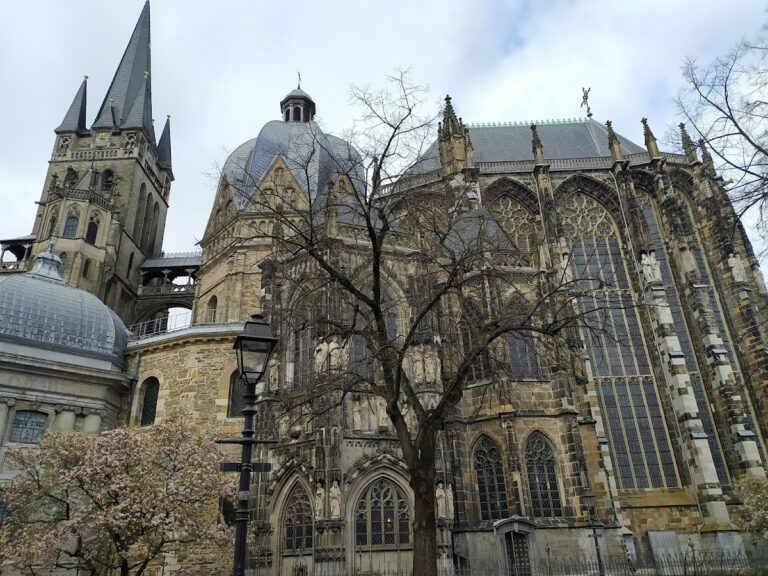
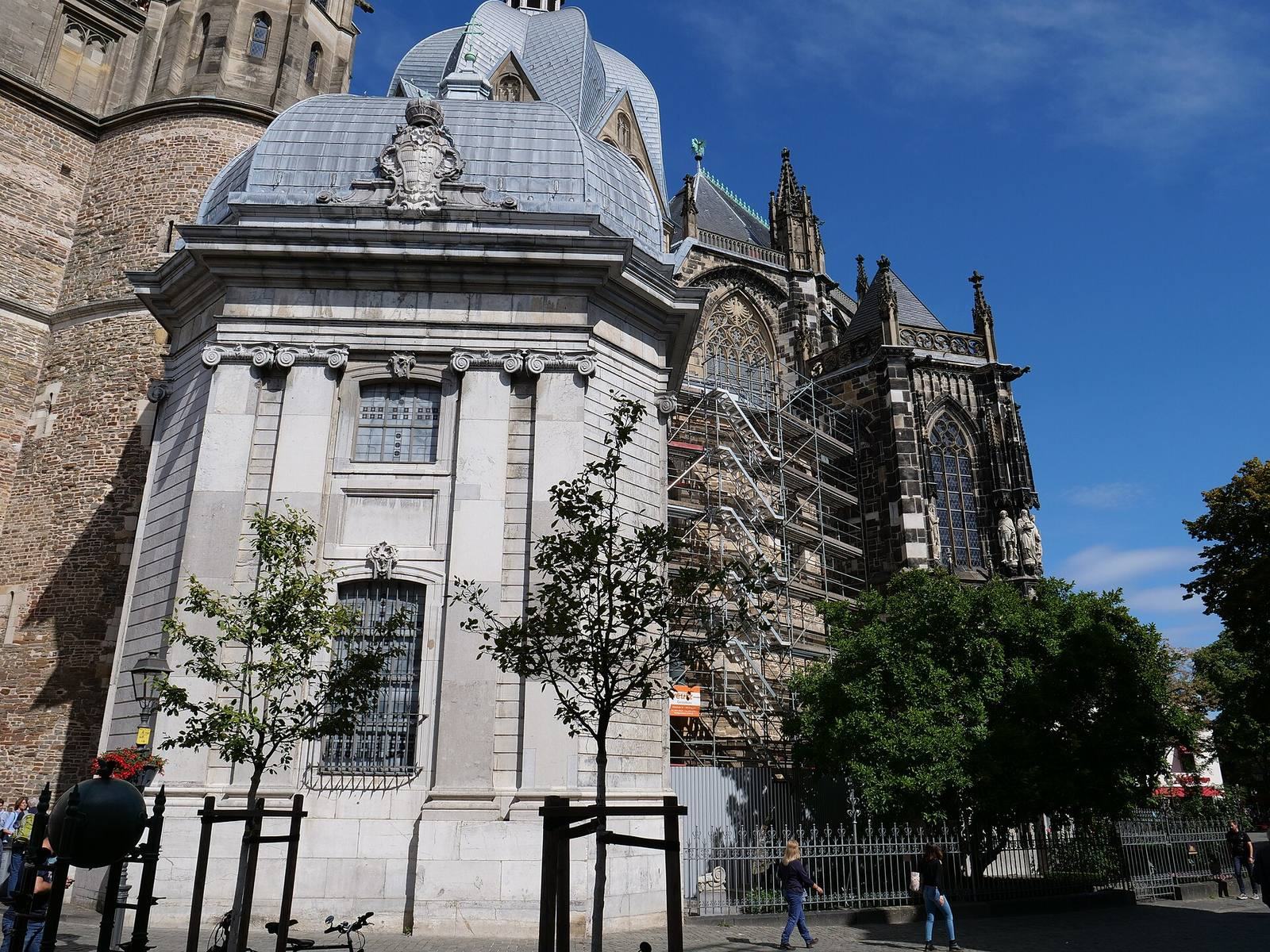
The Aachen Chapel of Hungary is a Roman Catholic side chapel of Aachen Cathedral in Aachen, Germany, within the Diocese of Aachen, a territorial church district led by a bishop. It forms part of the cathedral’s UNESCO World Heritage property, inscribed in 1978. The chapel’s medieval predecessor was completed in 1367 in the Gothic style, a medieval architectural style associated with pointed arches and tall windows. The present building was rebuilt in the eighteenth century in a Baroque-classical style, which combines Baroque design with classical forms. Founded through the patronage of Louis I of Hungary, it served two Hungarian priests and became closely associated with Hungarian pilgrimage to Aachen.
Hungarian pilgrimage and royal patronage
During the Middle Ages, Aachen was among Europe’s leading pilgrimage destinations, behind Rome and Santiago de Compostela. The pilgrimage centred on four relics, sacred objects associated with religious figures and kept for veneration. Charlemagne, the Frankish king and emperor, had received them from the patriarch of Jerusalem, a senior bishop, and given them to Aachen Cathedral. They were Mary’s garment, the swaddling cloth of Jesus, the cloth on which the head of John the Baptist rested, and Christ’s loincloth from the Cross. The pilgrimage is known from 1349 and was traditionally held every seven years.
Hungarian participation is known from the early fourteenth century. Walloon and Rhineland settlers probably introduced the custom in Hungary, where German communities helped it spread among Hungarian believers. Hungarians became the largest national group among the pilgrims, despite travelling more than 1,200 kilometres. In some years, their numbers exceeded 5,000. Groups of hundreds travelled for several weeks, sometimes more than a month, singing and carrying crosses, candles, and banners. Some went by water along the Danube and Rhine; the overland route passed through Vienna, Passau, Regensburg, Nuremberg, Frankfurt, Mainz, and Koblenz before reaching Andernach and Aachen.
In 1357, Elizabeth of Poland, widow of Charles I of Hungary and mother of Louis I, travelled to the tomb of Saint Elizabeth in Marburg and the Shrine of the Three Kings in Cologne before visiting Aachen with a large retinue. She sought the Virgin Mary’s protection for Hungarian forces fighting for Dalmatia. In Aachen she met Emperor Charles IV and Empress Anna and made rich gifts to the shrine. Some Hungarian treasures associated with her gifts remain in the cathedral treasury.
Inspired by his mother’s journey, Louis I donated funds in 1364 for a chapel at Aachen Cathedral and the support of two Hungarian priests. The chapel was completed in 1367. Its founding charter listed the worship equipment provided by the king, including vestments, chalices, altarpieces, candlesticks, and books for services. Louis also arranged the purchase of land near Aachen to fund the chapel’s upkeep and the Hungarian chaplains.
By 1366 at the latest, altars associated with relics of Saints Stephen, Emeric, and Ladislaus had been established. Pope Urban V granted privileges to the chaplain serving the altar dedicated to Ladislaus. A charter issued in 1370 set out legal relations between the Hungarian royal house and the city of Aachen. Louis probably visited Aachen in 1374, and the building soon became known as the Chapel of Hungary.
Pilgrimage, decline, and rebuilding
Hungarian pilgrimages were especially numerous in 1414, when Sigismund of Luxembourg was crowned German king. Pilgrims arriving in Aachen went to the cathedral’s main entrance and crawled on their knees to an altar dedicated to the Virgin Mary, offering candles decorated with Hungarian coins. They could lodge in a house reserved for them in Cologne. Wealthy Hungarians also built houses around Aachen Cathedral, many of which remain within the old town’s built fabric. French troops temporarily evicted Hungarian residents in 1794; Napoleon Bonaparte expelled them permanently in 1804.
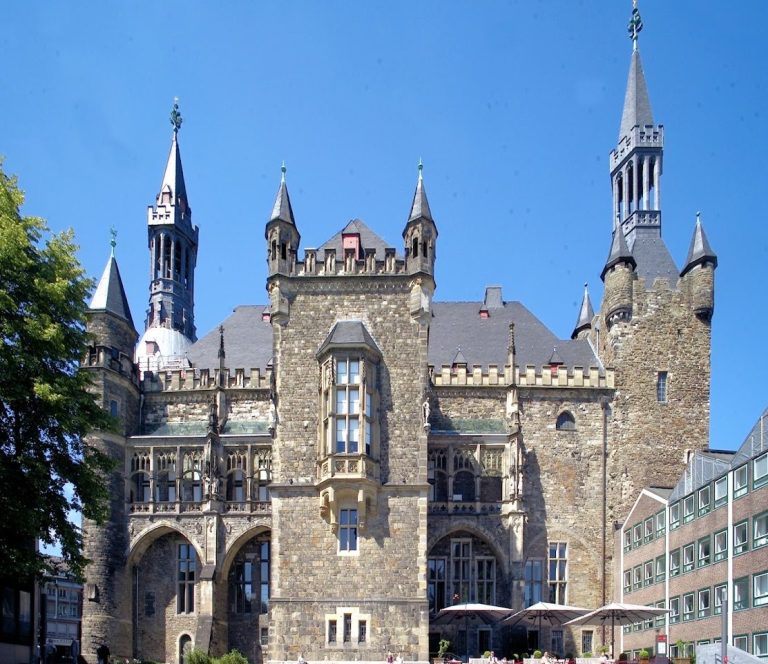
The chapel’s condition worsened in the early sixteenth century as the Reformation, a movement that divided Western Christianity and led to the establishment of Protestant churches, spread and donations from Hungarian pilgrims temporarily declined. A major fire in Aachen in 1656 burned the chapel’s roof. Its treasures were transferred to the city hall for safekeeping, and the building then deteriorated further.
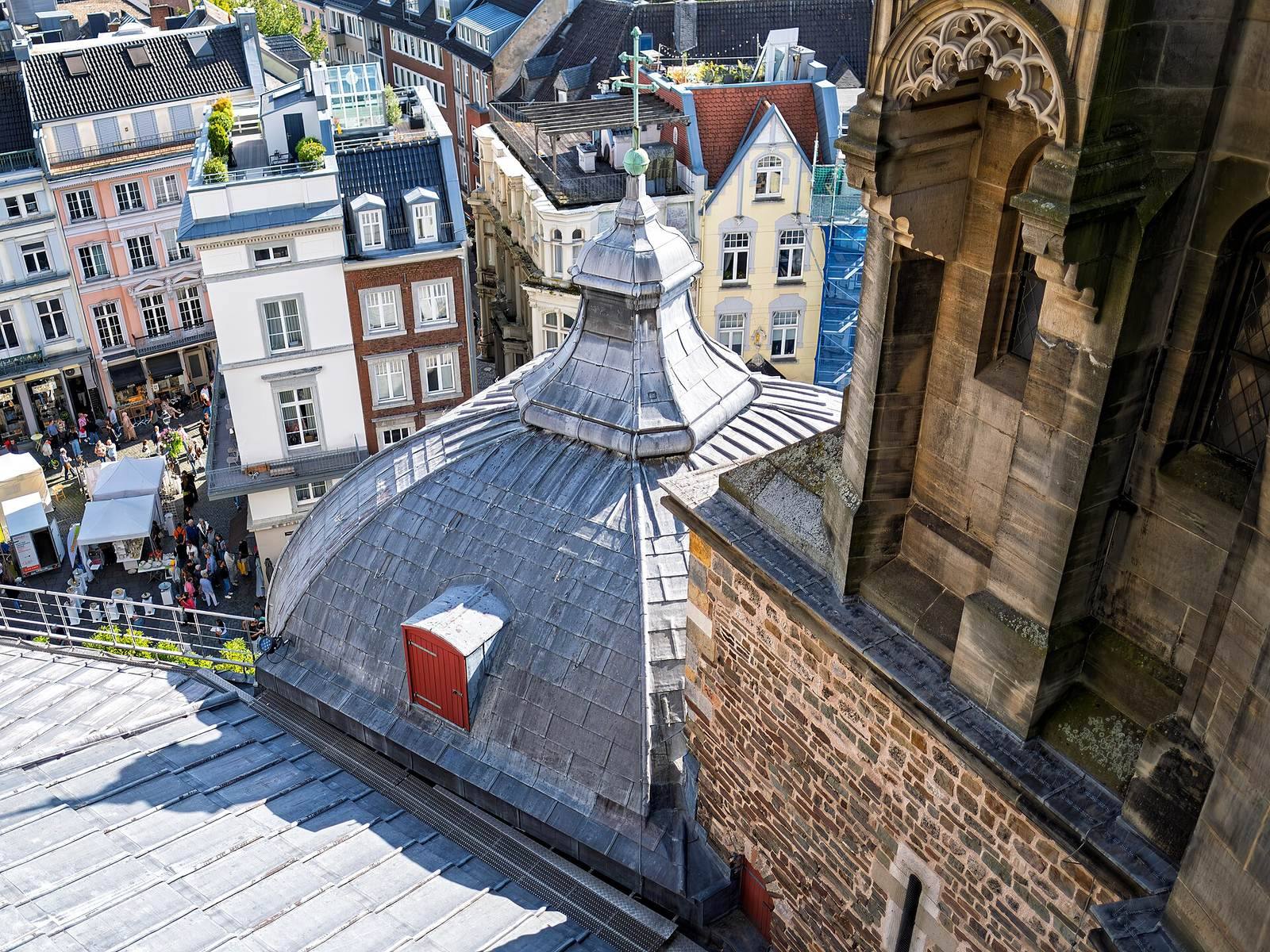
In 1747, during the War of the Austrian Succession, a conflict over the Habsburg succession, General Károly Batthyány and other Hungarian generals commissioned municipal architect Johann Joseph Couven to renovate the chapel. The Gothic building was taken down and a new foundation stone laid, but the work proceeded slowly and departed from the original plans. The new walls subsided and collapsed, forcing the demolition of the entire structure. In 1756, rebuilding was entrusted to Milanese architect Joseph Moretti. The new chapel was constructed in Baroque-classical style, and its roof was complete by 1764.
The cathedral treasury
From the Middle Ages, the cathedral treasury was kept in a wall cabinet in the Chapel of Saint Matthew. It moved to the Chapel of Saint Charles in 1861, then to the Chapel of Hungary in 1881 because of conservation concerns. Purpose-made cabinets housed the treasures there until 1929. They were subsequently stored temporarily in the Chapel of the Souls after its arcades were closed. By 1931 that space had been enlarged northward and fitted with an alarm system. Following repairs for war damage, the treasury reopened in 1946, was remodeled in 1958, and was redesigned in 1995.
Inventories from 1367 and 1381 identify two panel paintings as Louis I’s gifts to the Chapel of Hungary and a third as his gift to the cathedral. All three are now in the cathedral treasury.
Remains
Chapel fabric and decoration
Plan and construction
The present chapel stands on the south side of Aachen Cathedral, to the right of its main entrance. It has a rounded-square exterior and a circular interior. One side adjoins the cathedral, while another faces the south stair tower. The well-preserved building is used as a place for prayer and has the Baroque-classical form created during its eighteenth-century rebuilding.
The earlier Gothic chapel
The earlier chapel joined directly to the cathedral’s Carolingian octagon, its eight-sided central structure associated with Charlemagne’s building works. Abraham Hogenberg’s 1622 depiction shows the chapel with a three-sided choir, a pointed roof, and sculptures set between tall choir windows.
Exterior sculpture and heraldry
The chapel’s three windows and entrance are topped by large coats of arms, with stylized crowns above and drapery at the sides. A crowned Hungarian coat of arms appears on the exterior within an ornate framed panel. Above the entrance, the arms of Maria Theresa are accompanied by those of Francis I on the right and Joseph II on the left. Four statues of Hungarian saints stand in niches. Stephen wears a crown, armor, and cloak and leans on a cross with his right hand. Ladislaus wears a crown, holds a scepter, and leans on an oval shield. Emeric holds a scepter and lily, with his left hand resting on his heart. Adalbert, dressed as a bishop, leans on a ceremonial staff with his left hand and holds a book in his right.
Inscriptions
A black marble plaque on the right interior wall lists Hungarian holy kings and princesses in Latin. A separate black panel beneath the exterior coats of arms gives the chapel’s foundation as 1374 by Louis I, King of Hungary.
Objects associated with Hungarian devotion
Paintings in the cathedral treasury
Madonna and Child and Coronation of Mary are displayed on the first floor of the cathedral treasury. Their fourteenth-century metalwork frames surround eighteenth-century copies of the paintings.
The Hungarian Cross at Andernach
The Hungarian Cross carried by pilgrims from Andernach is a fourteenth-century plague cross, a crucifix associated with devotion during plague periods. It shows the suffering Christ on a branch-shaped cross with three arms. The cross remains in Andernach’s eleventh-century Church of Our Lady, a Romanesque building characterized by round arches and massive masonry.
Saint Stephen in the cathedral garden
A bronze statue of Saint Stephen by Hungarian sculptor Imre Varga stands beneath a magnolia tree in the cathedral garden. Hungary donated it in connection with the 1993 Aachen pilgrimage, and Prime Minister József Antall inaugurated it in the presence of Hungarian pilgrims. Its inscription identifies Stephen as the apostolic king of Hungary and names Varga as its sculptor.