Agen Cathedral: Seat of the Diocese of Agen
Site at a Glance
- Country
- France
- Primary era
- Medieval
- Eras represented
- Medieval, Modern
- Civilizations
- French
- Site type
- Religious
- Remains
- Cathedral
On this page12 sections
History
Agen Cathedral, a Roman Catholic church dedicated to Saint Caprais, is the seat of the Diocese of Agen in France. It began as a collegiate church, served by a community of canons, and the present building was erected on the site of an earlier basilica in the twelfth century. Its architecture brings together Romanesque and Gothic forms.
Early church and medieval rebuilding
Saint Caprais was martyred at Agen in 303, shortly after Saint Foy. Tradition places the two martyrs’ burial at the location where the church of Martrou later stood. It also credits Bishop Saint Dulcide with building a church in Caprais’s honor in the early fifth century and transferring the martyrs’ relics there.
An episcopal basilica dedicated to Saint Caprais existed by 580. The sixth-century bishop and historian Gregory of Tours relates that Renaud’s wife took refuge there after the military commander Didier drove her husband out and advanced toward Agen. She feared that the city would submit to Chilpéric, a Merovingian king of the Frankish realm. Before moving toward Agen, Didier had demanded an oath of allegiance from the people of Périgueux. Scandinavian raiders known as Normans sacked the basilica in 853, after which it was restored. A testament from 961 by Raymond, lord of Toulouse, mentions Saint Caprais alongside Agen’s Saint-Étienne Cathedral. The present cathedral was built on the basilica’s site in the twelfth century.
Religious conflict and cathedral status
In December 1561, the collegiate church was sacked during the French Wars of Religion, conflicts between Catholics and Protestants in sixteenth-century France. During the French Revolution, the political upheaval that began in 1789 and ended the monarchy, the church was converted into a fodder store in 1791. Worship resumed there in 1796. After the Revolution destroyed the former cathedral of Saint-Étienne, Saint Caprais became Agen’s official cathedral and was raised to cathedral status in 1802.
Nineteenth-century rebuilding
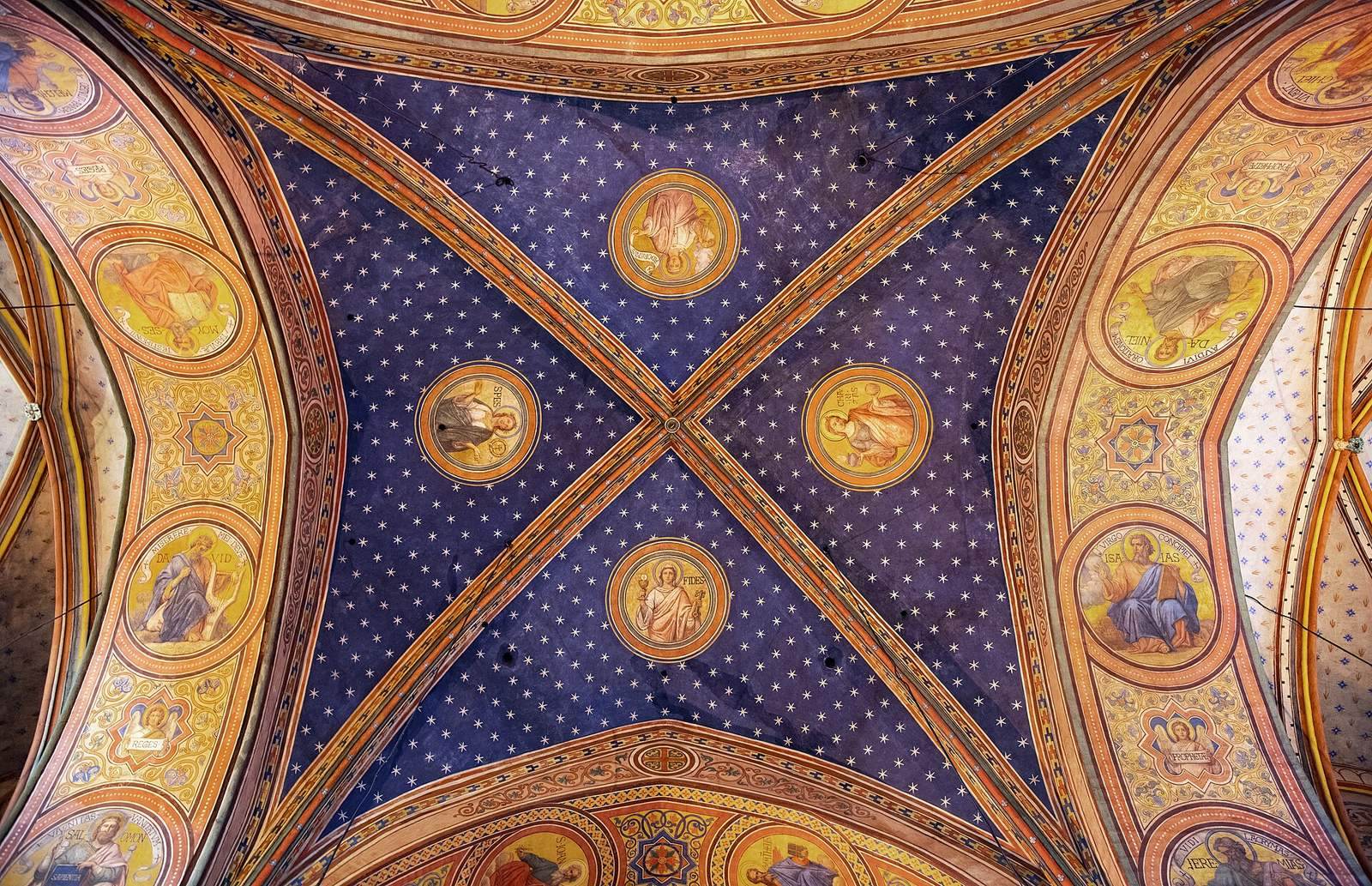
A bell tower built in 1835 replaced an earlier wooden tower. At the request of Bishop Jean-Aimé de Levezou de Vezins, architect Gustave Bourrières reconstructed the south façade and bell tower and renewed the interior floors between 1838 and 1847. Painter Jean-Louis Bézard began decorating the Virgin’s chapel in 1845 and continued work in the cathedral until 1869. The clergy selected the subjects, prompting debate between Bézard and Father Deyche.
Organs, photography, and heritage recognition
Jean-Baptiste Stoltz built the main organ for the 1855 Paris Universal Exhibition. Tradition credits the French empress Eugénie with giving it to the cathedral in 1858, which had previously lacked an instrument; it was installed in 1859. Rochesson substantially modified it in 1954, followed by further work by Gonzalez, and Claude Berger and an organ workshop restored it in 2004. The Magen organ builders made the choir organ in 1885. In 1877, French color-photography pioneer Louis Arthur Ducos du Hauron photographed the cathedral in color, among the early such photographs. The building was classified as a French historic monument in 1862. In 1998 it became part of the UNESCO World Heritage property Routes of Santiago de Compostela in France, associated with pilgrimage journeys to the shrine of Saint James in northwestern Spain.
Remains
Plan and exterior
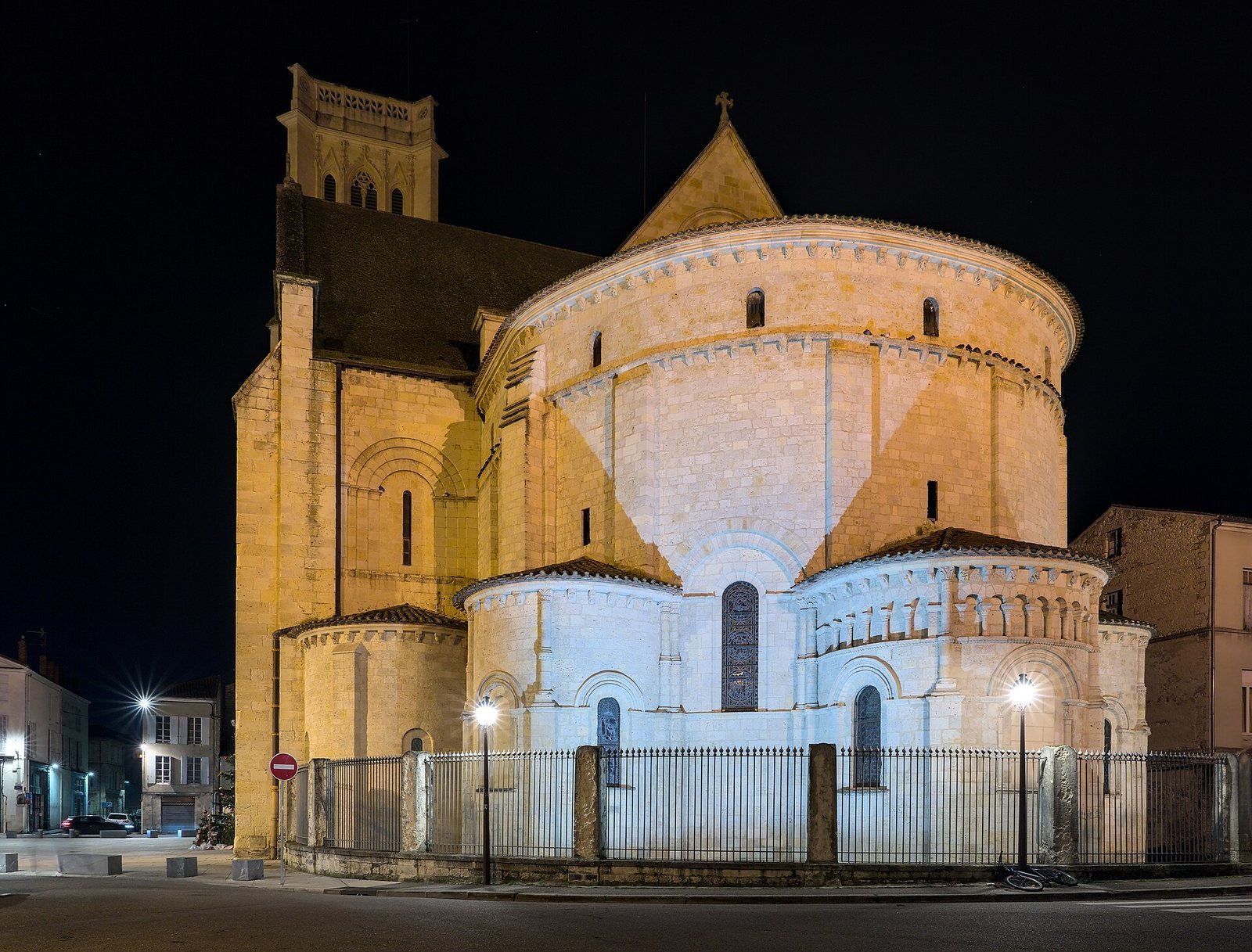
The cathedral has a Latin-cross plan, with a nave crossed by a transept, and combines a Romanesque semicircular apse, or rounded church end, with a single Gothic nave and a shallow choir. The nave is notably short in relation to the choir, a form shaped in part by political and financial difficulties. The overall composition has been compared with Byzantine churches. Chapels dedicated to Saint Anne and the Virgin Mary flank the choir. Three radial chapels extend around the apse: the chapel on the right is dedicated to Saints Primus and Felician, while the one on the left honors Saint Foy. Blind arcades, recessed decorative arches that do not open through the wall, rest on columns around the radial chapels. Their carved corbels, or projecting supports, feature human and animal heads; carved corbels also decorate the façade. The bell tower combines lancet, Rayonnant, and Flamboyant Gothic forms in reverse chronological order. Lancet Gothic is characterized by narrow pointed forms, while Rayonnant and Flamboyant are later Gothic phases. The south façade and entrance face Place du Maréchal-Foch.
North transept support
A projecting wall support of a form typical of the thirteenth century occupies a corner of the north transept. It carries two large wall arches and a broad pointed arch.
Painted decoration
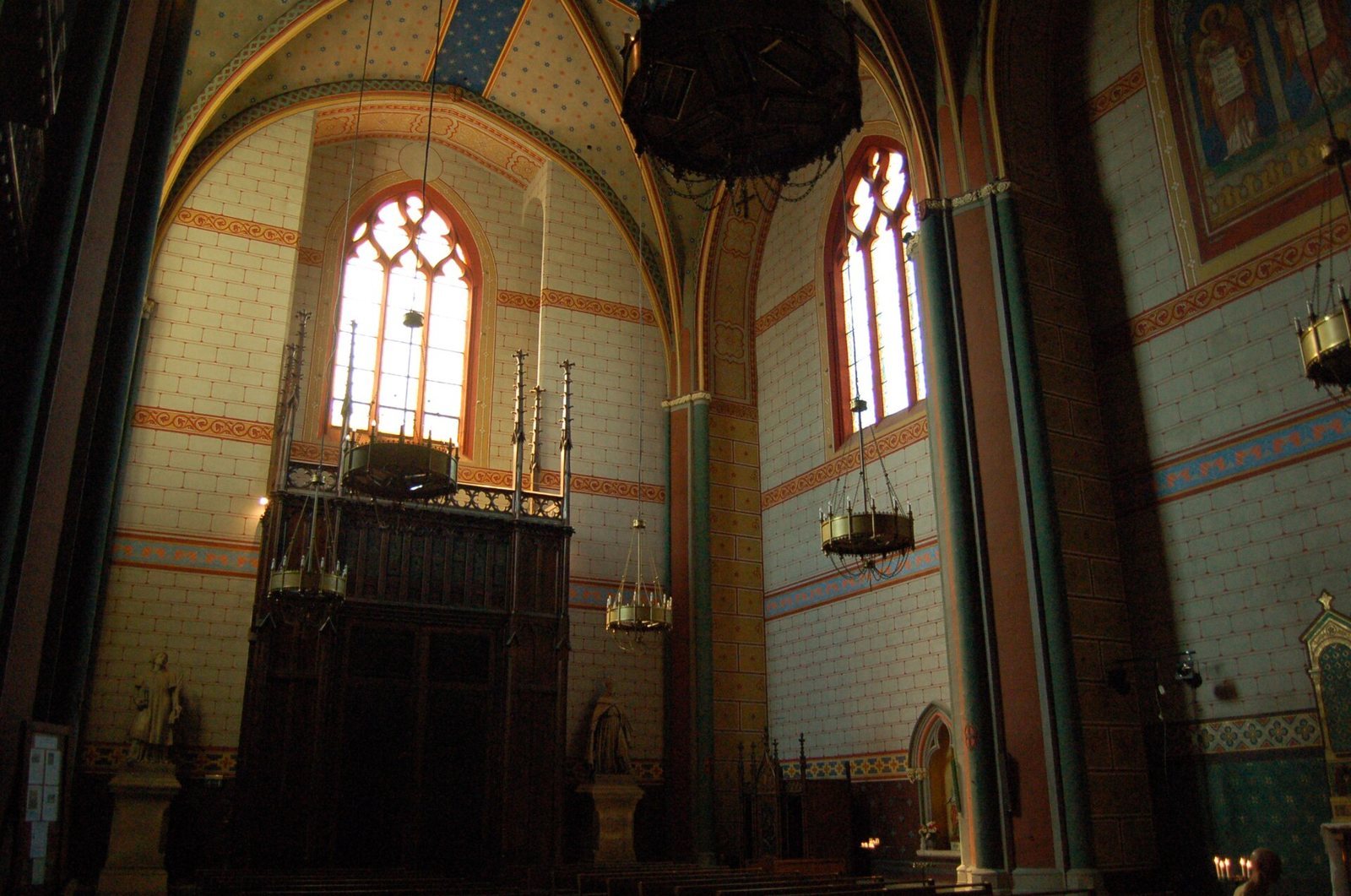
Wall and ceiling paintings portray the arrival of Christianity in the region, with particular attention to Agen’s early martyrs. Other subjects include the Evangelists, traditionally regarded as the authors of the four Gospels, the apostles, the biblical patriarchs Abraham, Noah, and Jacob, and the kings of Israel. Scenes and themes drawn from the Old and New Testaments include imagery centered on Mary, the mother of Jesus. Bézard took inspiration from churches in Palermo and Monreale for the medallions on the arches at the crossing. He also painted the ceiling of the semicircular apse, and the Virgin’s chapel is among the cathedral’s decorated spaces.
Sculpture and furnishings
On the inside face of the entrance façade, two statues by sculptor Louis Rochet date from 1844. Saint Caprais stands on the right and Saint Stephen on the left. The cathedral’s furnishings include an altar cross and six candlesticks, as well as a pulpit, a chapel containing the baptismal fonts, and a parish war memorial.
Main organ
The main organ stands in a gallery opening in the right-hand wall of the nave’s second bay. Its wooden case follows a Neo-Gothic design. The instrument has 45 stops, which control the sounds produced, across three hand keyboards and a pedal keyboard played with the feet. Its mechanical action is assisted by a Barker lever, and it includes a tremulant and an expressive box enclosing pipes to vary their volume. It is the largest organ in Lot-et-Garonne.
Choir organ
The choir organ is positioned beneath the arch of the apse’s left radial chapel. It has 15 stops, two hand keyboards, a pedal keyboard, and fully mechanical action.