Sikandar Bagh: A Royal Garden and Stronghold in the 1857 Rebellion
Site at a Glance
- Country
- India
- Primary era
- Modern
- Eras represented
- Modern
- Civilizations
- Unclassified
- Site type
- Domestic
- Remains
- Park
On this page8 sections
History
Royal garden and cultural life
Sikandar Bagh is a royal garden in India, established around 1800 by Nawab Saadat Ali Khan, a Muslim ruler of Oudh, a historic kingdom in northern India. In the first half of the nineteenth century, Nawab Wajid Ali Shah, Oudh’s last ruler, improved the garden, used it as a summer residence, and named it for his favourite wife, Sikandar Mahal Begum.
The central pavilion probably hosted Ras-lila performances, which depict episodes associated with Krishna, and Kathak, a classical dance tradition from northern India. Wajid Ali Shah also valued musical and poetic gatherings, and the garden served as a setting for cultural events.
The siege and assault of 1857
During the Indian Rebellion of 1857, an uprising against British rule in India, sepoy insurgents used Sikandar Bagh as a stronghold. The garden obstructed Sir Colin Campbell’s planned route to relieve the British Residency in Lucknow, the official compound of a British representative to an Indian state.
On 16 November 1857, British troops moving south along a sunken lane east of the garden came under heavy fire. The Bengal Horse Artillery, a horse-drawn artillery force, brought guns onto open ground to the east. Six guns opened fire while sappers and miners, military engineers, cleared earth banks so that two 18-pounder guns could be brought forward. An 18-pounder was a gun named for the weight of the shot it fired. After about half an hour of bombardment from roughly 73 metres, the British opened a breach in the south-east wall.
Some of the 93rd Highlanders and 4th Punjab Infantry, regiments serving under British command, entered through the breach under Lieutenant McQueen. Fourteen men got inside. At the same time, the rest of the 4th Punjab Infantry, led by Lieutenant Paul, attacked the gateway. Subadar Mukarab Khan, a senior Indian officer and a Pathan from Bajaur, held apart the closing gate leaves with his arm and shield despite being injured. Once the entrance was forced open, British troops entered through it and the enlarged breach.
The insurgents fell back to a large two-storey building and the high-walled enclosure behind it. The 4th Punjab Infantry attacked the enclosure’s two entrances, with McQueen leading one assault and Lieutenant Willoughby the other. Defenders had blocked the rear entrance with brickwork, preventing their retreat. After prolonged fighting, they were killed without quarter; about 2,000 insurgents died. British attackers appear to have associated the violence with earlier killings of European civilians, including women and children, at Cawnpore and during the capture of Delhi.
British losses included nine officers and 90 men of the 93rd Highlanders, and three officers and 69 men of the 4th Punjab Infantry, killed or wounded. Paul was killed when the eastern bastion exploded. Many Victoria Crosses, a British decoration for exceptional bravery in combat, were awarded for actions that day, including the assault on Sikandar Bagh. The day may have seen more awards than any other single day.
Aftermath and remembrance
The British and Punjabi infantrymen who fought on their side were buried in a deep trench. The insurgents’ bodies may have been dragged by elephants to a ditch outside the north wall, dug during the defence, and covered lightly. Their final disposal is uncertain; more than 2,000 bodies may instead have been piled inside a building. The 4th Punjab Infantry remained at the garden until the British evacuation of Lucknow on 27 November 1857. From 18 to 22 November, Campbell and his staff occupied a position west of the gate, beneath the south wall.
In early 1858, photographer Felice Beato made an image of skeletal remains scattered across the garden, believed to be those of insurgents. Campbell thought the remains might have been exhumed or rearranged to make the photograph more dramatic.
A statue of Uda Devi was later erected in the garden’s old campus. She is remembered as a woman who fought in the rebellion. According to legend, she had been one of Wajid Ali Shah’s female bodyguards and fought from a tree in men’s battle dress, holding off British attackers until her ammunition ran out. The tradition also describes her as trained in martial arts, espionage, and guerrilla warfare.
Sikandar Bagh now houses the National Botanical Research Institute of India, a scientific institution devoted to botanical research.
Remains
Garden enclosure and defences
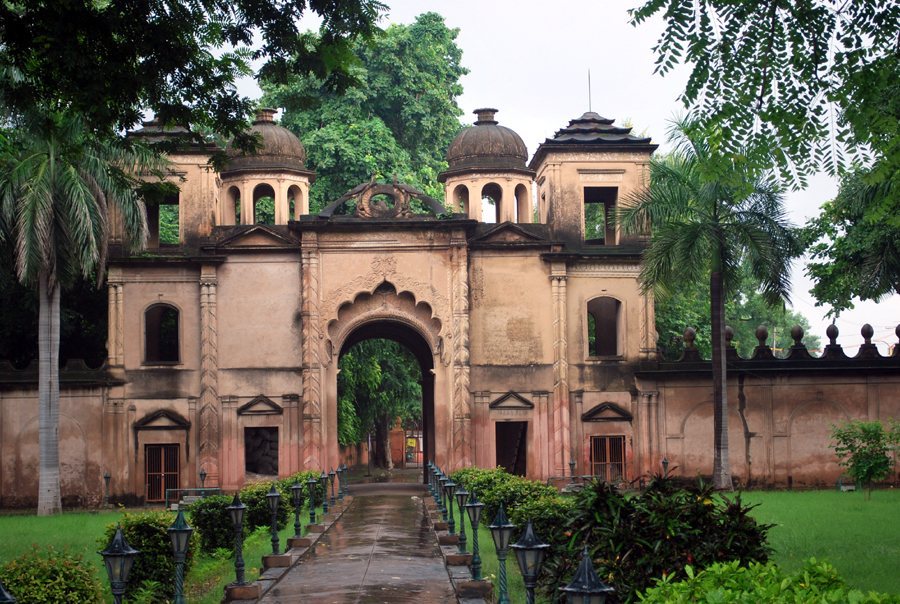
The garden and villa covered about 4.5 acres (1.8 hectares) and formed a roughly square enclosure, approximately 150 yards on each side. A fortified wall bounded the compound, with narrow openings for observation or firing, a gateway, and projecting defensive works at the corners. A sunken lane ran south beside the eastern wall, while open ground lay to the east. At the south-east corner, a bricked-up doorway was breached by artillery fire. The opening was about three feet square and three feet above ground before it was enlarged. The eastern bastion was blown up during the assault, and cannonball marks remain on the old walls.
Pavilion and interior layout
A small pavilion with a verandah stood at the garden’s centre. The battle-era layout also included a large two-storey building overlooking the garden, with a courtyard behind it, and a high-walled enclosure farther back. The enclosure had two entrances.
Statue and recovered objects
The statue of Uda Devi stands in the garden’s old campus. Cannonballs, swords, shields, and fragments of muskets and rifles recovered from the garden over the years are displayed in the National Botanical Research Institute exhibition.