Fort of Monserrate: A Portuguese Colonial Fort in Salvador
Site at a Glance
- Rating
- 4.7
- Popularity
- Medium
- Country
- Brazil
- Primary era
- Early Modern
- Eras represented
- Early Modern
- Civilizations
- Portuguese
- Site type
- Military
- Remains
- Fort
On this page5 sections
History
Construction and early record
The Fort of Monserrate is a Portuguese colonial fort in Boa Viagem, Salvador, Brazil, built in the late sixteenth or early seventeenth century. It may have been constructed between 1583 and 1587, during the tenure of Manoel Teles Barreto, a Portuguese colonial governor-general. Diogo de Campos Moreno, a Portuguese military engineer and chronicler, mentioned the fort in a report in 1609. Its design is attributed to Baccio de Filicaia, a Tuscan military engineer and architect who served under Francisco de Sousa, a Portuguese colonial governor-general of Brazil, from 1591 to 1602.
The fort was one of four fortifications recorded from this period. The others were the Towers of Saint Albert, now lost; the Towers of Saint James at Água de Meninos, later adapted as a stronghold; and the second Fort of Saint Anthony of Barra.
Names and later recognition
From its construction until the nineteenth century, the fort was known as the Fort of Saint Philip. It is also called the Small Fort of Our Lady of Monserrate; Our Lady of Monserrate is a title of the Virgin Mary. In 1938, Brazil’s National Institute of Historic and Artistic Heritage (IPHAN), the federal agency responsible for protecting historic and artistic heritage, listed the fort as a historic monument.
Remains
Plan and surviving features
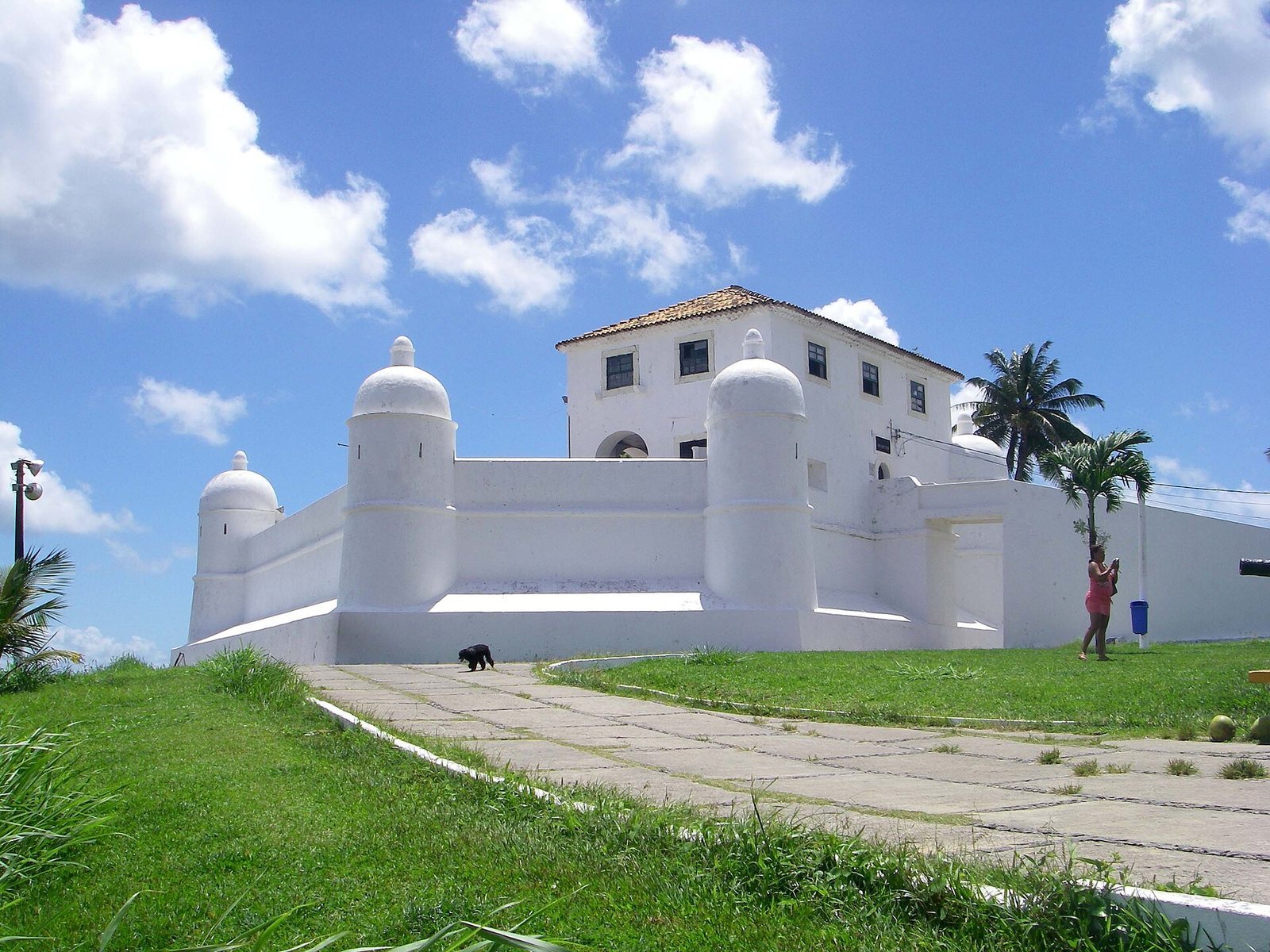
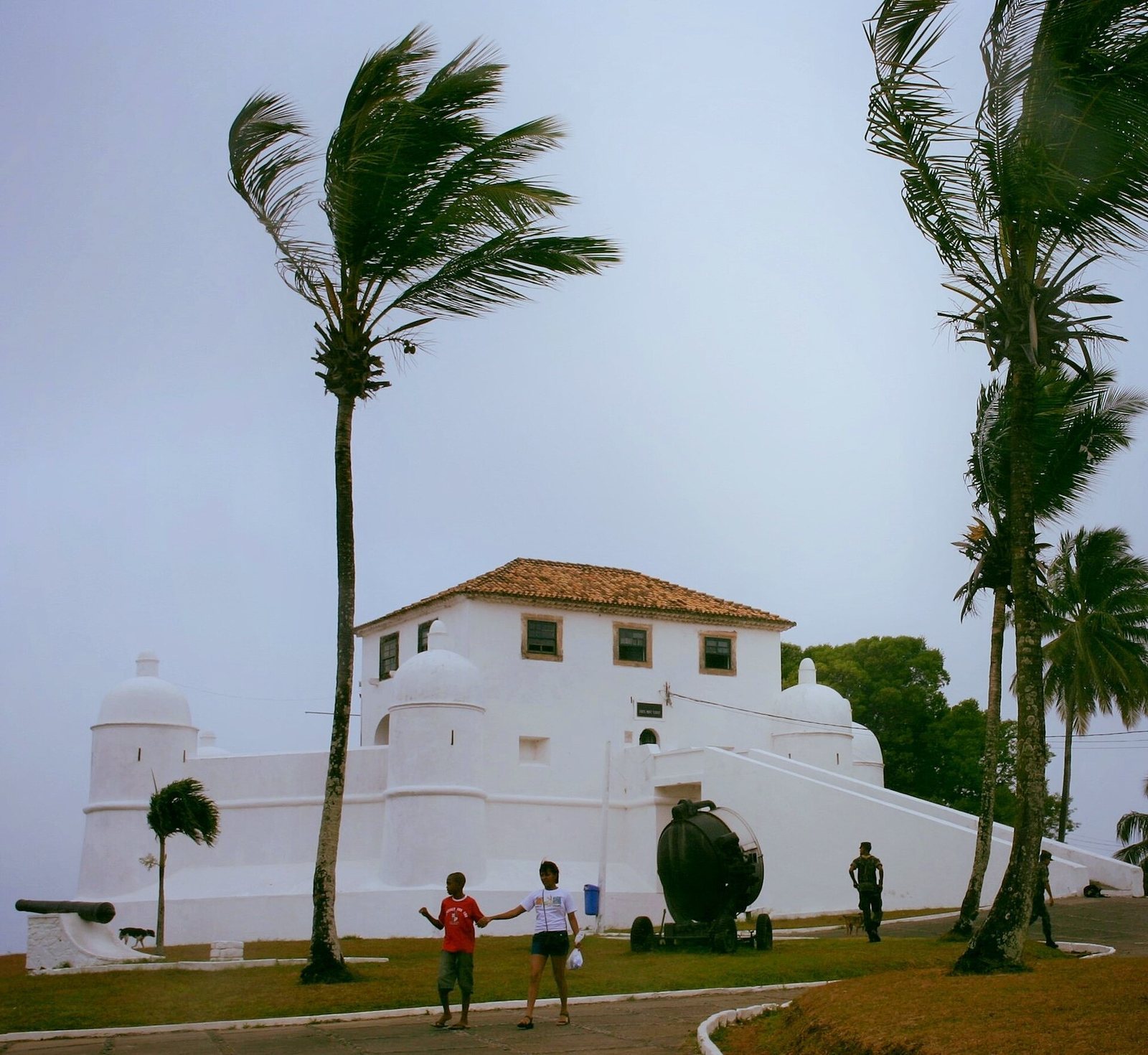
On the Itapagipe Peninsula, the fort stands above the Church and Monastery of Our Lady of Monserrate, described as among Brazil’s oldest church structures. Built of stone masonry, it has an irregular polygonal plan, circular turrets at its angles, and domed coverings. Its perimeter uses curtain walls, defensive walls connecting towers or bastions. Bastions, projecting platforms built outward from a fortification wall, belong to a later phase of fortification design. The fort’s plan is shared with the second Fort of Saint Anthony of Barra. It originally had six turrets, two of which were demolished in the eighteenth century. A drawbridge once linked the ramp and embankment, and two barracks flanked the entrance. Its present form retains the appearance of its original late-sixteenth-century design, a quality shared by only a few Brazilian fortifications.