Down House: Charles Darwin’s Home and Scientific Workplace
Site at a Glance
- Country
- United Kingdom
- Primary era
- Early Modern
- Eras represented
- Early Modern, Modern
- Civilizations
- British, English
- Site type
- Domestic
- Remains
- House
On this page13 sections
History
Farmhouse and changing ownership
Down House is a former farmhouse and the home of naturalist Charles Darwin in Downe, United Kingdom. It originated in the mid-seventeenth century. In 1651, Thomas Manning sold most of the present property to John Know the elder for £345. It is uncertain whether a house was included in the sale; if not, Know built the first farmhouse. In 1653, he gave the house to his son Roger, probably as a wedding present.
The property passed to the Bartholomew family through Mary Know’s marriage in 1743. Leonard Bartholomew sold the unoccupied house to Charles Hayes in 1751. Businessman and landowner George Butler acquired it in 1778 and is thought to have rebuilt and enlarged it. He paid the village’s highest window tax in 1781, when the property was apparently known as the Great House. After Butler’s death in 1783, it changed hands several times. In 1819 it passed to Lieutenant-Colonel John Johnson, an engineer with the East India Company’s Bombay establishment. The company was a British trading enterprise that also maintained administrative and military operations in India.
Johnson emigrated to Upper Canada in 1837 and transferred the house, then called Down House, to the Reverend James Drummond, the parish incumbent. Under the supervision of architect Edward Cresy, the house was reroofed and put in good order. Drummond left it empty around 1840 and offered it for auction, but it remained unsold for two years.
Darwin’s home and scientific work
Charles and Emma Darwin sought a country home because their London house had become cramped, and its noise and coal smoke troubled them. With financial help from Charles’s father, Robert, they looked for a house within railway reach of London. Drummond refused to lease Down House. Though he wanted £2,500 and Cresy advised an offer of £2,100, Darwin offered about £2,200, which Drummond accepted. Emma moved in on 14 September 1842, and Charles arrived three days later.
Their first child, Mary Eleanor, was born at the house on 23 September 1842 and died on 16 October. Etty, George, Bessy, Francis, Leonard and Horace were born there between 1843 and 1851. Their youngest child, Charles Waring, was born in 1856 and died in 1858. After the death of Francis’s first wife, Amy, their son Bernard was brought up by Charles and Emma.
Darwin had conceived his theory of evolution by natural selection in London before the move. At Down House and in its grounds, he developed his work on the theory, which explains how inherited traits that aid survival or reproduction can become more common over generations. In 1846, he rented adjoining land from Sir John William Lubbock and planted it as Sandwalk Wood. Darwin used its path for daily exercise and uninterrupted thought. In 1874, he exchanged pasture with Lubbock’s son, John, to secure ownership of the wood. John became a close friend and frequent visitor.
Changes to the house and grounds accommodated the growing family and Darwin’s research. Work on orchids led to the completion of a heated greenhouse in 1863. For 16 years, Darwin also grew sundews and other carnivorous plants, feeding them proteins. These experiments contributed to his book Insectivorous Plants, published in 1875.
Darwin died at Down House on 19 April 1882, aged 73, and Emma died there in 1896. Darwin had wished to be buried in the churchyard at Downe, but was instead buried at Westminster Abbey.
School, museum and preservation
After the house was advertised for letting in 1897, George Darwin rented it to Mr Whitehead from 1900 to 1906. In February 1907, headmistress Olive Willis and her friend Alice Carver established a girls’ boarding school there. It grew from one pupil and five mistresses to about 60 pupils. The school moved to larger premises in Cold Ash, Newbury, on 1 April 1922, continuing as Downe House School; one of its houses kept the Darwin name. A second girls’ school operated in Down House from 1924 until it closed in 1927.
Following an appeal by Sir Arthur Keith, president of the British Association for the Advancement of Science, surgeon Sir George Buckston Browne bought Down House from the Darwin heirs in 1927. He paid £4,250 and spent about £10,000 on repairs. On 7 January 1929, he gave the house to the British Association, together with an endowment intended to preserve it as a Darwin memorial, support science and allow free admission. The house opened as a museum on 7 June that year. In 1931, Buckston Browne gave the Royal College of Surgeons of England an endowment and nearby land for a surgical research station, the Buckston Browne Research Farm.
The endowment for Down House did not cover its maintenance costs, and the British Association transferred it to the Royal College of Surgeons in October 1953. In 1962, surgeon Sir Hedley Atkins and his wife moved into the house, and Atkins became its honorary curator. Down House was listed Grade I in May 1954, the highest category for listed buildings in England. The garden and Sandwalk were added to England’s Register of Parks and Gardens of Special Historic Interest at Grade II in September 1988.
English Heritage acquired Down House in 1996 and restored the house and garden in 1998. A first-floor exhibition about Darwin’s life and work followed in 2009.
Remains
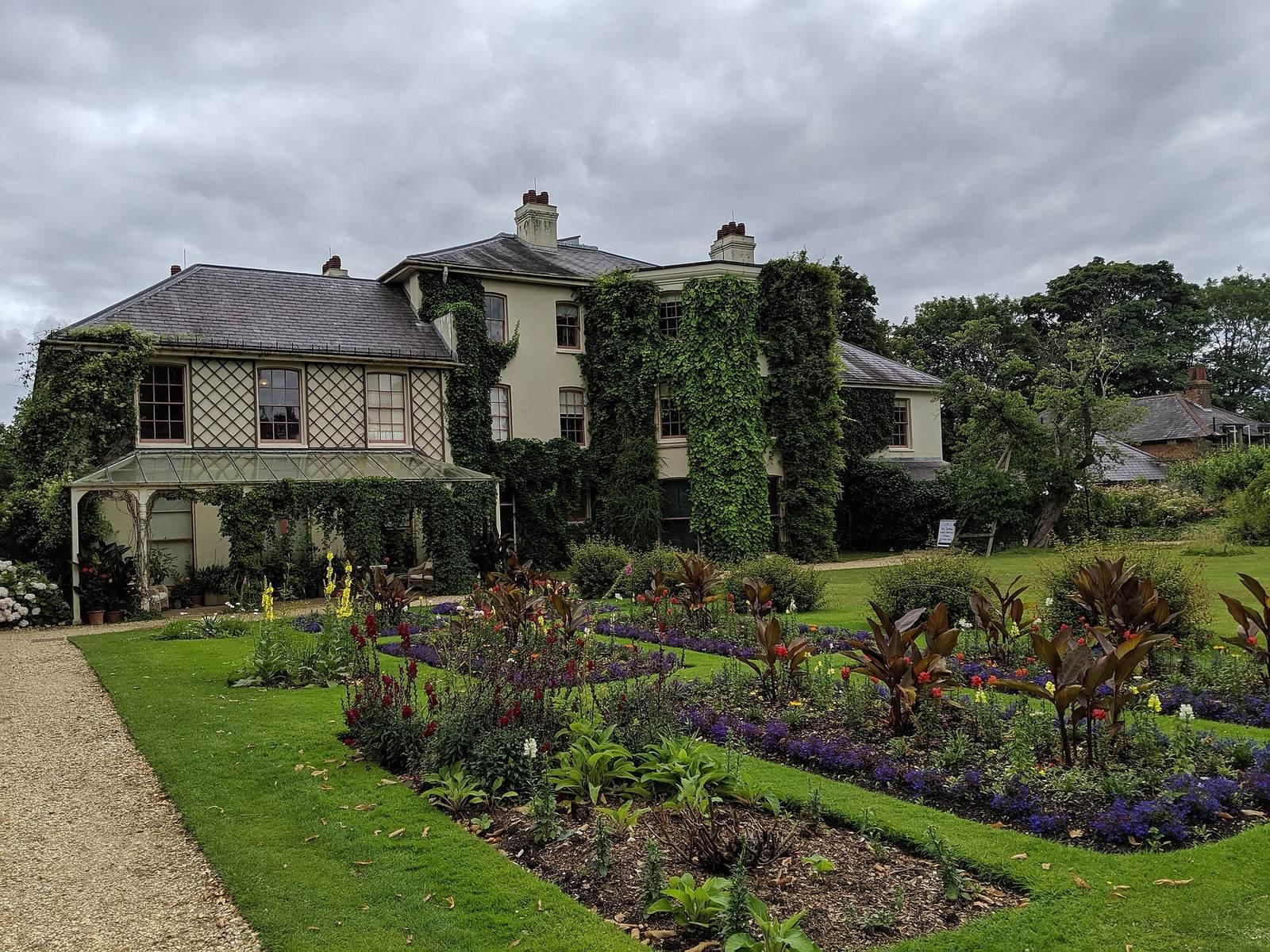
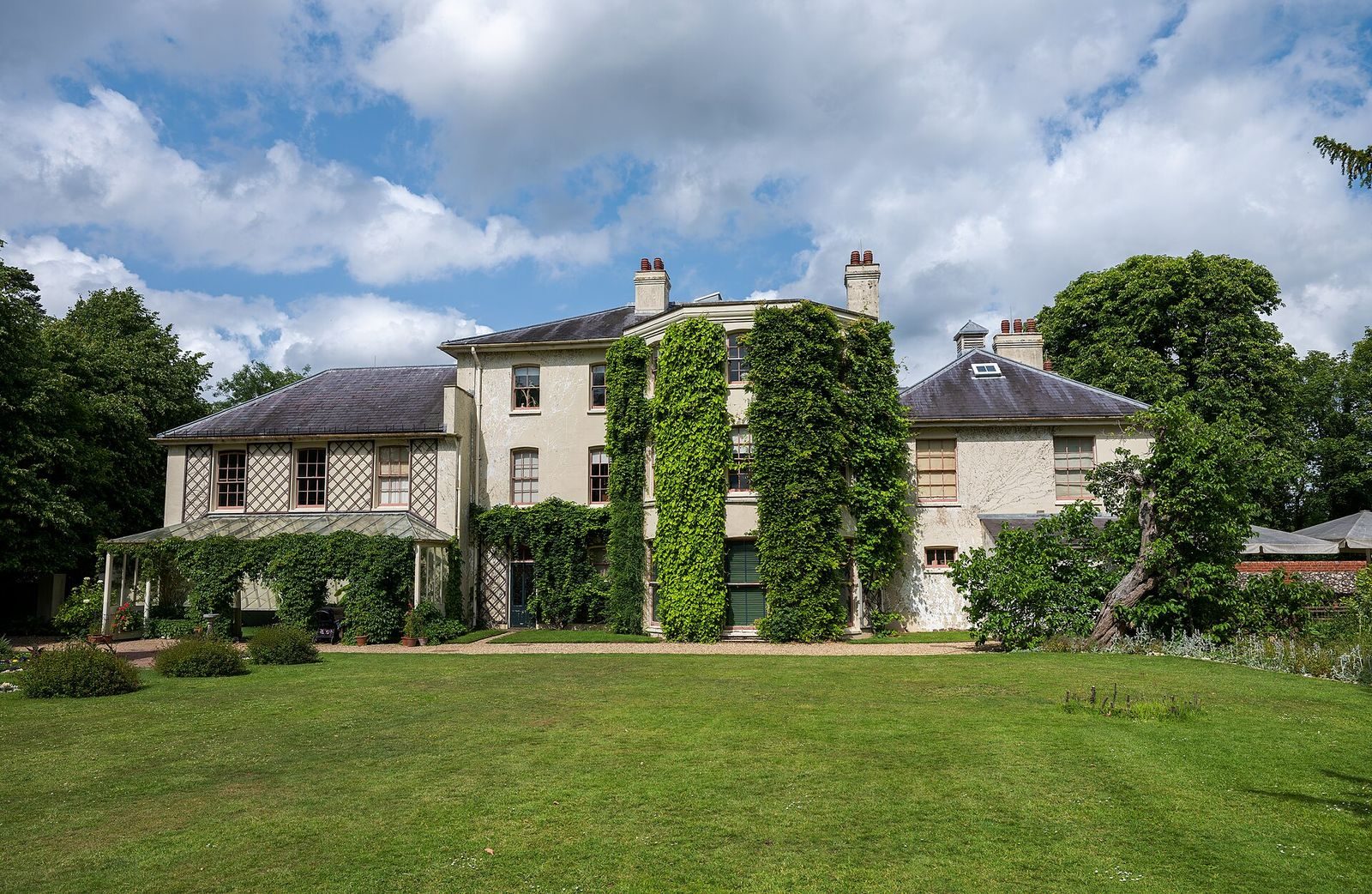
The three-storey house stands on Luxted Road, about 400 metres south of Downe village, on a site of 2.68 hectares. Its form reflects successive changes to the original farmhouse. Some flint walls may date from the seventeenth century.
House and domestic spaces
Main block
The ground floor included a study, an east-facing dining room and a large west-facing drawing room, with bedrooms above. An angled bay on the west side created a broad bow-shaped front across all three storeys, enlarging the drawing room and the rooms overhead. The drawing room and dining room later changed functions as the house was extended.
Service wing and extensions
A service wing south of the main block contained a rebuilt kitchen, a butler’s pantry and a schoolroom, with two small bedrooms on the upper floors. A north-end addition provided a west-facing drawing room and two bedrooms above. The former drawing room became a dining room, while the dining room beside the kitchen became a billiard room. Another billiard room was built east of the new drawing-room block; it later became a study, while Darwin’s former study became a smoking room. The hallway was extended into an entrance hall with an east-facing porch in the Georgian style.
Gardens and research grounds
Kitchen garden and greenhouse
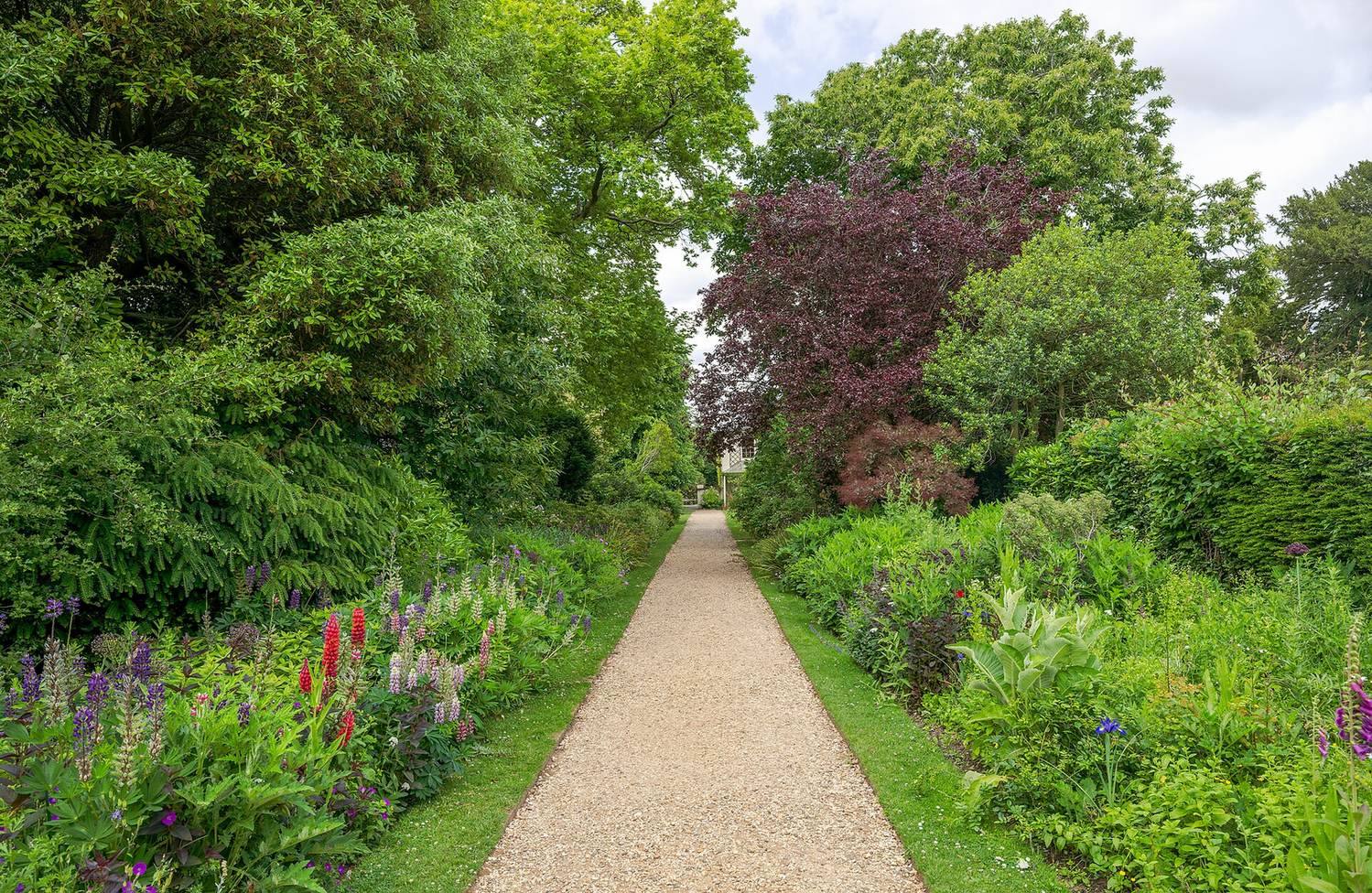
Part of a field became a kitchen garden with an experimental plot and, later, greenhouses. Darwin’s heated greenhouse had a tunnel passage that allowed bees to fly in and out. The east garden was enclosed for privacy by flint walls, earth mounds and shrubs. The neighbouring lane was lowered by as much as 0.61 metres. The outhouses were rebuilt, a mound on the west side was removed and another was added to the east for protection from wind.
Sandwalk Wood
Sandwalk Wood is a planted strip of 1.5 acres adjoining the grounds to the southwest. An old oak grove shaded one side, while the other looked over a hedge into a valley. A gravel path followed the wood’s perimeter, with small stones at one point to mark completed circuits. A wooden summerhouse stood at the lower end.
School-era structures
North of the property, beyond the orchard, a hard tennis court and a new wall were built. Corrugated-iron buildings from the girls’ school period served as a chapel, gymnasium, music rooms and lavatories; these structures were later removed.
Restored interiors
In 2016, the master bedroom was restored, including a reconstruction of Darwin’s collection of fine-art prints. These included biblical scenes associated with Raphael, Titian and Sebastiano del Piombo, as well as a Raphael self-portrait for the bedroom. A self-portrait of Leonardo da Vinci was placed in Darwin’s study, alongside portraits of geologist Charles Lyell and Darwin’s grandfather, Erasmus Darwin.