Skäfthammar Church: A Medieval Church in Sweden
Site at a Glance
- Country
- Sweden
- Primary era
- Medieval
- Eras represented
- Medieval, Early Modern, Modern
- Civilizations
- Swedish
- Site type
- Religious
- Remains
- Church
On this page19 sections
History
Skäfthammar Church is a medieval church on the outskirts of Gimo, Sweden. Its present building was probably erected in the second half of the fifteenth century and consecrated during that century. It belongs to Skäfthammar-Hökhuvud Parish in the Diocese of Uppsala, a church district administered by a bishop, within the Lutheran Church of Sweden.
Medieval origins
In 1316, Archbishop Olov Björnsson visited a church at Skäfthammar, probably a small wooden chapel. The present stone church followed later in the fifteenth century.
Changes from the sixteenth to the eighteenth century
The church’s wall and vault paintings were probably made in the late sixteenth century. They were covered with whitewash during the eighteenth century. In 1682–1683, galleries were added along the north side for Walloon smiths, skilled ironworkers associated with Wallonia, and their wives. They worked at Gimo’s iron-producing works.
A brick floor was laid during the first half of the eighteenth century, and the windows were enlarged around mid-century. The church also acquired its present pulpit and altar furnishings during this period.
Churchyard and later restoration
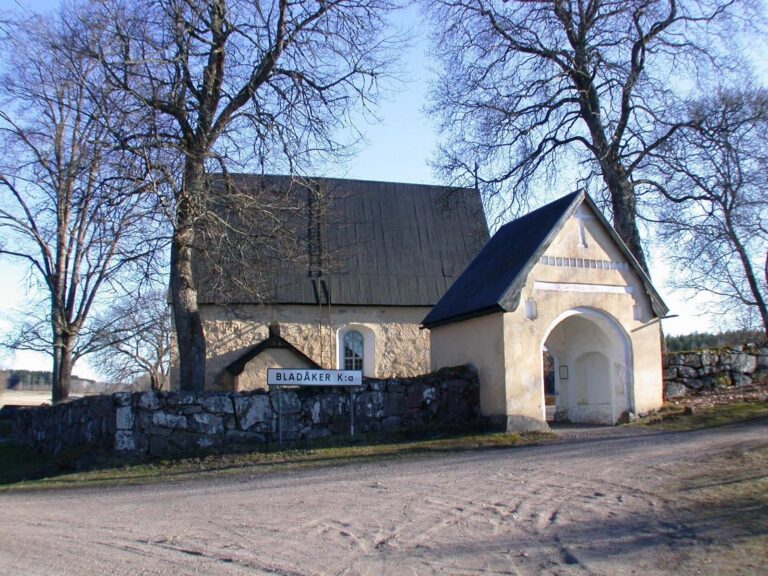
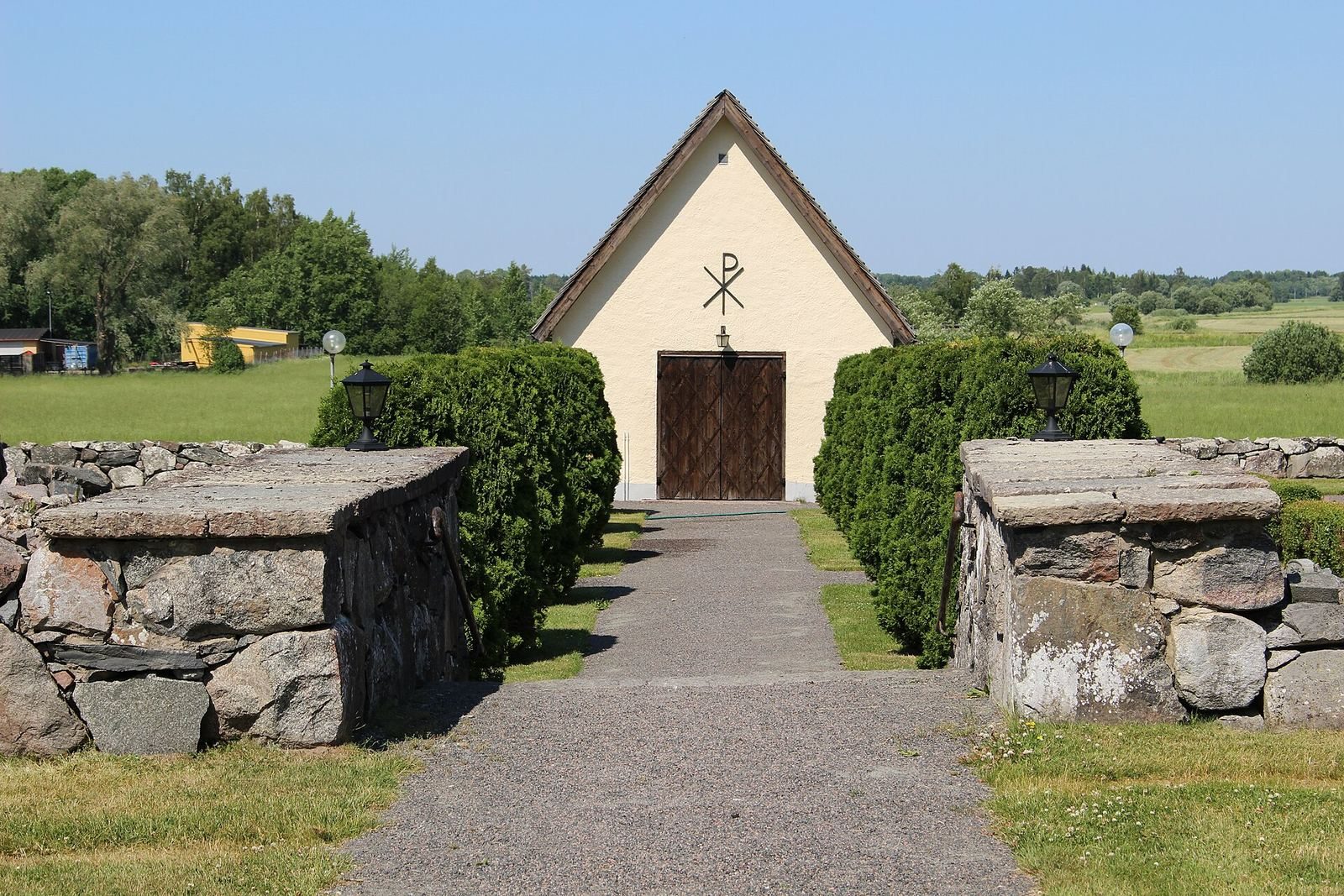
A drawing made in 1636 by the Swedish antiquarian and draughtsman Johannes Haquini Rhezelius shows the original churchyard extending mainly south and east of the church. A large covered gate stood in its southern wall before being demolished in the nineteenth century. A new cemetery north of the church was consecrated in autumn 1930, and a mortuary was built beside its north wall in 1941.
A restoration in 1915 uncovered the paintings, bricked up the chancel window, and restored the original colours of the furnishings, giving the interior its present appearance. The paintings had been whitewashed in the eighteenth century. A further restoration in 1965 made no changes to the church interior.
Remains
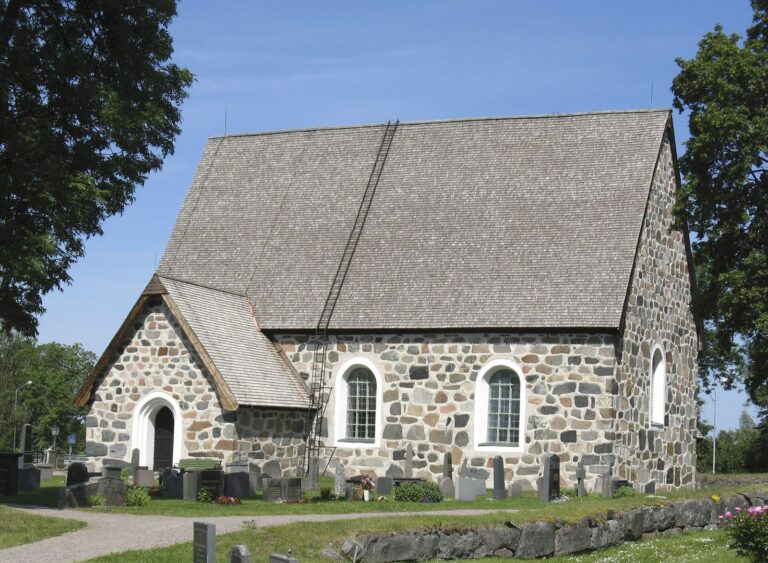
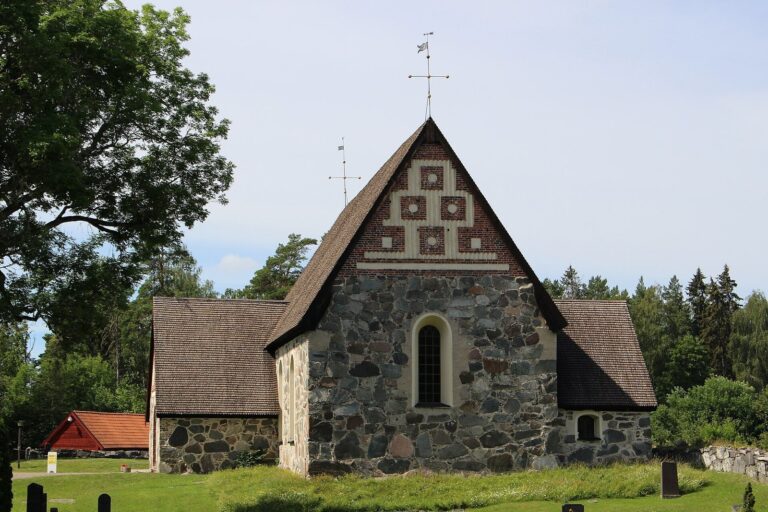
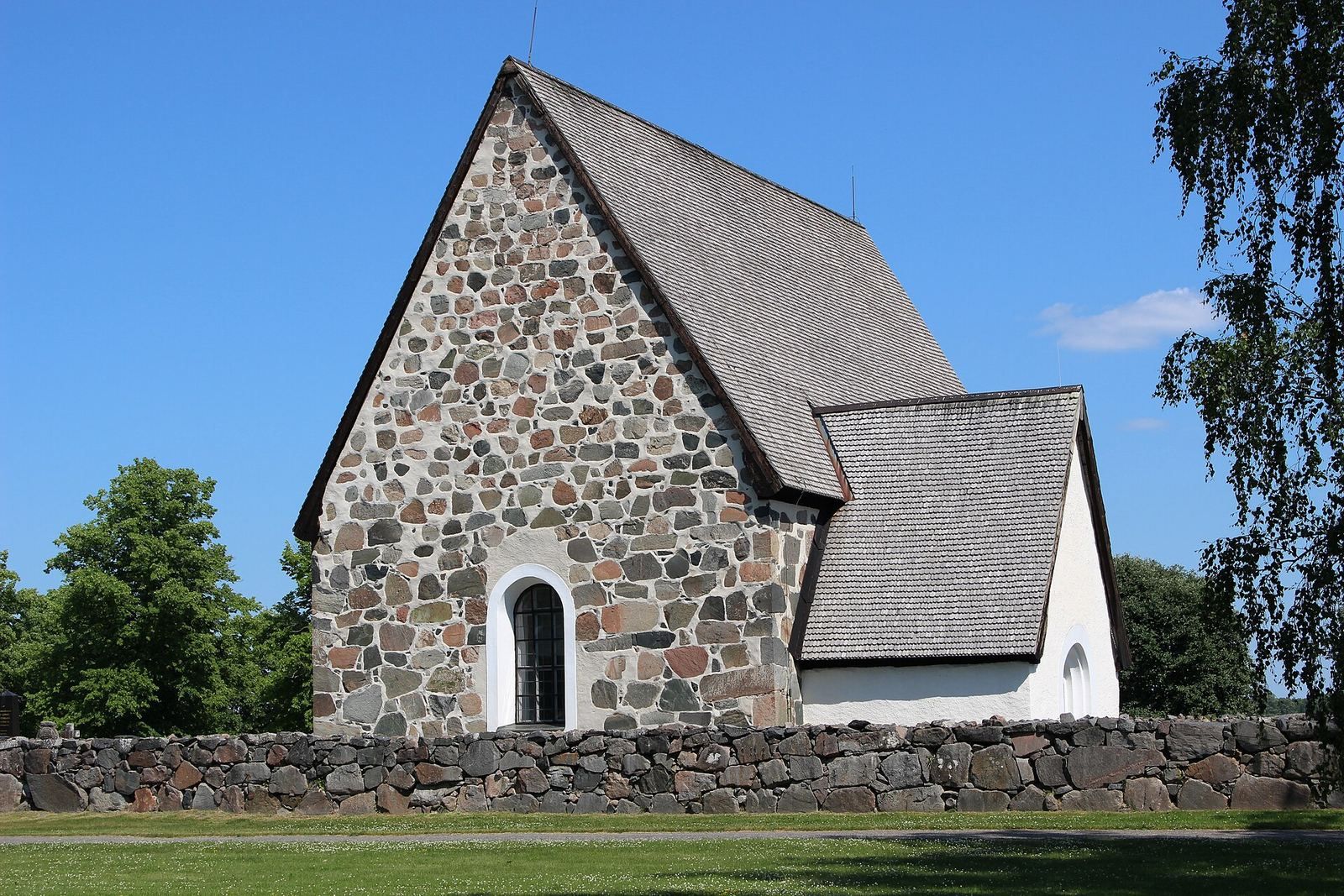
The church has a rectangular nave (the church’s main body) and a straight-ended chancel (the altar area) at its east end. Grey stone forms the walls, with brick around the windows and doorways. A gabled roof covered in shingles completes the main building.
Church building
Plan and exterior
The medieval exterior is well preserved. Round-arched windows light the nave, and the north wall has no window openings. A gallery runs along that wall. The church interior has brick vaults, probably built at the same time as the church.
Sacristy and porch
A sacristy (a room for clergy and service objects) is attached to the northeast side. Its barrel vault, a continuous semicircular ceiling, and possible date of 1250–1350 suggest it may belong to the earlier church. A plastered and whitewashed porch on the southwest side provides the south entrance. It may have been added after the main church was built.
Paintings and consecration crosses
The walls and vaults carry numerous paintings of biblical figures. Eight of the twelve consecration crosses, marks of a church’s dedication, remain on the walls.
Interior furnishings
Pulpit and altar furnishings
Sculptor Olof Gerdman made the Baroque pulpit, in an elaborate artistic style, which Louis De Geer donated in 1754. Because space is limited, it stands in the southeast corner of the chancel. The altar retable, an ornamental structure behind an altar, and the hymn-number board are from the same period.
Baptismal furnishings
The baptismal font combines a reddish sandstone foot from the twelfth or thirteenth century with a grey limestone bowl that may date from the present church. The bowl has a drain hole. A baptismal dish was donated during the 1915 restoration. The church also has two bowls for an eighteenth-century baptismal stand in the Gustavian style, a Swedish decorative style associated with Gustav III: one is pewter, while the other is nickel silver and dates from 1886.
Altar painting
Baroness Sofie Reuterskiöld donated the present altar painting in 1887. Elisabet Warling painted it as a copy of Carl Bloch’s Come unto me, based on Matthew 11:28. Bloch’s original is in Hörup Church in Skåne.
Organ
The present organ is the church’s third. It was inaugurated on Midsummer Day in 1950. Olof Schwan built the first organ, inaugurated in 1787, and a second was installed in 1893.
Communion and ceremonial objects
The communion vessels, paten (a plate for communion bread), and host box date from 1731; the wine jug was donated in 1691. A gilded silver bride’s crown was made in 1772. Two black velvet chasubles, vestments worn by priests during services, date from 1793 and 1847, while two collection bags date from 1849.
Lighting
A six-light chandelier above the north gallery was donated by mining councillor Jean le Febure, an official associated with Sweden’s mining administration. It was hung at Christmas in 1791. The altar holds a seven-arm wooden candlestick with a marbled finish, probably made around the time of the altar retable.
Bell tower and cemetery
Bell tower and bells
The bell tower stands on a small hill northwest of the cemetery. Its weather vane bears the year 1747, when the tower was built. The lower storey is shingle-clad, and the panelled walls support a shingle-covered hood topped by a large lantern, a raised structure atop a tower. The lantern has shutters, a gently rounded roof, and a spire.
Three bells hang in the tower. The largest, donated to the parish in 1746, bears the De Geer arms. Gerhard Meyer recast the middle bell in 1747. The smallest was cast in 1658 and is rung by a rope.
Cemetery and mortuary
The newer cemetery lies north of the church, with the mortuary building beside its northern wall.