Walls of Seville: The City’s Historic Fortifications
Site at a Glance
- Country
- Spain
- Primary era
- Medieval
- Eras represented
- Classical, Medieval, Early Modern, Modern
- Civilizations
- Almohad, Almoravid, Crown of Castile, Roman, Spanish
- Site type
- Military
- Remains
- Wall
On this page21 sections
History
The Walls of Seville are the historic defensive enclosure of the Spanish city, with origins associated with the Roman period. Their successive phases protected a growing urban centre, and the circuit was repeatedly rebuilt and expanded before much of it was removed in the nineteenth century.
Roman origins and early Islamic repairs
Seville may have had defenses before the Romans arrived. A traditional account says Roman forces under Julius Caesar replaced a Carthaginian barrier made of timber and mud, with construction dated to about 68–65 BC. Both this account and the possibility of an earlier walled settlement remain uncertain. The defenses were later extended and improved under Augustus as the city grew.
In 844, Viking forces devastated Seville and burned or destroyed its walls. The Umayyad ruler Abd al-Rahman II ordered their rebuilding or reinforcement. In 913, Abd al-Rahman III, Córdoba’s first Umayyad caliph, ordered the walls and gates destroyed to limit Seville’s independence from Córdoba. It is uncertain whether this order affected the whole enclosure or only its gates.
Taifa, Almoravid, and Almohad expansion
In 1023, Abbad I, ruler of the Taifa of Seville, an independent Muslim-ruled kingdom, ordered a new enclosure to defend the city against Christian forces. It probably followed the earlier Roman circuit and may have been built of earth. The Almoravids, a North African Muslim dynasty, greatly enlarged the fortified area in the second half of the eleventh or early twelfth century. Their expansion took place amid conflict with the Christian kingdoms of Alfonso VI and Alfonso VII. In 1090, cooperation from some of the gate guards enabled Almoravid forces to enter Seville.
The Almohads, another North African Muslim dynasty, renovated, enlarged, and strengthened the defenses during the second half of the twelfth and early thirteenth centuries. A Guadalquivir flood destroyed western sections in 1200, and these were rebuilt. The final major construction phase included the Torre del Oro, built in 1220–22, and the raising of the walls to match the reconstructed riverside section. At their greatest extent, the defenses measured about 7.3 kilometres, enclosed roughly 300 hectares, and included 166 towers, 13 gates, and six smaller entrances.
Castilian rule and urban change
After Ferdinand III of Castile captured Seville in 1248, the Crown of Castile, the monarchy and political realm of Castile and its associated territories, retained the general layout of the Almohad walls. During royal visits, monarchs swore to uphold the city’s privileges at important gates. Isabella I of Castile did so in 1477, Ferdinand II of Aragon in 1508, and Charles V and Isabella of Portugal in 1526. Philip II took the oath at Goles Gate in 1570, after which it was known as the Royal Gate. Philip IV swore at the Macarena Gate in 1624.
A city council programme begun in 1560 renovated several gates to accommodate urban growth and carriage traffic. The work affected the Carmona, Carne, Royal, and Arenal gates, as well as the Oil Postern, a smaller entrance in the defenses. The Triana Gate was moved and rebuilt farther north in 1585, and the Coal Postern was relocated along Santander Street. These changes formed part of a longer process of adapting the entrances to the city’s changing needs.
As the walls lost military importance, they continued to guard against Guadalquivir floods, regulate entry, and allow officials to collect passage tolls and taxes on transactions. They also served as a sanitary barrier during disease outbreaks. Once restrictions on building beside them were lifted, houses were constructed against the walls. From the sixteenth century, some towers, especially near Macarena, were used as dwellings.
Eighteenth-century changes included rebuilding the Arenal Gate, opening a chapel in the Oil Postern, and constructing the San Fernando Gate beside the Royal Tobacco Factory. The Macarena Gate was remodelled in 1723 and 1795. Pablo de Olavide’s 1771 city plan shows that the thirteenth-century wall was still intact at that time.
Demolition and preservation
In the early nineteenth century, municipal official José Manuel de Arjona initiated the removal of a defensive wall linking the Torre del Oro to the main enclosure. The work made space for a riverside promenade and gardens. During the Carlist invasion of Andalusia in 1836, part of the nineteenth-century dynastic conflict over a rival Bourbon claim to the Spanish throne, a moat and drawbridge were added near the Macarena Gate.
Demolition of the wider circuit accelerated from 1858 and intensified after the 1868 revolution. The walls and gates were then regarded as signs of repression and impediments to urban expansion. Railway construction, public-health concerns, traffic, and economic development were also given as reasons for removal. The southeast and Arenal districts were affected first. The Barqueta Gate was demolished in 1858, the Royal Gate in 1862, and the Carne, Jerez, and San Juan gates in 1864. The Arenal Gate was removed before 1868; the Carmona, San Fernando, and Triana gates were destroyed in 1868, followed by the Osario Gate around 1869 and the Sun Gate in 1873. The Coal Postern was also destroyed after 1868. In all, twelve gates were demolished between 1858 and 1873, along with extensive stretches of wall.
Historical counts of the entrances vary. Estimates describe 18 or 19 access points in total, while Islamic records count 12 gates and three smaller entrances. Other records list eight gates in the Book of Distribution, 11 in thirteenth-century documents, 12 in fourteenth-century documents, and 13 in fifteenth-century documents, when the Jerez Gate appears in the count. In 1859, an estimate suggested that buildings stood against or incorporated nearly two-thirds of the wall, perhaps concealing almost five kilometres within later structures.
Historian and heritage advocate José Gestoso campaigned against further demolition in 1906. The Macarena-to-Córdoba section became a National Monument in 1908; another section received protection in 1931, and protection was extended to the remaining standing walls in 1985. Two openings were made in the Macarena section in 1911 to ease passage. Archaeological work and later building projects revealed additional sections, including a tower dated to the late eleventh or early twelfth century found in 2012 and a Roman wall segment identified beneath the modern city in 2021.
Remains
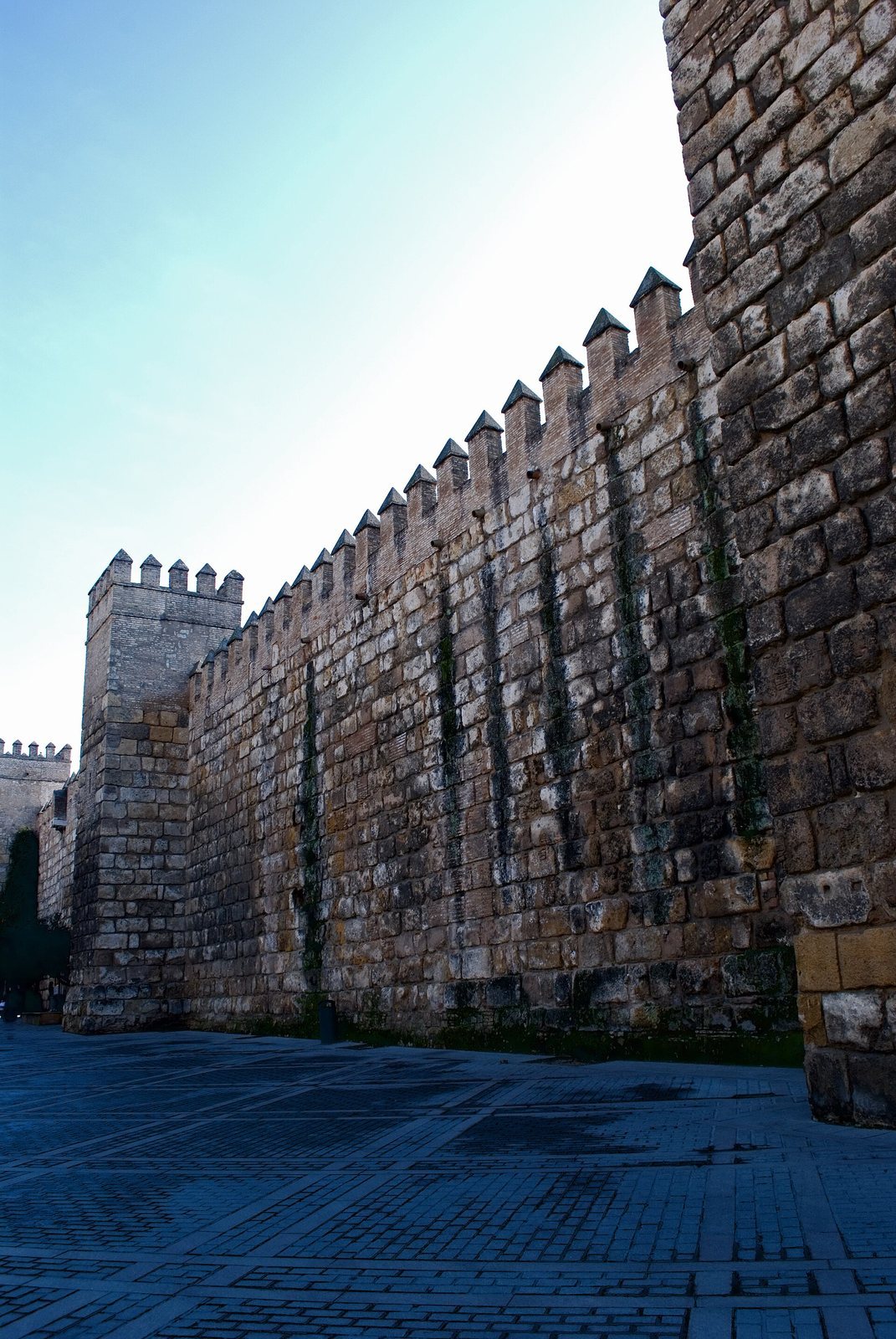
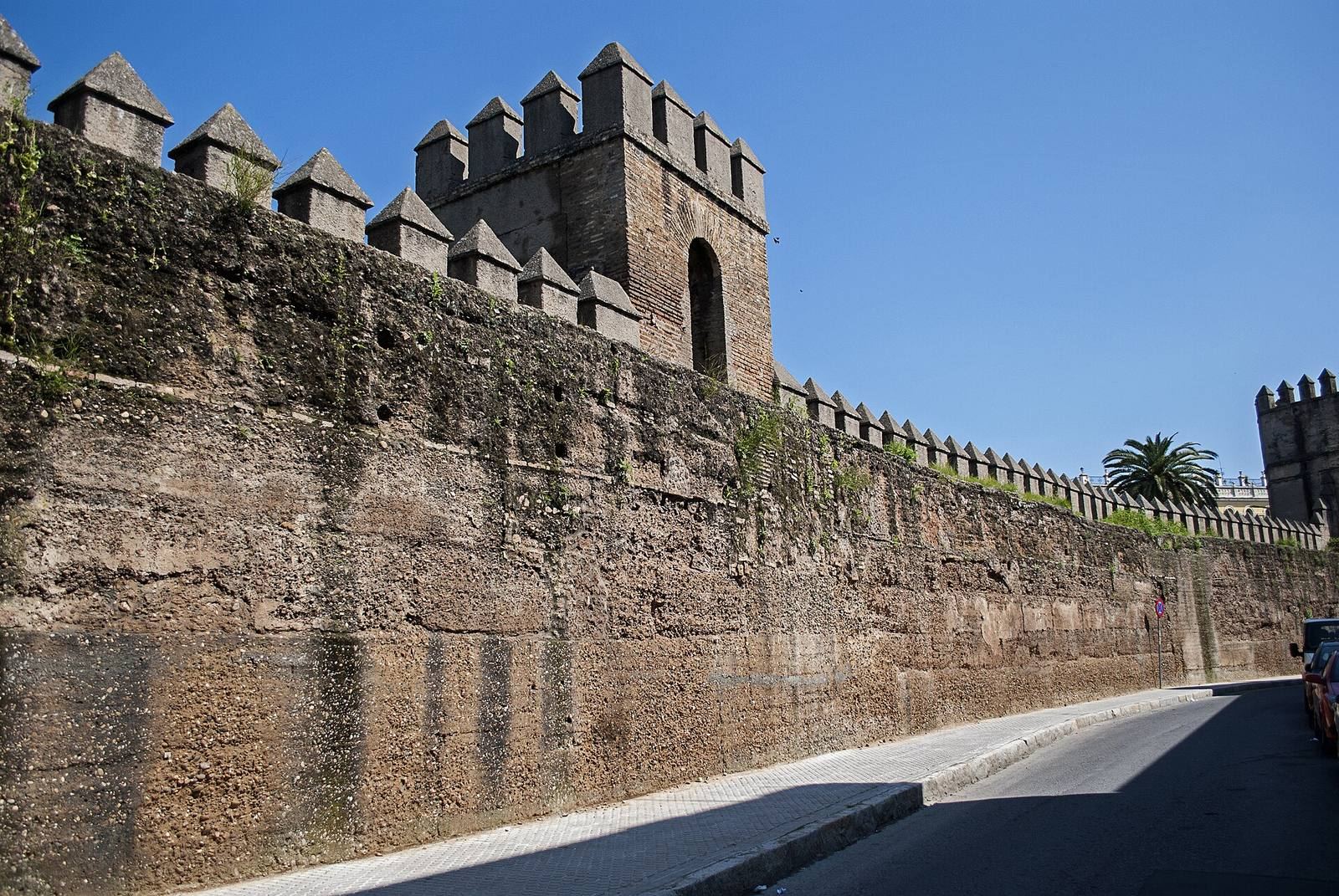
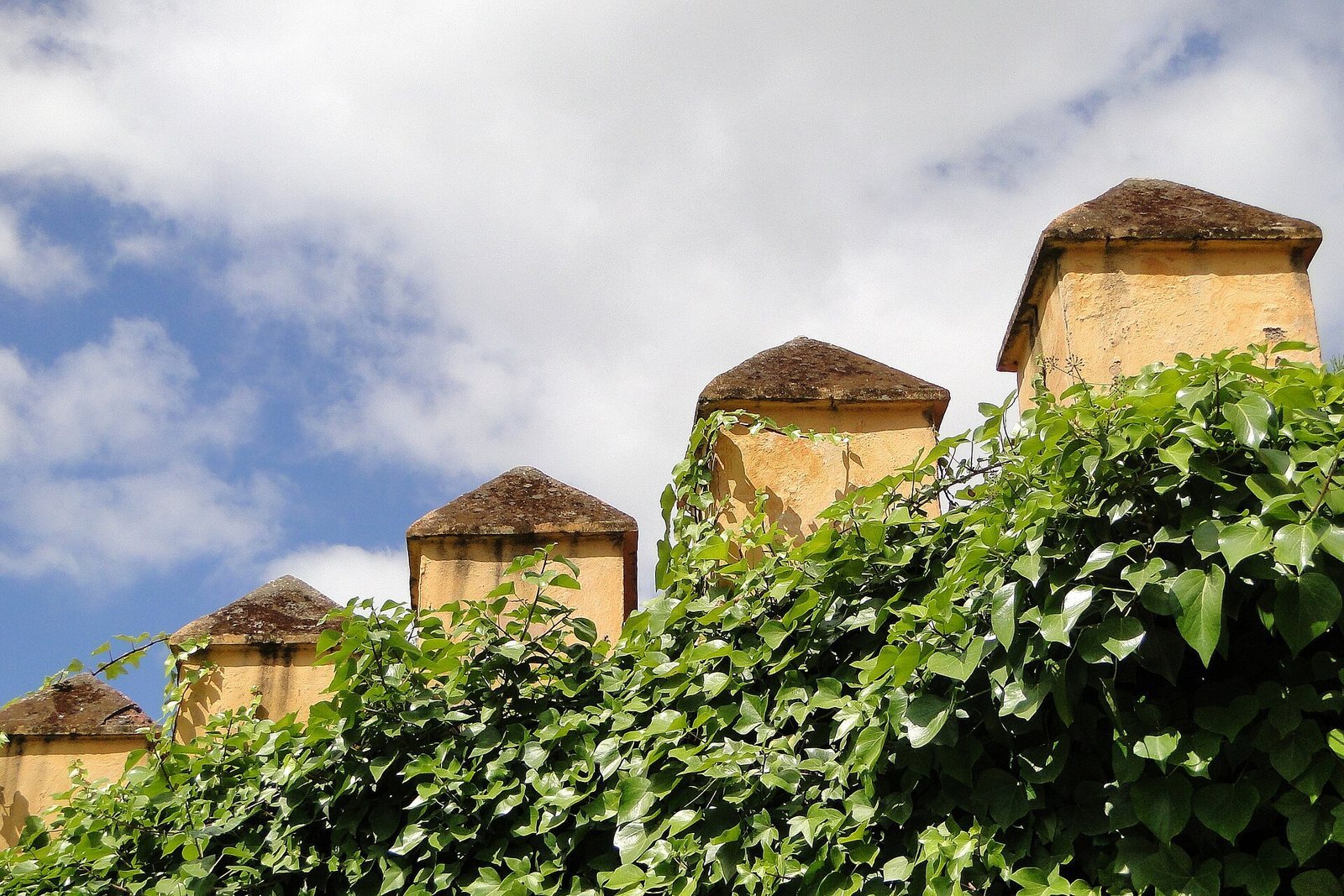
The surviving enclosure is chiefly a rammed-earth wall, built by compacting soil in layers, with later repairs and alterations. Its main wall is about 1.90 metres thick. In some areas a barbican, an outer defensive work, stands roughly three metres in front of it and is about 1.45 metres thick. Towers were set at varying intervals of about 40–50 metres. Eight rectangular towers are described as roughly four metres wide and projecting about 4.5 metres beyond the wall. Their earth construction has dressed-stone corners; openings are framed with rows of solid brick set in lime mortar. The towers were solid up to the wall walk, the path along the top of the defenses, and stairs led to roof terraces protected by parapets with regularly spaced raised sections. The surviving walls retain an Almohad character, modified by later restoration.
Surviving stretches
Macarena to Córdoba
The longest and best-preserved stretch runs north of the San Gil district between the Macarena and Córdoba gates. It includes seven square towers and the irregularly octagonal Torre Blanca. The Córdoba Gate is attached to the church of San Hermenegildo, and its entrance turns at an angle rather than passing straight through the wall.
Valle Gardens
The second-longest preserved section extends for about 250 metres in Valle Gardens. It was once enclosed within the Franciscan convent of Valle. After the convent’s property was confiscated and sold in the nineteenth century, the Marchioness of Villanueva acquired it for a school run by the Sisters of the Sacred Heart. The school disappeared in the mid-twentieth century, and the site later became the gardens.
Other wall fragments
Other surviving or recorded stretches include a short section inside commercial premises beside the Torre de Abd el Aziz, and a roughly 50-metre stretch with a tower visible from Plaza del Cabildo and a rear street. A remnant lies near the former Carmona Gate, while a fragment that flanked the Royal Gate is embedded between modern buildings. Further sections are incorporated into buildings along streets including Sol, Menéndez Pelayo, Tintes, Concepción, San Esteban, Marqués de Paradas, Gravina, Julio César, and Goles. Wall remains are also found around the Alcázar, in Valle and Murillo gardens, and in the Arenal district.
Alcázar defenses and river connections
Walls around the Alcázar
The Alcázar of Seville, the city’s historic fortified royal palace complex, contains several forms of wall. Dressed-stone masonry near the Lion Gate probably incorporates material from the early Roman defenses. Almohad rammed-earth sections can be seen along Judería and Agua streets and are concealed within buildings along San Fernando Street. Later walls separate the Alcázar gardens from Murillo Gardens. Excavations during construction of Metro Line 1 exposed a wall running parallel to the present Alcázar wall before it was reburied.
Water conduits and riverside defenses
Water conduits run within walls in the Alcázar area. One section dating to the eleventh or twelfth century carried water to the Alcázar and city during the Christian period and was restored in 1993. Defenses along the Guadalquivir were connected to the main enclosure by walls linking fortified points. One connection ran from the Alcázar towards the Torre del Oro by way of the towers of Abd el Aziz and Plata. A surviving stretch includes part of the wall between the Torre de la Plata and Torre del Oro, as well as a short remnant of the Coal Postern.
Gates and smaller entrances
The gates and smaller entrances controlled public, royal, and private access to the city. Some pedestrian entrances remained open at night. The original gates are described as plain, while later Christian alterations gave some a more decorative, triumphal-arch appearance.
Macarena Gate
The Macarena Gate, the largest of the city’s gates, stands beside the Basilica of the Macarena on Don Fadrique Street, north of the old enclosure. It was rebuilt in 1723 and remodelled again in 1795.
Córdoba Gate
Of Almoravid origin and rebuilt in the sixteenth century, the Córdoba Gate has been little altered and retains a closed, military appearance. It stands where Puerta de Córdoba meets Madre Dolores Márquez Street and has an angled entrance.
Oil Postern
The extensively altered Oil Postern, a small gate in the defenses, stands in the Arenal district near Arfe and Almirantazgo streets. Its name refers to nearby oil warehouses; an arsenal in the area gave it the earlier name Gate of the Boats. It was renovated in 1572. A chapel opened in its right side during the eighteenth century, with a Baroque altarpiece and an image of the Immaculate Conception, the Catholic belief that Mary was conceived without original sin, by Pedro Roldán.
Coal Postern and Royal Gate fragments
A short remnant of the Coal Postern survives along with part of the wall that connected the Torre de la Plata and Torre del Oro. The Coal Postern was moved along Santander Street in the sixteenth century and was successively called the Water Carriers’ Postern, the Gold Postern, and the Shipyards Postern before taking its final name from the coal sold there. A fragment of the Almohad wall that supported the Royal Gate is embedded between later buildings.
Roman-period remains
Early circuit
The route of the early Roman enclosure has been reconstructed hypothetically from chance underground finds and the modern city’s topography. It is thought to have enclosed the southeastern quadrant of the present old town. Roman building material was reused in later construction at the Alcázar.
Wall beneath the modern city
A Roman wall section identified in 2021 lies within a shared wall between buildings facing Álvarez Quintero Street and Plaza de San Francisco. It is about 4.8 metres wide, has two different heights, and dates to around the third century AD.