Fort William Henry: A British Frontier Fort at Lake George
Site at a Glance
- Country
- United States
- Primary era
- Early Modern
- Eras represented
- Early Modern
- Civilizations
- British
- Site type
- Military
- Remains
- Fort
On this page8 sections
History
Fort William Henry was a British fort at the southern end of Lake George in New York, United States, built in 1755 during the French and Indian War. This North American conflict between Britain and France and their Indigenous allies formed part of the wider Seven Years’ War. Sir William Johnson, a British colonial official responsible for relations with Indigenous peoples, ordered the fort as a base for attacks on the French Fort St. Frédéric at Crown Point. It stood on a frontier between New York and New France, France’s colonial territory in North America, along an inland route connecting New York and Montreal.
Construction and early campaigns
In August 1755, Johnson established a military camp at the lake’s southern end with about 3,000 to 4,000 men. He renamed the lake for King George II; it had previously been called the Lake of the Blessed Sacrament. On September 8, French commander Baron Dieskau attacked Johnson’s support base at Fort Edward. The resulting Battle of Lake George ended in a British victory, and some of the fighting took place at Johnson’s camp. The battle led Johnson to order a nearby fort in September, while the French began building Fort Carillon at the lake’s northern end.
The fort’s name honored two grandsons of George II: Prince William, Duke of Cumberland, the king’s younger son, and Prince William Henry, Duke of Gloucester and Edinburgh, a younger brother of the future George III. Although work was not complete, the fort was ready to be occupied on November 13, 1755. Its first commander, military engineer William Eyre, led companies from the 44th Foot regiment and Rogers’ Rangers, a British colonial ranger force.
The 1757 siege and surrender
Command passed to George Monro in spring 1757. The garrison, drawn mainly from the 35th Foot and the 60th Foot, also known as the Royal American Foot, reached about 1,600 men by June with the arrival of militia from Connecticut and New Jersey. Another 1,000 regular troops and militia arrived in late July after news of a French attack. With about 2,300 men crowded into the fort and camps, poor conditions contributed to widespread illness, including smallpox.
In February 1757, Pierre de Rigaud, marquis de Vaudreuil-Cavagnial, governor-general of New France, sent about 1,500 men against the fort. The assault failed. A larger force commanded by Louis-Joseph de Montcalm reached the area on August 3 and camped south and west of the fort. It numbered about 8,000, including 3,000 regular troops, 3,000 militia, and nearly 2,000 Indigenous allies from several nations.
During the six-day siege, French artillery bombarded the fort from changing positions as troops dug trenches closer to its walls. British guns began to fail and ammunition ran low. Monro asked Daniel Webb, the British general at Fort Edward, for reinforcements, but Webb refused, fearing an attack on his own position. The British surrendered on August 8. Under the terms, they could withdraw to Fort Edward under French escort with their flags, muskets without ammunition, and one symbolic cannon. They agreed not to return to the war for 18 months, while British authorities were to release French prisoners within three months. The fort was to pass to the French. Montcalm checked whether his Indigenous allies would accept the terms before he and Monro signed the agreement.
Violence after the surrender and later history
After the surrender, French-allied warriors looted the fort and killed some of the sick and wounded left behind. French guards tried to restrain them in the entrenched camp without success. Montcalm and Monro first planned to move the prisoners the next morning, then considered leaving at night. They abandoned that plan when warriors gathered around the camp. Before the column could form the following morning, attacks resumed. Warriors entered quarters where wounded British soldiers were being treated by French surgeons, killing and scalping some. During the march, they took weapons and possessions and forcibly separated people who resisted, including women, children, and Black servants. Many British and militia soldiers were killed, as were women and children. Montcalm and some French officers tried to stop the attacks, but the promised French protection did not hold.
The violence is commonly called the Fort William Henry massacre, but estimates differ widely. Overall estimates for people captured, wounded, or killed range from 200 to 1,500. Ian Steele considered it unlikely that more than 200 prisoners were killed or wounded, and estimated that 69 to 184 were dead or ultimately missing, no more than 7.5 percent of the 2,308 people who surrendered. Edward J. Dodge estimated that 429 of about 2,300 occupants reached Fort Edward, 406 were killed, 536 were missing, and 929 were taken prisoner. His estimate included 97 deaths during the siege and 308 during the massacre. Another estimate placed British losses above 700.
Some graves of soldiers who died from wounds or illness during the siege may have been disturbed for trophies. It is uncertain whether Indigenous warriors contracted smallpox from the remains and carried it back to their communities. Before withdrawing to Fort Carillon, the French systematically destroyed the fort. The site then remained abandoned as a fort for about two centuries, and Fort George was later built nearby. Interest in Fort William Henry’s history revived in the 1950s. James Fenimore Cooper’s novel The Last of the Mohicans, first published in January 1826, had earlier brought the siege and massacre into American fiction.
Remains
Original fort layout
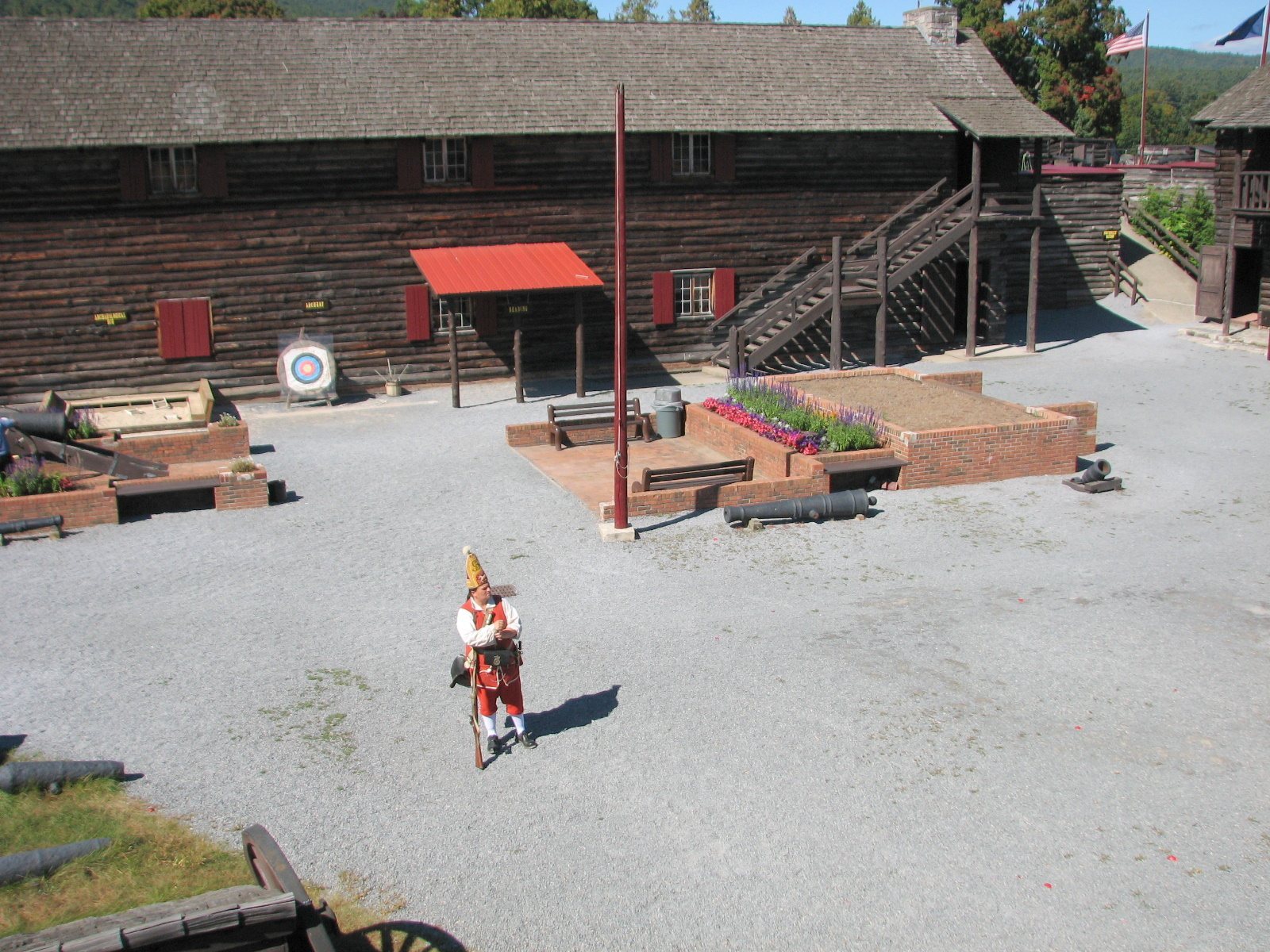
The original fort stood beside Lake George’s southern end. It had an irregular square plan with a bastion (a projection used to defend fort walls) at each corner. Its earthen walls, faced with logs, were about 30 feet (9.1 m) thick. The design was intended to withstand Indigenous attacks, though it might not have resisted artillery. Two-story wooden barracks stood around a central parade ground, an open area for military assembly and drills. The northeast bastion held a magazine (an ammunition store), while the southeast bastion contained the hospital. A dry moat surrounded three sides; the fourth sloped toward the lake, and a bridge across the moat provided the sole entrance. The fort could hold about 400 to 500 men. Other troops stayed in an entrenched camp about 750 yards (690 m) away near the 1755 battlefield. In 1757, many additional troops occupied Johnson’s earlier camp southwest of the fort, where trenches were dug quickly.
The replica fort
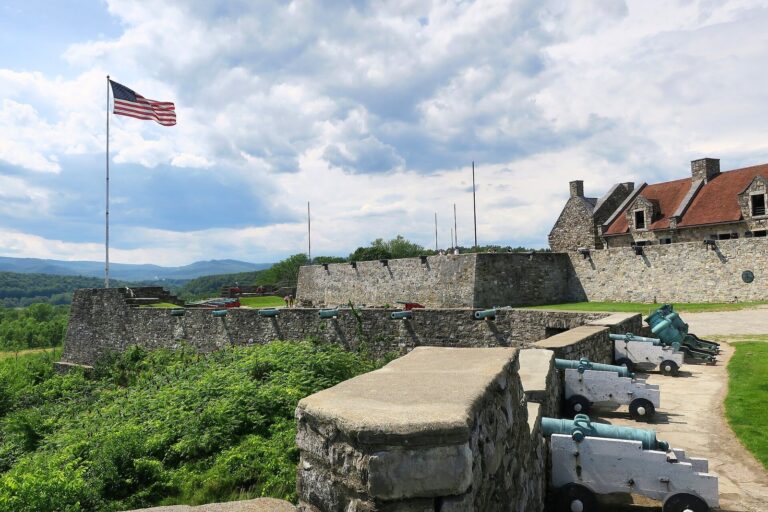
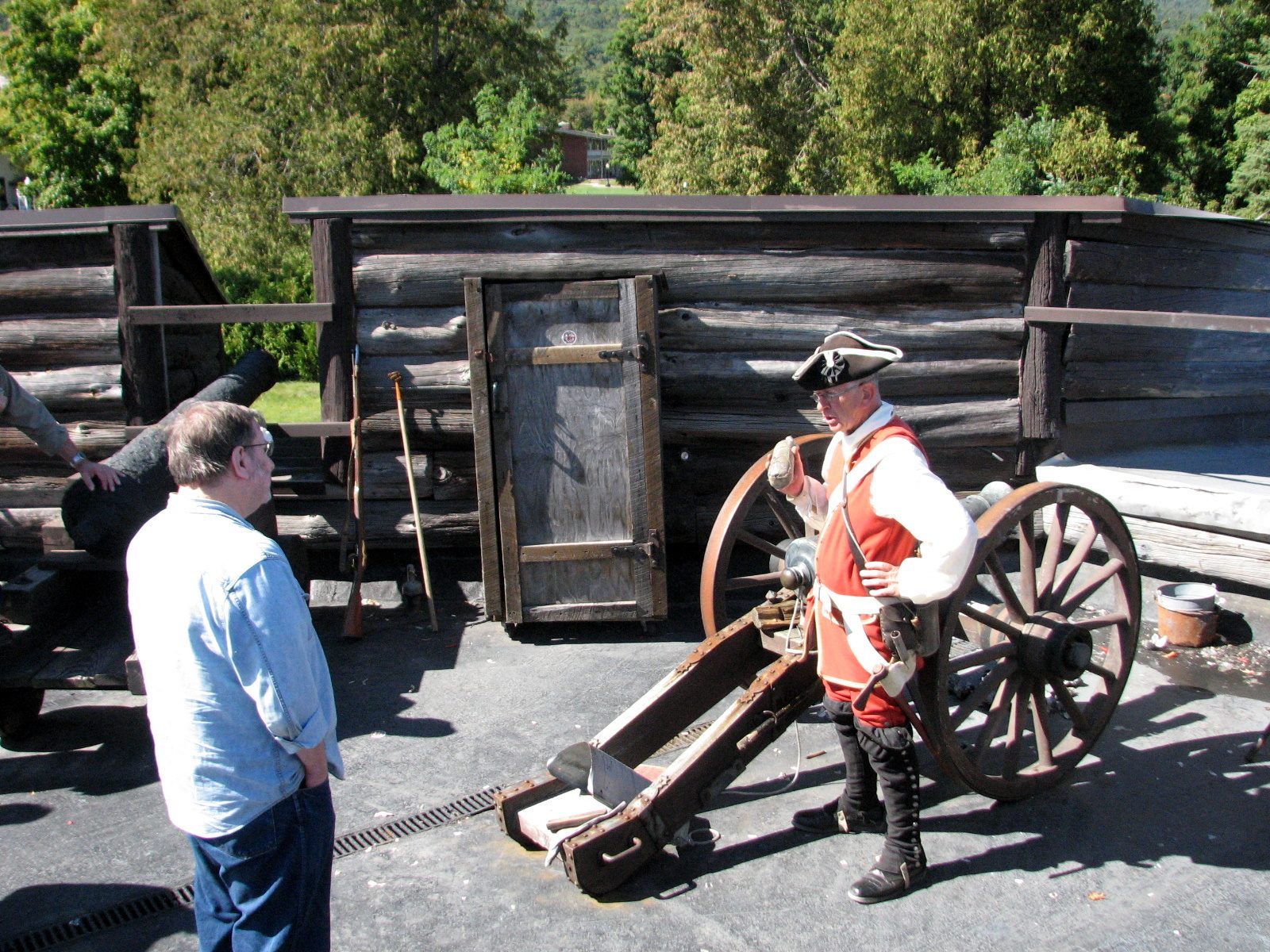
The fort visible at the site today is a replica constructed in the 1950s, following renewed interest in the site’s history. The original fort had been destroyed by the French in 1757.
Excavated human remains
Forensic anthropologists excavated human remains at the site in the 1990s during an investigation of the massacre. The remains showed violent injuries, including beheading, mutilation, and disembowelment. Many of the soldiers examined had died from blows to the head.