Morioka Castle: Seat of the Nanbu Clan in Japan
Site at a Glance
- Country
- Japan
- Primary era
- Early Modern
- Eras represented
- Early Modern
- Civilizations
- Tokugawa, Toyotomi regime
- Site type
- Military
- Remains
- Castle
On this page15 sections
History
Morioka Castle is a hill-and-lowland castle in Morioka, Japan, built by the Nanbu clan as the seat of its domain. Construction began in 1598 and was completed in 1633. The castle stood near the meeting of the Kitakami and Nakatsu rivers, beside routes connecting Japan’s Pacific and Sea of Japan coasts and the Ōshū Kaidō highway. The Nanbu ruled Morioka Domain under the Tokugawa shogunate, Japan’s military government during the Edo period.
Early fortifications and Nanbu control
The area had long been a regional center. During the eleventh-century Former Nine Years’ War, rival Abe and Kiyohara warrior clans contested it. The Kiyohara are believed to have established the earliest fortification on the castle site. After the Northern Fujiwara defeated the Kiyohara, the Minamoto later overcame the Northern Fujiwara, and the area came under the control of their allies, the Kudō clan. Internal conflict weakened the Kudō during the Muromachi period, allowing the Nanbu to displace them.
A late-Heian chronicle may refer to a holding associated with a nephew of a Kiyohara leader. One interpretation identifies the place as Kozukata, while another locates it nearer Akita. Kozukata Castle is often used as another name for Morioka Castle, but it was a predecessor fortification on the same site. A Nanbu retainer from the Fukushi family established it. The Nanbu later took control, as the Fukushi were related by marriage to the Kunohe clan, which the Nanbu had defeated.
Construction and the Morioka domain seat
In 1590, Toyotomi Hideyoshi confirmed Nanbu Nobunao’s holdings in five districts. After the Nanbu defeated Kunohe Masazane in 1591, they moved their base from Sannohe Castle to Kunohe Castle, later renamed Fukuoka Castle. The Nanbu lost three districts in Tsugaru, but gained Waga and Hienuki, bringing their holdings to seven districts and a value of 100,000 koku, a rice-based measure of land productivity and wealth.
In 1592, advice from Gamō Ujisato and Asano Nagamasa prompted preparations for a new seat at Kozukata, which they considered better placed than Kunohe. Nobunao ordered his heir, Nanbu Toshinao, to begin construction in 1598. An official responsible for overseeing the works managed the project. Nobunao died the following year. The castle’s design may have drawn on Nagoya Castle in Hizen, which Nobunao had seen during the Japanese invasions of Korea. The Toyotomi and Tokugawa governments encouraged the Nanbu to build strong defenses, partly in response to the Date clan to the south.
After the Battle of Sekigahara in 1600, the decisive conflict that helped establish Tokugawa rule, Tokugawa Ieyasu confirmed the Nanbu holdings because Toshinao had supported the Eastern Army. Toshinao chose the name Morioka, expressing the hope that the hill would prosper. Work on the castle town advanced alongside the fortifications, including the reclamation of wetlands north of the Nakatsu River. The castle was substantially complete during the late sixteenth and early seventeenth centuries, with construction finished in 1633 under Nanbu Shigenao.
A fire destroyed the main enclosure in 1634, and the Nanbu temporarily moved their seat to Fukuoka Castle. They repaired Morioka Castle the following year and returned. It remained the administrative center of Morioka Domain until the Meiji Restoration, which ended Tokugawa rule.
Abolition and parkland
The castle was abolished in 1871 when the domains were dissolved. Although initially marked for retention under the 1874 Castle Abolition Act, its buildings were badly deteriorated, and most were dismantled or moved. When the former castle grounds passed to the former ruling family, land used by the army was excluded.
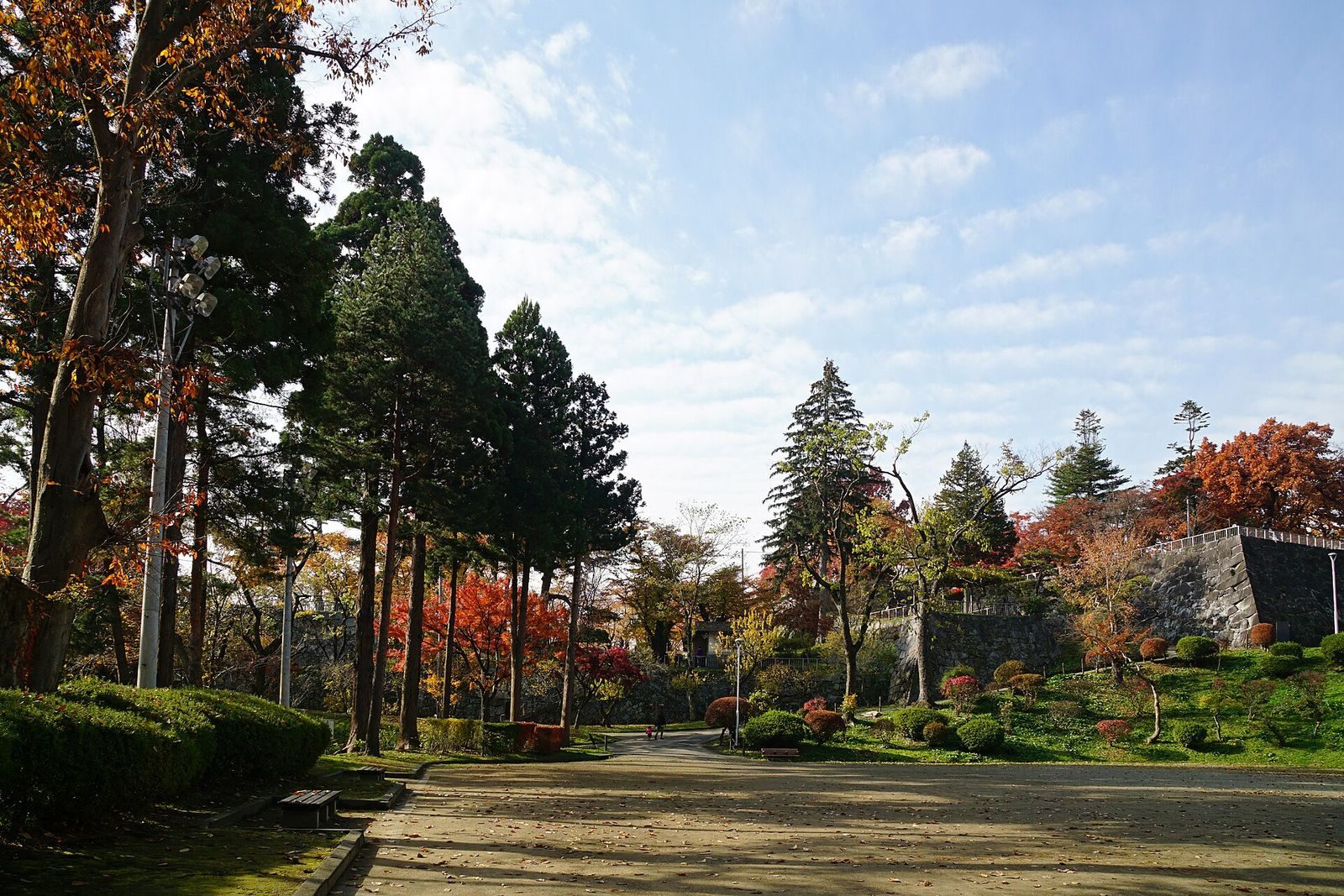
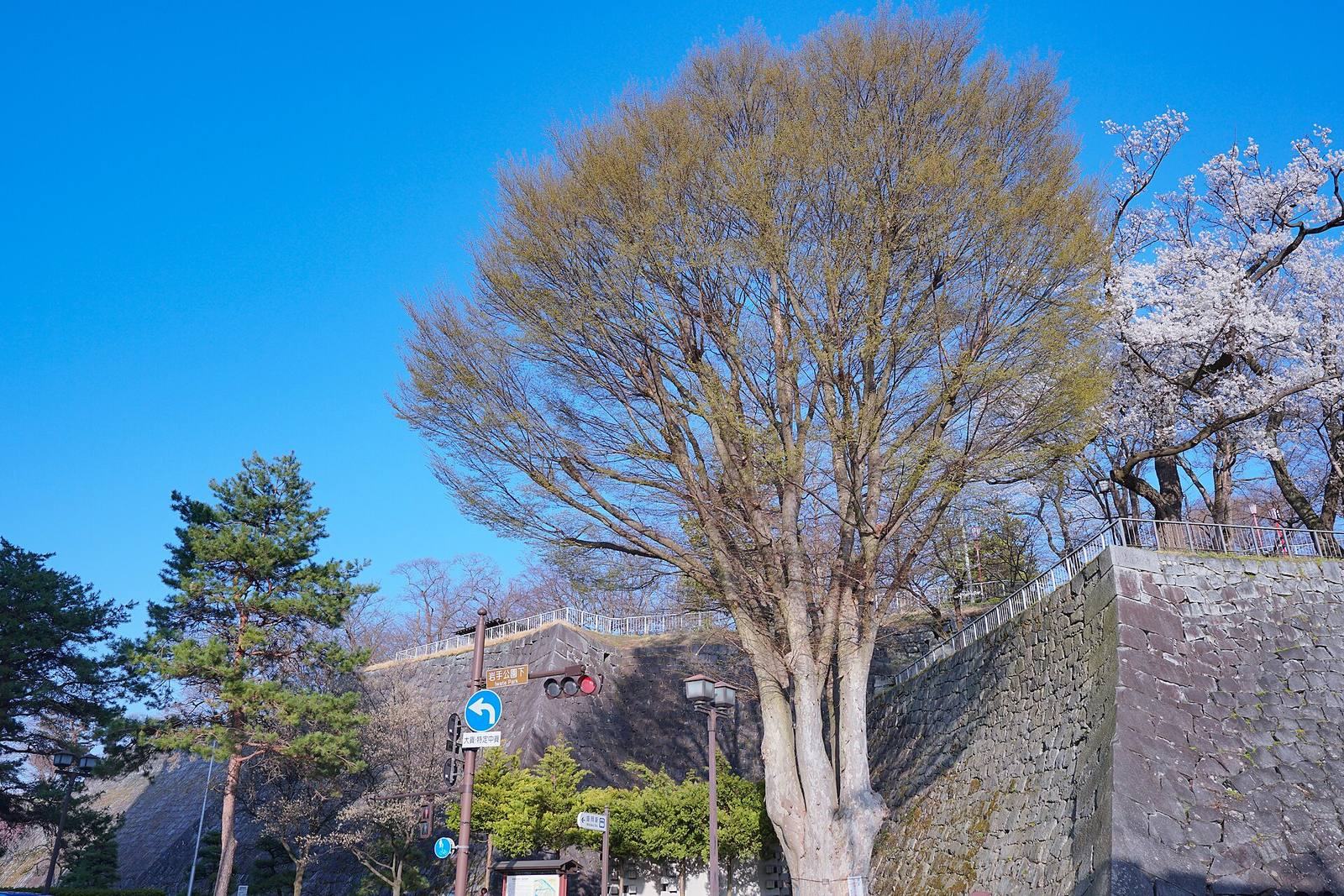
The grounds opened as Iwate Park in 1906, with gardens designed by park designer Yasuhei Nagaoka. Morioka City acquired the land from the Nanbu family in 1934. The grounds became a National Historic Site in 1937, recognized for the surviving stone walls, moats, and earthworks. In 2006, “Morioka Castle Ruins Park” was adopted as the park’s nickname, though its legal name remains Iwate Park. That year, the castle was also selected for Japan’s 100 Fine Castles.
An equestrian bronze statue honoring Nanbu Toshiyoshi, the 42nd head of the Nanbu family, was erected in the main enclosure in 1908. Toshiyoshi had died during the Russo-Japanese War. The bronze was requisitioned for metal during the Second World War in 1944.
Remains
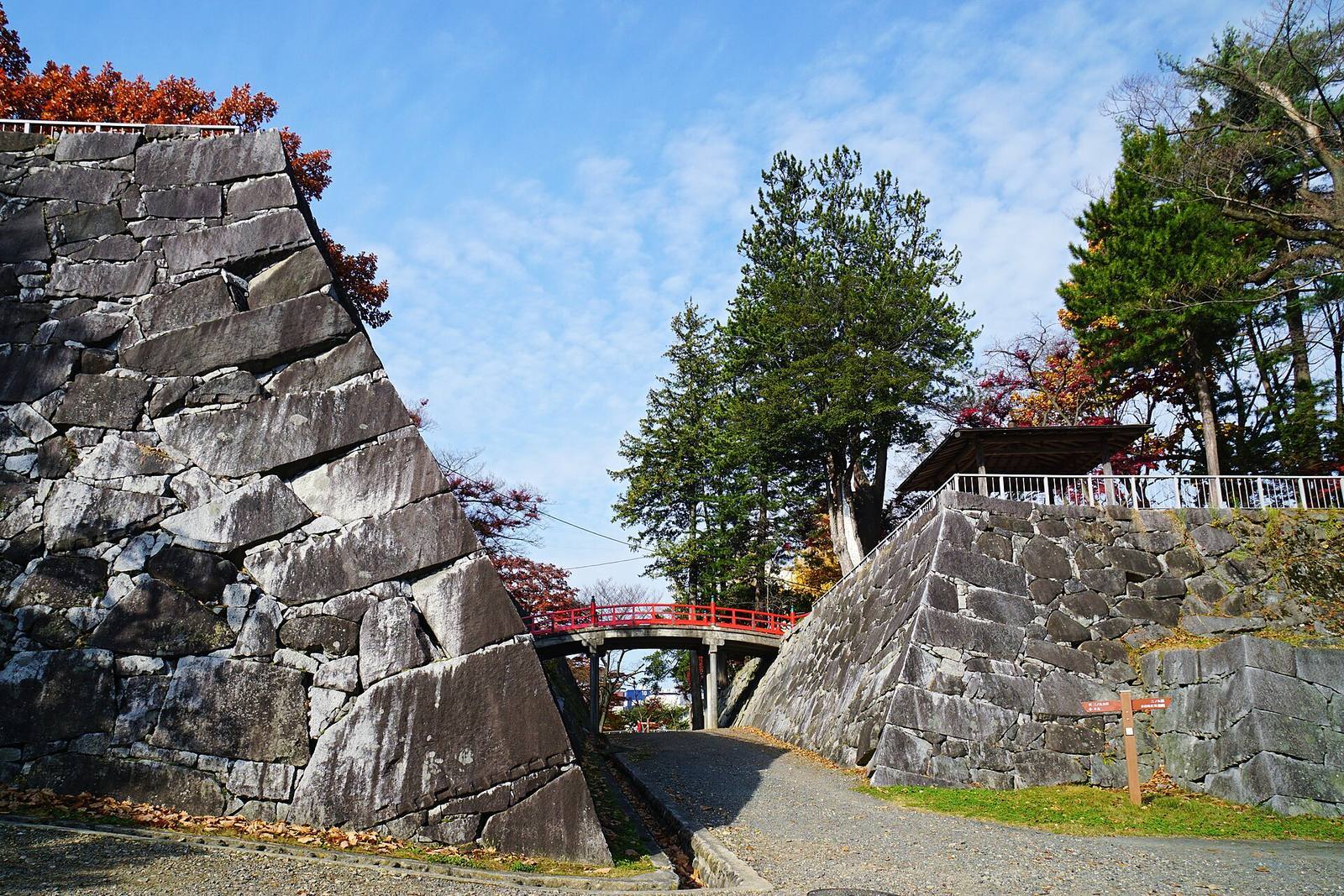
The castle occupied a long, narrow granite hill, roughly 300 metres long and 100 metres wide, with linked defensive enclosures arranged along its length. The southeastern side faced the Nakatsu River, while the former channel of the Kitakami River protected the western side. White granite was available nearby, and stone facing covered most of the ramparts, an unusual approach among castles in the Tōhoku region. The walls reach about 14 metres in height, and earthworks and moats formed additional defenses.
Enclosures and defenses
Main enclosure
The roughly square main enclosure measured about 60 metres on each side. A large gate stood at its eastern end, and the southern corner contained a platform for a tower. The Nanbu palace and administrative buildings occupied the rest of the enclosure.
Northern enclosures
The second enclosure lay north of the main one, with a dry moat between them. A vermilion-painted bridge now crosses this gap; during the castle’s use, a covered corridor bridge occupied the crossing. The third enclosure extended farther north. A large rock found there during Toshinao’s site clearance remains in the grounds and is revered as a treasure of a local shrine. It is also called Ceremonial Hat Rock.
Outer enclosures and gates
The lower defensive enclosure, Awaji enclosure, and triangular Sakakiyama enclosure extended around the main enclosure. Large gate complexes protected these areas, with walled approaches that made entry more difficult.
Towers and surviving buildings
Towers and roof ornaments
A three-story turret on the southwest tower platform served in place of a main keep. In 1842, the 12th lord had it remodeled with copper sheeting replacing its roof tiles and a pair of copper ornaments shaped like mythical fishlike creatures. It was then called the keep. A separate two-story turret stood outside it, while a two-story turret joined to another structure occupied the lower defensive enclosure.
Storehouse and relocated gates
A storehouse built with thick mortar survives within the castle grounds after being moved there. Other storehouses were later relocated to sites elsewhere in Morioka, and part of the accounting magistrate’s office from the second enclosure was transferred to a warehouse. A gate at a Zen temple in the city is said to have come from the castle, though its identity is uncertain. A gate at another local temple is also associated with the castle, but its original identity is not established.
Bridge ornaments and memorials
Bridge ornaments
Bronze ornamental finials brought from the former Nanbu administrative seat at Sannohe were installed on the Kami-no-hashi bridge in 1609 and the Naka-no-hashi bridge in 1611. The finials that survive on Kami-no-hashi are designated a national Important Art Object, a Japanese classification for valued works of art and craft.
Poem stones and statue remains
A stone monument in the grounds bears a poem by Kenji Miyazawa, a Japanese poet and writer. A separate memorial stone carries a poem by Takuboku Ishikawa: “I lay down on the grass of Kozukata Castle, absorbed by the sky; my fifteen-year-old heart.” The pedestal of Nanbu Toshiyoshi’s equestrian statue remains in the main enclosure. A mold for the statue’s bust survives at a local shrine, and a mold for the horse’s head is kept at a Buddhist temple in the city.