Shiwa Inari Shrine: A Historic Inari Sanctuary in Japan

Site at a Glance
- Rating
- 4.4
- Popularity
- Low
- Country
- Japan
- Primary era
- Early Modern
- External website
- Open
- Eras represented
- Early Modern
- Civilizations
- Unclassified
- Site type
- Religious
- Remains
- Sanctuary
On this page7 sections
History
Shiwa Inari Shrine is a Shinto shrine in Japan, located in Shiwa Town, and traditionally said to have been founded in 1057 during the Former Nine Years’ War, an eleventh-century conflict in northern Japan between Minamoto forces and the Abe family. Minamoto no Yoriyoshi, a Minamoto military commander, is said to have prayed for victory at Jingaoka and enshrined a divided spirit from Fushimi Inari Shrine in Kyoto. Inari is a Shinto deity tradition associated with rice, food, agricultural fertility, prosperity, and fox symbolism. The shrine’s principal deities are Ukanomitama no Okami, Sarutahiko no Okami, and Omiyanome no Okami. Ukanomitama is an Inari-associated deity, while Sarutahiko is linked with guidance and the crossing of boundaries. The shrine identifies Omiyanome with Ame-no-Uzume no Mikoto, a goddess associated with dance, performance, and the restoration of divine order.
Origins and Medieval Traditions
The shrine’s origins are preserved through several traditions rather than a single accepted foundation account. One tradition places its beginning in the Daido period, from 806 to 810, while others attribute a rebuilding to members of the Fujiwara family, including the Hizume family, who held Shiwa District. Another tradition says that Minamoto no Yoritomo rebuilt the shrine during the Oshu War in 1189. The Oshu War was Yoritomo’s campaign against the northern Fujiwara regime. A further account credits Shiba Ienaga, a military commander of the Shiba family, with inviting the spirit of Fushimi Inari in 1335.
Throughout the Muromachi period, the Shiba family, the ruling house of Shiwa District, venerated the shrine. Shiba Akinao sponsored the construction of shrine buildings in 1588. Later that year, Nanbu Nobunao drove Akinao from the district. During the conflict, Akinao briefly took refuge at Jojuin, a Buddhist temple that served as the shrine’s administrative subsidiary temple, before fleeing to Sanno-kai in the upper Takina River basin.
Nanbu Patronage and the Edo Period
After Nanbu Nobunao’s victory, the Nanbu family became the shrine’s principal patrons. Nobunao’s first recorded donation came in 1599, when he granted more than 24 koku of fields. Further grants followed, including 20 koku from Hirasawa Village in 1612 and more than 10 koku in 1619. In 1652, Hachinohe Naoei, a member of the Nanbu family, donated another seven koku of shrine land. Grants from Morioka Domain eventually brought the domain’s total donations to 70 koku by 1849.
The Nanbu lord, or a representative acting for him, frequently attended the shrine’s festivals and rites or sent deputies. These connections gave Shiwa Inari the character of a prayer sanctuary for the Nanbu family. In 1834, the domain lord Nanbu Toshitada paid for a five-ri approach road from Morioka, modeled on the Nikko Highway. The approximately 15-kilometer Shiwa Inari Road was completed in 1835.
Until the beginning of the Meiji period, Jojuin administered the shrine. Jojuin was a Shugendo temple, and Shugendo is a Japanese mountain-based religious tradition combining ascetic practice, Buddhist teachings, and local kami worship. This arrangement reflected Buddhist–Shinto syncretism, the historical combination of Buddhist and Shinto institutions and beliefs. During the Edo period, the shrine’s honji-butsu, or Buddhist counterpart understood to correspond to its Shinto kami, was Eleven-Headed Kannon.
Modern Religious Status
At the beginning of the Meiji period, the shrine was classified as a village shrine. It was elevated to prefectural-shrine status in June 1918 and joined the Association of Shinto Shrines after the Second World War. In June 1957, it entered that association’s Beppyo category, a special classification for selected shrines.
Shiwa Inari is locally sometimes described as one of Japan’s “Three Great Inari Shrines” or “Five Great Inari Shrines.” These descriptions are local claims rather than an established national designation. The principal annual festival takes place on May 5. Its major religious observance is the Hatsu-uma Festival, held on the first day of the Horse in the second month of the traditional calendar.
Remains
Precinct and Shrine Buildings
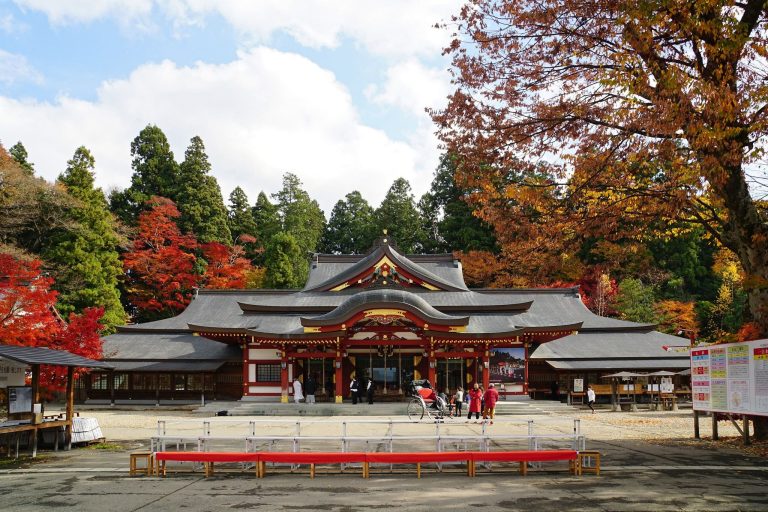
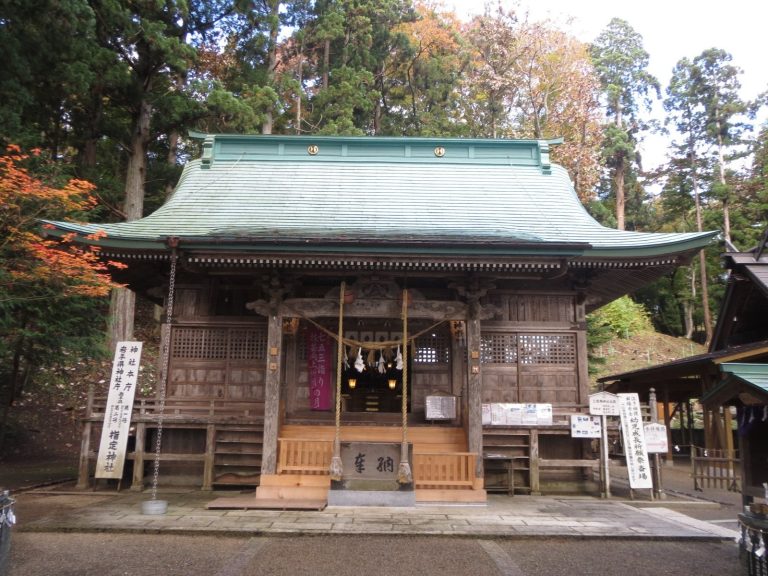
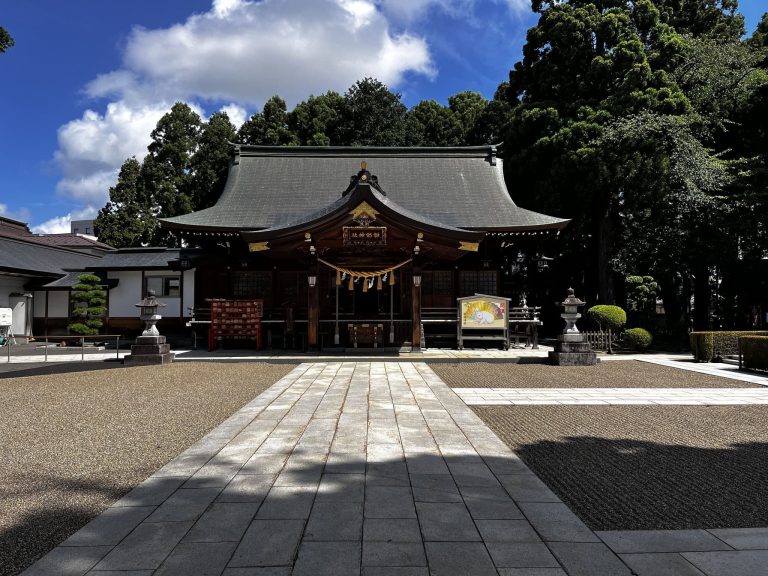
Shiwa Inari Shrine stands in the western foothills of the Masuzawa settlement, on the left bank of the Takina River. Its precinct contains a worship hall and a main sanctuary. The main sanctuary has an irimoya-zukuri roof, a form combining a central gable with sloping hipped roof surfaces. These buildings form the principal architectural remains of the shrine precinct.
Inariyama Great Cedar
A cedar known as the Inariyama Great Cedar stands within the precinct. It is more than 1,000 years old and is treated as a sacred tree. A local custom involves searching for white-fox hair at the base of the cedar as a prayer for longevity, linking the tree’s ritual meaning with the fox symbolism associated with Inari.