Ornunga Old Church: A Medieval Church in Vårgårda, Sweden
Site at a Glance
- Country
- Sweden
- Primary era
- Early Modern
- Eras represented
- Medieval, Early Modern
- Civilizations
- Swedish
- Site type
- Religious
- Remains
- Church
On this page11 sections
History
Medieval foundation and later expansion
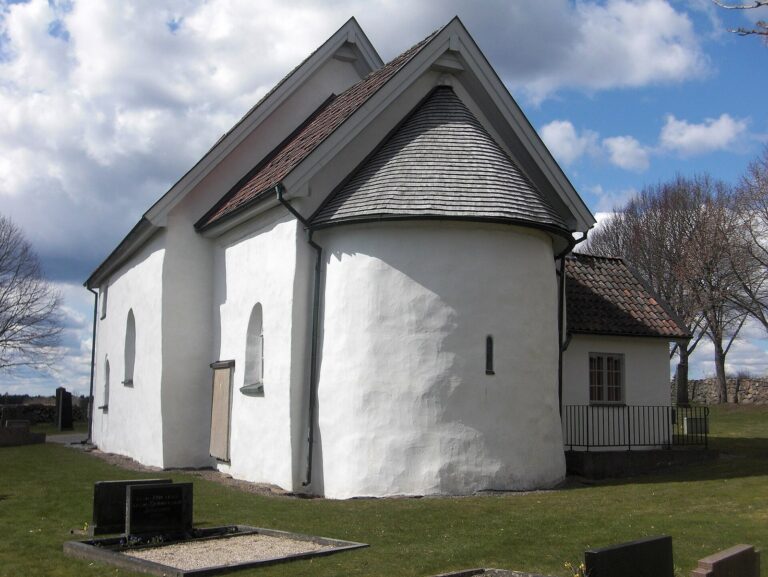
Ornunga Old Church is a medieval church in the village of Ornunga, in Vårgårda Municipality, Sweden. It was consecrated in the 13th century and was probably built during the same century. A local tradition credits its construction to two wealthy sisters from the Sällerhög estate, who are said to have built it for the congregation. The church belongs to the Lutheran Church of Sweden, which is organized into dioceses, and to Skara Diocese. It was part of Ornunga Parish until 2006, when it became part of Asklanda Parish.
In the 17th century, ceiling paintings were added and a gallery was built at the west end. The gallery was later extended eastward along the north wall. A freestanding bell tower was built in the 1670s. In 1720, the church was enlarged to twice its previous size. This work established the present chancel and the current size of the windows, and added two wooden entrance porches. A masonry sacristy followed in 1794.
Threat and preservation
Maintenance declined during the 19th century as plans developed for a new church. An earthquake damaged the old church’s walls in 1904, and the replacement church was completed the following year. A decision was then made to demolish the medieval building.
Asklanda curate Gustaf Sandzén and his brother, the artist Birger Sandzén, who was living in the United States, helped lead efforts to save it. The Svältorna Antiquities Association formed, bought the church, and arranged its restoration with some financial support from the Swedish Tourist Association. The altarpiece was restored in 1908, repairs followed in 1909, and from 1923 the association used the building as a museum.
By the mid-1950s, the roof was in poor condition. The Swedish National Heritage Board agreed to restore the church on condition that the association remove the museum objects stored inside, which the Board considered an unsuitable use of the building. In 1967, the association bought nearby Kyrkebol farm, and its main building became a new museum. The church’s exterior was restored in 1973–1974.
Remains
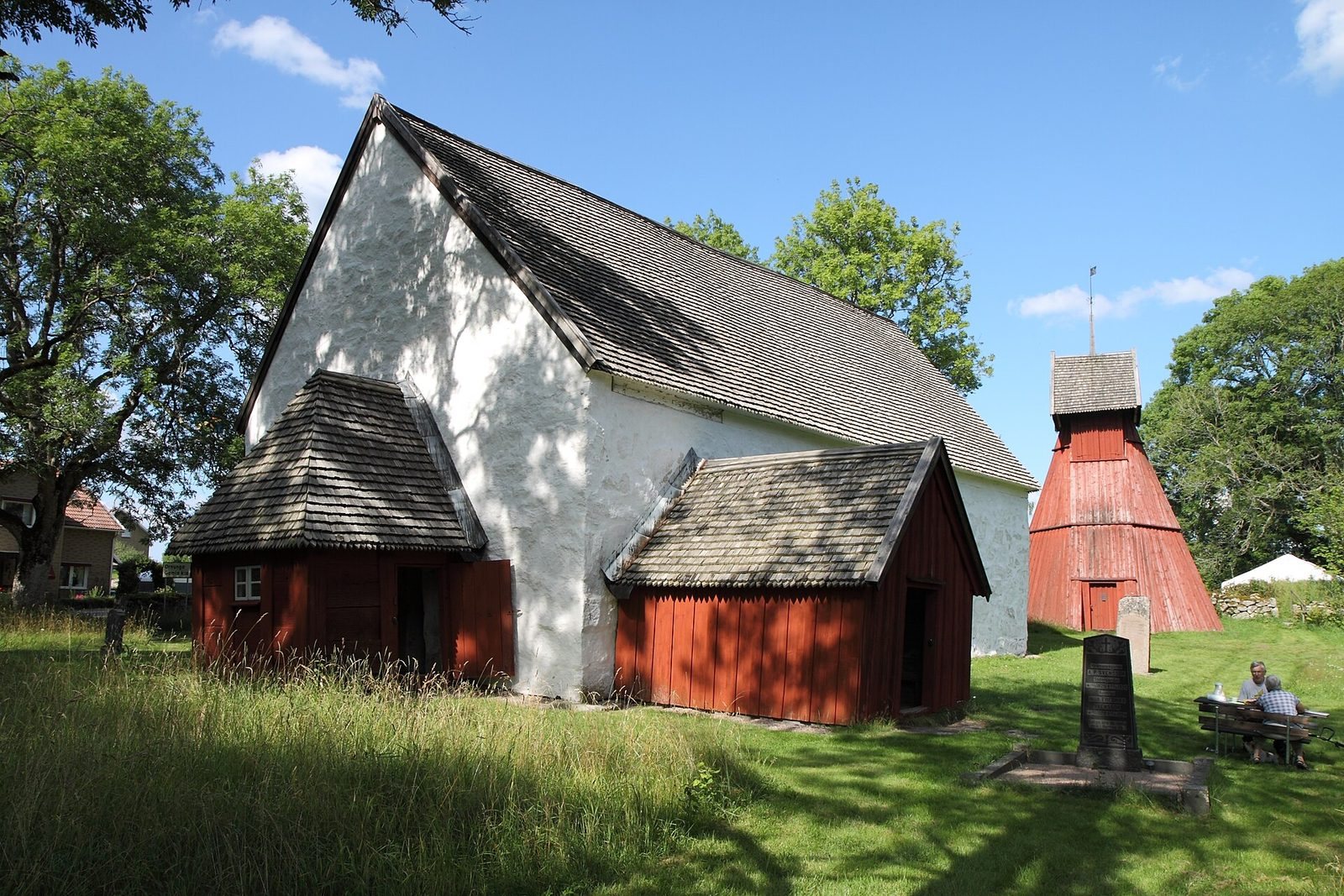
The fieldstone church has a rectangular nave and a three-sided chancel at its eastern end. Its surviving plan also includes a masonry sacristy beside the chancel and wooden porches at the entrances.
Church and grounds
Building and entrances
The sacristy, a room for clergy to prepare for services and store furnishings, adjoins the north side of the chancel. At the west end, the women’s entrance porch uses upright posts and boards; a wooden men’s porch stands on the southwestern side. The windows retain the size established during the enlargement.
Interior
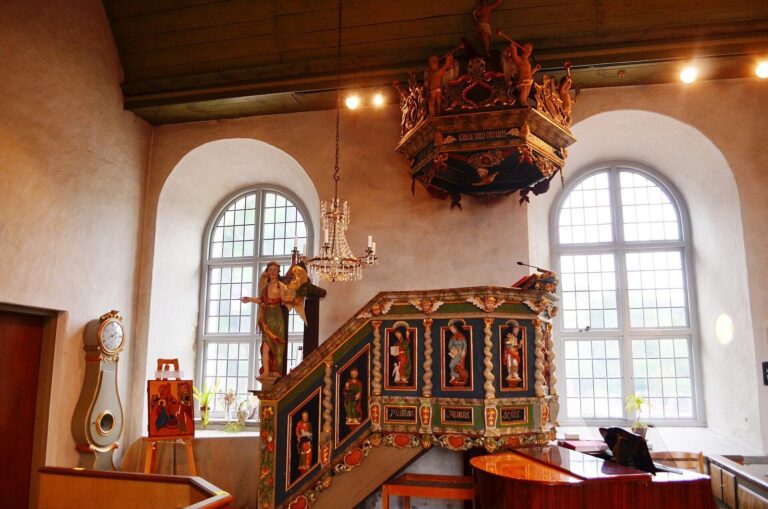
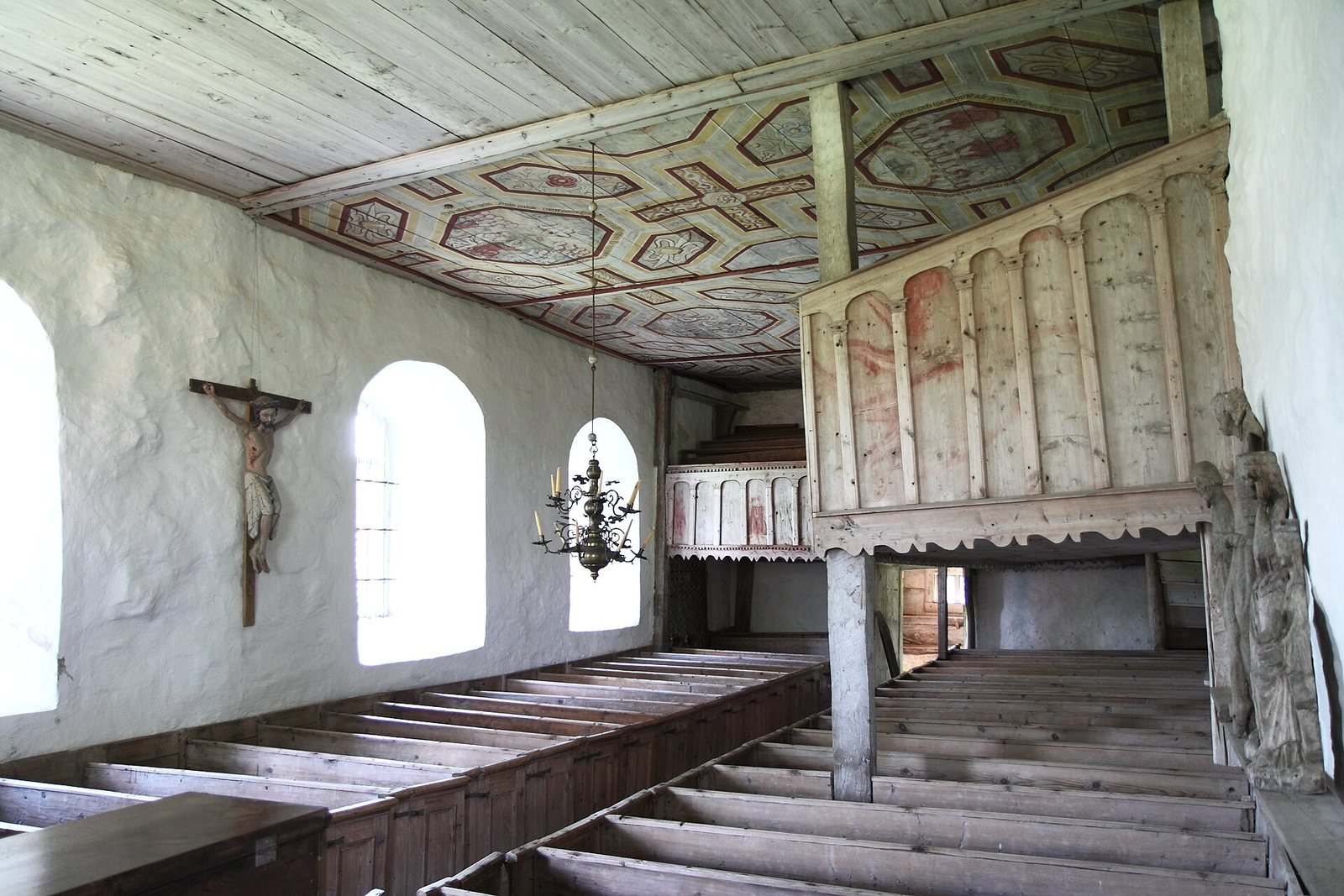
The interior remains intact and conveys the appearance of 18th-century churches in Västergötland. The ceiling paintings are in a rustic Renaissance style. The gallery begins at the west wall and extends along the north wall. The pulpit, made in 1720 by Swedish woodcarver Niklas Kihlman, bears images of the four Evangelists, the authors traditionally associated with the Gospels. The altarpiece dates to 1744. An old church collection box is kept in the men’s porch.
Bell tower and churchyard
The wooden bell tower stands east of the church, and its bells are still rung by hand. The churchyard retains the character of a medieval meadow and is mown each year.
Medieval objects
Baptismal font
The sandstone baptismal font, a vessel used for baptism, was made in two parts during the first half of the 13th century. It has been held at the Swedish History Museum since 1878 and is 73 centimetres high. Its rounded bowl bears unfinished, mostly outline-carved decoration of curling plant forms and leaves. A thick rope-pattern band runs around the four-sided base, and a drain hole passes through the centre. The font has no major damage.
Wooden sculptures
Several wooden sculptures from the 13th century survive, including three held at Gothenburg City Museum. Among them are an oak Madonna seated on a throne, from the later 13th century and 73 centimetres high, and an oak standing Madonna, 93 centimetres high, which belonged to a mid-13th-century group depicting the Crucifixion.