Fridlevstad Church: A Medieval Parish Church in Sweden
Site at a Glance
- Country
- Sweden
- Primary era
- Medieval
- Eras represented
- Medieval, Early Modern, Modern
- Civilizations
- Danish, Swedish
- Site type
- Religious
- Remains
- Fortified Church
On this page19 sections
History
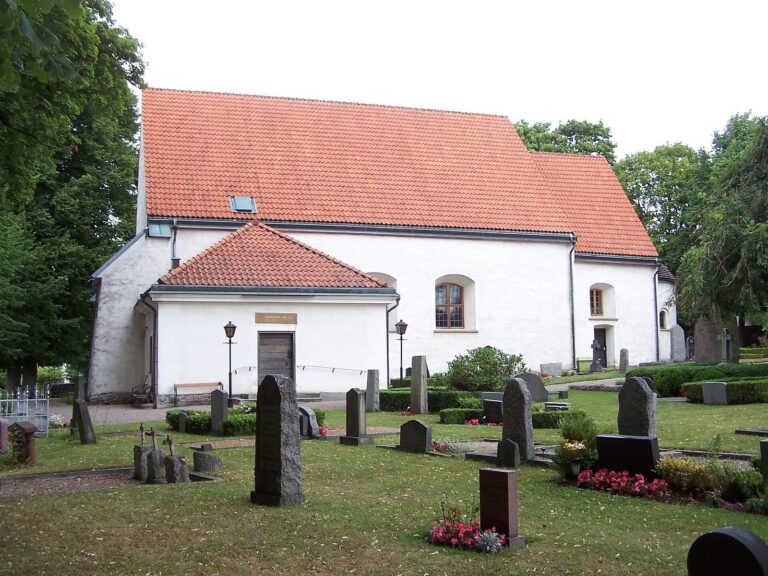
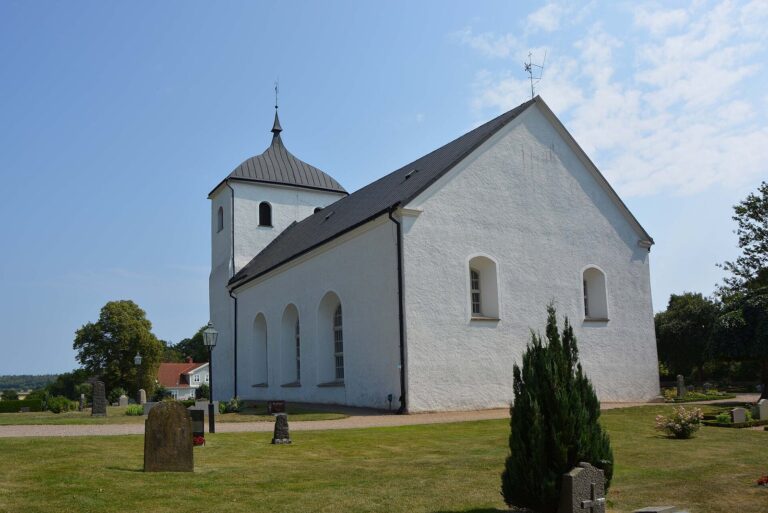
Fridlevstad Church is the medieval parish church of Fridlevstad, Sweden. Probably built in the late 12th or early 13th century in the Romanesque style, a medieval western European architecture associated with rounded arches and substantial masonry, it was consecrated during the 13th century. It is one of Blekinge’s oldest churches and serves the parish within the Diocese of Lund, a regional district of the Lutheran Church of Sweden. Its attic is thought to have offered a defensive platform.
Medieval origins and wartime destruction
During the Northern Seven Years’ War of 1563–1570, a conflict between Sweden and Denmark-Norway, Swedish forces burned and plundered the church. Between 1571 and 1579, it was repaired using the surviving walls, preserving its medieval ground plan.
Changes to the church and its furnishings
A porch is mentioned in 1665, although its construction date is unknown; it was taken down during the 19th century. That year, the church’s earlier belfry was described as octagonal and resembling the one at Edestad Church. The present belfry was built in 1749. A sacristy, a room used by clergy to prepare and store vestments and liturgical objects, was added beside the choir’s north side in 1714.
A plan to give the church a tower proceeded as far as the laying of foundation walls, but the tower was not completed. Instead, the nave was lengthened westward between 1779 and 1781. The interior was restored in 1914.
Organ history
The church’s organ history began with an instrument made in 1639 by Anders Bruce of Linköping. Andreas Åbergh of Hjortsberga parish built a 15-stop organ in 1852, with each stop selecting a set of pipes. Mårtenssons Organ Factory in Lund supplied another 15-stop instrument in 1933, which was expanded to 18 stops in 1948. A gallery organ followed in 1977, and a choir organ was added in 1979.
Remains
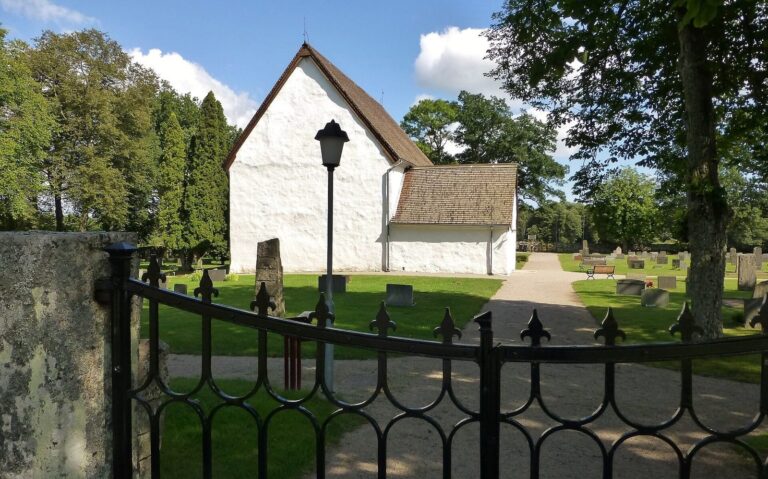
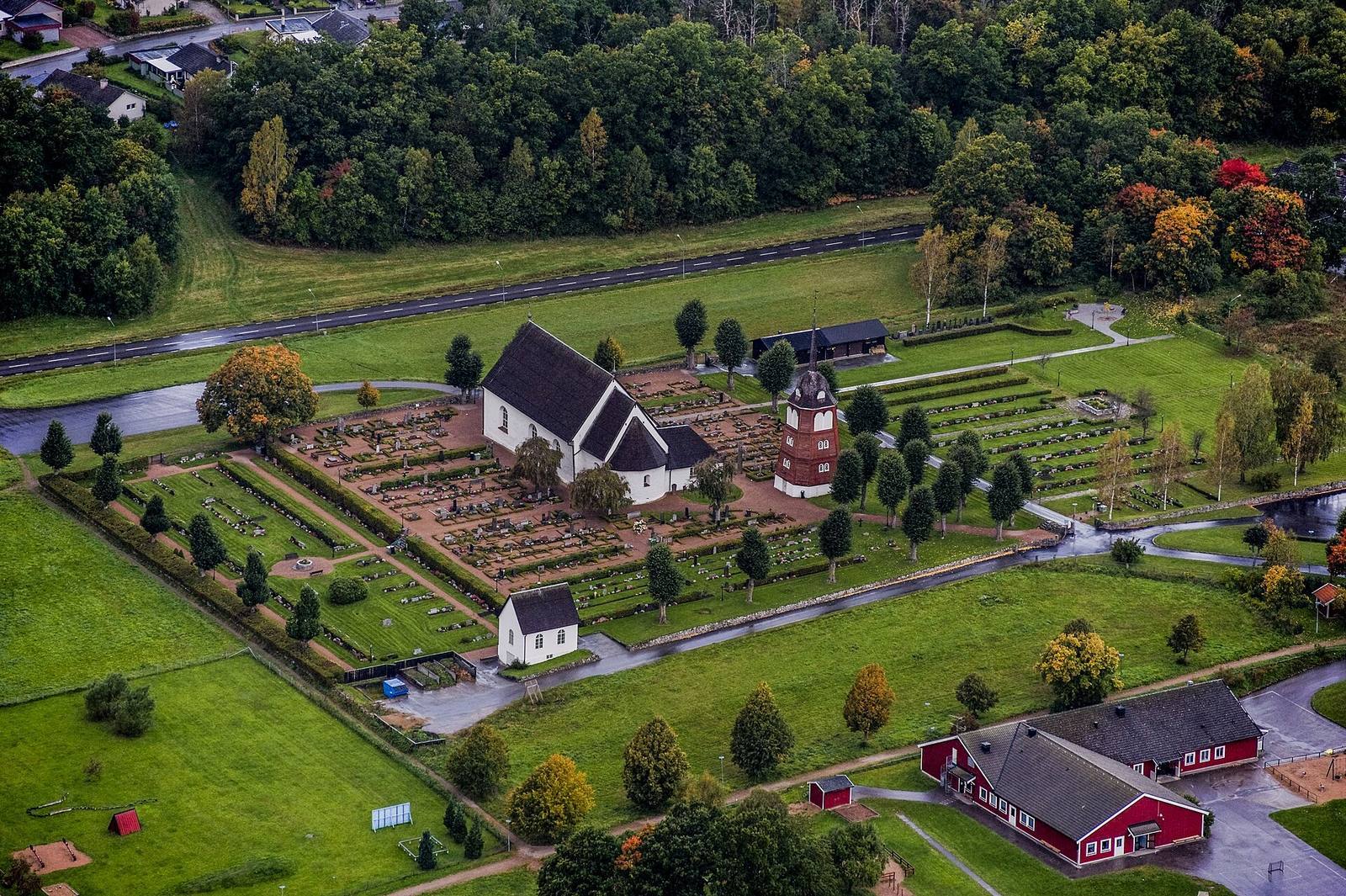
The church and cemetery form a group of stone and timber structures. The grey-stone church is arranged on an eastward axis, with a nave, the main body of the church, leading to a choir, the area around the altar, and an apse, a recess at the east end.
Church and cemetery
Main church
The nave, choir and apse preserve the medieval plan. The nave and choir have flat wooden ceilings. A white-painted wooden screen separates them in place of a triumphal arch, the type of arch commonly used to mark the division. The church’s walls retain the grey stone of its construction.
Sacristy
Beside the north side of the choir, the grey-stone sacristy has a grey-painted wooden ceiling and iron grilles over its windows.
Belfry
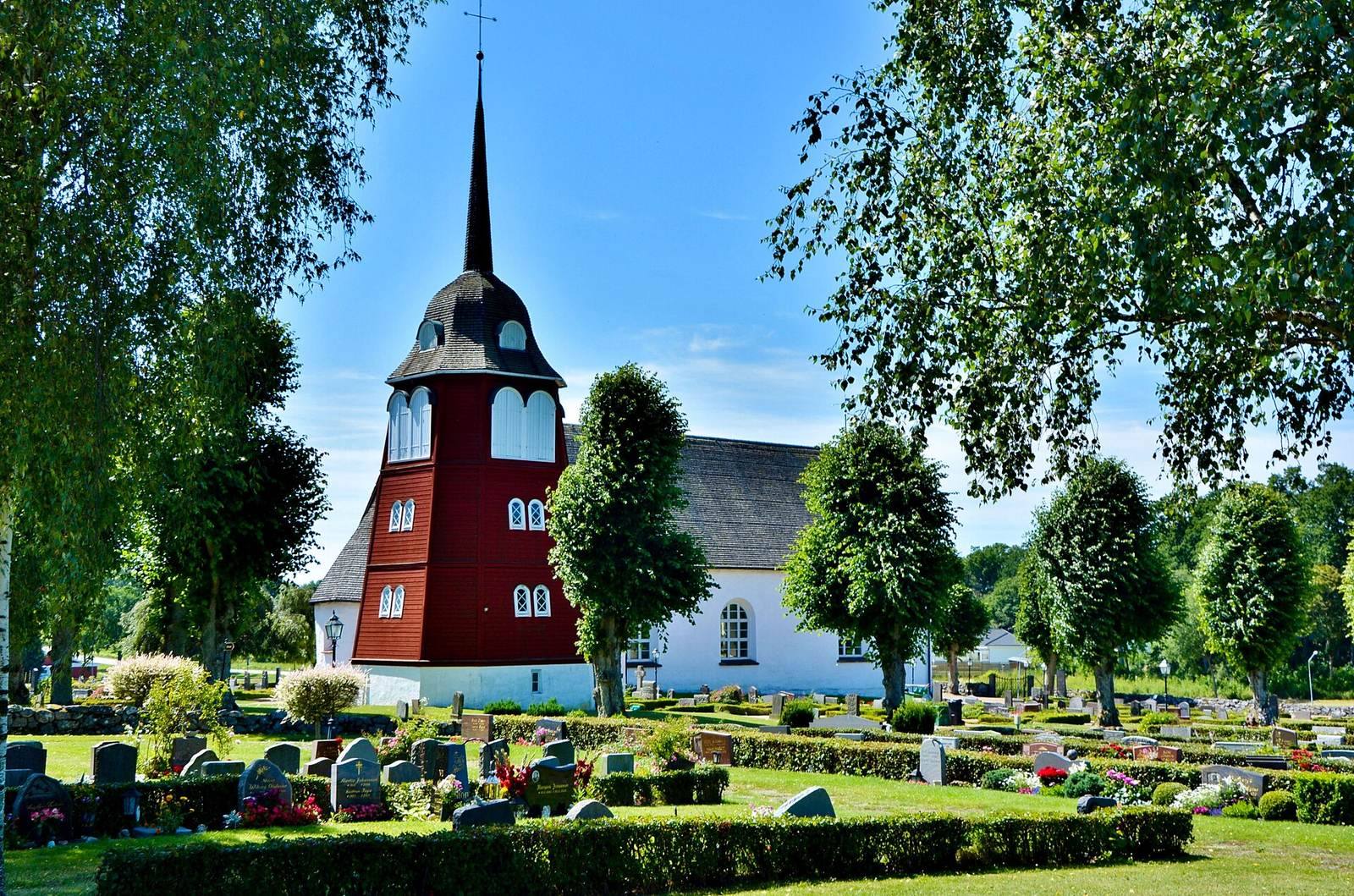
A separate wooden belfry stands beside the church at the cemetery’s northeast corner. Board cladding covers its frame; above it is a helmet-shaped cap, a spire topped by a cross, and a housing for three bells.
Burial chapel and cemetery enclosure
The burial chapel occupies the cemetery’s southeast corner. It is built of rendered timber and has a shingle roof. A dry-stone wall of grey stone encloses the cemetery, with cast-iron gates between stone posts on the northeast and west sides. In 1665, the enclosure was described as a masonry wall with four roofed gate structures covered in planks.
Interior furnishings
Altar and altarpiece
The altar stands free of the surrounding structure, while the altar rail has turned balusters, small shaped supports, and a central opening. The closed pews date from 1856. On the south wall of the nave hangs an altarpiece dated 1653. Its central painting shows the Last Supper, framed by columns and twisting grapevines. Wooden figures of Faith and Hope occupy the side wings; above them, two angels hold palm branches beside a figure of Christ. An inscription quotes the words associated with the institution of the Eucharist, the Christian communion rite commemorating the Last Supper. A carved altar crucifix made by Nils Sandberg of Rödeby dates to 1964.
Pulpit
The oak pulpit was made in 1692 by Åke Truedsson and has a sounding board, a canopy intended to help project the speaker’s voice. Its body is divided into five carved panels. The scenes include the Creation and the Flood, alongside the Fall of Man with the apostles James and Paul, the Nativity with Christ holding a globe and God the Father, the Crucifixion beneath God the Father and the seven lamps of Revelation, and the Ascension. The Ascension scene is flanked by John the Evangelist and a figure thought to represent Martin Luther. The seven-sided sounding board is decorated with angel heads and grape clusters, and its upper ornament carries the monogram of Charles XI, king of Sweden from 1660 to 1697.
Baptismal fonts and basins
The oak baptismal font, which holds water for baptism, was carved in 1682 by Åke Truedsson of Jämshög. It is 87 centimetres high and 68 centimetres across. Seven putti, child figures used as decorative or religious motifs, support its bowl; a canopy above is crowned by Christ holding a globe. An inscription names parish priest Anders Bager and his first wife, Cicele, as those who paid for the font. It also records that his wife Christina, daughter of Knud, had it decorated in 1687. The font’s brass basin depicts the Fall of Man and has acanthus scrolls, dogs and deer. Given by Anders Bager and his wife, it measures 53 centimetres across and bears the initials N-P-RA-C-D.
An earlier font made of pine stained to resemble oak dates to the middle or later 16th century. It is described as Sweden’s oldest font from the Protestant period. Initially painted in white and red watercolours, it received blue and gold decoration in 1671. It measures 106 centimetres high and 52 centimetres across, and was lent to Sillhövda Chapel in 1777. A second brass baptismal basin, 50 centimetres across, has a band of flower buds and figure-eight designs, two rings, and an Annunciation scene in its base. A shield bears the inscription K-I 80.
Organs
The gallery organ has 20 stops, mechanical action that transmits key movement to the pipes through linkages, electric registration that operates the stops, and free combinations that let the organist preset groups of stops. Its facade comes from the earlier organ. The choir organ has five stops and mechanical action.
Memorials and church objects
Memorials
A memorial to Anders Bager is mounted on the north wall of the nave and is probably the work of Åke Truedsson. Its inscription describes a couple parted by death and their hope of meeting again in heaven. A wooden John the Baptist stands to one side and a thorn-crowned Christ to the other. Above them, the risen Christ tramples a serpent; pyramidal forms frame the sides. Magnus Frodelius is remembered by a white-painted wooden memorial bearing only his name, set within a black-painted frame. J. G. Heerman’s name-only memorial is made of lead beneath glass and has a black-painted wooden frame.
Collection scoop, bridal crown and wafer box
A green-painted wooden collection scoop ends in a carving of a burning church. Its inscription, dated 1682, asks God to protect house and land from fire. The silver-gilt bridal crown has two wreaths and red, blue and green stones. Its marks include the arms of Karlskrona and other maker’s or silver-testing marks. A round wafer box made of pressed leather measures 9.7 centimetres across and 12 centimetres high.
Communion vessels
A silver-gilt chalice dated 1694 bears the letters INRI and an inscription identifying it as belonging to Fridlevstad Church. It is 21.3 centimetres high and 11.2 centimetres across, and its stated weight is 35 5/8 lod, a historical unit of weight. A silver paten, a plate for communion bread or wafers, is gilded on its upper surface, inscribed as church property, and has a stated weight of 10 3/4 lod. A silver-gilt communion spoon has a perforated bowl, is 13.2 centimetres long, and bears the name Fridlevstad. Its marks include the arms of Karlskrona and other maker’s or silver-testing marks.
A partly gilded silver communion pitcher, 32 centimetres high, is decorated with acanthus-leaf scrolls and a fruit ornament on its lid. Jöns Björckman made it in Karlskrona. An inscription says that Anders Lagomstor and his wife gave 52 lod of silver toward it in 1755, while the church paid for the remainder and for the gilding. A leather case holds another communion set, comprising a silver-gilt chalice and silver paten. Both are inscribed as belonging to the Fridlevstad and Rödeby parishes. The chalice measures 13 centimetres high and 7.7 centimetres across; the paten is 10.5 centimetres across. The chalice’s marks include the arms of Karlskrona and other maker’s or silver-testing marks.