Temple Bar Gate: The City of London’s Historic Boundary Gateway
Site at a Glance
- Country
- United Kingdom
- Primary era
- Early Modern
- Eras represented
- Early Modern, Modern
- Civilizations
- British, English
- Site type
- Civic
On this page7 sections
History
Temple Bar Gate is a historic gateway of the City of London, in London, United Kingdom, first built on the City’s western approach where Fleet Street met The Strand. The present stone gateway was constructed between 1669 and 1672 to replace earlier barriers. Temple Bar was the busiest of the City’s boundary bars, regulating trade on a major route between London’s commercial centre and Westminster’s political centre. It also stood on the royal ceremonial road connecting the Tower of London, Westminster, and St Paul’s Cathedral.
Medieval boundary and early records
The name came from Temple Church, south of the bar. The church gave its name to the Temple area, formerly associated with the Knights Templar, a medieval religious and military order, and later home to the Inner and Middle Temple Inns of Court, institutions of the English legal profession. Temple Bar stood beyond the City’s old defensive wall, where barriers controlled important routes some distance from the old gatehouses.
After the Battle of Evesham in 1265, Prince Edward punished Londoners who had supported Simon de Montfort, a baron who rebelled against Henry III. Edward seized the City’s street chains and bars and had them kept in the Tower of London. A City bar at the Temple was mentioned in 1293 and may at that time have been a chain or barrier strung between posts. A specific notice of Temple Bar follows in 1327, in connection with a mayoral hearing over a right of way. By 1351, a timber archway with a small prison above it had been built there. In 1384, Richard II authorized paving the road from Temple Bar to the Savoy, with tolls collected to fund the work.
Royal ceremonies and political conflict
Temple Bar became a setting for royal funerals and processions. In 1422, citizens and nobles carried Henry V’s body to Westminster Abbey, with torch-bearers stationed at every doorway along the route from Southwark to Temple Bar. Elizabeth of York’s funeral procession paused at the bar in 1503 while travelling from the Tower to Westminster. The Abbots of Westminster and Bermondsey blessed her body there, and the Earl of Derby and other nobles joined the procession.
On 31 May 1534, the day before her coronation, Anne Boleyn passed through the bar on her way to the Tower. The gateway had been painted and repaired for the occasion. Singers and children gathered nearby, and the Fleet Street conduit flowed with claret. A customary civic ceremony also took place when monarchs entered the City from Westminster: the Lord Mayor presented the City’s pearl-encrusted Sword of State as a token of loyalty. The ceremony later became a subject of art and literature.
During Thomas Wyatt’s 1554 uprising against Queen Mary I’s proposed marriage to Philip II of Spain, the barrier was either opened to Wyatt’s force or forced open by it. After Wyatt was driven back at Ludgate, cavalry hemmed him in at Temple Bar, where he surrendered. The revolt persuaded the government to proceed with the execution of Lady Jane Grey, a claimant to the English throne whose brief reign had preceded Mary’s.
Rebuilding and removal
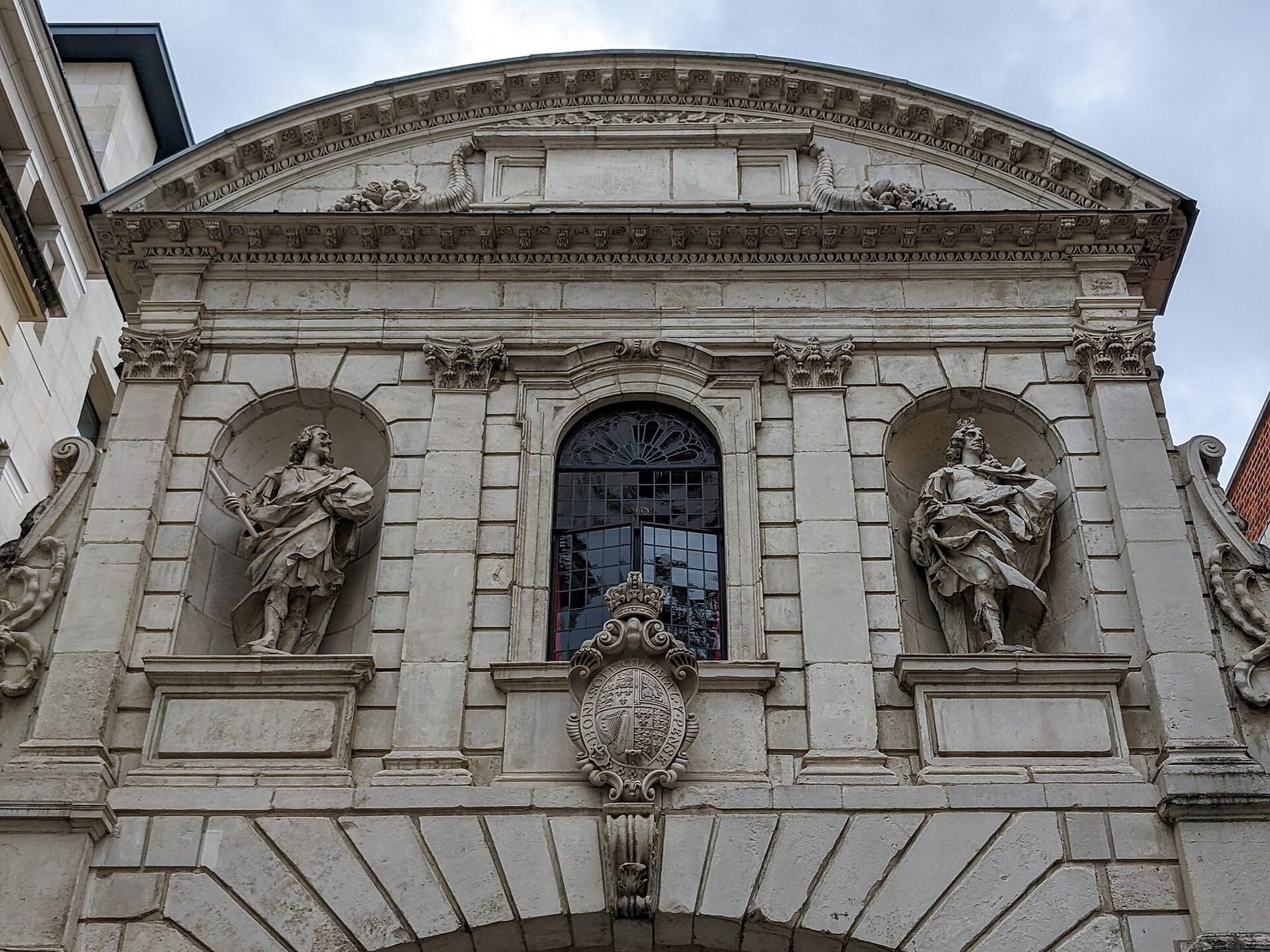
The gateway then standing escaped the Great Fire of 1666, which devastated much of the City. Charles II nevertheless commissioned a new gateway as part of the City’s post-fire improvements. Attributed to the architect Christopher Wren, it was built from 1669 to 1672 by City Mason Thomas Knight and master mason Joshua Marshall. John Bushnell carved its statues, which commemorated the 1660 Restoration, the return of the Stuart monarchy after a period of republican government.
In the eighteenth century, the heads of executed traitors were often displayed on pikes on the gateway roof. The neighbouring Child & Co bank leased a room in the upper storey for its records. By 1874, the keystones, the central stones at the crowns of the arches, had dropped, and timber supports were needed beneath the arches. Increasing horse-and-cart traffic also made the gateway a bottleneck. The City Corporation, the City’s municipal governing body, dismantled it in 1878 to widen the road, carefully storing its 2,700 stones.
Following the gateway’s removal, City architect and surveyor Horace Jones designed the Temple Bar Memorial to mark its former position. The memorial was unveiled in 1880. That year, brewer Henry Meux bought the stored stones at the instigation of his wife, Valerie Susan Meux, and had the gateway reassembled as the facade of a new gatehouse at Theobalds Park in Hertfordshire. When the park was sold to Middlesex County Council in 1938, the gateway was excluded and remained with the Meux trustees. The Temple Bar Trust bought it from the Meux Trust in 1984. In 2001, the City’s Court of Common Council resolved to contribute toward its return.
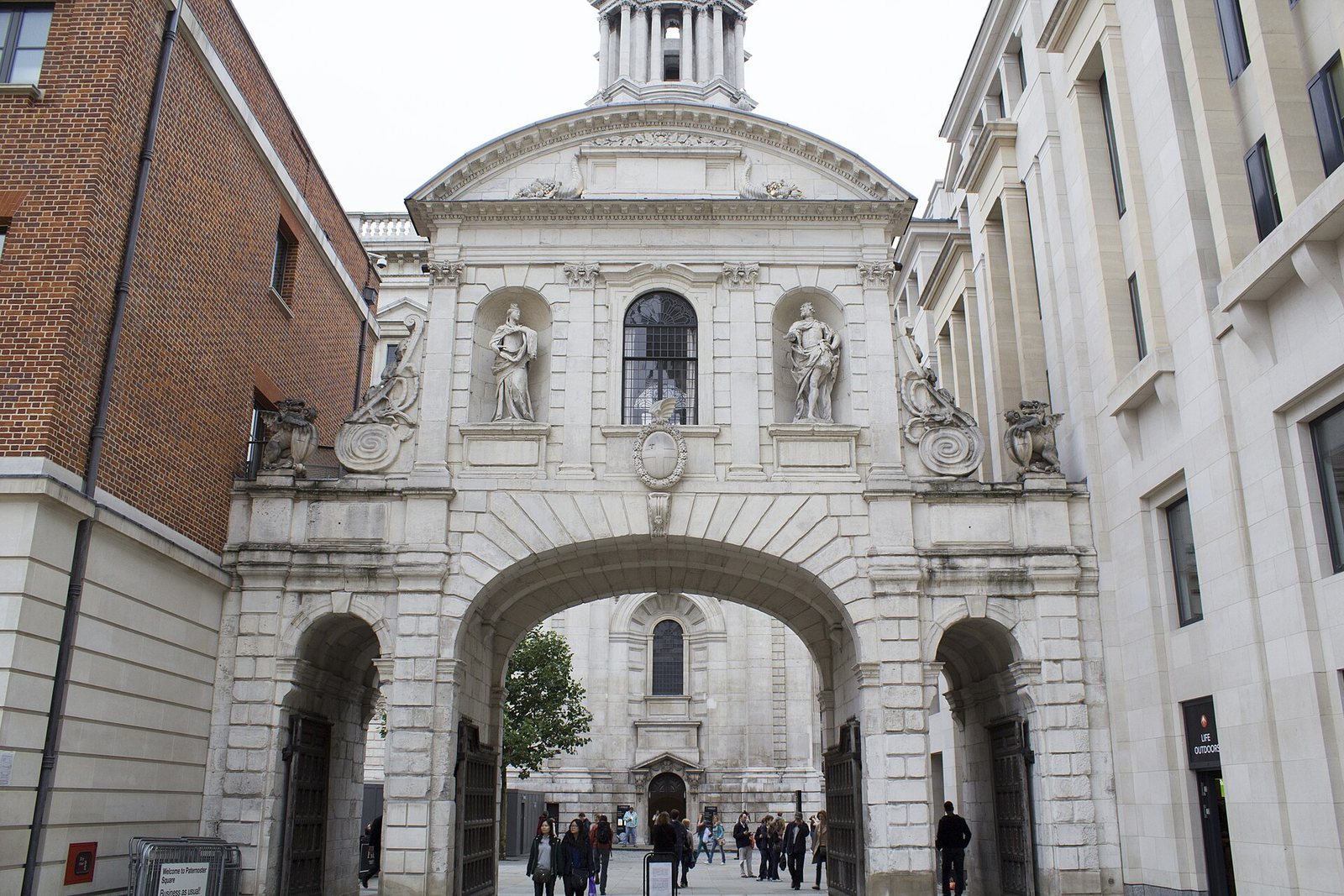
The gateway was dismantled at Theobalds Park in 2003 and re-erected the following year at Paternoster Square, next to St Paul’s Cathedral, as an entrance to the redevelopment. In September 2022, the gateway and adjacent Paternoster Lodge became the home of the Worshipful Company of Chartered Architects, a professional membership body, with space for meetings, dining, and an education centre.
Remains
The gateway is a two-storey Portland-stone structure with a central road arch flanked by narrower pedestrian arches. Its stone faces are rusticated, meaning deliberately roughened or strongly emphasized. It now stands at Paternoster Square, immediately north of St Paul’s Cathedral. At its former site, Fleet Street met The Strand; Temple Church and the Inner and Middle Temple lie to the south, and the Royal Courts of Justice to the north.
The gateway
The broad central opening carried road traffic, while the two side arches provided narrower passages for pedestrians. A room occupied the upper storey, later serving as a records store for Child & Co. The gateway’s four upper statues represent members of the Stuart royal family. In its original position, Charles II and his father Charles I stood on the west side; Charles I’s parents, James I and Anne of Denmark, stood on the east.
The Temple Bar Memorial
The memorial stands in the street in front of the Royal Courts of Justice. Its elaborate neo-Renaissance pedestal draws on forms associated with Renaissance architecture and supports a sculpture by Charles Bell Birch. A dragon figure bearing the City of London’s arms forms the support. The figure is sometimes mistaken for a griffin and has also been interpreted as a copy of the Welsh dragon.
Joseph Boehm sculpted the pedestal’s statues of Queen Victoria and her son, then Prince of Wales and later Edward VII. Reliefs designed by Charles Henry Mabey show Victoria’s progress to the Guildhall in 1837 on the south face. On the north face, a relief depicts Victoria, the Prince of Wales, and the Princess of Wales travelling to St Paul’s in 1872.