Ōgaki Castle: A Strategic Lowland Castle in Mino, Japan
Site at a Glance
- Country
- Japan
- Primary era
- Early Modern
- Eras represented
- Early Modern
- Civilizations
- Tokugawa, Toyotomi regime
- Site type
- Military
- Remains
- Castle
On this page12 sections
History
Ōgaki Castle was a lowland castle in western Mino, Japan, valued for its defensive position and command of the Sekigahara Pass, a land route connecting Mino with Ōmi Province and Kyoto. Its beginnings are uncertain, and it has also been called Bi Castle and Kyoroku Castle.
Early fortifications and Sengoku-period control
Two traditions offer different accounts of the castle’s origins. One places a fort at Ushiya in 1500 and attributes it to a member of the Takekoshi family. Another says a member of the Miyagawa family built a fort at a different location in 1535. The early castle was also known as Ushiya Castle.
During Japan’s Sengoku period, an era of warfare and political fragmentation before Tokugawa rule, Oda Nobuhide captured the castle in 1544. An Oda commander holding the title Governor of Harima controlled it for five years. The Saitō, a warrior clan that held power in Mino, took it in 1549 and placed it under one of their retainers. Ujiie Naomoto became lord in 1559 and expanded the fortifications in 1563, strengthening its enclosures, moats, and earthworks.
Toyotomi rule and rebuilding
After the Battle of Shizugatake in 1583, Toyotomi Hideyoshi assigned Ōgaki to his general Ikeda Tsuneoki, whose holding was assessed at 150,000 koku, a measure of rice yield used to express a domain’s income. Tsuneoki died at the Battle of Komaki and Nagakute in 1584. His son Terumasa inherited the castle before transferring to Gifu Castle in 1585.
Hideyoshi then entrusted Ōgaki to a succession of relatives and retainers, including Toyotomi Hidetsugu, Toyotomi Hidenaga, Katō Mitsuyasu, Hitotsuyanagi Naosue, Toyotomi Hidekatsu, and Itō Morimasa. In 1585, Hitotsuyanagi received the castle with a holding of 30,000 koku. The Tenshō earthquake of 1586 devastated the castle, causing it to collapse and burn. Its keep was built in the late sixteenth century, although its exact construction date is unknown. A tradition says that a traveling mountain ascetic was used as a human pillar, a person sacrificed or buried in connection with a building project.
After Hitotsuyanagi died in the 1590 campaign against Odawara, the castle passed to a member of the Itō family, credited with distinguished service in that campaign. His son succeeded him in 1599.
Sekigahara and Tokugawa rule
In 1600, during the Battle of Sekigahara between the Western and Eastern armies, the Itō lord supported the Western side, and Ishida Mitsunari used Ōgaki as his base. When the main Western force moved to Sekigahara, commanders remained to defend the castle. After the Western defeat, Eastern forces led by Tokugawa Ieyasu besieged it. Defections among the defenders helped bring about its surrender, which was negotiated through an intermediary. A historical narrative also preserves the episode.
Under the Tokugawa shogunate, the government established by Ieyasu, the castle passed among several fudai clans, hereditary Tokugawa retainers. The Toda family became its lords in 1635 and held it until 1871. A major rebuilding in 1649 gave the castle the form it retained in later years.
Demolition, wartime destruction, and reconstruction
Ōgaki ceased to function as a castle in 1871. Following the 1873 order to abolish castles, many buildings were demolished and the outer moats were filled, although some structures initially remained. In 1936, the keep and northeast turret received National Treasure status under the prewar system. Both burned, along with other buildings, in an air raid on 29 July 1945.
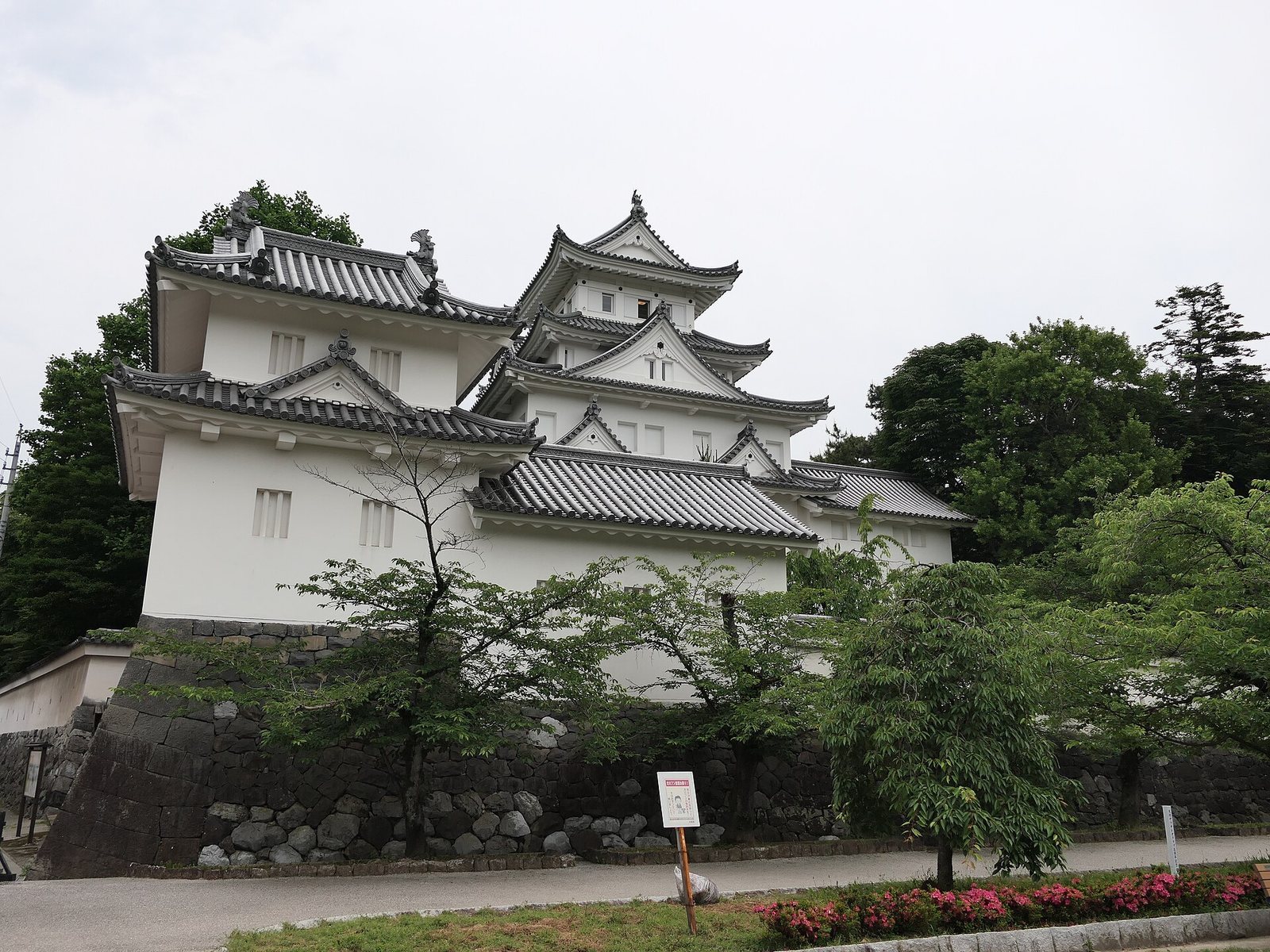
After the war, the keep and two corner turrets were rebuilt in reinforced concrete. The keep was reconstructed in 1959 and the northwest turret in 1967. Repairs completed in 2011 adjusted the keep’s roof and exterior to bring its appearance closer to the prewar building. The reconstructed keep now houses a museum.
Remains
The castle stood between the Ibi and Kuisegawa rivers. Its central fortified area was relatively compact, while a network of moats connected with the rivers extended its defenses. The site’s layout developed from an early arrangement of two enclosed areas, or baileys, to a later plan with multiple baileys and an outer enclosure.
Enclosures and defenses
Moats and baileys
In the earlier layout, a main bailey and a second bailey were protected by the Ushiya River, which served as an outer moat. In the later arrangement, the main and second baileys lay alongside each other, with a third bailey around them and an outer enclosure forming the perimeter. Four lines of moats surrounded the castle. The Minoji road crossed an enclosure within the outer moat, linking the East and West Outer Gates.
Towers and gates
The main bailey contained a four-storey, four-level tower at its northwest corner, one three-storey turret, and three two-storey turrets. The second bailey had a Moon-Viewing Turret and four three-storey turrets. Four two-storey turrets and one single-storey turret stood in the third bailey. The main bailey had two gates, the second had one, the third had five, and the outer enclosure had seven.
The keep began as a three-storey, four-level structure in a watchtower form and was later changed into a four-storey, four-level tower. The Tsugaru version of the Battle of Sekigahara Screen, a painted battle screen, and the seventeenth-century Shōhō Castle Plans depict a three-storey keep, unlike the present reconstruction.
Surviving structures and relocated gates
Remains in Ōgaki
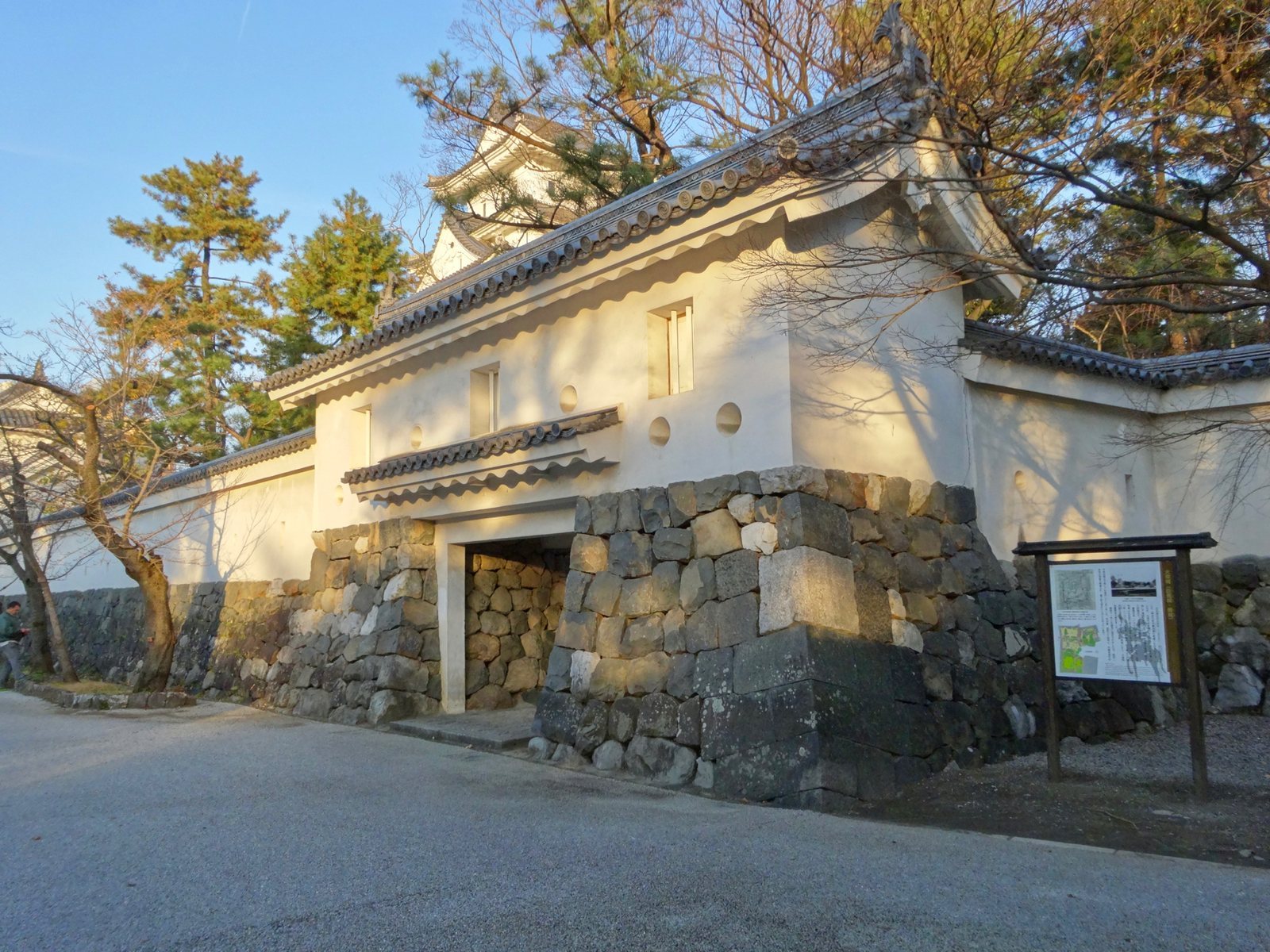
The main and second bailey areas now form part of Ōgaki Park. Stone walls survive in the main bailey, and a section of the outer moat is incorporated into the Suimon River. The reconstructed keep and corner turrets are reinforced-concrete structures. The northwest turret stands on a base of limestone fieldstones laid as masonry.
Gates preserved elsewhere
Several original gates survive away from their first locations. The northwest gate of the main bailey was moved to a private residence in Ōgaki. The Shimizu Gate is at a Tenrikyo branch church in Nagamatsu, and another castle gate is at a private residence in Nishikata, Ōno. An iron gate once thought to have come from Kanō Castle was identified as Ōgaki’s Iron Gate after it was transferred and dismantled for examination. It was repaired and is displayed at Unuma-juku in Kakamigahara.