Fort Niagara: A French Fort and U.S. Military Post
Site at a Glance
- Country
- United States
- Primary era
- Early Modern
- Eras represented
- Early Modern, Modern
- Civilizations
- French
- Site type
- Military
- Remains
- Fort
On this page16 sections
History
Fort Niagara is a French-established fort at the mouth of the Niagara River, where it enters Lake Ontario in the United States. Its permanent French phase began in June 1726, as France sought to control a strategic water route between the Great Lakes and the interior of North America.
French outposts and permanent fort, 1679–1748
French efforts to secure the river began before the permanent fort was built. In 1679, the explorer and colonial figure René-Robert Cavelier de La Salle established Fort Conti, a fortified supply station for boats carrying provisions across Lake Ontario to Fort Frontenac. The post burned down before the year was over.
In 1687, Jacques-René de Brisay, Marquis de Denonville, governor of New France, built another fort during a campaign against the Seneca, one of the nations in the Iroquois League, an Indigenous confederacy in northeastern North America. Cold, hunger, disease, and isolation reduced its garrison of 100 to 12 survivors by the time relief arrived in spring 1688. The French abandoned and destroyed the post that September.
Louis-Thomas Chabert de Joncaire secured Iroquois permission for a French trading post in the Niagara area in 1720, followed by approval for a site at the river mouth in 1725. Joncaire and eight men from Fort Frontenac established a trading house known as the Royal Store or House of Peace, where goods were exchanged for furs. In June 1726, military engineer Gaspard-Joseph Chaussegros de Léry established a permanent fortified post there. The French presented it as a peaceful trading place while seeking control of an important waterway. Its small garrison and Iroquois neutrality kept it largely out of the War of the Austrian Succession (1744–1748).
French expansion and British capture, 1749–1759
From about 1749, France worked to secure the Ohio River region by building a chain of posts between Lake Erie and Fort Duquesne. Fort Niagara became a key French base on the Great Lakes. In 1755, Captain Pierre Pouchot received orders to strengthen it against a possible British attack.
In July 1759, during the Seven Years’ War, a major conflict between European powers known in North America as the French and Indian War, British forces besieged the fort. Pouchot had sent most of his troops south, expecting the Iroquois to warn him of a British advance. Instead, about 2,000 British regular soldiers and 1,500 Iroquois allies arrived on July 6. The siege began on July 10. British artillery opened fire on July 14, and guns on the opposite bank joined the bombardment on July 17. By July 23, the fort’s remaining guns had been destroyed.
A French relief force of about 1,600 approached from upriver, but British-allied Iroquois persuaded Indigenous members of the force to leave. The remaining 600 attacked on July 24 and were defeated at the Battle of La Belle-Famille. About 100 survivors, most of them wounded, were captured, while many others were killed by Iroquois fighters. British General John Prideaux had been killed by a mortar during the siege, and Sir William Johnson took command. Pouchot surrendered on July 25. The British capture severed the French connection between Montreal and the Ohio Valley and contributed to the collapse of French power in North America.
British rule and the American Revolution
Britain held Fort Niagara for 37 years. After French resistance ended in 1760, the fort became a major supply and administrative center for British posts and settlements around the Great Lakes, as well as a place for contact with Indigenous communities. About 150 British soldiers died of scurvy during the first winter after the capture. During Pontiac’s War of 1763–1764, an Indigenous uprising against British rule and policies in the Great Lakes and Ohio regions, the fort supplied the relief of Detroit and served as a staging point for Colonel John Bradstreet’s 1764 expedition. Negotiations there formed part of British efforts to restore relations with Great Lakes Indigenous communities.
During the American Revolution, Fort Niagara served as a British base for operations in the western colonies, a transit point for Loyalists, colonists who remained loyal to the Crown, moving to Canada, and a center for military intelligence. Loyalist units and Indigenous allies, including followers of Mohawk leader Joseph Brant, conducted raids from the area. John Butler’s Rangers were among the principal units. The fort also held American prisoners, including a senior Continental Army officer captured at Cherry Valley in 1779.
After the 1779 Sullivan campaign damaged Iroquois villages and crops, British forces supplied Iroquois communities from the fort. Hundreds of American civilians taken by Iroquois were also ransomed there. The 1783 Treaty of Paris assigned the fort to the United States, but Britain retained control until the Jay Treaty, a 1794 agreement addressing outstanding disputes between the two countries, provided for the handover of British-held posts. American troops took possession in 1796.
U.S. border post and the War of 1812
With the Niagara River marking the international boundary, Fort Niagara became a U.S. border fort opposite British-held Fort George. During the War of 1812, the conflict between the United States and Britain, the guns at Niagara exchanged fire with Fort George and sank the Provincial Marine schooner Seneca on November 21, 1812. In fighting around Queenston Heights that October, British return fire forced the American garrison to leave its positions temporarily. U.S. volunteers later reoccupied the fort, and American engineers improved its gun positions.
On May 25 and 26, 1813, Fort Niagara’s guns joined U.S. naval guns in bombarding Fort George. American troops crossed the river and captured it on May 27. In December, after U.S. forces burned Newark, renamed Niagara in 1796, British troops seized Fort Niagara by surprise on the night of December 18–19. Of the 433 American defenders, 65 were killed and 15 wounded. Britain held the fort until the end of the war. U.S. troops returned on May 22, 1815, under a settlement that left the border unchanged.
Nineteenth-century military changes
Proposals to rebuild the fortifications after the war were set aside as relations with Britain improved. Completion of the Erie Canal in 1825 reduced the Niagara River’s importance as a transport and trade route. The U.S. Army left the fort in 1826, returned in 1828, and was again away for periods in 1846–1848 and 1854.
In 1826, former Freemason William Morgan was abducted and temporarily held in the fort’s gunpowder store before disappearing. His fate remained unknown, and the case helped fuel anti-Masonic sentiment in New York and elsewhere in the United States. Tensions following the Canadian rebellion of 1837 renewed concern about the fort’s defenses. During the U.S. Civil War, fears that Britain might intervene on the Confederate side led to further defensive plans and work beginning in 1863; only part of the planned reconstruction was completed by 1872.
After the Civil War, the Army developed a new post outside the old fort’s walls, and construction of its barracks and other buildings continued until 1912. From 1865, the garrison also helped counter incursions into Canada by the Fenian Brotherhood, an Irish nationalist organization operating from the United States.
Twentieth-century military use and preservation
The post trained U.S. troops for the Spanish-American War and the 1899 Philippine campaign. During the First World War it hosted an officer-training school and trained Polish soldiers for General Józef Haller’s Blue Army. Between the world wars, it served as a Citizens’ Military Training Camp. In the Second World War, it first operated as an induction center and then housed about 1,200 German prisoners captured in North Africa. After the war, it provided temporary housing for returning veterans.
During the Korean War era, the fort housed anti-aircraft artillery headquarters and later supported Nike missile defenses. The 2nd Artillery Group (Air Defense) was headquartered there from March 1958 to December 1961. The Army deactivated the fort in 1963, although the U.S. Coast Guard continues to operate on the grounds.
Restoration began in 1927, when the Old Fort Niagara Association took on the work and established a museum. An agreement with the U.S. War Department in 1931 authorized the association to preserve and operate the fort. The Father Millet Cross National Monument was transferred to New York State in 1949. The state owns the grounds, which it manages with the association and the state parks agency. Designated a National Historic Landmark as Old Fort Niagara in 1960, the fort is also part of the Colonial Niagara Historic District, listed on the National Register of Historic Places in 1966. It is a State Historic Site and a contributing element of the Niagara Falls National Heritage Area.
Remains
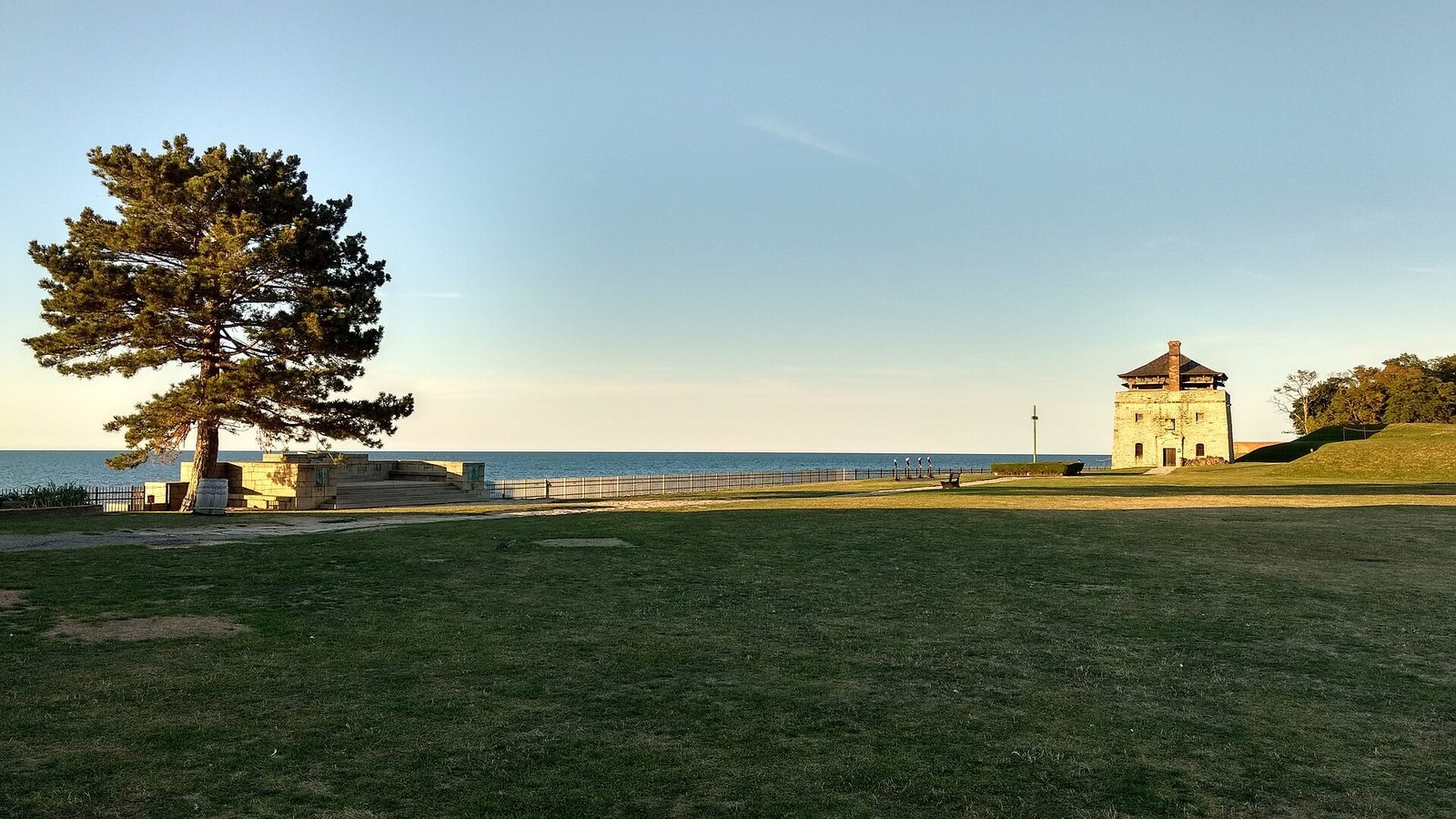
The 250-acre (100-hectare) site occupies the eastern bank of the Niagara River at its meeting with Lake Ontario. Across the river, Fort George stood about 500 meters away on higher ground. The surviving complex includes the old fort, later defensive walls, and a military post built outside the fortifications in the form of a camp rather than a masonry fortress.
The French stone building
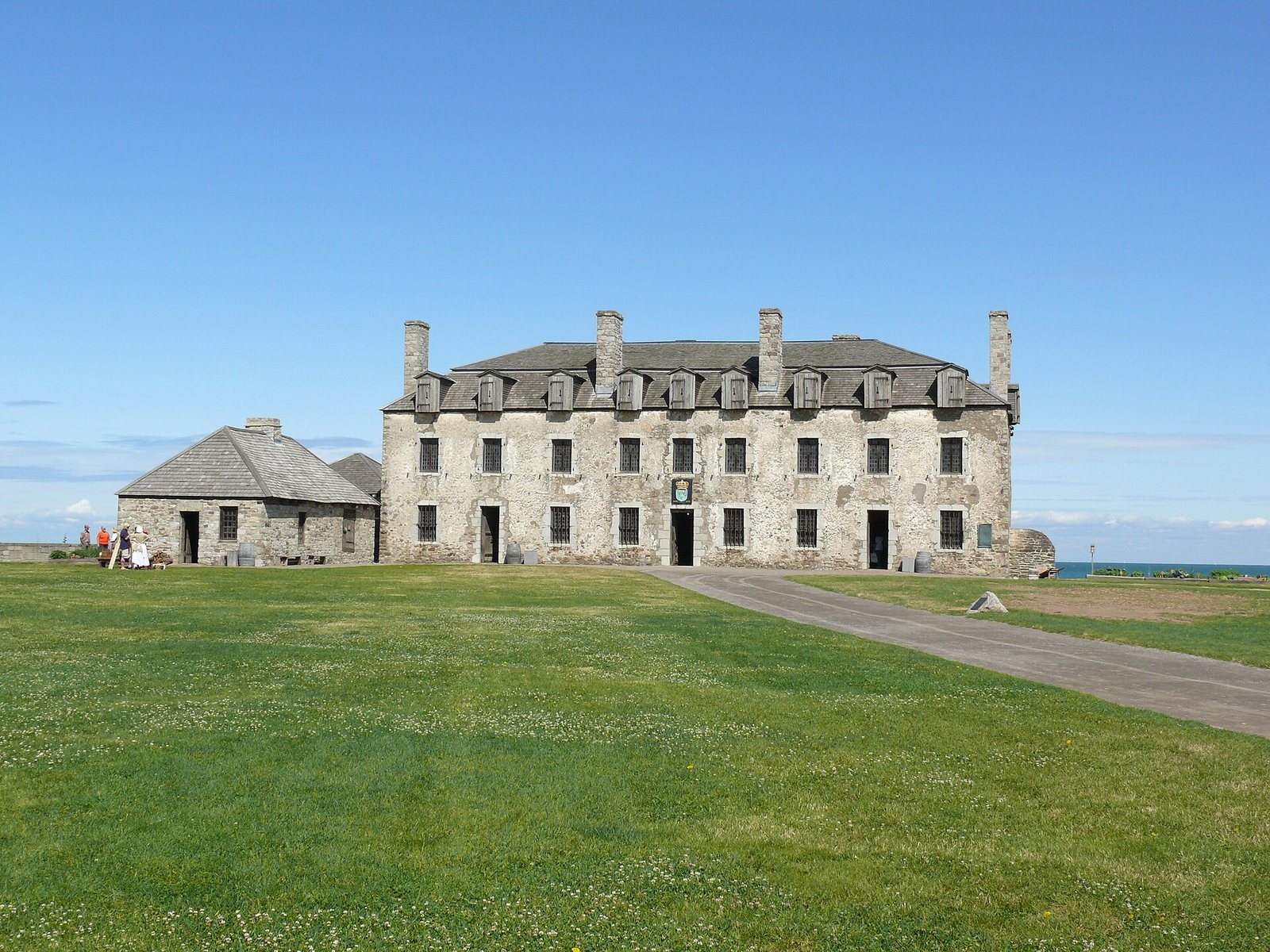
The oldest building on the grounds is a two-story stone house built during the fort’s permanent French phase. Its projecting upper structure contains machicolations, openings through which defenders could attack people below. A wooden palisade originally surrounded the building. The name “French Castle” came into use in the nineteenth century, rather than at the time of its construction. The building is maintained as part of the fort museum.
Fortifications and defensive walls
French-era earthworks
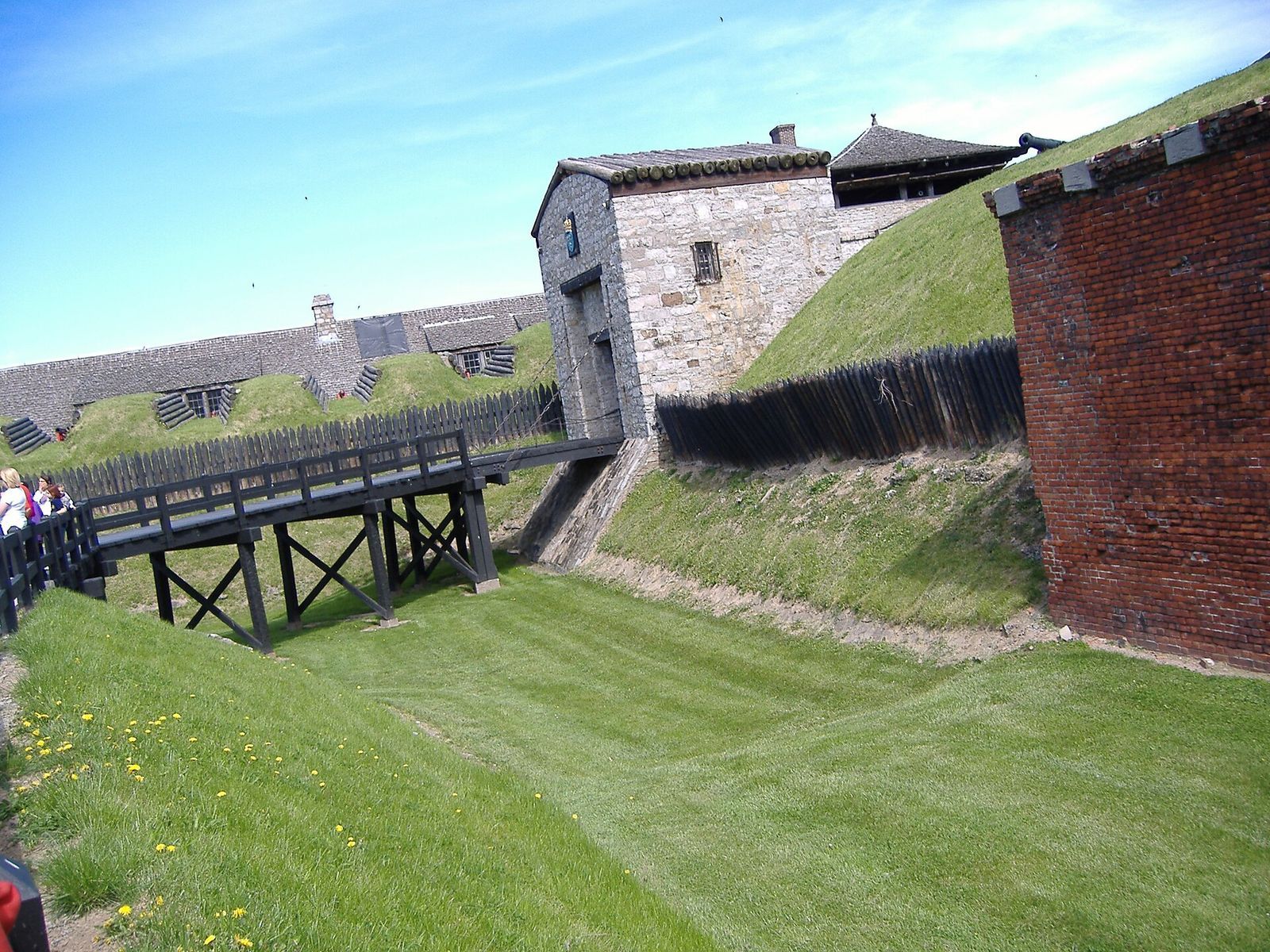
In 1755, the French replaced the old palisade with earthwork bastions, projecting platforms for defense. During the 1759 siege, the fort’s defenses included bastions, ditches, and overlapping lines of fire. By 1775, the major earthwork fortifications had largely disappeared.
Nineteenth-century walls
Work in 1839–1841 added a thick stone wall facing Canada and a separate wall along the water’s edge to limit erosion of the riverbank.
Military grounds beyond the old fort
The later military post
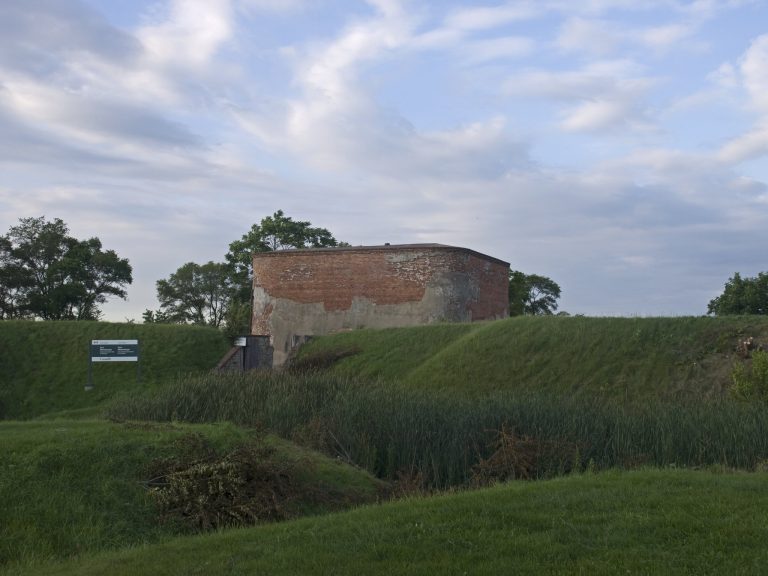
The later Army post stood outside the old fort’s walls and followed a military-camp plan rather than the form of a stone fortress. Its grounds included a 1,000-yard rifle range and had access to rail lines and the industrial areas of Niagara Falls and Buffalo. Most nineteenth- and twentieth-century military buildings were demolished in 1965 and 1966, and most barracks were removed after the Army left.
The Bottom
The Bottom was the flat riverside area below the fort. During the Revolutionary War era, it had taverns, stores, and brothels.
Father Millet memorial
A small memorial to Father Millet, a French Jesuit missionary who worked among Indigenous communities in New France, stands on the grounds.