Dundurn Castle: A Regency Country House in Hamilton, Canada
Site at a Glance
- Country
- Canada
- Primary era
- Modern
- Eras represented
- Modern
- Civilizations
- British
- Site type
- Domestic
- Remains
- Castle
On this page11 sections
History
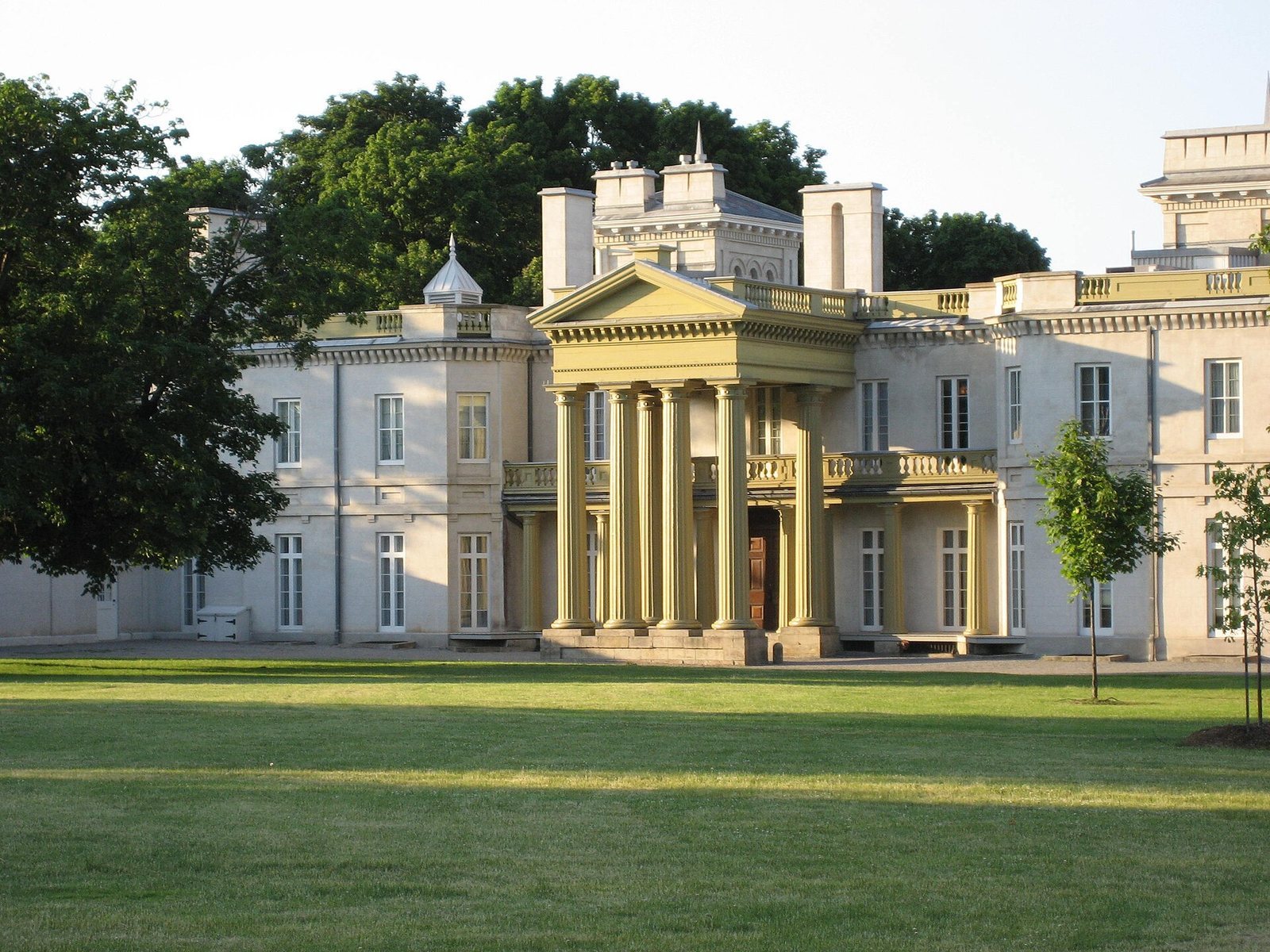
Dundurn Castle is a country house in Hamilton, Canada, commissioned by Sir Allan Napier MacNab and completed in 1835 in the Regency style, associated with early nineteenth-century Britain, with neoclassical forms inspired by ancient Greek and Roman architecture. MacNab, a Canadian political figure and baronet (a hereditary British title below a baron), commissioned architect Robert Charles Wetherell. Construction lasted three years and cost $175,000.
The park before the castle
During the War of 1812, a conflict between the United States and Britain fought partly in British North America, nine men convicted of treason were executed near present-day Inchbury Street at the eastern edge of the park. The executions became known as the Bloody Assize. An assize was a court session, often dealing with serious criminal cases, and this event was the largest mass hanging in Canadian history. A curved plaque commemorating the executions was unveiled at Fieldcote Museum in Ancaster on 20 July 2014, the event’s bicentenary. The museum is outside the Dundurn grounds.
MacNab’s house and public life
MacNab acquired the Burlington Heights property from Richard Beasley, an early Hamilton settler whose financial difficulties led him to sell. The house was built over the foundations of Beasley’s brick home. In 1855, columns and a portico were added as MacNab’s household prepared for the wedding of his daughter Sophia. Dundurn became known for its large entertainments, attended by guests including Sir John A. Macdonald, later Canada’s first prime minister, and Edward VII, king of the United Kingdom from 1901 to 1910. MacNab served as premier of the Province of Canada from 1854 to 1856. The Province of Canada was a British colony that existed from 1841 to 1867.
After MacNab
MacNab was first buried in the park in 1862, between Dundurn Castle and Castle Dean near the corner of Locke and Tecumseh Streets. His remains were moved in 1909 to Holy Sepulchre Cemetery in western Hamilton. His grave was unmarked until 1967, when the Canadian Club of Hamilton placed a bench and gravestone there. After MacNab’s death, the estate also served as an institution for deaf people. Donald McInnes acquired it in 1872 and later sold it to the City of Hamilton, which bought the property in 1899 for $50,000.
The estate in the twentieth century
An aviary opened on the grounds in 1928 and was later moved to Westdale. In 1931, parts of the entrance gates were transferred to Chedoke Golf Club. During the 1970s, an outbuilding was added to the park when York Street was widened into York Boulevard, and the Hamilton Military Museum moved into it. A German artillery piece, kept as a trophy from the First World War in the park’s southeastern part, was removed in the mid-1980s.
In the late 1960s, Dundurn was restored as a Canadian Centennial project, with its rooms arranged to represent their appearance in 1855, when MacNab was at the height of his career. The City of Hamilton owns the property, which now operates as a public museum. Dundurn was designated a National Historic Site of Canada in 1984, recognizing its national historical importance. Other protections include an Ontario Heritage Trust easement dating to 1983, a legal agreement intended to safeguard heritage property, and a municipal designation under Part IV of Ontario’s Heritage Act, which allows municipalities to designate individual properties, dating to 1977. A bagpipe piece in the Scottish dance-tune form known as a strathspey was also composed in the castle’s honour.
Remains
The estate covers 40,469 square metres and brings together the main residence, service buildings and park features.
The house and service buildings
The two-storey residence contains 40 rooms and covers 1,700 square metres. Its original conveniences included gas lighting and running water. The columns and portico added to the house form part of its exterior. The estate’s service buildings include servants’ quarters and stables.
Park features and outbuildings
Gates, folly and performance spaces
The park’s entrance gates originated in England, and their stone pillars were cut from stone quarried at Dundas. A folly, a deliberately picturesque or whimsical estate structure, stands east of the house. Local legend tells of tunnels linking the castle with different parts of the estate, with one entrance said to be through the folly. The structure has also been mistaken for a theatre, laundry, boathouse, storeroom, office or chapel for MacNab’s Catholic wife. The separate Cockpit Theatre has hosted outdoor performances. A covered pavilion once sheltered picnickers, and a walled garden was later created in its place.
Hamilton Military Museum
The Hamilton Military Museum occupies an outbuilding in the adjacent park. Its displays cover the War of 1812, the Rebellions of 1837, the Boer War, both World Wars and women’s roles in the military. The collections include uniforms, medals, weapons, photographs and other military objects.
Garden
A cultivated garden near the eastern edge of the park supplies produce for the castle kitchen, with surplus donated to a local food bank.