Petra Fortress: A Byzantine Stronghold in Georgia
Site at a Glance
- Country
- Georgia
- Primary era
- Medieval
- Eras represented
- Medieval, Early Modern
- Civilizations
- Byzantine, Ottoman
- Site type
- City
On this page10 sections
History
Petra Fortress is the remains of a fortified town in Georgia, generally identified with the ruins at Tsikhisdziri on the eastern Black Sea coast, though scholars have disputed the identification. The Byzantine stronghold was established in 535 to reinforce Roman authority in Lazica, a kingdom on the southeastern Black Sea coast. It became an important political and commercial center in western Georgia.
Early fort and Byzantine foundation
The Byzantine foundation expanded an earlier small fort. Treasure excavated at Petra led archaeologist N. Khoshtaria to suggest that the site had served as the residence of a Georgian regional governor during the first centuries AD.
Emperor Justinian I ordered the new fortress, and Roman official John Tzibus is credited with its foundation. The town was named Petra Pia Justiniana in the emperor’s honor. Its position gave it control over a coastal road linking western Georgia with Byzantine provinces, Iran, and Armenia, as well as shipping from Byzantine lands toward the eastern Black Sea. Historian Simon Janashia compared Petra’s place in Byzantine-era western Georgia with Tbilisi’s.
Tzibus imposed tight controls on imports into Lazica, including salt and luxury goods. The resulting trade monopoly worsened relations between Rome and the Lazi. King Gubazes II secretly sought help from the Sasanian Empire, and its ruler Khosrow I invaded in 541. The conflict that followed, the Lazic War of 541–562, was a struggle between the Eastern Roman Empire and Sasanian Persia for influence in the region.
Petra during the Lazic War
Khosrow’s forces first failed to take Petra by direct assault. They then entered through a tunnel built in secret and destroyed the fortress towers, forcing the Roman defenders to surrender. Khosrow seized Tzibus’s wealth, and Tzibus was killed in battle. The city’s Roman inhabitants were treated considerately.
In 548, Justinian sent a force under the Roman commander Dagisthaeus, joined by Lazi opposed to Sasanian rule, to recover Petra. The besiegers defeated two Sasanian relief armies, but the maneuvers of commander Mihr-Mihroe made their position untenable. Dagisthaeus withdrew in 549 without retaking the town. A Roman–Lazi force led by Bessas began another siege in 551. Petra fell after more than a year, and Bessas demolished its fortress to prevent its return to Sasanian control. Settlement continued into the seventh century and later, while the fortifications remained in use and were repeatedly repaired.
Church, medieval, and Ottoman periods
Petra was also a bishop’s center. Its church jurisdiction belonged to the province led from Phasis and fell under the Patriarchate of Constantinople. At one time, it covered Lower Guria, Adjara, and the Rize region. Bishop John of Petra attended a church council in 692. The bishop’s center appears to have ended by the tenth century, when it moved to Khino Tsminda in Adjara.
Under the united Georgian monarchy, the town apparently no longer existed, although the fortress retained importance. In the 1470s, Venetian envoy Ambrosio Contarini described a small town at the site and rendered its name as “Kaltikhea.” The Ottomans captured and fortified Tsikhisdziri in the 1760s. During the Crimean War they placed 25 cannons there. Battles took place near Tsikhisdziri during the nineteenth-century Russo-Turkish wars, but the fortress was not captured. The 1878 Treaty of Berlin returned the territory to Georgia.
Identification and archaeological study
The identification of Petra with Tsikhisdziri was first proposed by Dositheos II, the Greek Orthodox patriarch of Jerusalem, after his visit to western Georgia in the 1670s. Historians Marie-Félicité Brosset and Dimitri Bakradze supported the proposal, and Simon Janashia developed its scholarly basis in 1949. Scholars Simon Kaukhchishvili and Guram Grigolia disputed it.
Swiss archaeologist Frédéric Dubois de Montpéreux studied the site in the 1830s. Survey excavations followed in 1934 under Simon Janashia and in 1953 under N. Khoshtaria. Archaeological work resumed in 1987, and the Petra Fortress Museum Reserve was established in 1989. The site is protected as a cultural monument of national importance in Georgia and as the Tsikhisdziri–Petra Archaeological and Architectural Museum Reserve.
Remains
Fortifications and site layout
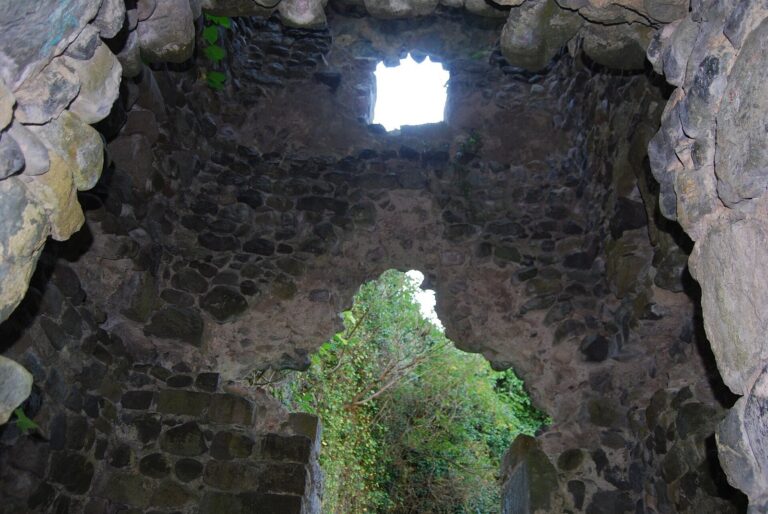
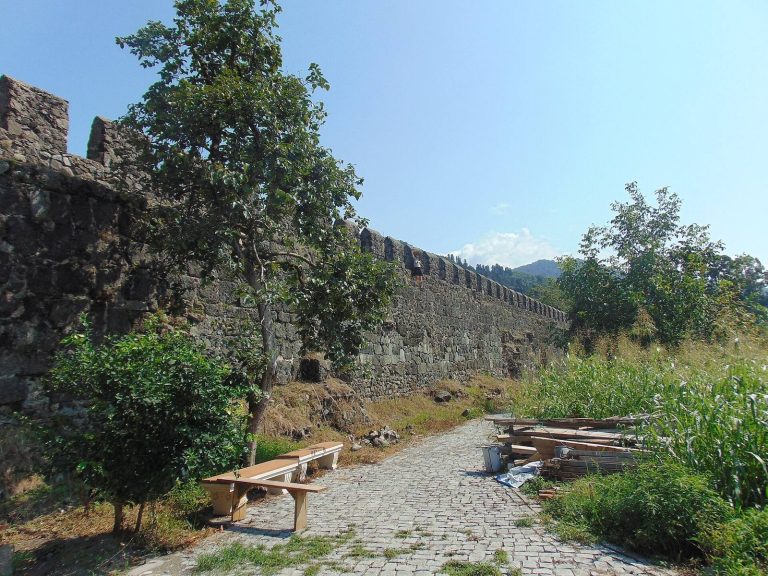
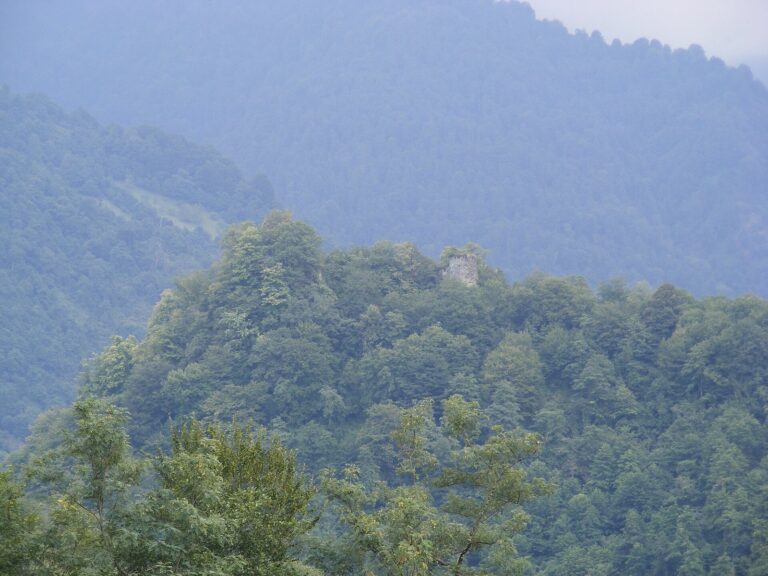
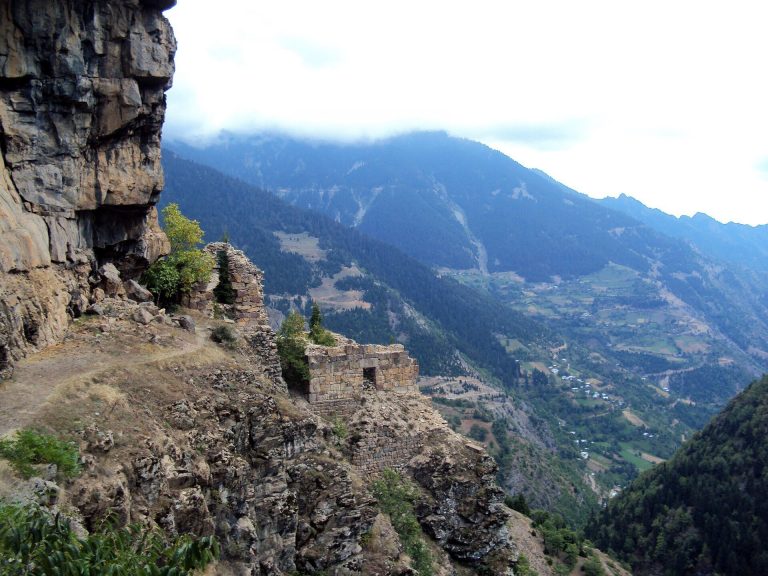
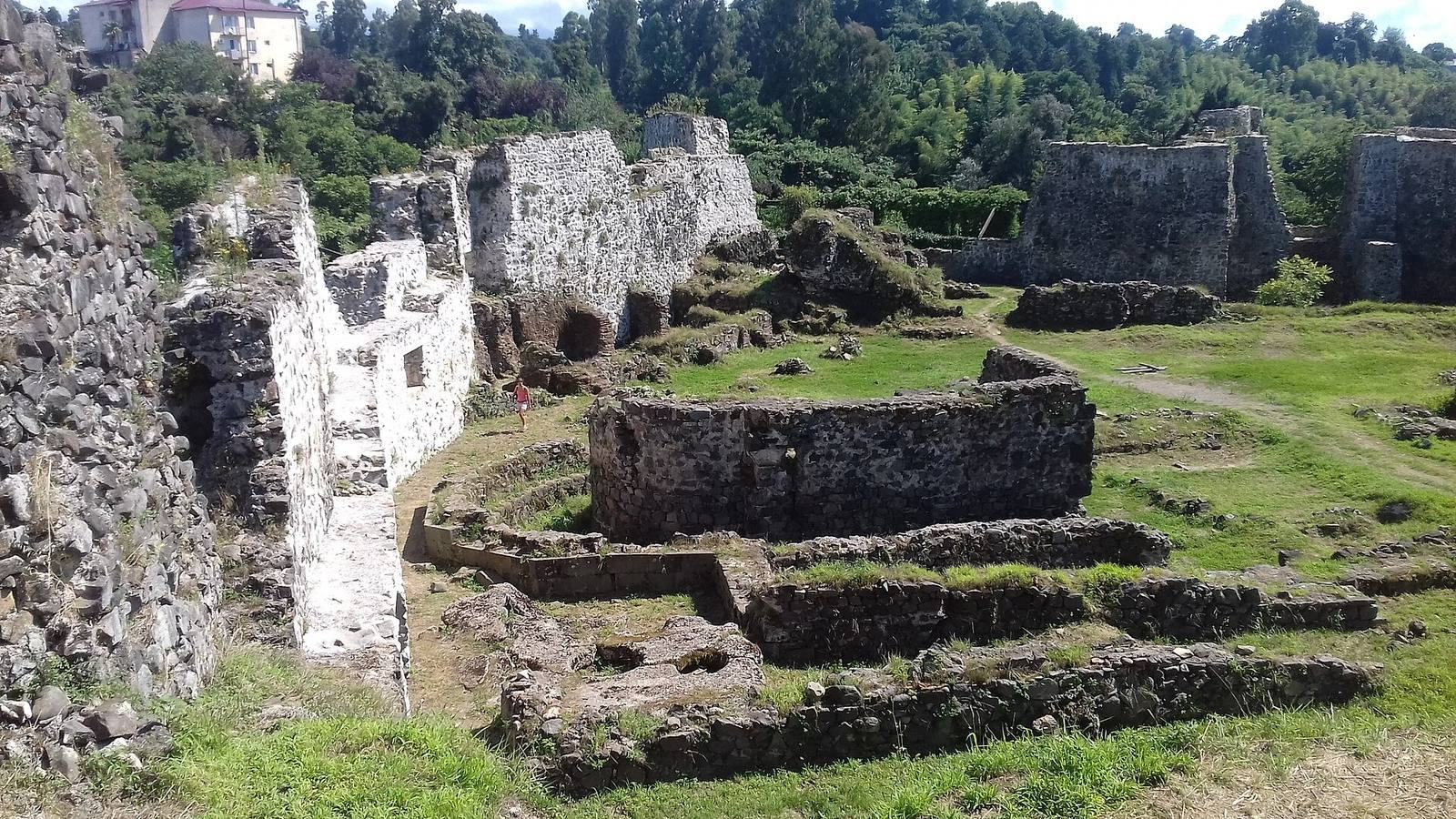
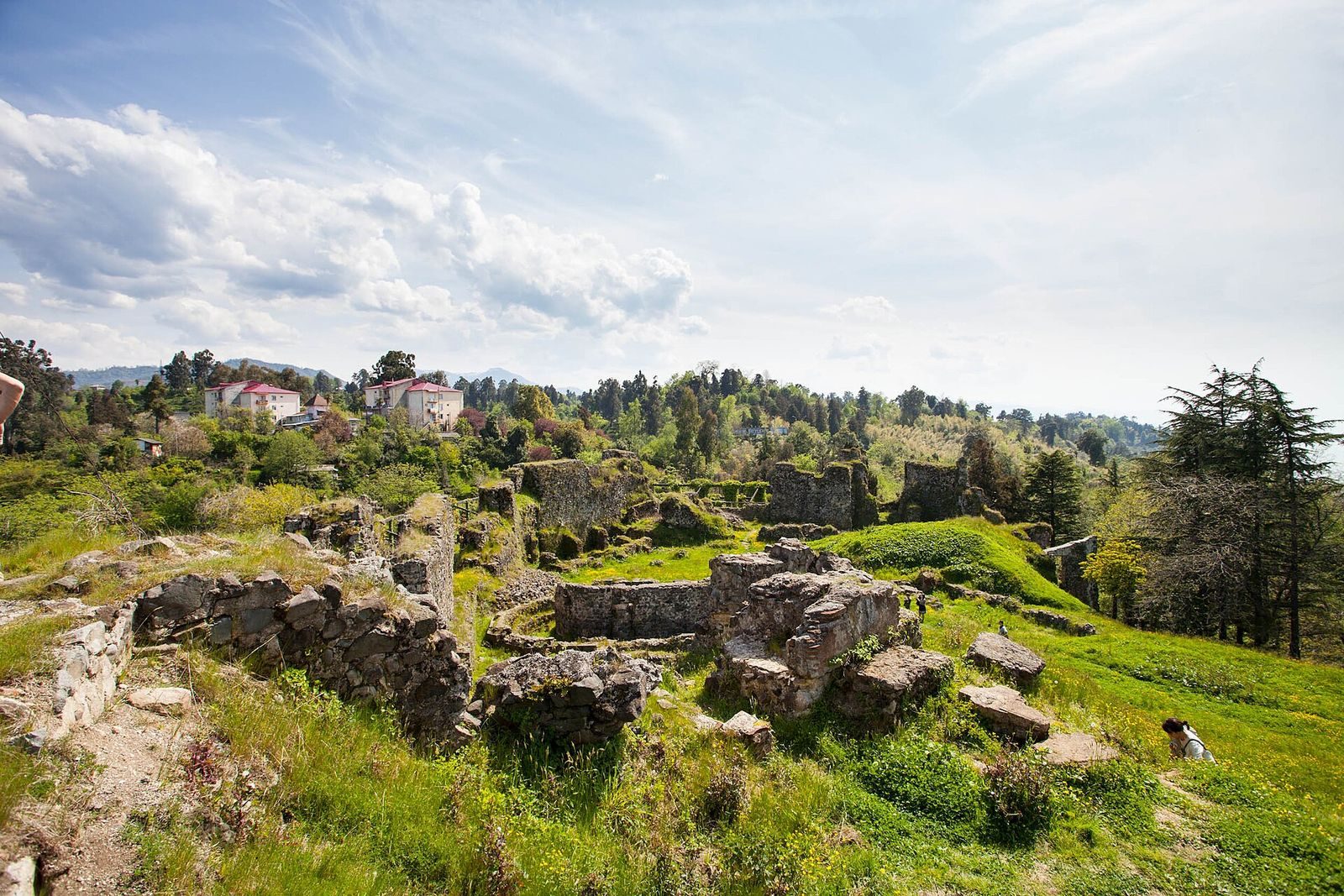
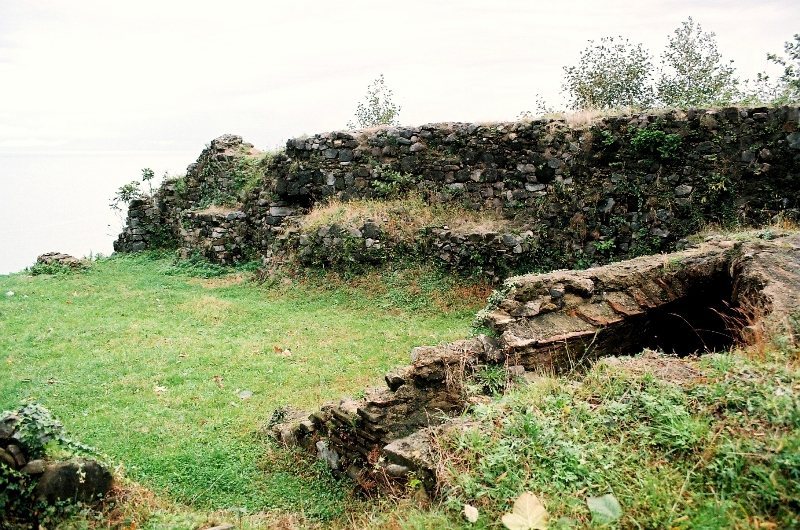
The archaeological complex covers about seven hectares and includes an inner fortress, an outer town, and settlement remains. Ruins of the inner fortress occupy two neighboring rocky hills beside the sea, in an area about 200 meters long and 100 meters wide. The high fortified area stood on a rocky coastal hill, with the sea, cliffs, and rugged ground forming natural protection. Land access was limited to a narrow, rocky strip of level ground, defended by a wall with two towers. The name Petra means “rock” in Greek and refers to this coastal setting. The western part of the fortress was destroyed in the nineteenth century during construction of the Baku–Batumi railway.
Buildings within the fortress
Ruins inside the fortified area include a palace, an ancient bath, utility buildings, and quarters for soldiers. A water cistern and structures associated with the town’s settlement are also among the remains.
Church architecture
The church remains are associated with a sixth- to seventh-century basilica, a large church. A square structure believed to have been the cathedral stands about three to four meters from the inner fortress’s northeastern wall; its surviving walls rise to roughly 2.5 meters. The sixth-century basilica had three aisles, an entrance hall, a projecting apse, and a mosaic floor. It probably served as the bishop’s seat.
Burials and archaeological finds
More than 300 burials have been found near the settlement. A richly furnished burial discovered in 1908 contained a large crystal set in a gold frame, now held at the Hermitage. Finds from Petra span the Late Bronze Age, Hellenistic, Roman, and medieval periods. The museum collection ranges from the Bronze Age to the early Middle Ages and includes architectural pieces, mosaic fragments, ceramics, coins, a sacrificial altar, and materials from dwellings dated to the eighth–sixth centuries. It also contains remains of a fourth- to fifth-century building described as a villa, meaning a substantial residence or estate.