Gonio Fortress: A Roman Military Stronghold on Georgia’s Black Sea Coast



Site at a Glance
- Rating
- 4.5
- Popularity
- Medium
- Country
- Georgia
- Primary era
- Classical
- Eras represented
- Classical, Medieval, Early Modern
- Civilizations
- Byzantine, Ottoman, Roman
- Site type
- Military
- Remains
- Fort
On this page14 sections
History
Gonio Fortress, ancient Apsaros, is a fortified settlement in Georgia on the Black Sea coast at the mouth of the Chorokhi River. Its earliest archaeologically identified occupation dates to the eighth or seventh century BC, while a Roman fort was established probably in the AD 70s. The site controlled access to the Chorokhi and Adjaristskali valleys, linking the coast with the interior of southwestern Georgia and giving Apsaros a major strategic role.
Early Apsaros and Roman expansion
Classical tradition connected Apsaros with the Argonauts, the legendary Greek heroes who accompanied Jason in the quest for the Golden Fleece. One tradition placed the burial of Absyrtus, the son of King Aeetes and brother of Medea, at the site. Another held that Saint Matthias, the apostle traditionally chosen to replace Judas Iscariot, was buried within the fortress, although the location of his grave remains unverified.
Greek and Roman geographical accounts identify Gonio with ancient Apsaros. Pliny the Elder described a fortress at the mouth of the Absarus River, and Arrian visited the area in AD 134, recording both Apsaros and the nearby Acampsis River. The ancient branch of the river beside the fortress later dried up and became Gonio Lake.
Roman troops first reached the region around 63 BC during the conflicts involving Mithridates VI of Pontus. No remains at Gonio have been securely connected with that early Roman presence. A permanent Roman fort was established during the reign of Nero, probably in the AD 70s, after Rome incorporated the neighboring kingdom of Pontus. The first fort was smaller and faced toward the sea. It was probably abandoned after the rebellion led by Ancietus in AD 68–69. A larger fort was later built under Trajan, probably in connection with preparations for the Parthian War.
The Roman military center
During the second century AD, Apsaros became a major Roman military and civilian center in Colchis. Five cohorts were stationed there, and the fortress served as a base for controlling the coast and protecting routes from piracy. During Arrian’s inspection in AD 135, temporary legionary detachments, known as vexillationes, were present, including units associated with Legio V Macedonica and Legio XV Apollinaris.
The fort continued in use under Hadrian, when its defenses and headquarters were renewed. The commander’s praetorium, a residence and administrative headquarters, was built or expanded as a substantial complex, replacing an earlier bathhouse. After an earthquake damaged it, a barracks complex took its place through at least two building phases. A further earthquake in the 250s destroyed the fortress. Reconstruction began soon afterward, but the rebuilt walls were largely left at foundation level. Apsaros was then abandoned, probably because strategic conditions changed or because of conflicts with the Borani.
Stamps and inscriptions indicate that later Roman units may have included a cohors milliaria civium Romanorum, a cohort of approximately one thousand soldiers, and possibly a Cohors Aurelia civium Romanorum. An inscription names the officer Numerius Marcius Plaetorius Celer as praepositus, or commander, of a specialized unit connected with the bridge at Apsaros.
Byzantine, Georgian, and Genoese phases
After the Roman withdrawal, the fortress was occupied again during the sixth century. This followed the Roman-Persian wars and the stabilization of the frontier between Colchis and Lazica under Justinian I. The Byzantine Empire, the eastern continuation of the Roman Empire centered on Constantinople, continued to describe Apsaros as a city and military-administrative center. A sixth-century account identifies it as the place where the killers of King Gubaz were imprisoned, while a seventh-century source calls it a frontier camp responsible for protecting the imperial border.
After Byzantine rule, the fortification came under the Georgian kings. The name Gonio emerged after the twelfth century. From the thirteenth century, the territory belonged administratively and ecclesiastically to Guria and marked the beginning of the Diocese of Anchisi. A Genoese trading station operated nearby during the thirteenth and fourteenth centuries. This type of overseas commercial establishment was known as a faktorei, and some restoration or rebuilding at the fortress is attributed to the Genoese period.
Ottoman and modern history
In 1547, the Ottoman Empire conquered Chaneti, including Gonio, reinforced the fortress, and used it as a base for operations against the Principality of Guria. The Ottoman Empire was the imperial state that controlled much of southeastern Europe, Anatolia, and the eastern Mediterranean from the late medieval period into the early twentieth century.
Gonio changed hands during later Ottoman conflicts. The sultan granted it to Teimuraz I in 1617–1618. Don Cossacks captured the fortress in 1640, but the Ottomans recovered it the following year. In 1672–1673, a small janissary garrison and two cannons were stationed there. Janissaries were professional infantry soldiers of the Ottoman sultan’s army. By the late seventeenth century, Gonio was held by a Muslim branch of the Tavdgiridze family.
Ottoman control ended in 1878, when the San Stefano settlement transferred Adjara to the Russian Empire. Gonio therefore passed through Roman, Byzantine, Genoese, Ottoman, and Russian spheres of control. Archaeological reconnaissance in 1959 exposed substantial buried remains. An expedition in 1961 investigated a large structure west of the fortress, provisionally interpreting it as an ancient hippodrome, and discovered a major iron-metallurgy center in the surrounding area.
Investigations at the fort continued from 1995 through Georgian and Polish-Georgian projects, with photogrammetric, topographical, and geophysical surveys adding non-invasive evidence in 2012. Gonio has functioned as a museum-reserve since 1994, with exhibitions covering material from antiquity through the 1880s. It is a nationally significant immovable cultural monument of Georgia.
Remains
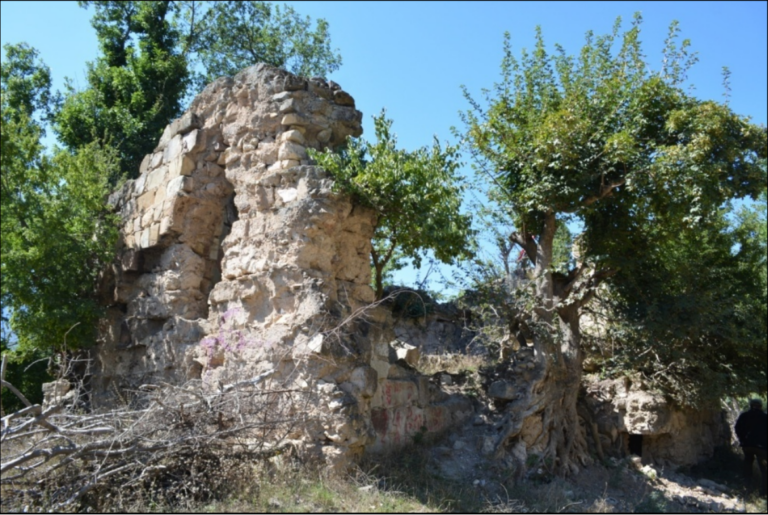
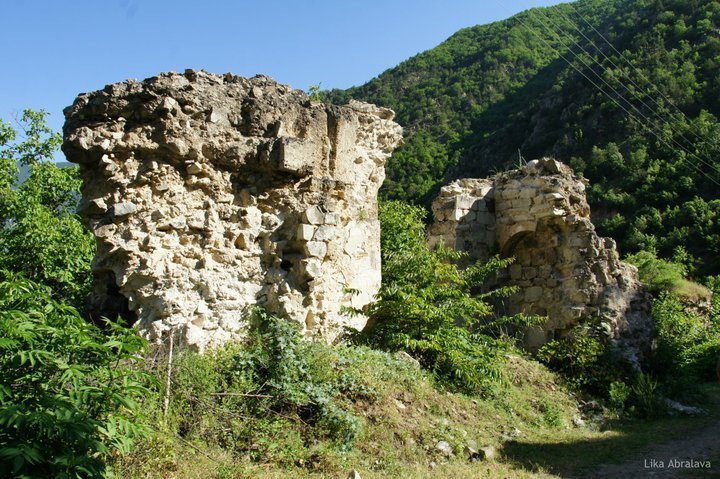
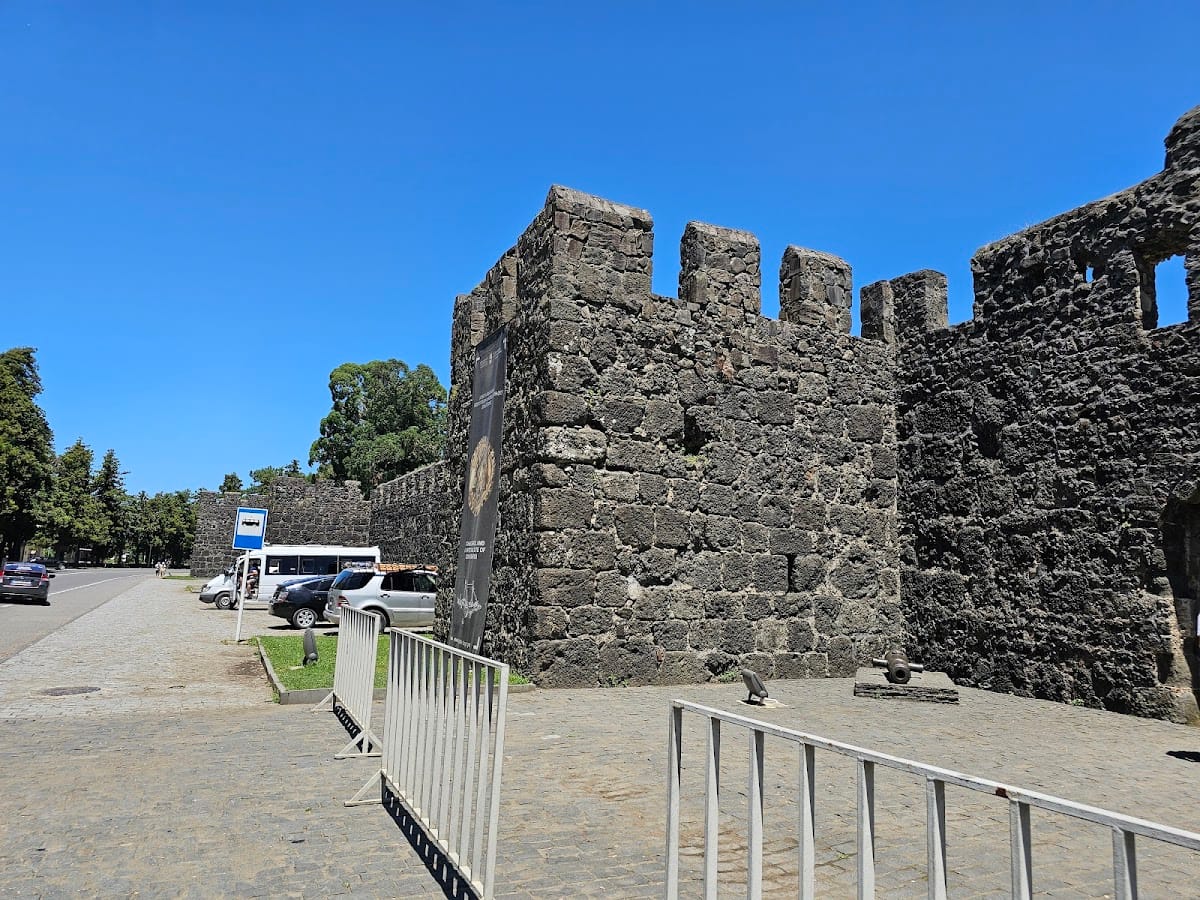
Gonio Fortress occupies a rectangular enclosure measuring approximately 228 by 195 meters and covering about 44,460 square meters. The surviving complex is ruined but well preserved in its overall form. Its walls contain several construction layers, from massive dressed stone in the lower courses to irregular river-stone rebuilding above. Roman military, administrative, residential, water-management, and bathing structures survive within the enclosure, while associated civilian and industrial remains extend into the surrounding area.
Fortifications and entrances
Walls and towers
The circuit wall was originally equipped with 22 rectangular towers, of which 18 survive. The four corner towers are larger than the intermediate and gate towers, and each tower contains an internal stone staircase. The oldest lower masonry consists of carefully cut rectangular blocks and massive dressed boulders, often about one meter long, 80 centimeters high, and 70 centimeters thick. This lower section rises about five meters and reaches seven meters at the corners. Its upper portion is approximately 1.5 meters thick and is bonded with lime mortar.
Higher sections preserve later rebuilding. A layer of irregular river stones belongs to subsequent construction, including Ottoman work in the mid-sixteenth century, while another construction layer dates to the Byzantine period of the sixth and seventh centuries.
Gates and tunnels
An earlier description assigns four gates to the fortress, while on-site examination and another historical account identify two entrances, one on the south and the principal entrance on the west. The western entrance lies between projecting towers, is deeply recessed into the enclosure, and has a rectangular opening. A large dressed stone above it was traditionally said to have carried an inscription. The stone was reportedly removed in 1878. At the beginning of the twentieth century, the entrance still had an elaborately carved door; by 1915, the door had been removed, leaving the entrance in ruins. Tunnels remain beneath the fortress.
Roman buildings and infrastructure
Headquarters and command complex
The Roman enclosure contained the principia, the headquarters building of the fort, and the praetorium, the commander’s residence and administrative headquarters. The Hadrianic praetorium covered about 1,200 square meters and included private baths, a large peristyle, or colonnaded courtyard, and at least three rooms with mosaic floors. The principia had a renewed tiled floor. A fragment of a praetorium mosaic is among the finds displayed in the site museum.
Granary, baths, and water systems
The earliest Roman fort included a military granary and two foundation deposits. A bathhouse belonged to the Trajanic phase, while a larger public bathing complex was built west of the headquarters and commander’s residence. Bath mosaics cover a broad area and use alternating pinkish and dark stones arranged in checkerboard and diamond patterns.
Excavations have also revealed Roman barracks, reservoirs, wells, drainage and sewage systems, water conduits, paved surfaces, and other structures dating from the first to the third centuries AD. A large mosque of comparatively late date stands in the central courtyard.
Associated settlement and finds
The civilian settlement linked with the fortress probably included a theater and hippodrome. A ditch north of the enclosure appears to have surrounded the ancient harbor on three sides and was probably constructed during the Trajanic or Hadrianic period. In the surrounding area, a wine press supplied the Roman garrison while it operated. The press was destroyed during the Roman army’s withdrawal in the period of conflict with the Borani.
Excavated material includes glassware, Roman coins, ceramics, amphora fragments, terra sigillata, roof and building tiles, and objects associated with Byzantine and Ottoman garrisons. Two hoards from the wider Apsaros area contained gold objects and other valuables, including a chest filled with gold. Coins in one group range from the reign of Tiberius to Caracalla, while another extends from Trajan to Severus Alexander. A bronze candlestick inscription and stamped tiles provide further evidence for the Roman garrison.
Early Christian remains
At Akhalsofeli, a monumental sixth-century church measures approximately 24 meters in length and up to 18 meters in width. Its surviving remains are comparatively well preserved and form part of the wider archaeological landscape associated with Gonio and ancient Apsaros.