Fort Reef: A Russian Coastal Fort on Kotlin Island
Site at a Glance
- Country
- Russia
- Primary era
- Modern
- Eras represented
- Early Modern, Modern
- Civilizations
- Russian
- Site type
- Military
- Remains
- Fort
On this page15 sections
History
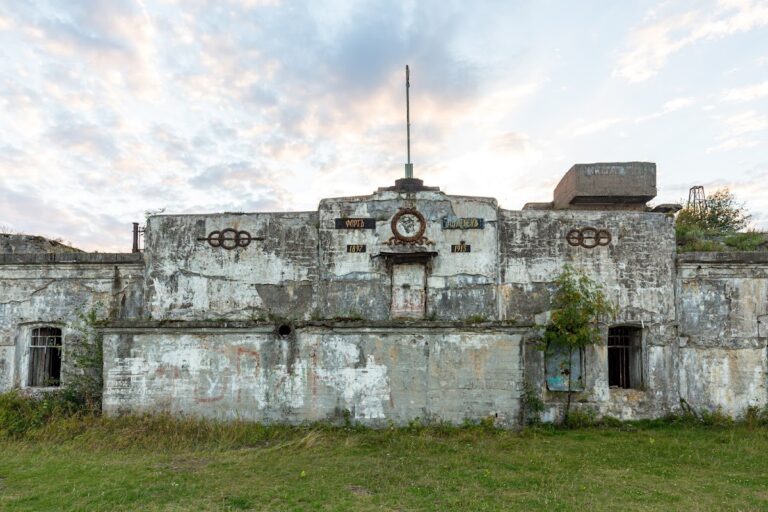
Fort Reef is a coastal fort at the western end of Kotlin Island in Russia, part of the Kronstadt Fortress, the coastal defense system protecting the approaches to Saint Petersburg. The Russian Empire built the present fort between 1909 and late 1912 as a major strongpoint in the modernization of Kronstadt’s defenses. Its site had served as a battlefield and military position long before the permanent fort was constructed.
Early defenses and the experimental range
During the Northern War, the prolonged conflict between Russia and Sweden from 1700 to 1721, Swedish landing forces fought at this location in 1704 and 1705. Before the fighting, troops under Russian commander Fedot Semyonovich Tolbukhin had raised two earthen gun batteries, groups of gun positions. The heaviest battle came on 14 July 1705, when as many as 400 Swedish soldiers were killed.
After the campaigns, Vice Admiral Cornelius Cruys proposed a strong defensive position in western Kotlin as a secure base for Russian forces on the island. A small fortress dedicated to St. Alexander was built in 1706 and later became known as Alexander-Shanets. During another war with Sweden, field defenses were built here in 1788 under military engineer Lieutenant Colonel Prevo de Lumilian. Emperor Paul I ordered their demolition in 1801. Their forward position helped shape the view that an enemy might seize weak outer defenses and use them as a bridgehead.
The arrival of high-explosive shells in the 1880s led the Imperial Russian War Ministry to test concrete fortifications made with Portland cement. Work on the experimental range began in 1889 under military engineer Vladimir Alexandrovich Kukharsky; military engineer Leonid Petrovich Kapitsa took charge in autumn 1892. Construction continued actively through 1897. Firing trials started in 1890, reached their most intensive phase through 1894, and then declined. The trials became an important episode in the development of Russia’s permanent fortifications.
Construction of Fort Reef
A temporary battery was established at the range in 1904 during the Russo-Japanese War, fought by Russia and Japan in 1904–05. It was disbanded after six years as construction of the permanent fort got underway, and most of its temporary structures were removed. In 1909, a commission chaired by Lieutenant General Leonid Konstantinovich Artamonov, chief of Kronstadt, drew up a plan to strengthen the Kronstadt Fortress in response to lessons from the war. Fort Reef was selected as one of three principal strongpoints, alongside Krasnaya Gorka and Ino.
The experimental range was closed, and its surviving works were repaired or partly rebuilt for the new fort. Lieutenant Colonel Baranov prepared the first design in August and September 1909; Colonel Savrimovich produced two more, in February and July 1910. Construction began in August 1909 and was completed in late 1912. Emperor Nicholas II visited the works on 19 July 1910. By imperial order, the battery was named Alexandrovskaya on 27 December 1911, in honor of Alexander III. The name Reef returned on 13 April 1917, after the February Revolution, and the designation Fort Reef became established after 1917.
Revolution, Soviet period, and wartime service
On 18 August 1919, the fort’s guns helped repel an attack by British torpedo boats during the British torpedo-boat attack on Kronstadt. During the Kronstadt uprising of March 1921, a revolt against Bolshevik rule, most of the garrison left across the ice of the Gulf of Finland for Finland on the evening of 17 March. A small artillery detachment remained to cover their departure, then left during the night. About 8,000 people went to Finland, and most of those leaving the island crossed from the reef.
The fort’s name changed several times under Soviet rule. It became Fort Zinoviev on 24 November 1924, was identified by the letter R in 1926, and received the name Fort Komsomolsky on 21 January 1933. After the front lines had stabilized in autumn 1941, the fort was far from the enemy. In winter 1941–42, two of its 10-inch guns were moved to central Kotlin. They fired on German forces near Peterhof and Strelna and later took part in Operation January Thunder in early 1944, which ended the Siege of Leningrad.
Postwar use and preservation
After the war, the fort’s 10-inch and 6-inch guns were withdrawn from service. Four 130-mm guns were installed on the central battery in 1950, forming Battery No. 235. That battery was disbanded in 1973, ending the fort’s original military role. Warehouses and the 547th communications center of the Leningrad Naval Base later used the site. The military intermittently left and returned during the 1990s and 2000s, then departed permanently in 2014. After three years of abandonment, the fort was leased long-term in May 2017 for development as a cultural and recreational complex, including an interactive exhibition about the 1921 uprising.
Fort Reef has been a federal-level cultural heritage site since 2001. Since 1990, it has also been included in the UNESCO World Heritage property Historic Centre of Saint Petersburg and Related Groups of Monuments, within the group of defensive installations and forts of Kronstadt and Kotlin Island.
Remains
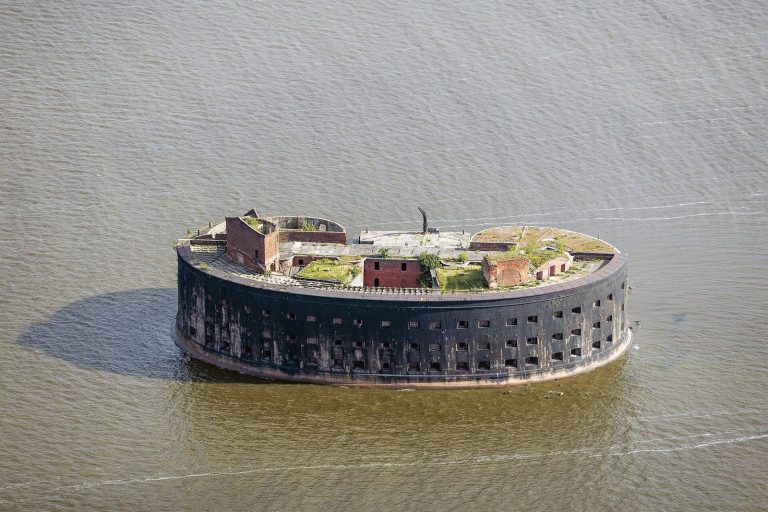
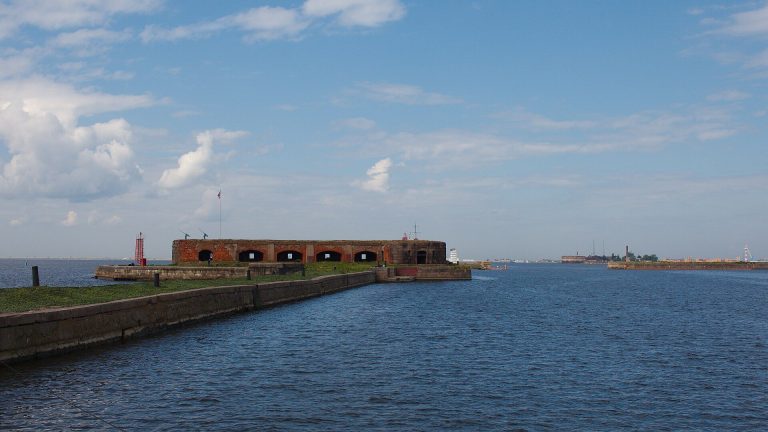
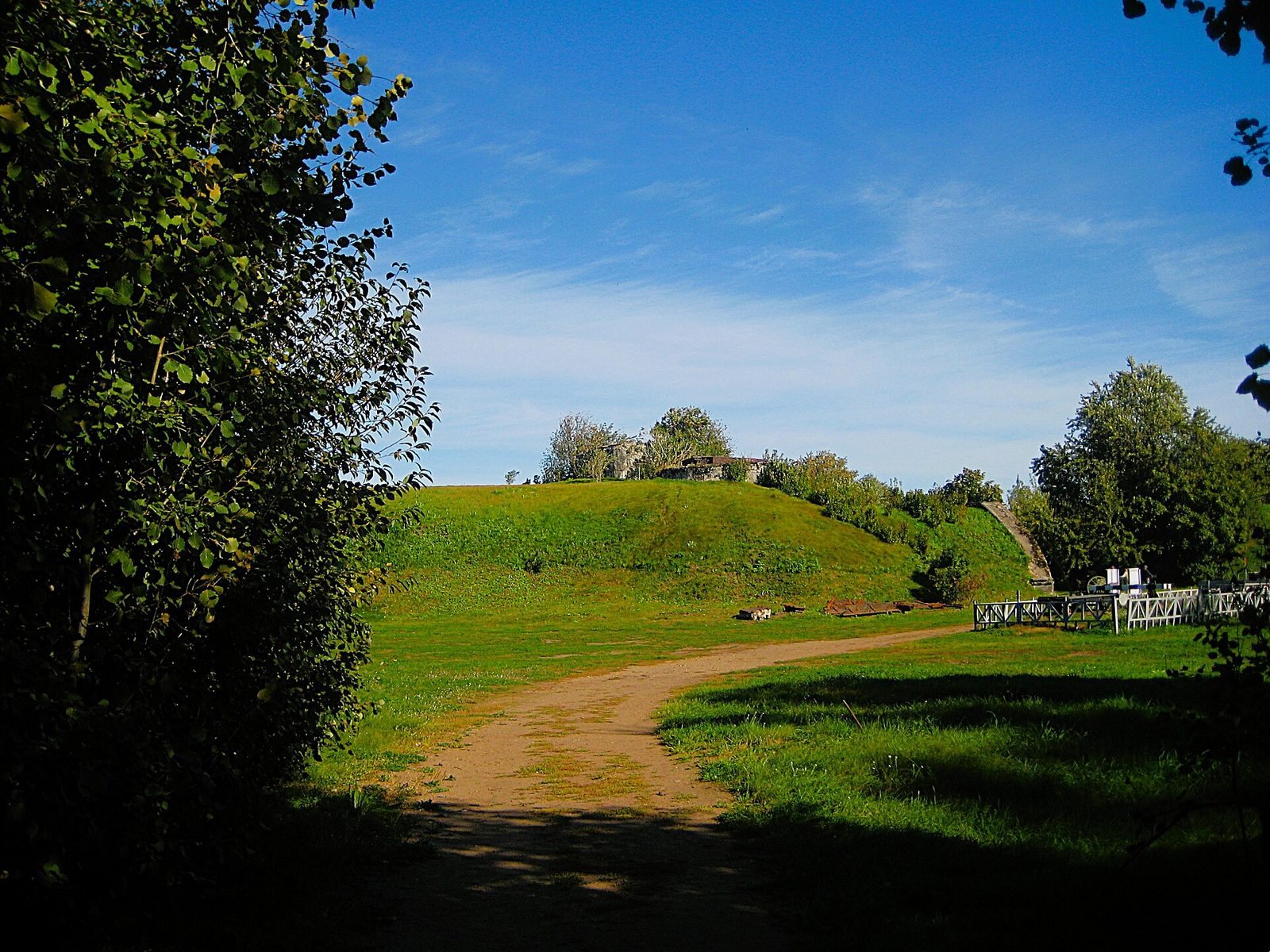
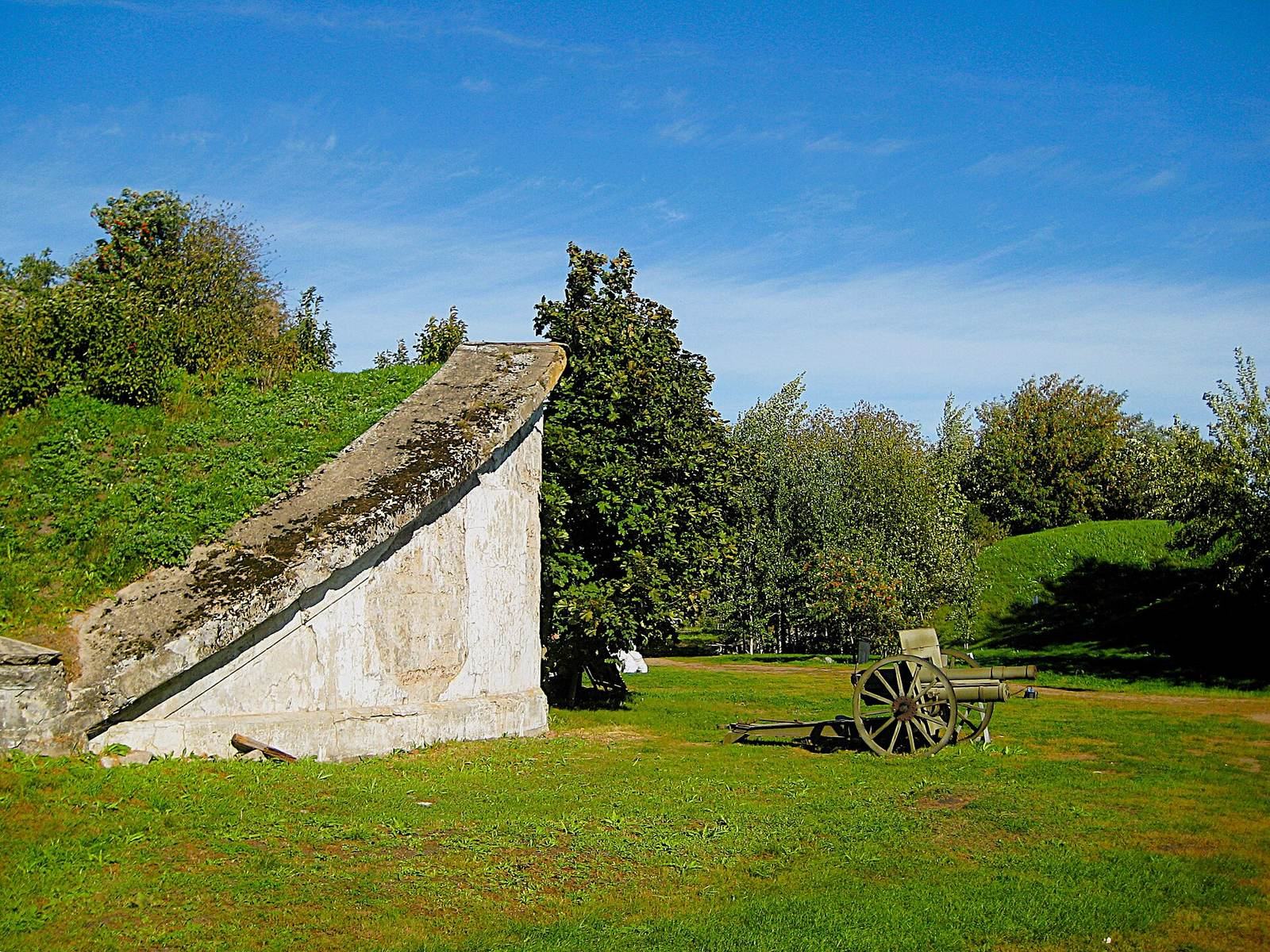
The fort’s concrete defenses center on a main battery flanked by two smaller gun batteries. A defensive wall enclosed the front and sides, linking the gun positions, barracks, searchlight facilities, and later observation and command structures. Earlier test works and parts of the temporary battery also survive within the site.
Principal fortifications
The central battery held four 10-inch guns on Durlacher gun mounts. On either side stood a battery of four 6-inch Canet guns. Two concrete barracks housed officers and enlisted personnel. A concrete outer defensive wall, rising as much as 3.5 m above the usual water level, enclosed the front and flanks. The flanks also had open positions for 3-inch guns and machine guns. In 1950, the former 10-inch battery was fitted with circular concrete emplacements for four 130-mm guns.
Searchlights and observation
Four concrete wells were built to raise searchlight towers, with an additional searchlight on each flank. The lights were kept in shelters and moved to their fighting positions on narrow-gauge railway sections. Each gun battery had an instrument shelter with an armored roof for rangefinding equipment. These instruments estimated distance by comparing observations taken from separated points. During the First World War, three concrete observation posts for optical rangefinders and a group command post were added.
Earlier fortifications and test works
1788 field defenses
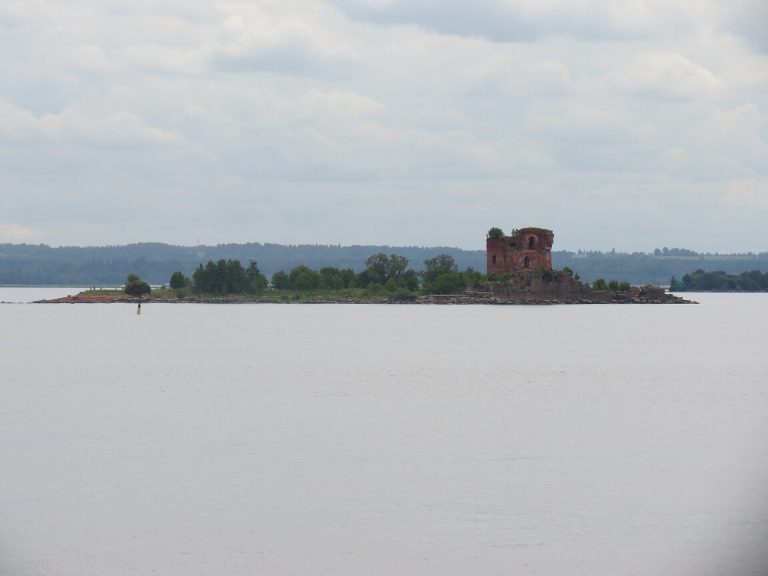
The field defenses included St. Catherine’s Redoubt, a detached field fortification armed with 10 guns, about 300 m west of the present fort at the site of a shoal. St. Peter’s Redoubt stood to its east, near the area later used for experimental works.
Experimental range
The range, built from 1889 through 1897, included casemates, or protected chambers, as well as galleries, barriers shielding positions, and armored closures. Four retractable armored turrets were constructed. One hydraulic turret survives in heavily reconstructed form.
Temporary battery
The temporary battery’s eight 9-inch mortars were arranged in a line along the spit’s north shore. Its north rampart contained shelters and four concrete casemates. Measures to protect the garrison from blast and fragments were added in 1905. The temporary works were later removed, while the four casemates remain.
Later military adaptations
Interwar defenses
Three machine-gun pillboxes, small fortified firing positions, were built in 1932 to defend the fort in all directions. In 1938 and 1939, a battery of four 45-mm 21-K guns was constructed on each flank.
Wartime and postwar alterations
The two 10-inch guns transferred from the fort in 1941–42 were installed on concrete foundations near the German Cemetery in central Kotlin. Battery No. 235’s command post occupied the north part of the former enlisted men’s barracks, and a reinforced-concrete tower for a radar station was built on the barracks roof. The fort is in unsatisfactory condition. Vandalism during its abandonment caused the loss of many original fittings, including armored doors and shutters.