Sanctuary of Greccio: A Franciscan Hermitage and Nativity Shrine
Site at a Glance
- Country
- Italy
- Primary era
- Medieval
- Eras represented
- Medieval, Early Modern, Modern
- Civilizations
- Italian, Papal States
- Site type
- Religious
- Remains
- Monastery
On this page18 sections
History
The Sanctuary of Greccio is a Roman Catholic Franciscan hermitage, a religious retreat of the Franciscan order, in Greccio, Italy. Its foundation is attributed to Francis of Assisi, the medieval Italian friar who founded the Order of Friars Minor, and it is closely associated with the living reenactment of Jesus’s birth that he arranged here in 1223. The sanctuary belongs to the Diocese of Rieti and is one of four Franciscan sanctuaries in the Holy Valley of Rieti, alongside Fonte Colombo, the Sanctuary of the Forest, and Poggio Bustone. It is described as the oldest of the four and the only one that already had buildings for friars during Francis’s lifetime.
Francis and the Greccio tradition
The date of Francis’s first visit is uncertain. Franciscan tradition places it in either 1209 or 1217, and his presence around that time is considered probable. Tradition says that he first lived in a modest hut among the woods on Mount Lacerone, above the present sanctuary, and preached in Greccio. His preaching impressed the local feudal lord, Giovanni Velita, who encouraged him to stay.
A local legend tells that Francis asked a child to throw a burning brand to choose his place of settlement. The brand flew to a steep rock face on land belonging to Velita. Francis then made his home in a cave there, which became the first nucleus of the sanctuary.
Francis’s presence at Greccio is established for 1223. With Velita’s encouragement, he arranged a living Nativity scene, a representation of Jesus’s birth using participants, on Christmas Eve in the cave where he lived. The thirteenth-century Franciscan biographer Thomas of Celano describes an empty manger, an ox and a donkey, and a Mass at which Francis, dressed as a deacon, read the Gospel. Another tradition says the infant figure came miraculously to life.
Greccio became associated with the first live Nativity reenactment, and the practice later spread throughout the Christian world. The sanctuary and the town also acquired an association with Bethlehem. A small community of Francis’s followers formed soon after 1223, and the first buildings were raised at the site of the reenactment. Francis returned in late September 1224 and stayed until 1226, leaving about six months before his death.
The Franciscan community and its early churches
On 11 August 1246, three of Francis’s companions met at Greccio to compose the Letter of Greccio, an introduction to their biography of him. Giovanni da Parma, a minister general of the Franciscan order, lived in an associated cave in ascetic penance from 1257 to 1289. Francis also used a cell at the sanctuary for solitary prayer.
Soon after Francis’s canonization, a church was built around the cave where the Nativity reenactment had taken place. Constructed between July 1228 and February 1229, it became known as the Church of San Francesco. The Dormitory of San Bonaventura came into use after the earlier monastery was discontinued, around 1260–1270, and served the friars until 1915. Tradition places its construction in the period when Bonaventure was minister general of the Franciscan order.
Later development and continuing associations
In 1712, Pope Clement XI commissioned a small chapel on Mount Lacerone at the place traditionally associated with Francis’s hut. In 1889, the chapel was incorporated into a shepherd’s house. In 1906, an upper church replaced a sixteenth-century portico. After the Second World War, the complex was enlarged with a plaza and a larger church, the Church of the Immaculate Conception, built in 1959.
Pope John Paul II visited in 1983, becoming the first pope to visit the sanctuary. Pope Francis came in 2016 and 2019; during his 2019 visit, he presented the apostolic letter Admirabile signum on the meaning of the Nativity scene. The sanctuary is also part of the Way of Francis and the Francis Way.
Remains
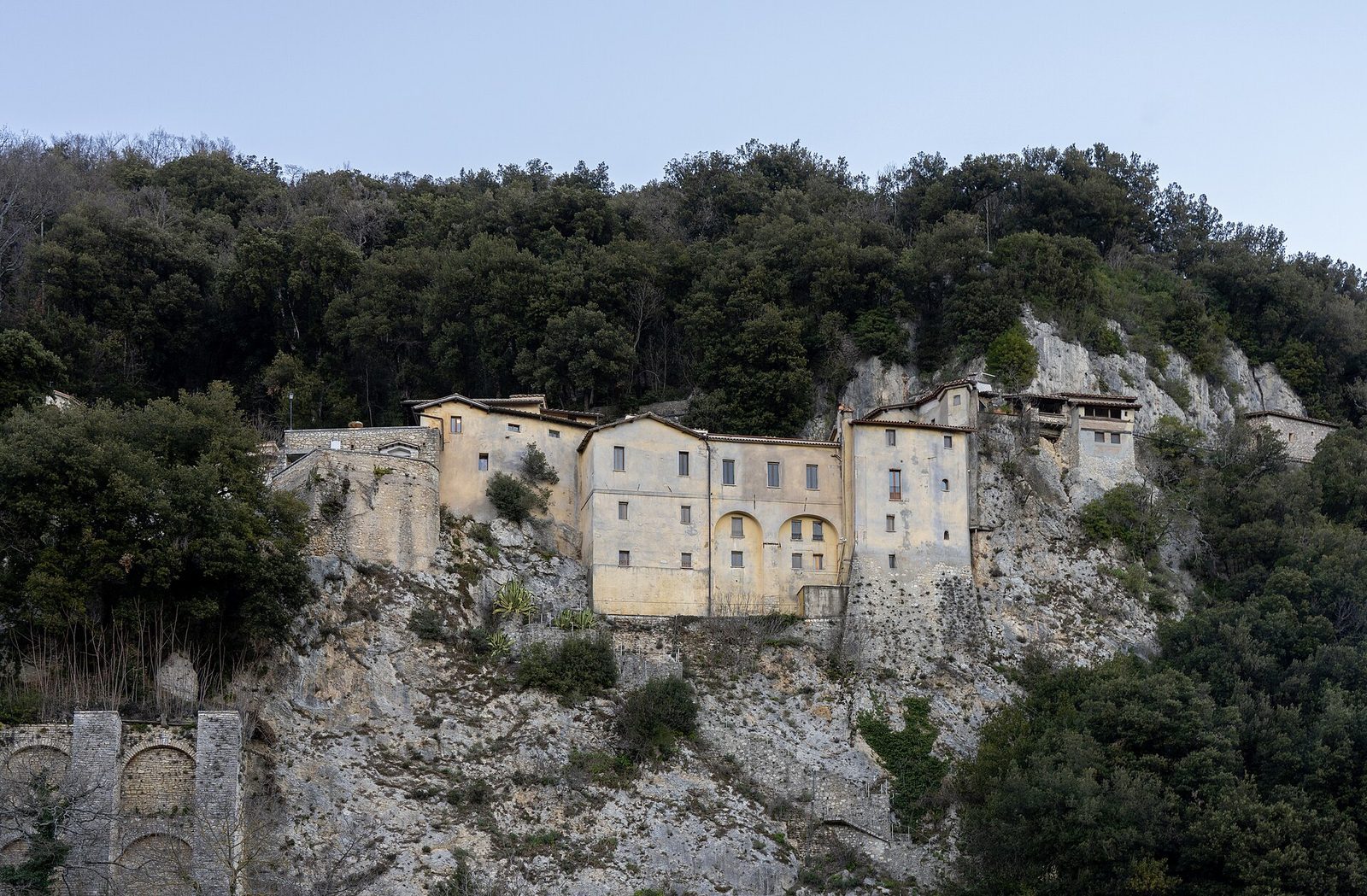
The sanctuary is set into the rock of the Sabine Mountains at about 665 metres above sea level. Its buildings occupy several levels around a plaza overlooking the Holy Valley of Rieti, combining spaces cut into the rock with later church buildings. The complex lies about two kilometres from the medieval village of Greccio and about 15 kilometres from Rieti.
Rock approach and outdoor features
Stairway and sculptures
A long stairway cut into the rock leads to the sanctuary. Near its foot stand two statues of Francis, one in stone and one in bronze; the bronze statue was installed in 2005. Near the top, a small terraced garden contains Homage to Saint Francis, a travertine sculpture by Leonardo Cumbo made in 1993. A bronze statue of Pope John Paul II, installed in July 2016, shows him blessing the Holy Valley of Rieti.
Medieval chapel and convent
Chapel of the Nativity
At the top of the stairway, the Chapel of the Nativity is built around the cave traditionally associated with Francis’s reenactment. The small, simply furnished cave contains an altar and two seats. A hollow in the rock beneath the altar table is traditionally identified as the place where the infant figure was set. Above the altar, a semicircular painted panel, or lunette, dated 1409 is attributed to the unidentified Master of Narni and reflects the style of Giotto. Its right side shows the Nativity at Bethlehem; on the left, Francis, dressed as a deacon, kneels before the infant at Greccio as townspeople watch.
A corridor leading from the chapel toward the old monastery contains two fourteenth-century frescoes. One depicts the Nativity in the Umbrian-Marche school; the other shows Saint John the Baptist. Both are attributed to the school of the unidentified Master of Fossa.
Friars’ rooms and Dormitory of San Bonaventura
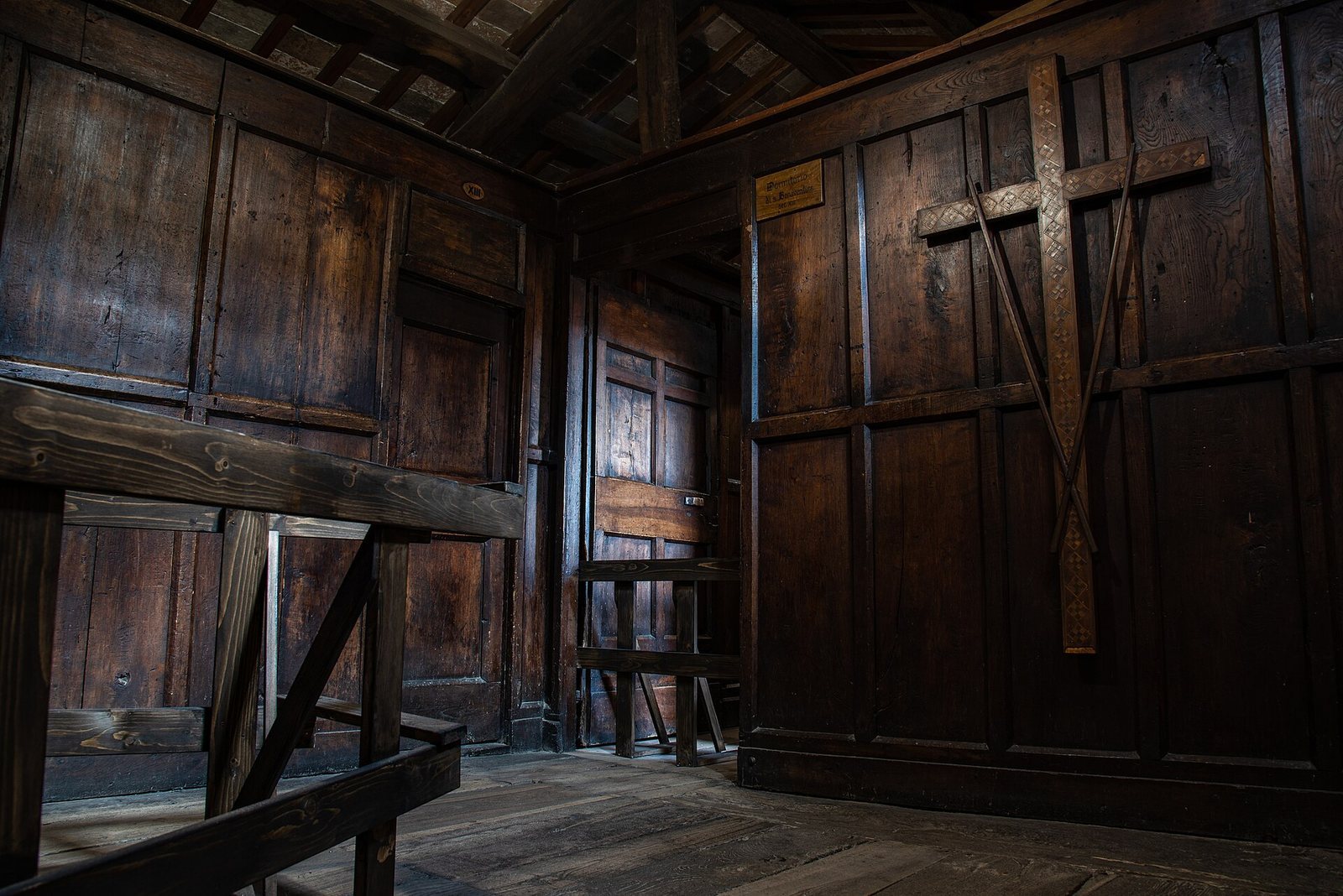
The oldest convent buildings adjoin the Nativity chapel. They include the friars’ communal dining room, or refectory, where remains of a washing basin and drainage channel survive, and a dormitory measuring seven by two metres. A very small cell cut into bare rock is said to have been Francis’s resting place. The separate Dormitory of San Bonaventura is made entirely of wood. A narrow corridor serves 15 small cells, and the first cell on the right is associated with Bonaventure and Bernardino of Siena.
Church of San Francesco
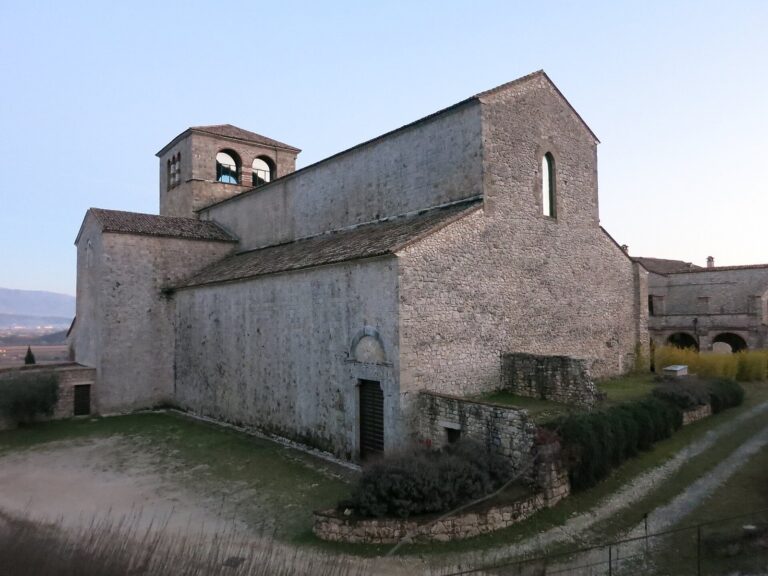
Above the Nativity chapel stands the sanctuary’s first church, dedicated to Francis and Bonaventure. The medieval Church of San Francesco has a Latin-cross plan, meaning a floor plan shaped like a cross, and a bell tower. It connects with the friars’ refectory. Its furnishings include a sixteenth-century Umbrian-school painting of the Deposition among saints, a fourteenth-century fresco of Francis with the angel announcing the remission of his sins, and a fifteenth-century circular painting of the Madonna and Child attributed to Biagio d’Antonio. Wooden choir stalls, a lectern, and a rotating lantern support used to illuminate the choir book also survive. A starry sky and an image of Giovanni da Parma decorate the church’s curved ceiling.
An underground chamber beneath the church is associated with the first Christmas celebration at Greccio. A thirteenth-century lunette there depicts the preparation of the Nativity.
Adjoining oratory
A small prayer chapel adjoining the church contains a portrait of Francis that the friars greatly venerated. Local tradition says Jacopa de Settesoli commissioned the original in 1225, during Francis’s lifetime; the surviving canvas is a fourteenth-century copy of that lost work. It depicts Francis wiping his eyes, referring to the eye disease he suffered late in life when he sought treatment from physicians at the papal court in Rieti.
Caves and Mount Lacerone
Giovanni da Parma’s cave and Francis’s prayer cell
Outside the sanctuary, Giovanni da Parma’s cave lies in the woods against the rock. Nearby, Francis’s small prayer cell has been converted into a small prayer chapel. It contains an eighteenth-century fresco of the Death of Francis and remains of an older fresco.
Chapel on Mount Lacerone
At the summit of Mount Lacerone, about 1,204 metres above sea level, a small chapel stands near two large hornbeam trees. The place is traditionally identified as the site of Francis’s hut.
Church of the Immaculate Conception
Exterior and entrances
The modern Church of the Immaculate Conception has an exterior of stone and plaster and a bell gable, a wall with openings for bells. Its apse, the projecting end of the church, and its right side face the plaza, while the mountain covers the front and left side. The apse is octagonal and has skylights. The right side has single-opening windows and two entrances, one near either end of the nave, the main space of the church. A stairway on the western side leads toward woodland paths and a third entrance to the raised gallery. A niche in the stairway holds a modern ceramic image of Saint Anthony of Padua and the Eucharistic miracle.
Bronze reliefs by Lino Agnini decorate all three entrances. The front relief, made by the Briman foundry in Verona in 1995, measures 245 by 155 centimetres and weighs more than 3,000 kilograms. It shows the Madonna giving the infant Jesus to Francis, alongside John Duns Scotus and Clare, who is depicted dying, holding a papal document and supported by two nuns. The faces of Francis’s benefactors Alticama Castelli of Stroncone and Giovanni Velita of Greccio also appear. The rear entrance relief depicts Francis’s encounter with the wolf.
Interior and artworks
The interior has a single nave on a Latin-cross plan, with no transepts, the crosswise part that would cross the nave. Raised galleries run along the left side and the rear. Beneath the left gallery are three small chapel-like niches. The apse contains a ceramic relief of the Immaculate Virgin Mary by Lorenzo Ferri, made in 1965–1966. At the rear of the nave is a large wooden Nativity scene by Ferri, made in 1967 with statues from Val Gardena.
The three niches beneath the left gallery hold an organ, a terracotta Nativity scene by Luigi Venturini made in 1962, and a wooden crucifix. On the right side, a wooden sculpture by the Spanish sculptor J. Campania, made in 1925, depicts Francis and his brothers caring for lepers. Ferri’s terracotta reliefs of the Stations of the Cross, made in 1967, line the walls. The upper gallery houses a growing permanent display of Nativity scenes, including a terracotta work by L. Agnini and Francis and His Nativity Scene by A. Fanfoni.
Stained-glass windows by Father Alberto Farina depict people and events associated with Francis and the sanctuary. Their subjects include Francis’s companions Leo, Rufino, and Angelo; Bonaventure, Clare, and Giovanni da Parma; the Pardon of Assisi; Jacopa de Settesoli and Giovanni Velita; and the Nativity at Bethlehem alongside the reenactment at Greccio.