Church of Saints Nicholas and Clement: Parish Church of Lama dei Peligni
Site at a Glance
- Country
- Italy
- Primary era
- Early Modern
- Eras represented
- Early Modern, Modern
- Civilizations
- Italian, Kingdom of Naples, Kingdom of the Two Sicilies, Spanish
- Site type
- Religious
- Remains
- Church
On this page18 sections
History
The Church of Saints Nicholas and Clement is a Roman Catholic parish church in Lama dei Peligni, Italy. Construction began in the sixteenth century, and an inscription on the bell tower gives 1589 as its building date. The church has Renaissance-Baroque architecture and belongs to the Archdiocese of Chieti-Vasto, a Catholic jurisdiction overseen by an archbishop. Originally dedicated to Saints Nicholas and Clement, it was reconsecrated by Archbishop Bruno Forte in 2015 under the dedication of the Child Jesus, the infant form of Jesus represented by the image venerated inside.
Foundation and rebuilding
The church was built outside the town walls, at the present Piazza Umberto I, to replace the older Church of Pope Saint Clement in Lama Vecchia. That building had become too small for services and was damaged by landslides. The 1706 earthquake sent half of Lama sliding downhill. It destroyed the older church, whose remains were abandoned after the 1933 earthquake, and prompted repairs to the newer church, including reconstruction of its interior and renewal of its bell tower.
The church escaped serious damage in the 1933 earthquake and during the German forces’ scorched-earth destruction of Lama in the Second World War. Its history is closely connected to the wax image of the Child Jesus, traditionally said to have arrived from Palestine in 1760 with Pietro Silvestri, a Franciscan friar belonging to the Catholic order founded by Francis of Assisi.
The image and local traditions
Local tradition holds that the image survived a shipwreck on its journey to Lama, that church bells rang on its arrival, and that animals knelt as it passed. People believed it could bring miraculous healing, and it was carried in Christmas processions. Votive offerings, made to fulfill vows or express gratitude for perceived divine help, and local testimonies preserve claims of sudden cures and children surviving falls into wells.
In 1799, when French forces under Napoleon were expected, residents prepared boxes to hide and transport the image. The boxes, made to its measurements, proved either too large or too small. People interpreted this as a sign that the Child Jesus wished to remain and protect the town. A silver key represents the community entrusting itself to the image’s protection. Its date is uncertain, and the year 1013 associated with it predates the image’s arrival in 1760.
Devotion during epidemics and war
During the 1854 cholera epidemic, masses were held in honor of the image. Local tradition says Lama suffered fewer deaths than nearby Taranta, Letto, Palena, and Civitella. The image was also carried in procession and displayed outside the church during the 1915–18 Spanish flu epidemic. Local tradition similarly associates those acts with fewer deaths in Lama than in surrounding towns.
In September 1943, German forces interrupted a procession and imposed a curfew. To protect the image from damage or theft, residents hid it in a farmhouse, where it survived the destruction of the town. German forces also took some of Lama’s votive offerings during the war. Local tradition held that those responsible later experienced misfortune and painful illnesses.
Remains
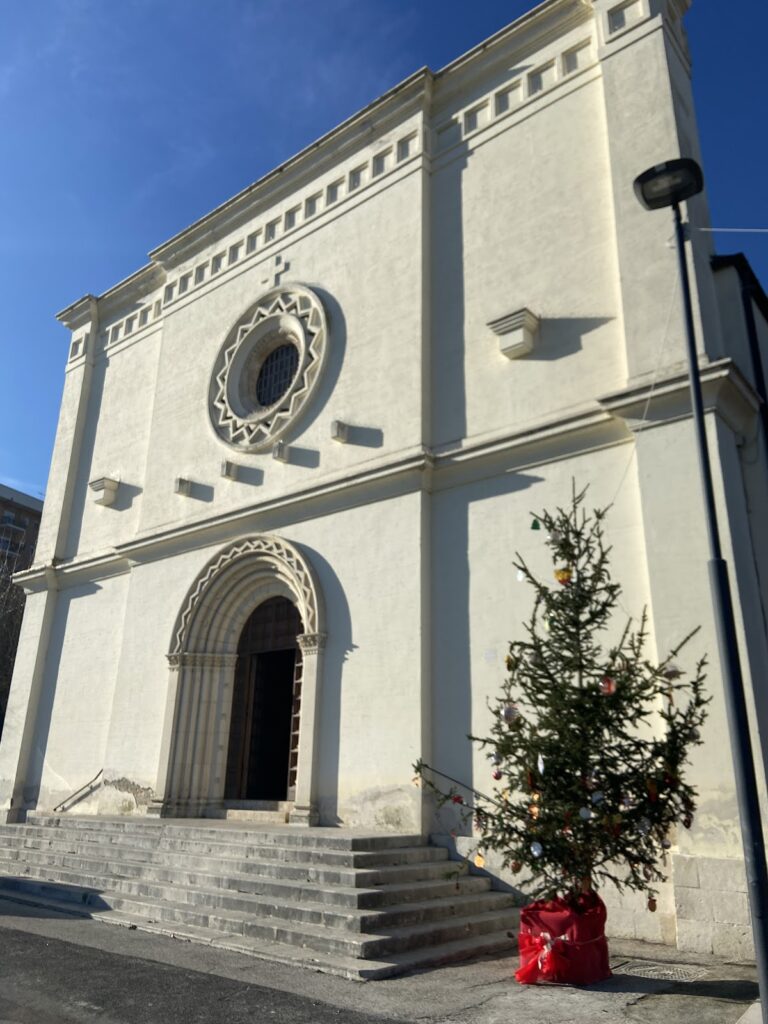
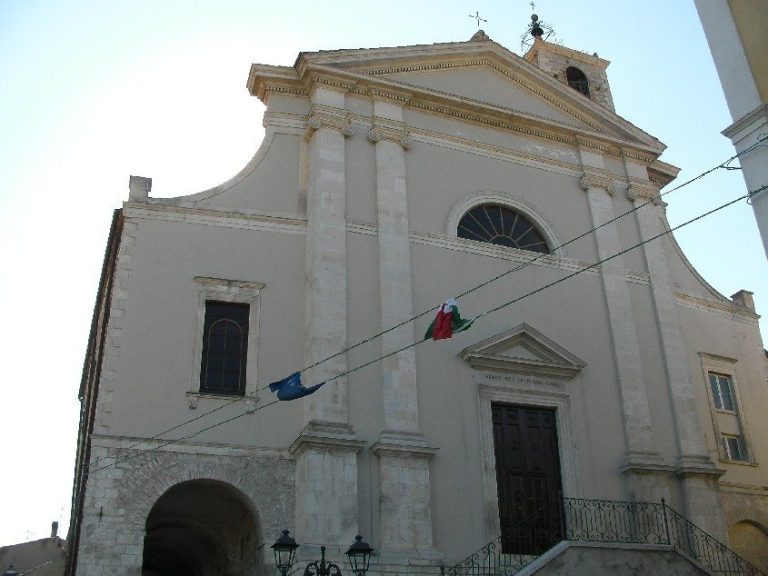
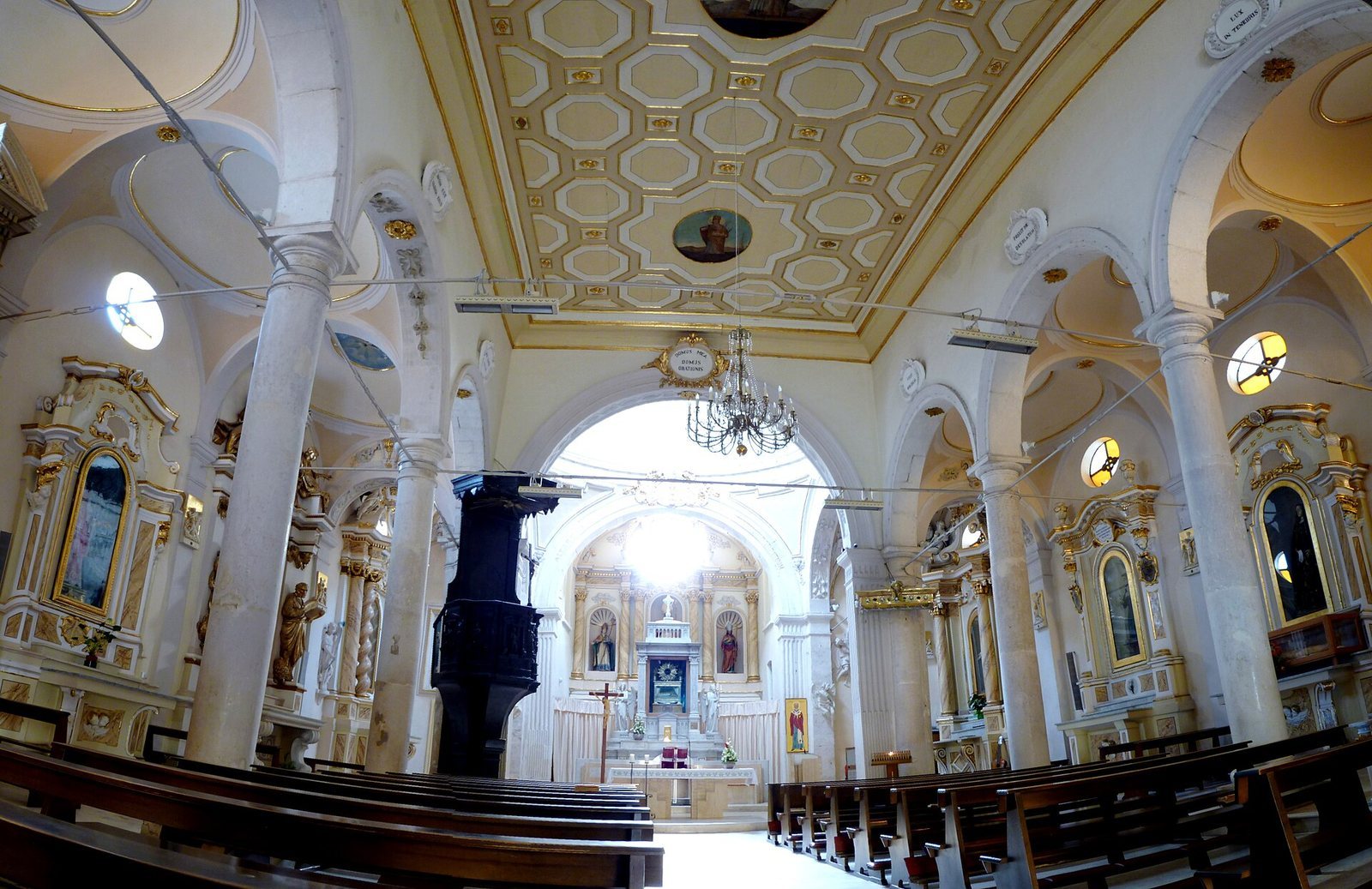
The church has a three-nave plan, with a central nave, the main interior space, flanked by two side aisles, and a rectangular apse, the terminal space at the end of the building. Its exterior has a restrained Renaissance character, while the richly decorated interior combines white and gilded stucco.
Exterior
Façade
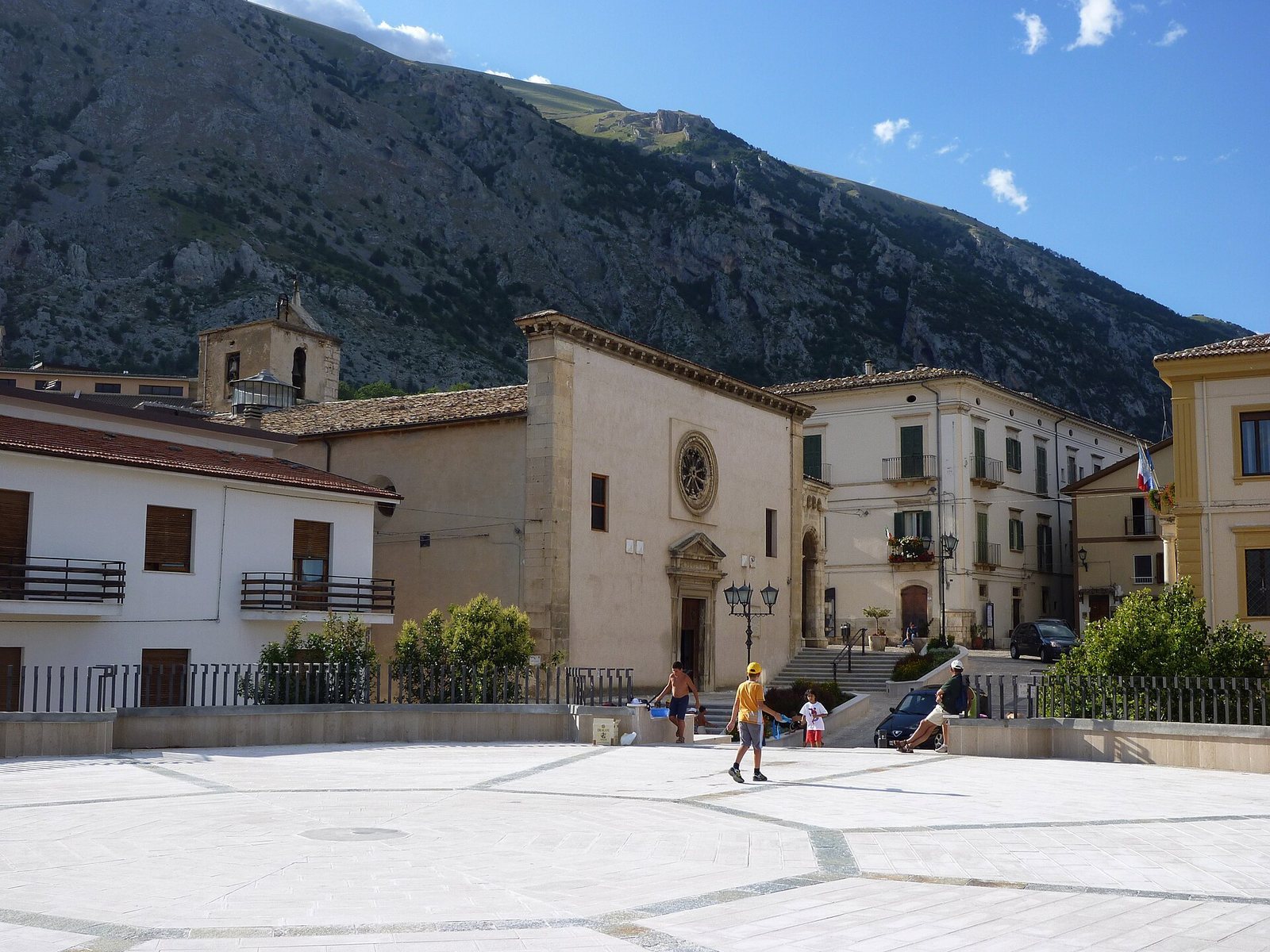
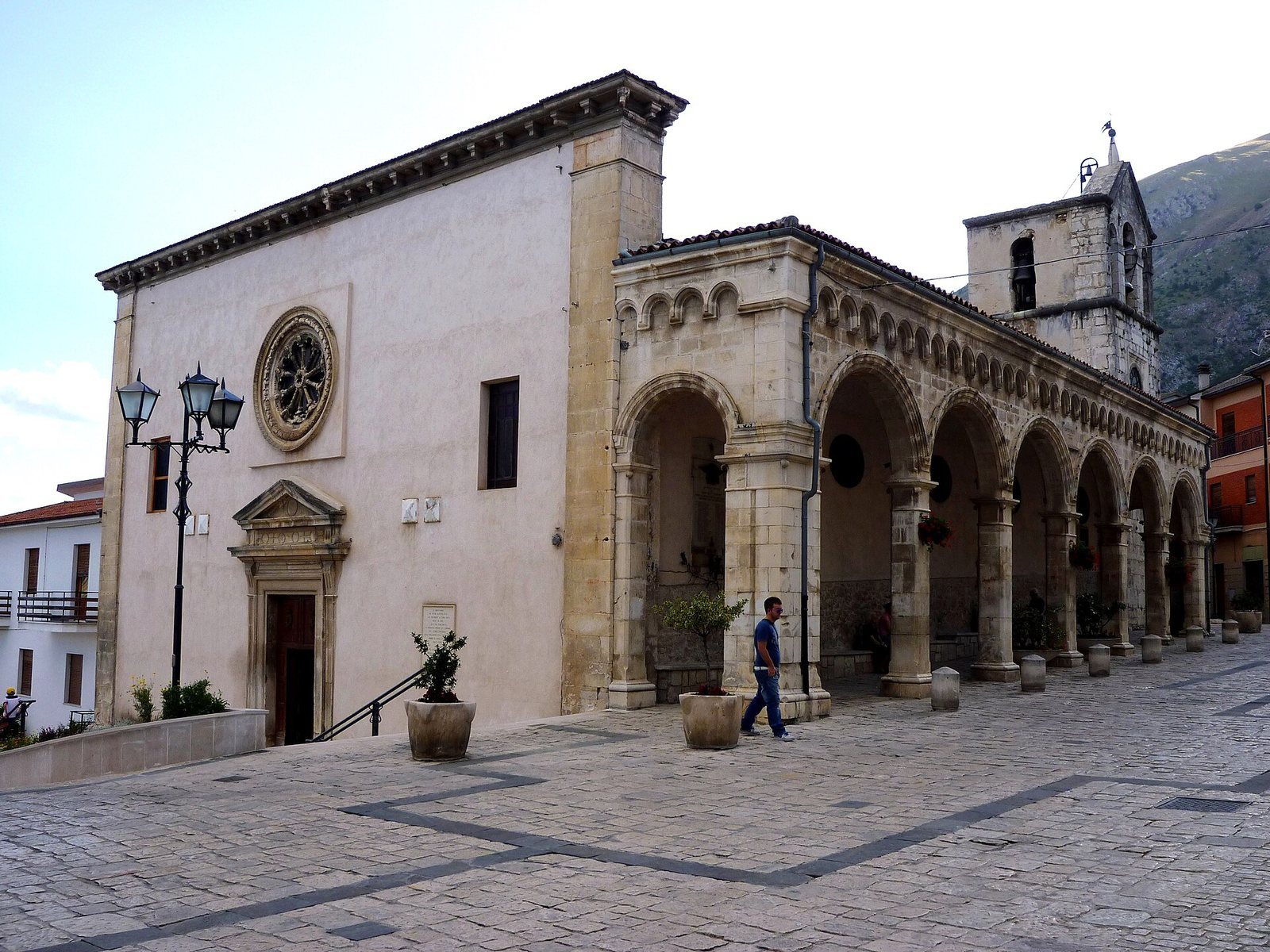
The plastered façade ends in a rectangular upper section. A triangular pediment crowns the entrance, with a large circular rose window, an ornamental window, aligned above it and decorated with angel heads. Two shallow stone projections resembling columns mark the corners. The window looks onto a small forecourt used by worshippers before services. Two rectangular windows were added to the façade in the eighteenth century to bring more light into the church; the side elevations are also plastered.
Portico and bell tower
A side portico, added in the twentieth century, has six rounded arches resting on pillars built from squared limestone blocks. The bell tower faces the main square. It rises from a square base and has three sections divided by two horizontal bands. Plaster covers most of the tower, while the side parallel to the portico is exposed stone. Its present form appears rectangular, though it is thought to have originally had a square plan. The arched façade facing the square belongs to the original structure.
Interior plan and furnishings
Structure and decoration
Four divisions between the supports, known as bays, are carried on round arches resting on columns and pillars. The central nave has a flat ceiling decorated with gilded octagonal motifs, while the side aisles have sloping vaulted ceilings over rectangular areas. A dome with a circular lantern, an upper structure that admits light, stands between the choir and the main nave.
Organ loft and pulpit
At the entrance, a wavy-profile organ loft with a decorated parapet rests on four columns and houses a seventeenth-century pipe organ. At the far left end of the central nave is a wooden pulpit dated 1600. It carries scenes from the life of Jesus and contains statues of saints by the Roman artist Bartolomeno Balcone.
Altars and devotional features
Right side
On the right is a niche with Saint Sebastian, an early Christian martyr. Next is a modern altar bearing an image of Divine Mercy, a Catholic devotion focused on Christ, alongside the baptismal font. A nineteenth-century wooden chest in a late Gothic style covers the font. Farther along are an altar to Our Lady of Sorrows, a title of Mary, with the dead Christ; an altar to Saint Anthony of Padua, a Franciscan friar and preacher; and an altar depicting the Sacred Heart of Jesus, another devotion focused on Christ.
Left side
The left side has an altar to Our Lady of the Rosary, a Marian prayer devotion, followed by an altar with a painting of Our Lady of Graces, another title of Mary. The next altars are dedicated to Saint Cesidio, especially venerated in Abruzzo, and Saint Joseph, the husband of Mary and foster father of Jesus. A niche at the end holds Saint Gabriel of Our Lady of Sorrows, an Italian saint of the nineteenth-century Passionist order, devoted to the Passion of Christ.
Main altar
The main altar stands at the far end of the central nave, centered in the presbytery, the area around the altar, and lit by the dome. Behind it is the urn containing the Child Jesus image, with the tabernacle, the receptacle for the Eucharist, below.
The Child Jesus image and shrine
Image and display
The venerated figure is a wax statuette of the Child Jesus, with its arms wrapped around its body, closed lips, and open black eyes. A local version of its story says that only the head was made because Silvestri had little money, and that it was intended to be wrapped in swaddling. Diocesan records describe it as a statuette. The figure bears the signature of Friar Giovanni Lorenzo da Limano, a Catholic missionary and parish priest of Old Cairo, Egypt.
The image is kept in the apse behind the main altar, inside a silver urn covered with crystals and wrapped in red silk. A local resident made the urn in 1845. It replaced a carved, gilded wooden urn made in 1778 by a master cabinetmaker from Sulmona. A silver dove, added to the urn in 1894 with contributions from emigrants in America, and the marble altar completed in 1906 form part of the image’s display.
Side shrine
A small shrine beside the main altar was made in 1826 to receive votive offerings. It survives in the church.