Lascaux: A Prehistoric Cave of Painted and Engraved Art
Site at a Glance
- Popularity
- Very High
- Country
- France
- Primary era
- Stone Age
- Eras represented
- Stone Age, Modern
- Civilizations
- French
- Site type
- Civic
- Remains
- Rock Art
On this page21 sections
History
Lascaux is a limestone cave near Montignac-Lascaux, France, known for its extensive prehistoric paintings and engravings. Most specialists associate the art with the early Magdalenian, a phase of the Upper Paleolithic, at about 21,000 calibrated years before present. Its exact age and cultural attribution remain debated, and human activity in the cave appears to have been connected chiefly with its decorated walls rather than habitation.
Prehistoric activity and the dating debate
Radiocarbon dating of reindeer bones, published in 2019, places related human activity at about 21,000 to 21,500 calibrated years before present. Calibrated dates adjust radiocarbon results to calendar years; in archaeology, “present” conventionally means 1950. Such dates on bones and other materials do not, by themselves, establish when nearby images were made.
Researchers have proposed different dates for the art. Henri Breuil first assigned it to the Gravettian, while André Leroi-Gourhan argued for the Solutrean. Norbert Aujoulat placed it between the late Solutrean and Badegoulian, and some researchers have suggested that part of the decorated cave may be Gravettian. Dates from charcoal in lamps and excavated deposits include about 15,500, 17,190 ± 140, and 16,000 ± 500 radiocarbon years before present. Accelerator mass-spectrometry measurements on a reindeer-antler fragment and a spear fragment yielded 18,600 ± 190 and 18,930 ± 230 years before present. These dates belong to the tested materials, not necessarily to the images. Despite the disagreements, most specialists place the paintings and engravings in the early Magdalenian.
Rediscovery and archaeological study
The cave came to attention in stages in September 1940. Marcel Ravidat is traditionally said to have found a small opening on 8 September, where a tree had been uprooted. After discovering that it led into a large cavity, he returned on 12 September with Georges Agniel, Simon Coencas, and Jacques Marsal. The group entered and saw the paintings. Henri Breuil, a prehistorian living in the region during the German occupation, visited on 21 September with other specialists and was the first to authenticate and describe the art.
Breuil began recording the paintings in late 1940 and studied them for several weeks. In 1949, he excavated with Séverin Blanc and Maurice Bourgon at the foot of the Well scene while searching for a burial; the work uncovered decorated reindeer-antler spear points. At Breuil’s request, André Glory made tracings of engravings from 1952 to 1963. Material collected by Glory was thought lost after his death in 1966. Brigitte and Gilles Delluc rediscovered it in 1999, and it was published in 2008.
The estate and heritage protection
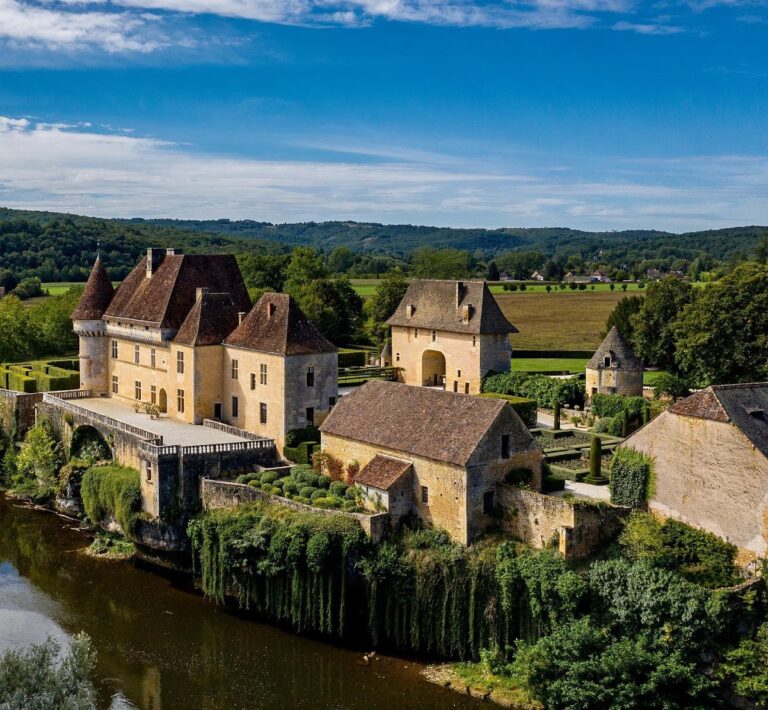
Before the cave’s discovery, Lascaux was the name of a lordship known from the early fifteenth century. The estate included a manor house, farm, mill, dovecote, cultivated land, vineyards, and the hill containing the cave. A description from 1667 mentions vineyards and woodland, along with chestnut trees, junipers, and heather on the hill. Ownership passed through the Lascaux, Cheylard, Reilhac, and Labrousse de Lascaux families before reaching the La Rochefoucauld-Montbel family, which held the estate when the cave was found. The family transferred the cave to the French state in 1972.
Lascaux became a French historic monument on 27 December 1940, with related protections applied to nearby or containing land parcels in 1940 and 1962. In October 1979, it became part of the UNESCO World Heritage listing for the Prehistoric Sites and Decorated Caves of the Vézère Valley.
Public access and conservation
After visitors began scratching paintings and carving initials into the walls, the owner had a door installed. Major access works in 1947 altered the entrance and floor levels and added a visitor path and electric lighting, among other changes. The cave opened to the public on 14 July 1948. About one million people visited before it closed to the general public in 1963.
The number of visitors disrupted the cave’s environment. By 1955, carbon dioxide from their breath was contributing to deterioration of the walls and images. A system installed in 1957 renewed the air and helped stabilize temperature and humidity, but visits continued at up to about 1,000 people a day. Algae appeared on the walls in 1960, in an outbreak called the “green disease,” while calcite deposits formed on walls and some images in what was called the “white disease.” Ozone filtration did not halt microbial growth. On 17 April 1963, André Malraux, then the minister responsible for cultural affairs, closed the cave to the public.
A climate-control system installed from 1965 to 1967 used natural air movement to condense water vapour at a designated point and restore circulation. The equipment was replaced in 2000. In spring 2001, mould appeared in the entrance vestibule, and the fungus Fusarium solani spread to the paintings. Its growth was associated with a bacterium that degraded the fungicide then in use. Emergency treatment from 2001 to 2003 included fungicides, antibiotics, lime, and biocides. An international scientific committee began investigating the cave’s environment and treatments in 2002. By 2006, contamination was largely controlled, although workers continued to remove recurring fungal filaments by hand.
Black fungal spots appeared in 2007 in the Passage, Nave, and Apse. A biocide treatment in January 2008 was followed by a three-month closure even to scientists. The treatment had encouraging results in nine of eleven test areas, while the spots continued to spread in two. Air movement in the affected part of the cave had changed substantially since the 1980s and appeared nearly stagnant. By 2016, fungal growth appeared to have stopped during a prolonged period without visitors. Entry remained limited to scientists, with human presence restricted to 200 hours per year.
Replicas for public access
Lascaux II was developed to let the public experience parts of the decorated cave without bringing visitors into the original. A three-dimensional photographic survey of the decorated areas was made in the late 1960s. The replica project began in the early 1970s, paused in 1980, and continued under the Dordogne department. Lascaux II opened in 1983, about 200 metres from the cave.
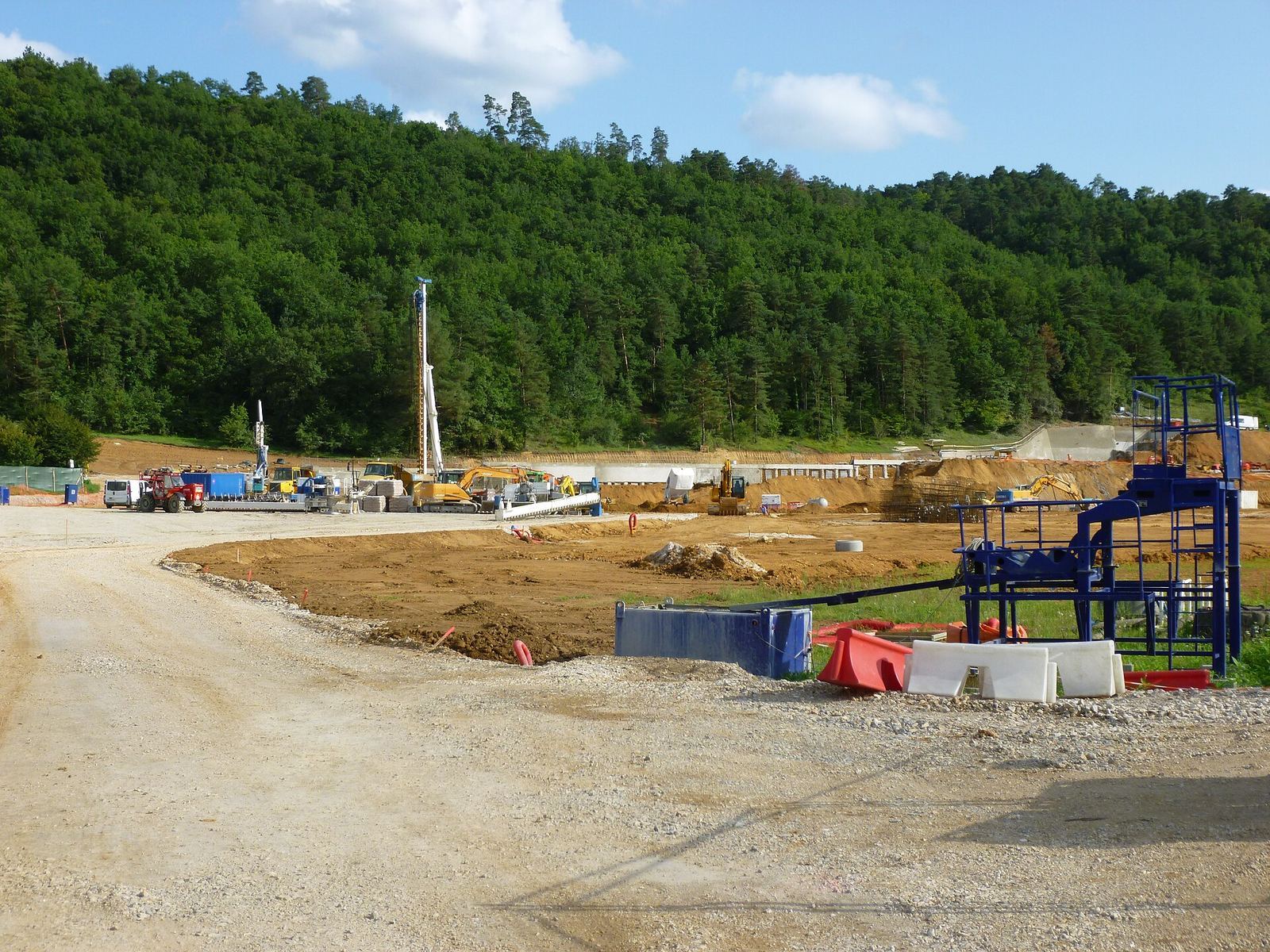
Lascaux III, a travelling group of partial replicas, was commissioned in 2003 to include scenes from the Nave that Lascaux II did not reproduce. Its eight panels were first shown in Dordogne in 2008, and the travelling exhibition began public presentation in 2012. Work on a full-scale replica of all the decorated areas, part of the International Centre for Parietal Art known as Lascaux IV, began in 2014. The centre opened in December 2016 to provide an alternative for visitors and help protect the original cave and the hill above it.
Remains
Lascaux is a limestone cave in a hill on the left bank of the Vézère. Its rock formed during the Coniacian, a subdivision of the Late Cretaceous. An impermeable layer of marl, a fine-grained rock containing clay and carbonate, limits water infiltration, and the cave is relatively dry. Its known passages extend about 235 to 250 metres, with a vertical difference of about 30 metres. The decorated galleries lie mainly in the upper part; carbon dioxide makes the lower network difficult to enter. The present entrance corresponds to the prehistoric entrance, although it has been modified and fitted with a vestibule. An ancient roof collapse formed the slope through which the discoverers entered. The entrance works changed the floor level and removed the rubble cone that had helped buffer temperature and humidity.
Decorated galleries
Hall of the Bulls
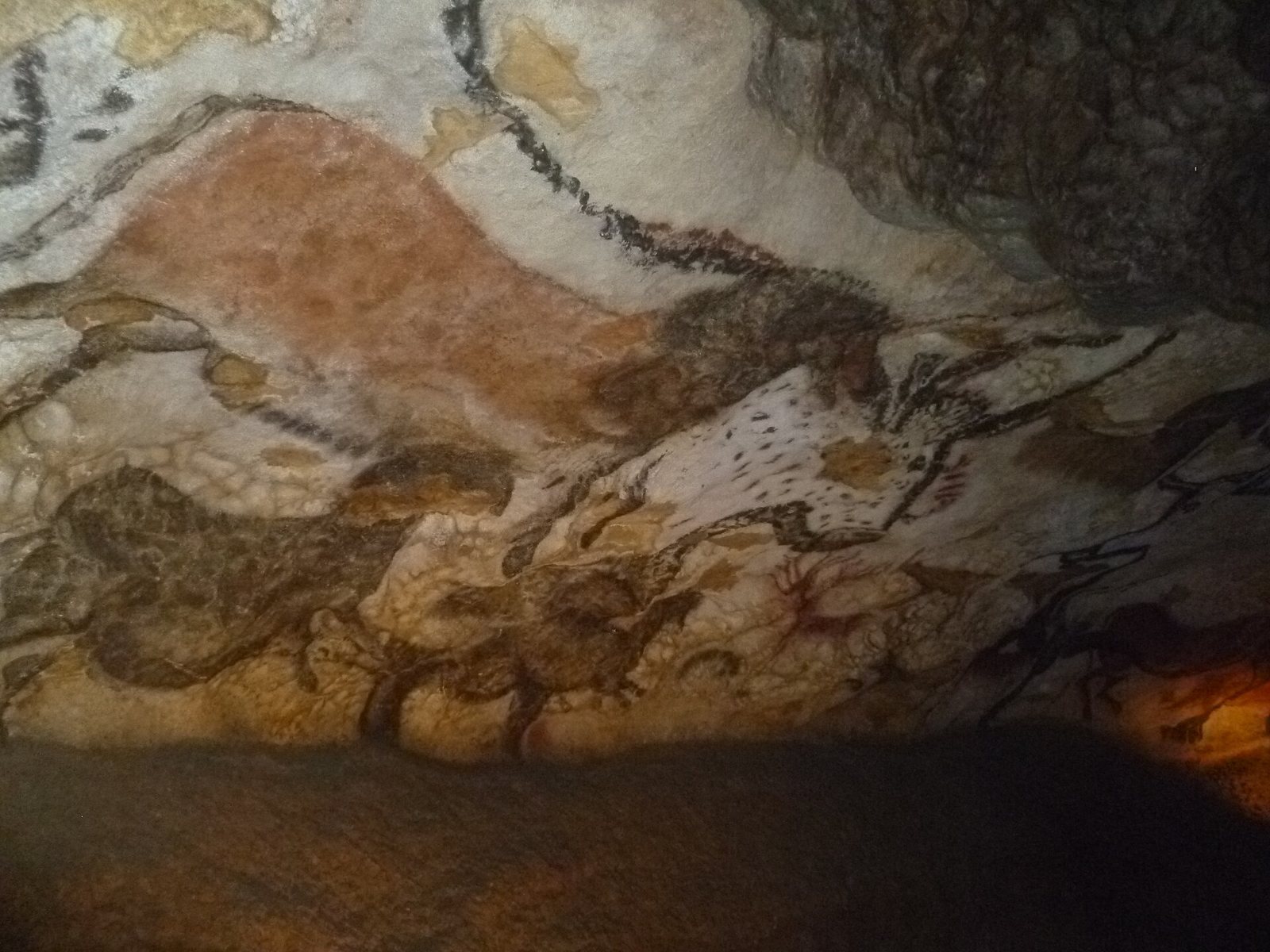
The Hall of the Bulls, also called the Rotunda, is 17 metres long, 6 metres wide, and 7 metres high. Its calcite walls are poorly suited to engraving, so the room is decorated with paintings, some as long as five metres. Two facing groups of aurochs, or extinct wild cattle, contain two animals on one side and three on the other. The northern group includes about ten horses and a large, enigmatic creature with two straight marks on its forehead, nicknamed the Unicorn. With the aurochs, horses, deer, and bear shown on its walls, the chamber contains 36 animals. One aurochs measures 5.2 metres.
On the southern side, three large aurochs appear with three smaller red aurochs and six small deer. A bear is painted over the belly of one of the aurochs and is difficult to make out.
Axial Diverticulum
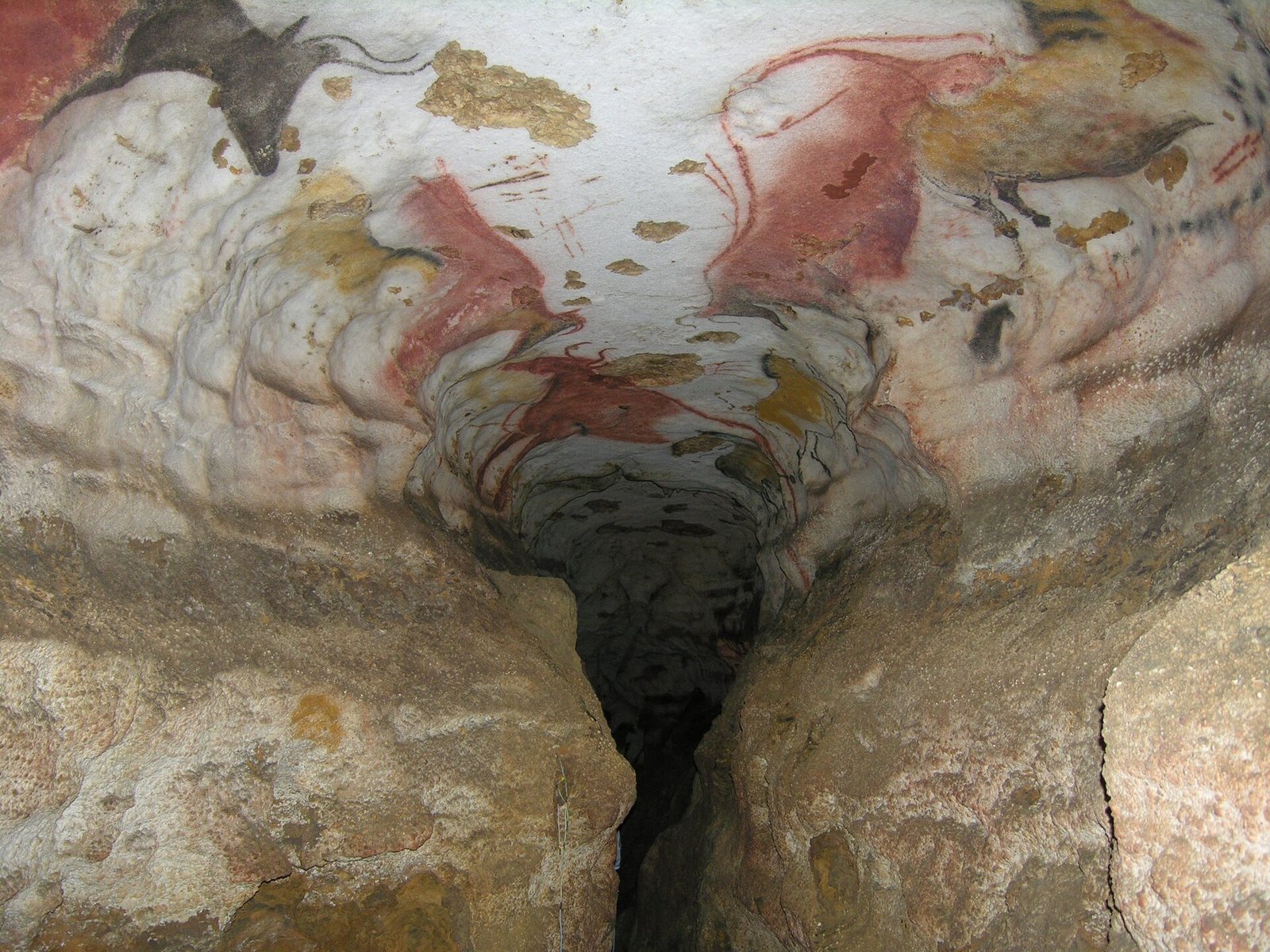
The Axial Diverticulum is a narrow gallery that continues in the same direction as the Hall of the Bulls and is roughly as long. Its paintings show aurochs and horses with deer and ibex, wild mountain goats, as well as signs in the form of sticks, dots, and rectangles. A fleeing horse, made with manganese pigment, is about 2.5 metres above the ground. Other animals appear on the ceiling, as high as about four metres, and extend visually from one wall toward the other. Scaffolding may have been used to reach some of these surfaces.
Passage and Nave
The Passage branches to the right of the Axial Diverticulum and extends about 15 metres. Its decoration is badly degraded, particularly by air circulation. It leads to the higher Nave, which is about 20 metres long. Four main groups of figures there are known as the Imprint, Black Cow, Swimming Deer, and Crossed Bison panels. Geometric signs accompany the animals, including coloured checkerboard forms that Breuil called “coats of arms.”
Feline Diverticulum
Beyond an undecorated stretch past the Nave is the narrow Feline Diverticulum, also called the Chamber of Felines, about 20 metres long. Its engravings show wild animals and a group of felines; one appears to be marking its territory. A horse is depicted facing the viewer, an unusual treatment in a cave where animals are generally shown in profile or with twisted perspective.
Apse
The Apse is a rounded chamber at the junction of the Passage and Nave. It contains more than a thousand engravings of animals and signs, with some engravings placed over paintings. A reindeer appears among its images.
Well
The Well opens at the far end of the Apse and requires a descent of about four to five metres toward the lower network. Its scene includes a male figure who appears to be falling, with an erect penis and a bird’s head; a bison that appears to have been pierced and disembowelled by a spear; and a rhinoceros moving away. Beside the human figure is an elongated object topped by a bird, possibly a spear-thrower. A horse appears on the opposite wall. Three pairs of digit-like dots lie between the human figure and the rhinoceros, while a complex barbed sign is beneath the human and bison. Similar signs occur elsewhere on the cave walls and on nearby spear points and a sandstone lamp. Leroi-Gourhan interpreted the scene as a connected composition and suggested that it might refer to a myth whose meaning is difficult to recover. He and many other prehistorians have also interpreted Lascaux as a sanctuary; shamanic readings and proposed astronomical connections remain disputed.
Images, materials, and excavated objects
Paintings and engravings
More than 600 paintings cover parts of the walls and ceilings. A separate count gives nearly 6,000 figures, including animals, human figures, and abstract signs. More than 900 figures have been identified as animals, with 605 precisely identified. Horses, aurochs, bison, deer, and ibex are common subjects; bears, rhinoceroses, and felines appear less often. The animals and their poses can be realistic, but the scenes do not form a comprehensive naturalistic view.
A survey of the engravings recorded 1,433 representations, later listed as about 1,900 in the catalogue. Images were made with paints and by cutting designs into softer rock. Methods of applying pigment included smearing or blotting it onto a surface and spraying it through a tube. The artists used multiple colours, shading, perspective, unpainted areas within designs, and anamorphosis, or deliberately distorted imagery.
Pigments and excavated finds
Microscopic study identified at least seven pigments. Black came from manganese dioxide, black iron oxide, and carbon; red from hematite; yellow from goethite and clay; and white from calcite. Finds from the cave include 403 stone tools, about sixty bone objects, sixteen ornamental shells, about a hundred animal remains, charcoal, plant remains, and pigment fragments. The Nave yielded lamps, pigments, and food remains. Finds from the Apse include spear points, scrapers, burins, or stone tools with a chisel-like edge, and lamps. The Well yielded spear points, pigments, pierced shells, and lamps. A sandstone lamp from the Well has a shaped body and a handle decorated with a barbed sign. Decorated reindeer-antler spear points were also found at the foot of the Well scene.
Replicas
Lascaux II
Lascaux II reproduces the Hall of the Bulls and Axial Diverticulum in a double-shell concrete structure. Its contours were recreated using the earlier three-dimensional photographic survey. A metal framework supports mesh and three layers of fibre-cement, a cement-based material reinforced with fibres, made with lime, sand, and marble powder. Artists copied the paintings using natural pigments.
Lascaux III
Lascaux III includes partial reproductions of scenes from the Nave and Well. Its panels are modular and designed for transport.
Lascaux IV
The Lascaux IV replica reproduces all the decorated parts of the cave at full scale. Its semi-buried centre, designed by the architecture firm Snøhetta, extends for 150 metres and is no more than eight metres high. The replica consists of 36 panels representing 900 square metres of decorated surfaces. Milled polystyrene blocks were assembled and shaped by hand; moulds and resin shells reproduced the cave’s contours and mineral surfaces, which were finished with coloured patinas and copied paintings.