Castle of Condat: A Former Hospitaller Commandery in France

Site at a Glance
- Rating
- 4
- Popularity
- Very Low
- Country
- France
- Primary era
- Medieval
- External website
- Open
- Eras represented
- Medieval, Early Modern
- Civilizations
- French, Knights Hospitaller
- Site type
- Military
- Remains
- Castle
On this page7 sections
History
The Hospitaller commandery
The Castle of Condat is a former commandery of the Knights Hospitaller in Condat-sur-Vézère, France, founded in the twelfth century by this religious and military order. The foundation date is given as 1173, and the establishment was known as Hospitalis de Condato by 1239. The Hospitallers occupied the town from the twelfth to the eighteenth century, and the commandery was regarded as the most important Hospitaller establishment in Périgord.
A commandery was an administrative estate belonging to a religious or military order and supervised by a commander. At Condat, the complex served as a fortified residence and the commander’s home, while also functioning as a tithe barn, a hostel for pilgrims, and a hospital for the sick. A tithe barn collected and stored agricultural dues, linking the commandery’s defensive and religious functions with the management of surrounding resources.
Fortification and conflict
The commandery was restored around 1540. Its defensive role became especially clear during the Wars of Religion, the sixteenth-century conflicts between Catholics and Protestants in France. The Huguenot leader Captain Pouch converted the church into a fortress, after which it was besieged and captured by the seigneur of Losse, a landed feudal lord.
During the Wars of Religion and the Fronde, a series of rebellions against the French crown from 1648 to 1653, the castle changed hands several times. These conflicts added repeated episodes of military occupation and contest to the history of a complex that had originally combined religious, charitable, residential, and administrative purposes.
Revolution and later use
During the French Revolution, the commandery was sold as national property. After the storming of the Bastille in 1789, it was pillaged. Some of the premises were later adapted for industrial use, serving as a mill and flour mill during the nineteenth century.
The keep received protection as a French monument historique, a legal designation for buildings and sites considered historically or architecturally important, on 12 October 1948. The commune of Condat-sur-Vézère acquired the commandery in 2022. The former commandery buildings are disused, while the church remains the parish church of Condat-sur-Vézère.
Remains
Fortified residential complex
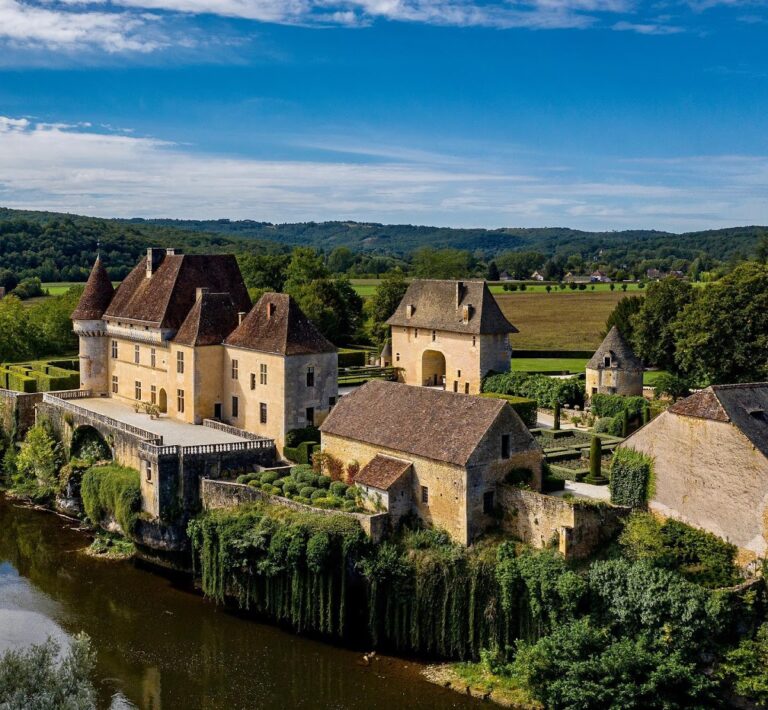
The complex stands on the left bank of the Coly at its confluence with the Vézère, a setting reflected in the name Condate, meaning “confluence.” Its surviving form combines an elongated sixteenth-century residential building with a medieval square keep. At battlement level, the keep retains a defensive walkway supported on corbels, or projecting blocks, together with machicolations and small projecting defensive structures called breteches. A turret occupies the opposite corner of the main building, although it has been reduced in height. A second building completes the complex and contains a square defensive tower. The former moats have been filled in, and the roofs are covered with slate from Brive.
Church and bell gable
The church forms part of the former commandery and has a regional comb-style bell gable. During the Wars of Religion, it was converted into a fortress as part of the site’s defensive transformation. It now serves as the parish church of Condat-sur-Vézère.