Chiafura: A Rock-Cut Quarter and Archaeological Park in Scicli
Site at a Glance
- Popularity
- Low
- Country
- Italy
- Primary era
- Medieval
- Eras represented
- Classical, Medieval, Modern
- Civilizations
- Byzantine, Kingdom of Sicily, Norman, Roman
- Site type
- Domestic
- Remains
- House
On this page10 sections
History
Chiafura is an ancient quarter and rock-cut archaeological park on San Matteo hill in Scicli, Italy. Its urban settlement developed between the eighth and tenth centuries AD, during the early medieval period, following earlier activity on the hill. The name is first recorded in 1684, but its origin is uncertain. One proposed explanation connects it with a phrase ending in “-fora,” possibly meaning a quarter outside the city. Local historian Mario Pluchinotta instead proposed an Arabic-derived meaning of a place with a wide horizon.
Early activity and medieval settlement
People inhabited San Matteo hill during the Early Bronze Age in Sicily, from 2200 to 1450 BC. Occupation was less intensive in the Middle Bronze Age, from 1450 to 1270 BC. Finds on the hill also point to activity in the seventh and sixth centuries BC, after an apparent gap following the Late and Final Bronze Age and Early Iron Age. A prehistoric cemetery of rock-cut tombs has been proposed, but its existence is uncertain.
From the fifth to seventh centuries AD, the Chiafura area was used as a cemetery. Some rock-cut tombs were later adapted for habitation, and an urban quarter took shape between the eighth and tenth centuries. Cave dwelling was already practiced elsewhere in Sicily in the eighth and ninth centuries and may have increased after the Norman conquest, possibly with migration from cave-settlement areas in southern Italy, including Puglia and Basilicata. Systematic occupation of Chiafura is tentatively associated with this period, though the earliest direct evidence for rock-cut habitation dates to the fourteenth century.
Fortifications and expansion down the valley
Danger along the coast encouraged communities to move inland, where they established permanent settlements in caves and built defenses. Scicli fell to Arab forces in 864 or 865, during the conquest that brought Sicily under Muslim rule. Defensive works were taken over and reused, and San Matteo remained a military position until the Normans established rule in Sicily in 1091. The fortress then became the seat of a settlement known as Sciclum or Scicla.
From the early fifteenth century, the settlement spread gradually down the valley, despite the winter risk of torrential water, and above-ground buildings became more common. Chiafura remained important into the early modern period, around 1500 to 1600. A second defensive wall, built around this time, controlled access to the lower town; an earlier wall enclosed the castle, San Matteo church, and the upper slopes of Chiafura.
Decline and relocation
As Scicli expanded during the eighteenth century, Chiafura lost standing within the town. By the late 1700s, about 1,700 people, roughly one fifth of Scicli’s population, lived in caves on the slope. The settlement remained densely inhabited under Bourbon rule, the dynasty’s rule in Sicily and southern Italy, even as some residents began moving into the town. In the nineteenth century both the quarter and Scicli declined. Descriptions from the period contrast grand buildings with deteriorating caves inhabited by poor people. About 700 residents still lived at Chiafura in the 1920s.
Poor sanitary and safety conditions led the municipality to move the remaining residents out between the late 1950s and early 1960s. Many relocated to peripheral areas, especially Villaggio Aldisio, now called Villaggio Jungi. On 17 May 1959, a delegation of intellectuals from Rome visited the caves to see the conditions of families still living there. Scicli’s Communist Party section organized the visit after local members raised the residents’ situation with Gian Carlo Pajetta, a prominent Italian Communist Party leader. Giuseppe Cartia was mayor at the time.
Historical accounts
An 1888 report by engineer Filadelfo Fichera described neighborhoods built on rock and conglomerate as healthier than those on clay. It also noted that the road leading to Chiafura remained one of the town’s main thoroughfares. In the early twentieth century, Pluchinotta interpreted Chiafura as the first quarter to develop outside old Scicli’s walls and as the starting point of the town’s gradual expansion down the valley. Giovanni Pacetto’s manuscripts, written between 1855 and 1870, offer a detailed account of the cave settlement.
Remains
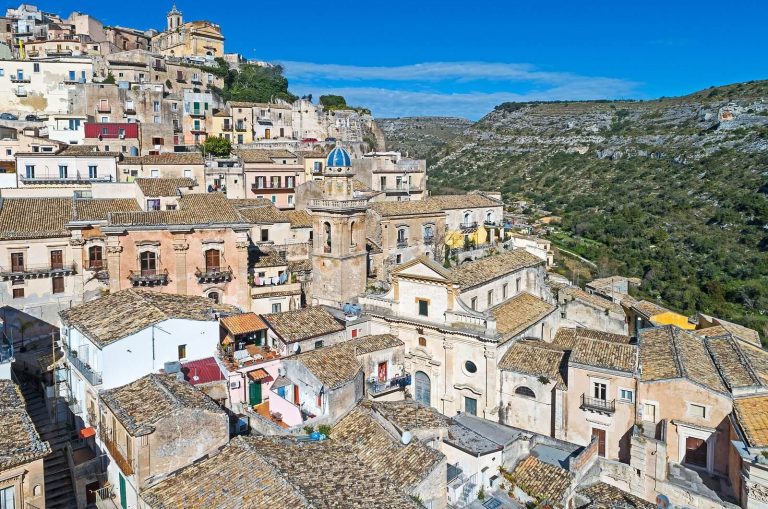
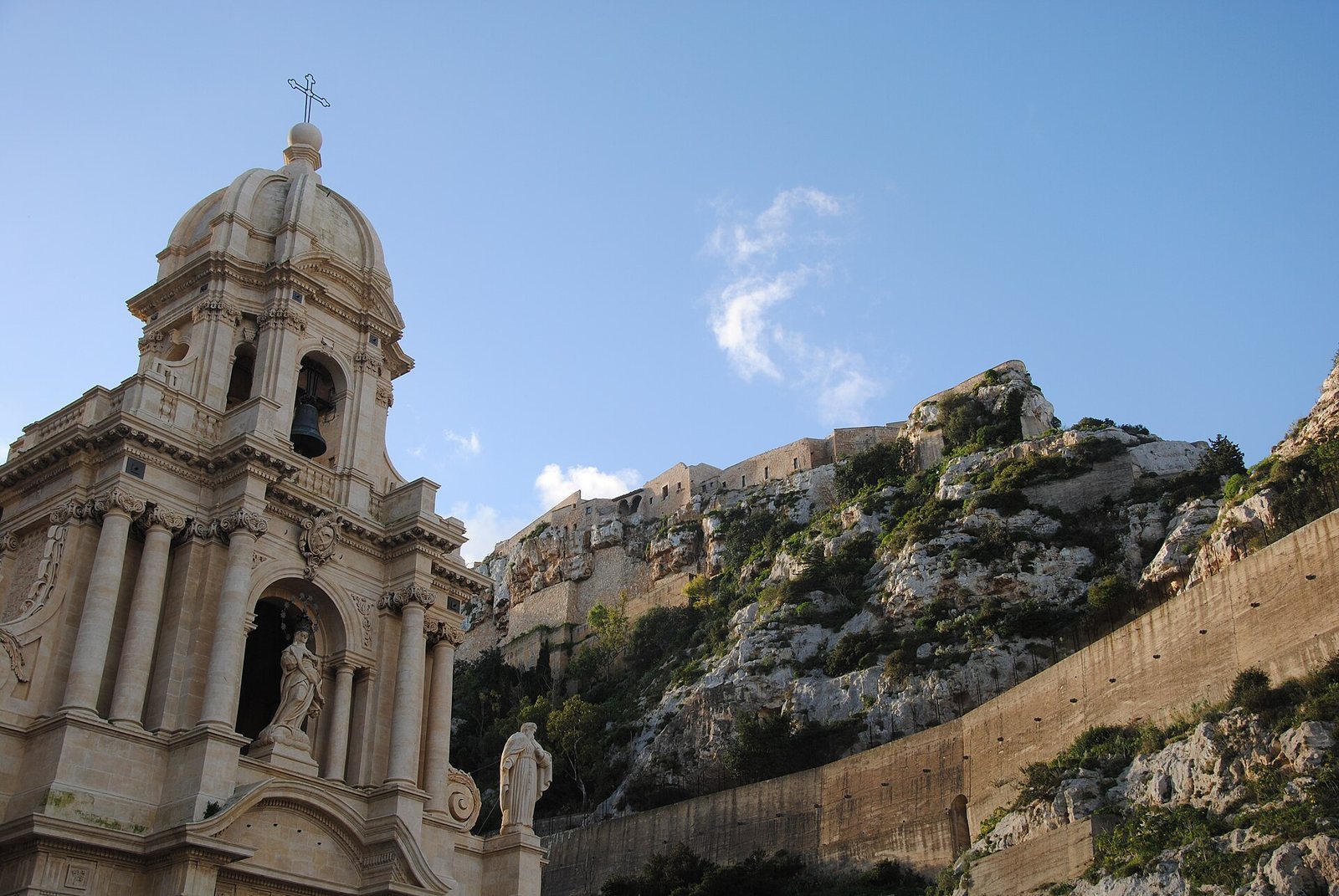
Chiafura extends down the slope of San Matteo hill, from the ridge to the San Bartolomeo valley, a limestone gorge. Rock-cut dwellings form stepped rows and terraces along the hillside. Pacetto described caves positioned one above another from the foot of the hill to its summit, recording larger spaces used as homes and smaller ones used as tombs.
Terraced dwellings
Most cave houses consisted of one or two rectangular rooms, each about 4 to 5 metres on a side. A small cultivated plot often stood in front of a dwelling. Interiors were simple, with features such as ovens, holes cut into the rock, and niches for storing household goods. Some homes had a manger, occasionally made from an earlier tomb. Pacetto also noted stables, rings for tethering animals, windows, and raised sleeping platforms. Some caves contained cisterns probably dating to the early medieval period, while better-appointed homes could have an internal passage between two caves. Later construction included masonry rooms outside cave entrances; some caves also had older adjoining rooms with curved, barrel-shaped ceilings.
Ridge fortifications
The ridge is crowned by the Castellaccio, a Norman tower, and the Castello dei Tre Cantoni, a fortification probably founded during the Byzantine period, the later eastern Roman Empire. Tre Cantoni controlled the meeting point of the Modica, Santa Maria La Nova, and San Bartolomeo ravines. San Matteo church formed part of the historic defensive enclosure, and a track links the Castellaccio with the Castelluccio.
Funerary chambers
Three underground funerary chambers from the Late Roman period, the final centuries of Roman imperial history and the transition to Byzantine rule, lie less than 100 metres from the Castellaccio, in the rock face below the track to the Castelluccio. They belonged to a larger cemetery altered by erosion of the carbonate rock and by later reuse, particularly during the medieval settlement under Arab and Norman regimes. One chamber, entered at ground level, was changed first into a dwelling and later into a stable or sheepfold. Peeling rock has altered the front sections of the other two, which are difficult to reach. The chambers may be the three burial caves mentioned by Scicli historian Antonino Carioti. Byzantine-period tombs with arched recesses were also converted into dwellings.
Archaeological and historical evidence
A few fragments from the Early Bronze Age, dated to 2200–1450 BC, have been found, along with ceramics assigned to the Thapsos facies, a material culture of Bronze Age Sicily. The ceramics were recovered by chance from the hill’s slopes and summit plateau. Painted pottery from the seventh and sixth centuries BC also indicates activity on the hill, though these finds alone do not establish how extensive settlement at Chiafura was. An unsigned, undated ink drawing on paper, attributed to Carioti and found among manuscripts collected by the eighteenth-century historian and antiquarian Vito Amico, depicts seventeenth-century Scicli, including Chiafura’s walls, streets, gates, and cave houses.