Sybaris: An Ancient Greek City in Southern Italy
Site at a Glance
- Popularity
- Very High
- Country
- Italy
- Primary era
- Classical
- Eras represented
- Iron Age, Classical
- Civilizations
- Ancient Greek, Roman
- Site type
- City
On this page13 sections
History
Foundation and expansion
Sybaris was an ancient Greek city on the Gulf of Taranto, at present-day Marina di Sibari, Italy. Achaeans from Achaea in the northern Peloponnese, accompanied by Troezenians, founded it around 720 BC during the Greek settlement of Magna Graecia, the Greek-settled regions of southern Italy. This westward migration followed earlier Greek settlement and was linked to population pressure and a shortage of cultivable land in the settlers’ homeland. The Achaeans later expelled the smaller Troezenian group.
The identity of Sybaris’s founder is uncertain, and the name preserved for him may be corrupt. A local tradition instead attributed the city’s foundation to a son of Ajax the Locrian. The city’s name also has no certain origin, though an ancient explanation connected it with a nearby river.
Fertile farmland, an active port, trade extending to Greek settlements in Asia Minor, and a willingness to accept outsiders as citizens supported Sybaris’s prosperity. It became one of the wealthiest Greek cities in Italy. Ancient estimates of its population range from 100,000 to 300,000; the higher figure is considered exaggerated, while the lower has been judged more plausible. Sybaris was said to control four tribal groups and 25 cities, with influence reaching across the peninsula to the Tyrrhenian Sea. It probably established Poseidonia around 600 BC, as well as Laüs and Scidrus, whose foundation dates are uncertain. Pandosia also appears to have been under its control. Achaeans founded nearby Kroton about ten years after Sybaris.
In the second half of the seventh century BC, Sybarites took over an Oenotrian sanctuary of Athena, associated with an ancient people of southern Italy, at Timpone della Motta. They used the sanctuary as an acropolis, the elevated central area of a settlement, and held regular festivals there.
Alliances, coinage, and the first destruction
Sybaris joined the Achaean colonies of Metapontum and Kroton against the Ionian city of Siris, which they conquered in the middle of the sixth century BC. Sybaris began issuing coins in the latter half of that century; the earliest known examples date to about 530 BC. Its currency followed the Achaean weight standard also used by Kroton, Caulonia, and Metapontum. Later coins showing Kroton’s tripod on one face and Sybaris’s bull on the other point to a period when Sybaris was a dependent ally of Kroton. A law possibly enacted in the sixth century BC may have given chefs or bakers a year of protection for their culinary creations, an early form of intellectual-property protection.
In 510/509 BC, Telys, a popular leader described by Herodotus as a tyrant, overthrew the oligarchy, a government controlled by a small group. Telys expelled 500 wealthy citizens and seized their property. When the exiles sought refuge at Kroton’s altars, he demanded that they be returned and threatened war. Pythagoras, the Greek philosopher and religious teacher, persuaded the Krotonians to protect them.
The ensuing battle ended in a Krotonian victory. Most Sybarites were killed, and the city was looted and razed. Ancient figures of 300,000 Sybarite troops facing 100,000 Krotonians are grossly inflated. Herodotus says the Spartan prince Dorieus helped the Krotonians. Telys and his supporters may have been killed between the battle and the sack, which were placed either nine days or two months apart. Strabo later claimed that the Krotonians diverted the Crati River to flood Sybaris. Sediment cores do not support that explanation; natural flooding and the buildup of river deposits are considered more likely causes of the city’s burial.
The destruction did not necessarily end Sybaris as a community. Survivors sought refuge at Laüs and Scidrus, and some may have gone to Poseidonia. That city’s use of Sybaris’s bull emblem and coin-weight standard has been taken as evidence for the presence of refugees, and a substantial merger of the two communities has been proposed. Sybaris appears to have continued as a dependent ally of Kroton, and some members of the Pythagorean movement are said to have moved there after its subjugation.
Siege and refounding
Kroton besieged Sybaris again in 476/475 BC. The Sybarites appealed to Hiero I of Syracuse, who assigned a relief force to his brother Polyzelos. The plan reportedly placed Polyzelos in danger of being killed, and he refused the command after suspecting this intention. He took refuge with Theron, the ruler of Acragas. Accounts of the siege’s outcome differ: Diodorus’s narrative implies another Sybarite defeat, while Timaeus and two scholia credit Polyzelos with ending the siege. Polyzelos later fled to Acragas after accusations that he planned a revolt.
Sybarites returned to their former site in 452/451 BC under a leader from Thessaly. Poseidonia may have helped establish the new settlement: its coins resemble the new Sybarite issues, and it guaranteed a possible treaty involving Sybaris, its allies, and the otherwise unidentified Serdaioi. Kroton expelled the Sybarites again in 446/445 BC.
In the mid-fifth century BC, around the time of the Thirty Years’ Peace of 445 BC, a treaty intended to secure a truce between Athens and Sparta, Sybarites sought help from both states and from other Peloponnesian communities. An Athenian expedition dated to 446/445 BC reinforced the population at Sybaris, but disputes between Sybarites and newcomers led to the Sybarites’ expulsion in 445 BC. In 444/443 BC, Athenians and other Greek settlers founded Thurii partly over the older city. Thurii’s democratic constitution divided citizens into ten tribes but excluded the Sybarites. Conflict there resulted in the deaths of nearly all the Sybarites; some survivors founded another settlement named Sybaris on the Traeis shortly after 444 BC.
Thurii was destroyed in 193 BC. The Romans later established Copia on the same street grid as Thurii, creating a sequence of three cities at the site.
Later reputation and rediscovery
Ancient literature made Sybaris a byword for wealth, feasting, and luxury. The English words sybarite and sybaritic came to describe extravagant pleasure-seeking. Later writers of the Roman period often presented the city’s defeat as divine punishment. Athenaeus preserves stories of a warning from the oracle at Delphi, where Apollo’s priestess gave responses to visitors, and of Sybarite internal strife. Other tales describe the killing and non-burial of Krotonian envoys, deaths among Telys’s supporters at altars, and efforts to rival the Olympic Games with more generous prizes. One story says Sybarite cavalry horses had learned to dance to flute music and ran toward Krotonian musicians during the battle. Claudius Aelianus connected the city’s fall to the killing of a musician at Hera’s altar. Vanessa Gorman rejected the divine-punishment stories as conventional fictional motifs; Vanessa and Robert Gorman argued that Athenaeus reshaped earlier accounts and added material. Peter Green likewise regarded the stories as moralizing inventions and proposed Sybaris’s wealth as a more plausible motive for Kroton’s attack.
Early nineteenth-century searches preceded the rediscovery of the ruins and the start of excavations in 1932. A major core-drilling project beginning in the early 1960s helped establish the location of the buried city, and archaeologist Donald F. Brown is credited with identifying it during that work. An archaeological museum in the area houses many finds. Flooding in 2013 inundated the excavated site and covered it with silt. As of 2023, powerful pumps were still needed continuously to remove groundwater.
Remains
Coastal setting and burial
Sybaris occupied an estimated 500 hectares on a coastal ridge close to the sea and a lagoon, between the Crathis and Sybaris rivers. Its circumference was estimated at about 50 stadia, an ancient Greek distance measure equivalent here to roughly 9.7 kilometres. The rivers are now called the Crati and Coscile. Today the Coscile joins the Crati about five kilometres from the latter’s mouth, and the Crati runs just south of the archaeological site. In Sybaris’s time, the Coscile probably took a more direct route to the Gulf of Taranto and entered it a short distance to the north.
The city lay on a broad, fertile plain subject to periodic flooding. More than six metres of river deposits accumulated over the ancient settlement, and its buried remains now lie below the present groundwater level.
Successive urban layers
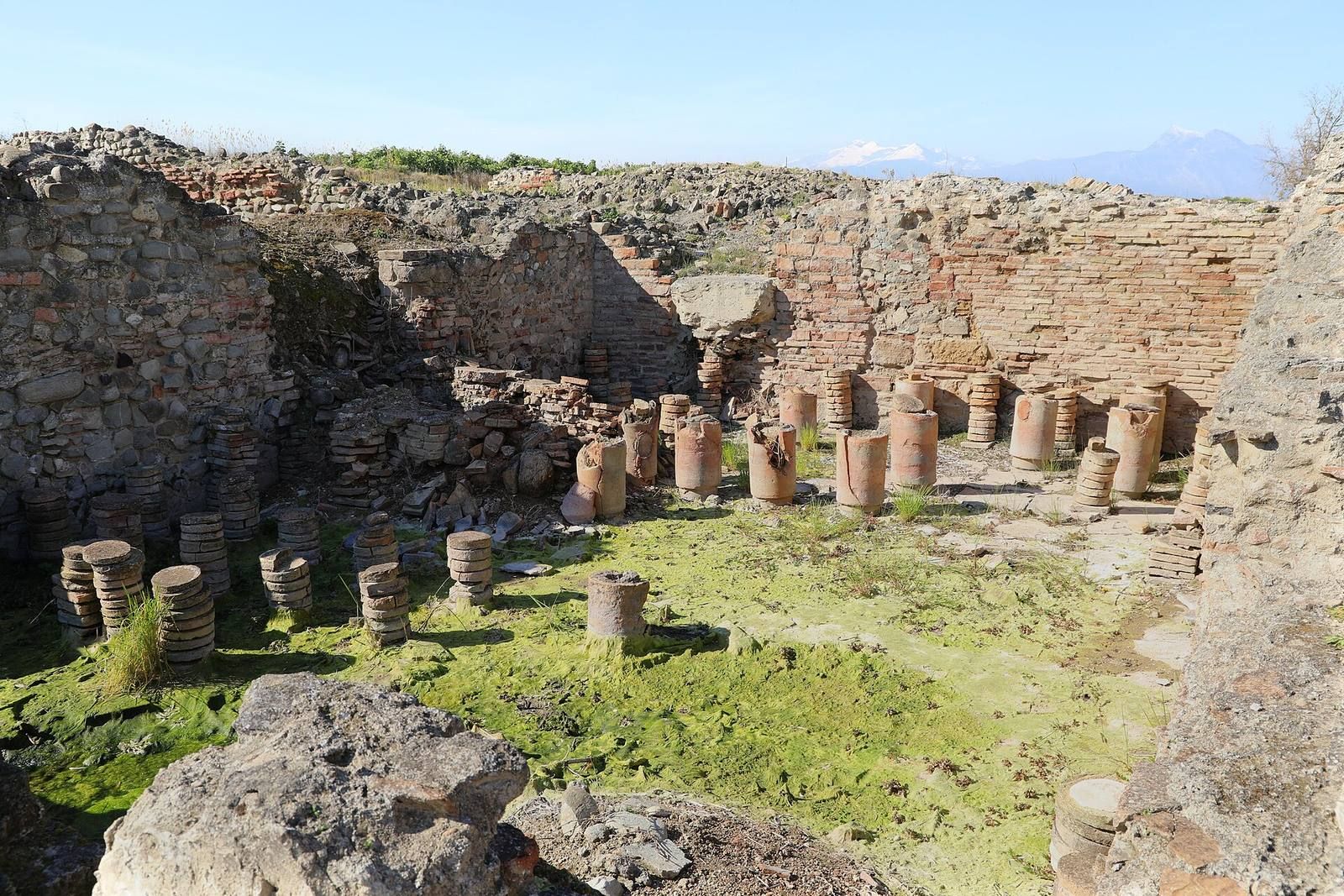
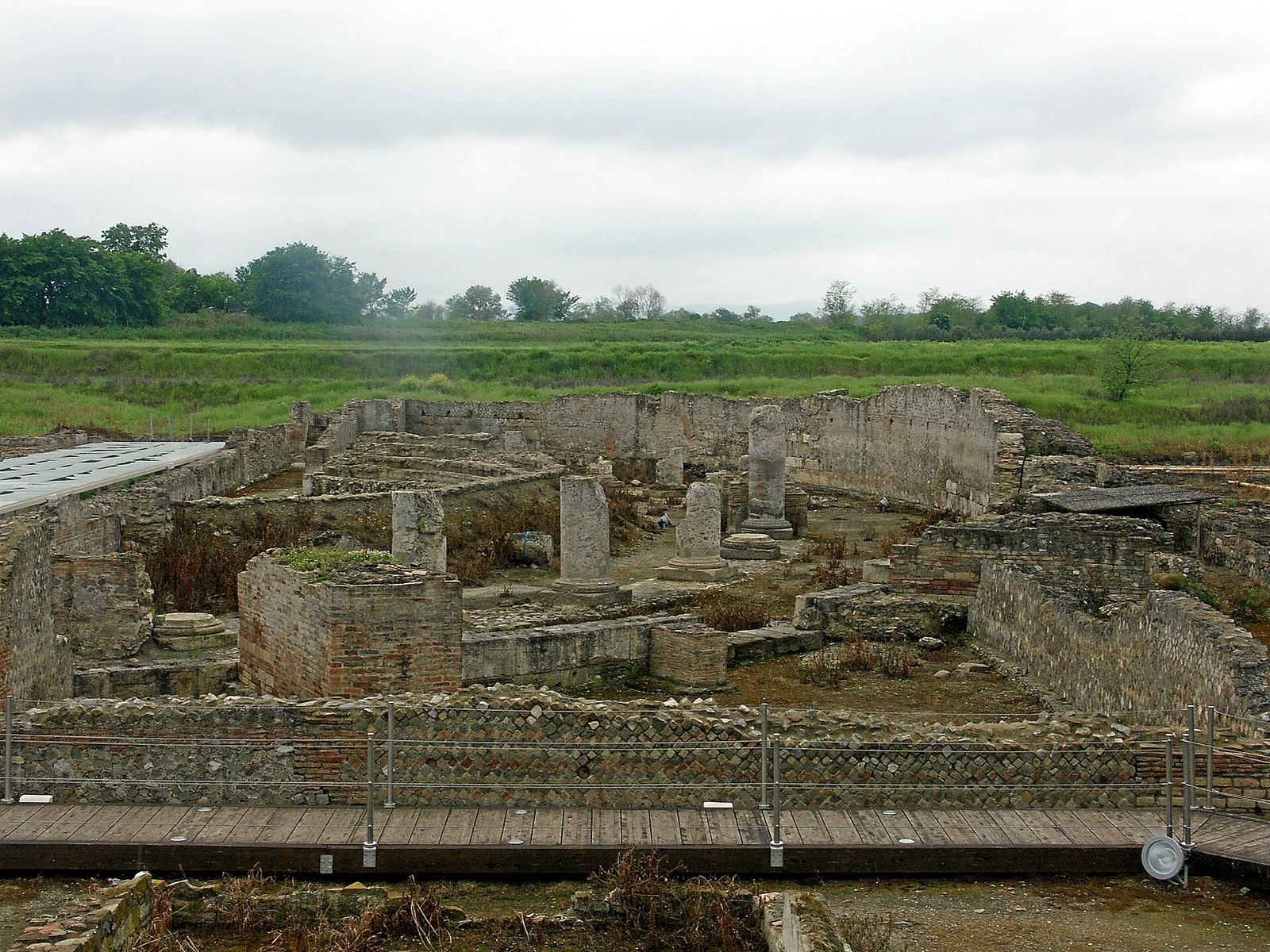
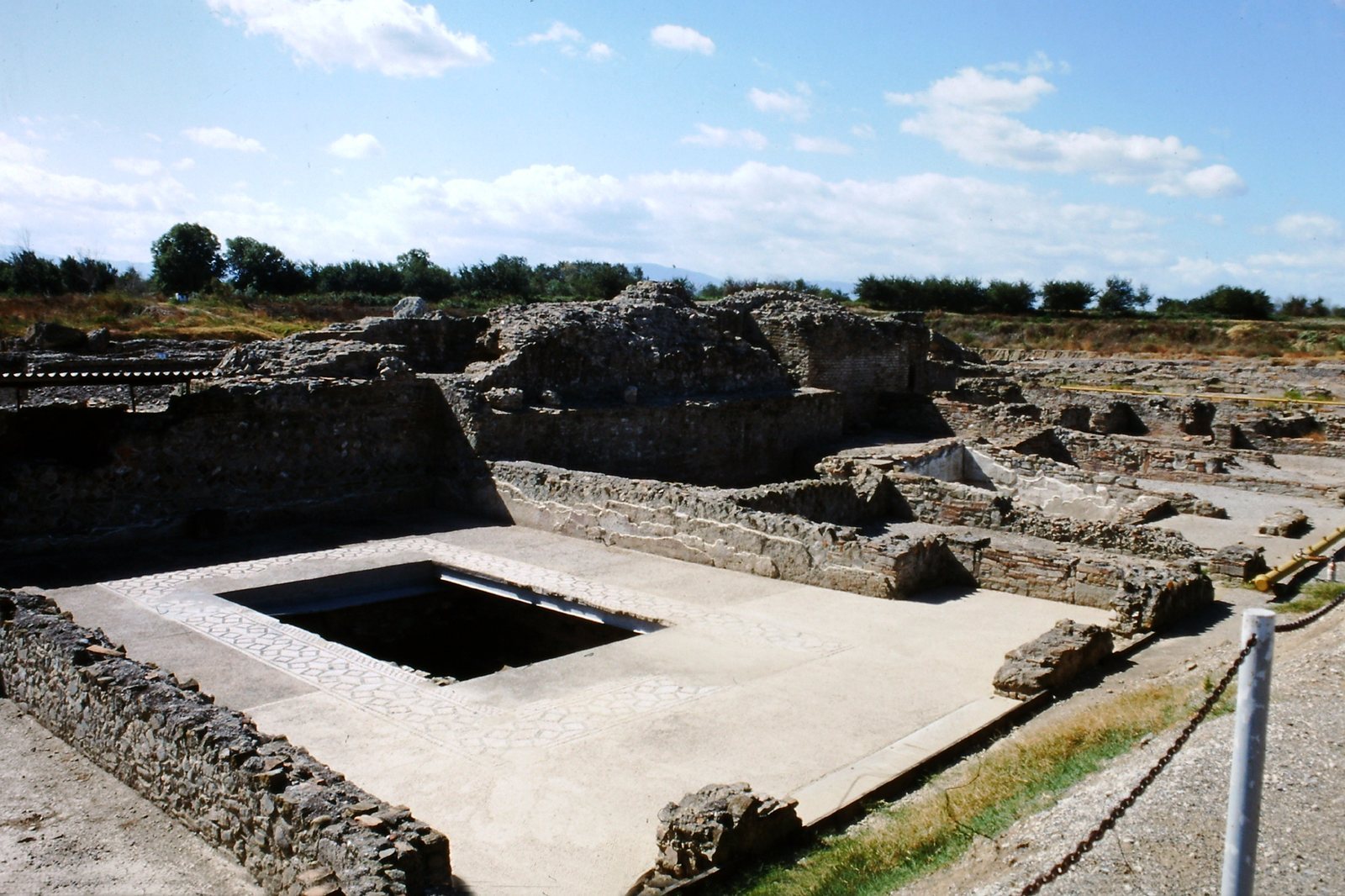
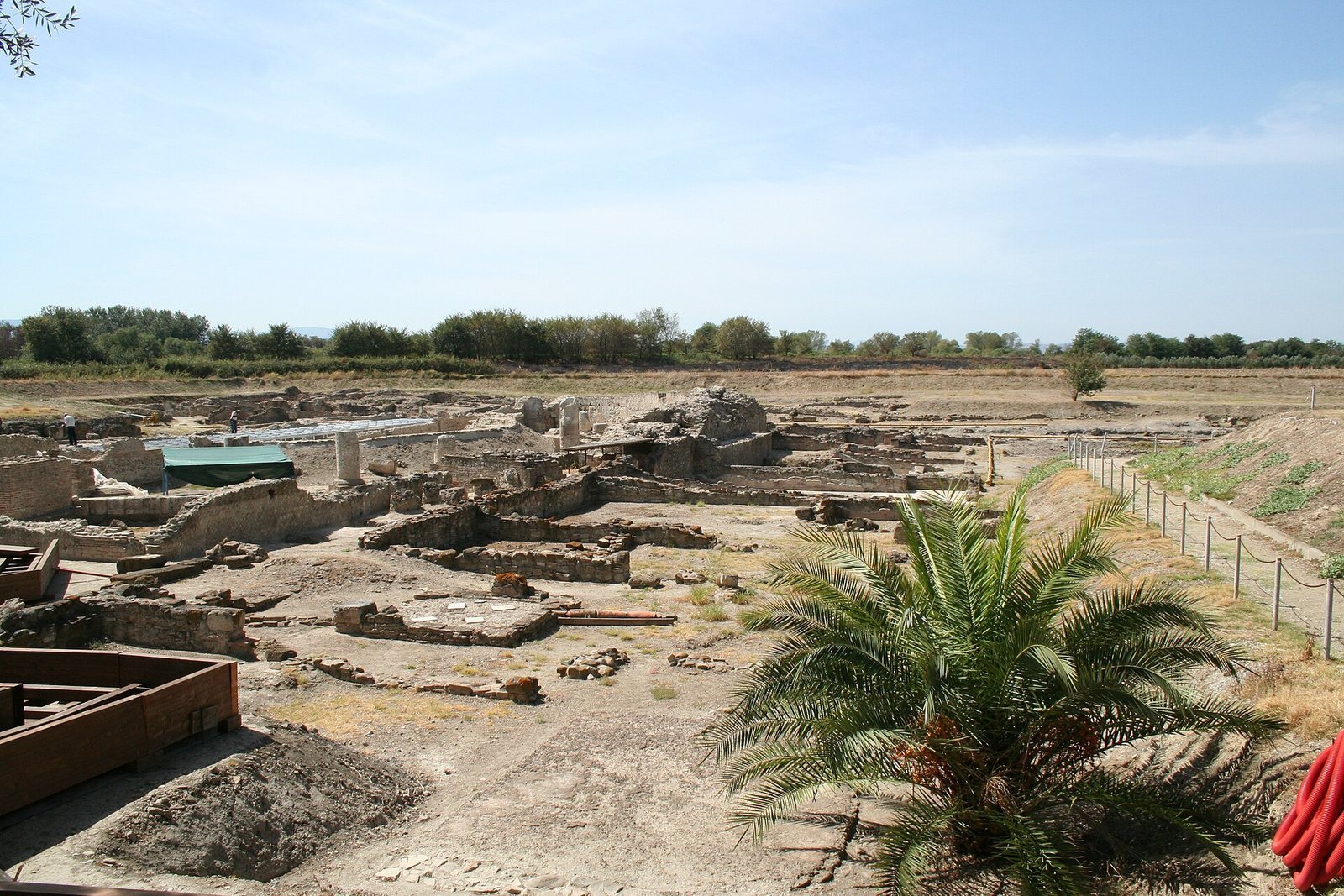
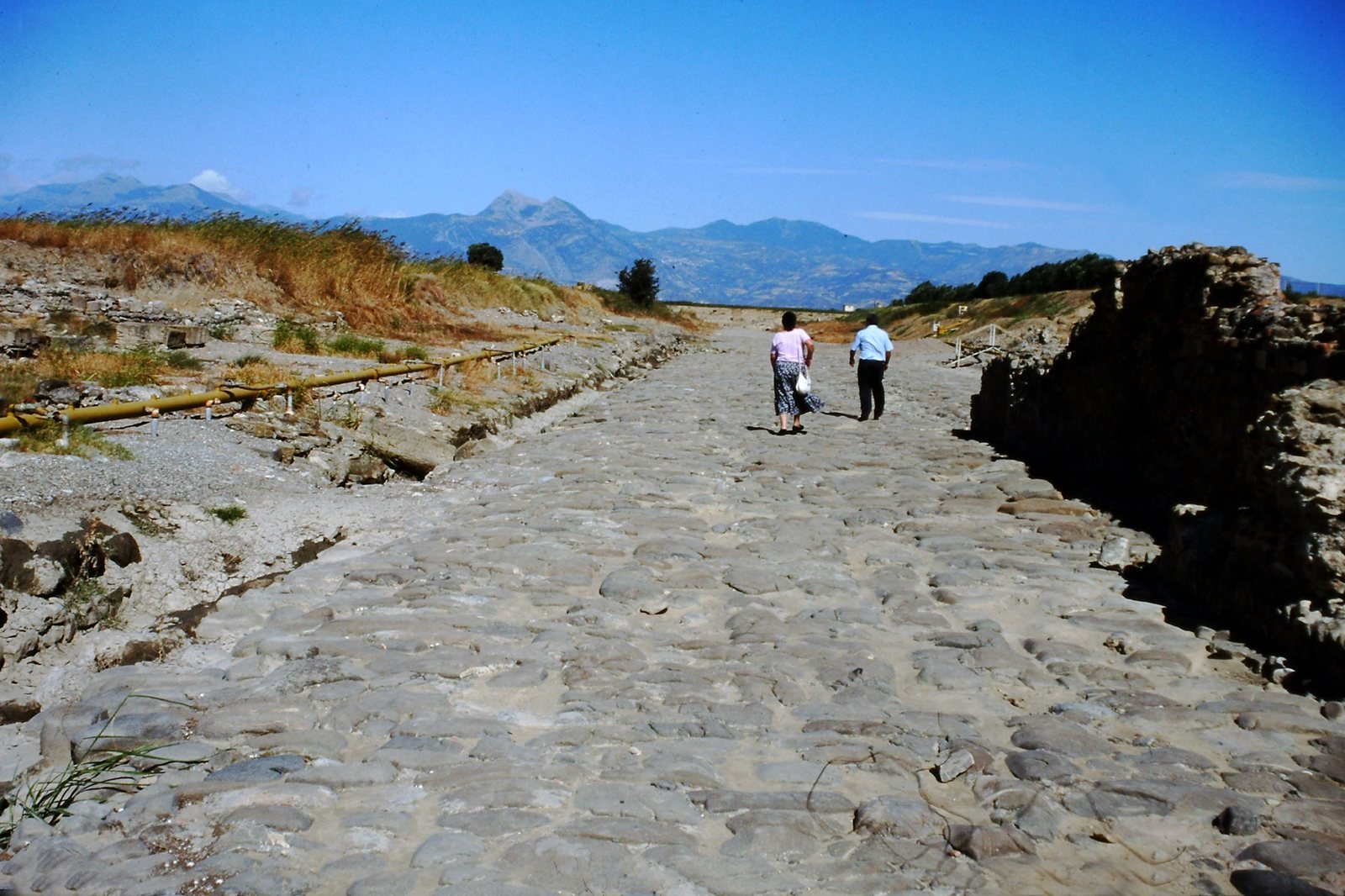
Thurii and Copia were built partly over Sybaris. Copia followed Thurii’s street grid, and parts of all three successive cities can be seen in the archaeological remains.
Excavated areas and associated remains
Stombi quarter
The Stombi quarter is one of the excavated areas of Sybaris.
Parco del Cavallo
Small test pits in the Parco del Cavallo area yielded richly decorated architectural pieces from a temple whose identity remains uncertain. The concentration of these finds in a small area has been interpreted as evidence of the city’s former magnificence.
Theatre
The remains of Sybaris include a theatre.
Timpone della Motta sanctuary
The sanctuary of Athena at Timpone della Motta stands on high ground overlooking the Crati plain, near Francavilla Marittima and roughly 10 to 15 kilometres northwest of Sybaris. It was used as the city’s acropolis.