The Hermitage of Saint-Guillem Combret: A Medieval Chapel in the French Pyrenees
Site at a Glance
- Popularity
- Low
- Country
- France
- Primary era
- Medieval
- Eras represented
- Medieval, Early Modern
- Civilizations
- Crown of Aragon
- Site type
- Religious
- Remains
- Chapel
On this page17 sections
History
The hermitage of Saint-Guillem Combret is a medieval chapel in the Coumelade valley, within the commune of Le Tech in France. Its surviving design combines a plan associated with regional pre-Romanesque churches with masonry and vaulting that point to work no earlier than the second half of the 12th century, although an origin in the 10th century is possible. The chapel has long been linked to shelter for travellers crossing the Canigou massif.
Origins and foundation traditions
A document dated 1007 refers to a refuge belonging to Guillem, but it is unclear whether this means the hermitage or the Pla Guillem plateau. The two places were connected by routes across the massif and by seasonal livestock movements. The chapel’s foundation is traditionally credited to a hermit named Guillem, whose life has been placed in different periods, from the 7th to the 11th century or earlier. He may have been a local religious figure later called a saint without formal canonization. A possible identification with William of Gellone, a count and saint of the Carolingian period, or with the semi-legendary Guillem of Llívia remains uncertain.
In the foundation story, fairies lived in a palace in the Cady valley while a dragon guarded it. Guillem’s arrival supposedly brought storms, fires, and earthquakes. An angel gave him a sword, and he used it to defeat the dragon and drive away the fairies. He then lived as a hermit in a cave in the Coumelade valley, eating forest produce and, in winter, drinking milk from female fallow deer and chamois. Farmers came to hear him during summer, and the story says that shepherds helped him build a church.
Medieval church and forest
The chapel was first dedicated to Mary Magdalene, a follower of Jesus in Christian tradition. A record from 1195 places it under the parish of Saint Juste at Prats-de-Mollo and notes its transfer to the Abbey of Saint Mary at Arles-sur-Tech by Guillem de Ceret, bishop of Elne. Between 1195 and 1198, the abbot granted the church a customary payment of one hen. By 1329, the chapel had adopted the shared patronage of Mary Magdalene and Guillem. Permission to establish two water-powered forges at the site was granted in 1321.
During the 14th century, the surrounding woodland belonged to the royal domain. Concessions allowed people to exploit the forest, but trees suitable for shipbuilding were reserved for the king. Logging and charcoal production greatly reduced the woodland, which had disappeared by the 20th century. Replanting began in the 19th century and increased after the disastrous 1940 flood in the Roussillon plain.
The name Combret, written as Combred in the 12th century, was once used for the Coumelade. Its origin is unresolved. One possibility links it to the Germanic word Comboros, meaning rocky ground; another connects it with the Gaulish Combra, meaning a confluence or barrier, as in the Aveyron village of Combret.
Resident hermits and upheaval
Records preserve the names of several hermits. Miquel Deltrull was noted on 29 June 1695. Pere Corominas died on 25 November 1727, and Jérôme Rondoni, recorded at the site in 1752, died on 25 December 1760. Joseph Falgos died on 31 August 1763. Climent Orri was recorded at the hermitage in 1818 and died on 31 March 1840.
Orri lived at the chapel in summer and spent winters in nearby villages, where he told religious tales and recited prayers. He died in Prats-de-Mollo at the age of 61. Local tradition says that, at his request, his body was carried from the hospice there and buried near the hermitage. Another story relates that villagers held a dance at an aplec, a Catalan religious gathering combining pilgrimage or a votive feast, despite Orri’s objections. He prayed beside the Coumelade and threw his crucifix into the water; a fierce downpour then lasted over the hermitage until nightfall.
Revolutionary law suppressed worship at the chapel in 1790, and it resumed in 1795. Its ownership and use during those years are not certain. It may have been seized and sold as national property. A different family tradition says it was never sold, but instead stood abandoned and was used as a farm building until a nearby landowner, M. Sors, bought it from a farmer in 1793 in exchange for two draft oxen. Sors made repairs, including to the hermit’s dwelling, and the chapel remained with his descendants.
Continuing devotion and modern recognition
The last known hermit died in 1840. Although the chapel is no longer a parish church, Mass is held at two traditional gatherings each year: on 28 May for Saint Guillem and on 22 July for Mary Magdalene. These occasions include the sharing of small blessed loaves and may feature processions, dancing, and a communal meal. Devotional songs, known as goigs, recount the lives and attributed miracles of Guillem, Mary Magdalene, and Saint Lucy.
The hermitage also entered Catalan literary works. Jacint Verdaguer’s 1901 epic Canigó evokes the hermit Guillem and presents his story as a popular tradition in the Vallespir. Canon Jacques Boher wrote a verse play about the chapel that received a silver palm at a Banyuls competition in 1887. Studies of the building appeared in 1860 and 1899.
The chapel was restored in 1982. Three associated objects, the iron bell, an alms dish, and a chalice with its paten, were listed as historic objects in 2003; the chapel itself was registered as a Historic Monument on 7 December 2009. A preservation association was founded in 2012, and a campaign to restore the 1659 altarpiece began in 2017.
Remains
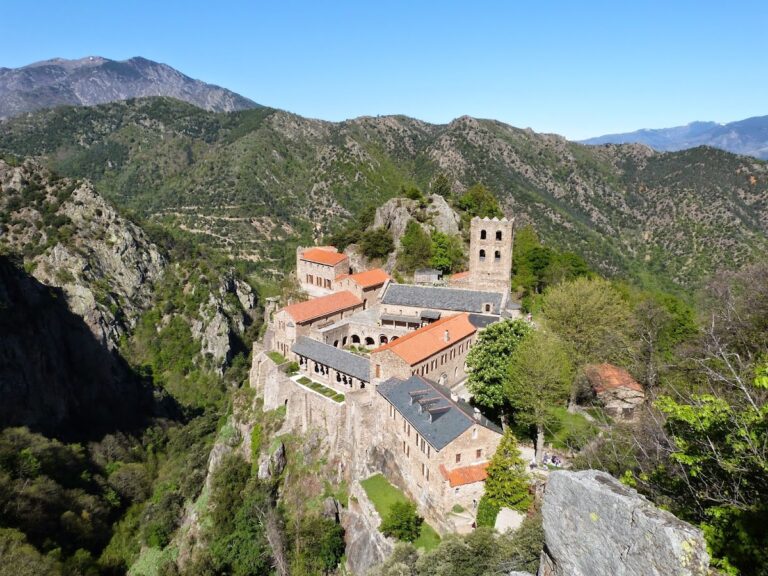
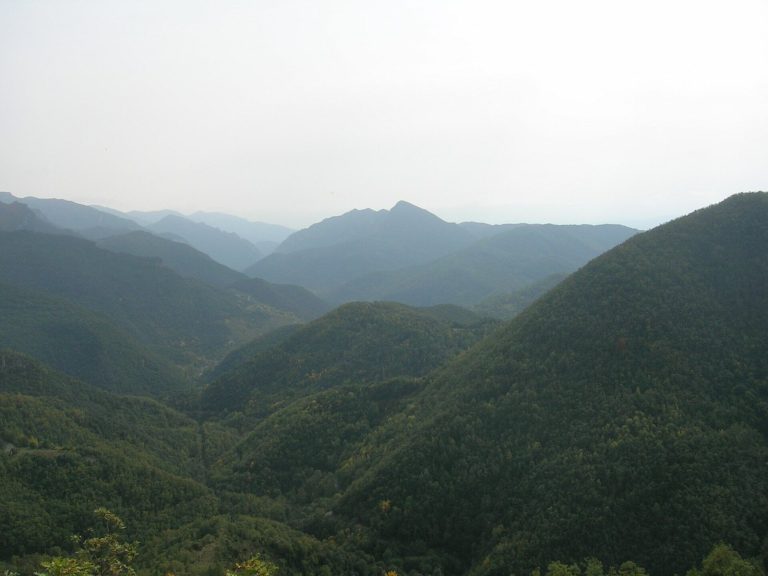
The hermitage stands on the southern slope of the Canigou massif, at about 1,330 metres above sea level. The chapel occupies a knoll roughly 50 metres above the Coumelade stream, within the Vallespir state forest. The complex includes the chapel and an adjoining dwelling. Disused buildings stand a short distance downstream, while an iron cross is positioned upstream.
The chapel
Plan and masonry
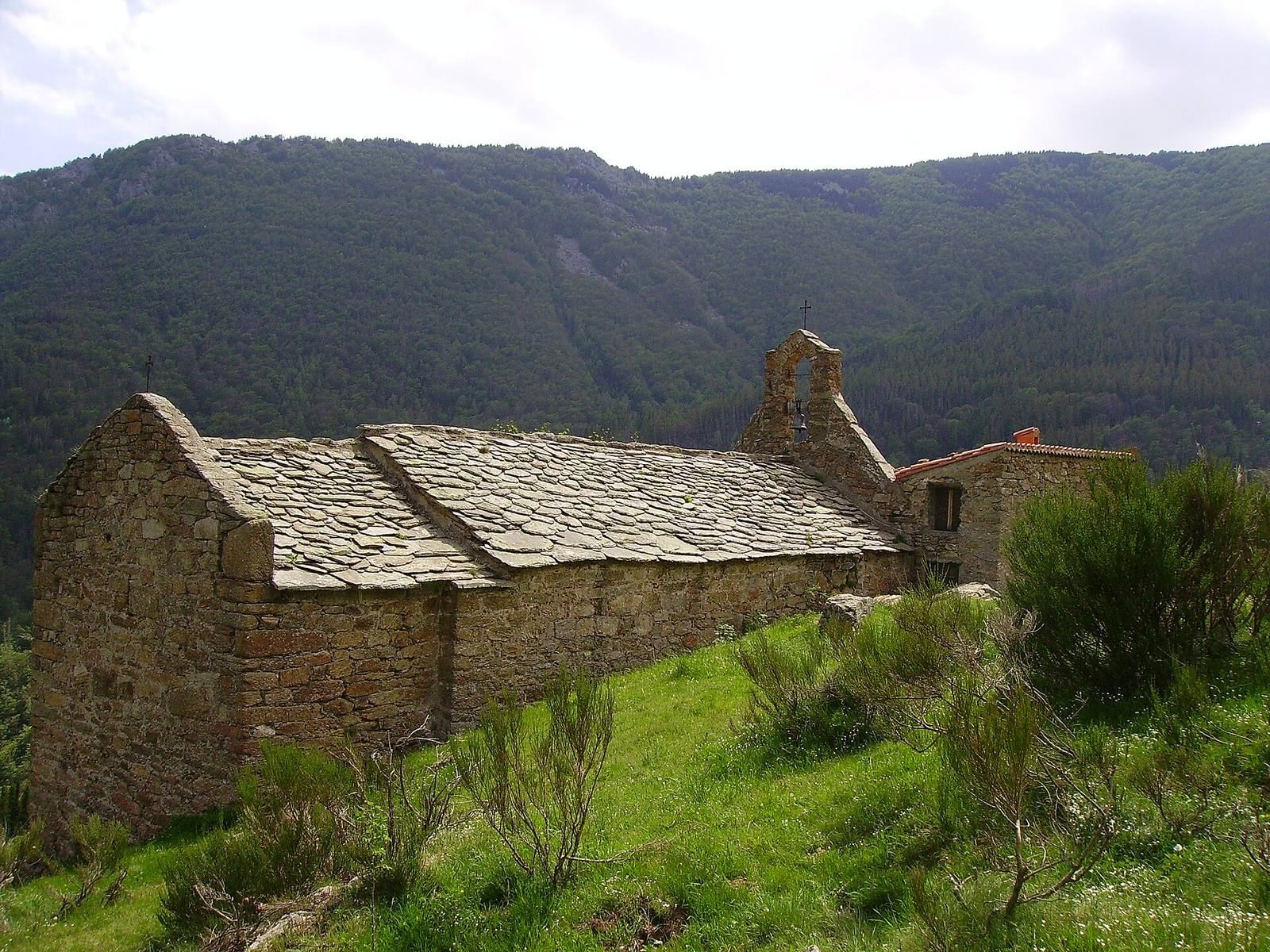
The chapel measures about 17 metres by 7 metres and runs east to west. Its main worship space, or nave, is rectangular, while the roughly square sanctuary end, called the apse, is slightly wider than it is deep. The apse is set at a small angle to the nave. The layout resembles regional pre-Romanesque churches, but the building’s masonry and vaulting indicate a date no earlier than the second half of the 12th century; an earlier origin in the 10th century remains possible. Walls about 1.4 metres thick are made of rough rubble, with larger corner stones, some reaching 60 centimetres in length. Lime mortar partly covers the interior. A sharply pointed barrel vault forms the nave ceiling.
Windows, entrance, and roof
Four small windows light the chapel, two in the south and west walls of the nave and two in the south and east walls of the apse. Each opening widens or bevels through the thickness of the wall. The small rectangular entrance is in the south wall, reached by four steps. Broad cut stones frame its lintelled opening, which has no relieving arch. Each of the door’s two leaves carries an iron ring, one roughly rectangular in cross-section and the other circular.
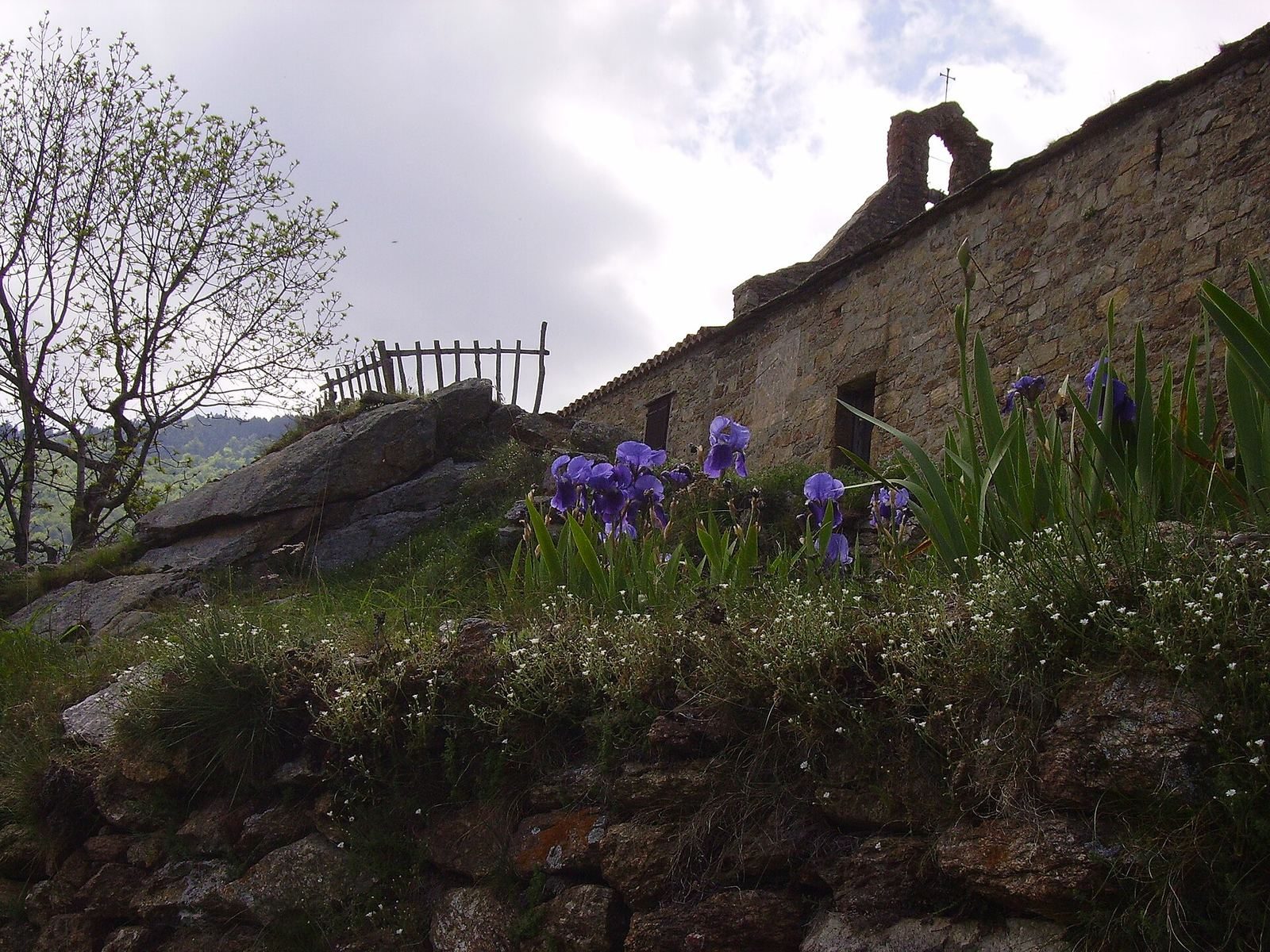
Broad, thick gneiss slabs cover the roof and also pave the floor. A later bell gable, a raised section of wall with an opening for bells, rises above the west wall. Its single opening could accommodate two bells. Repairs completed by 2016 renewed the roof, door, bell gable, and sundial; the roof was repaired with gneiss slabs in 2015.
Altar and bells
The original altar is a single granite slab about 2 metres long, 1 metre wide, and 25 centimetres thick, set on a masonry base with a prismatic form. Tradition says Guillem carried the heavy stone alone from the Coumelade’s banks.
The original bell, dated to the 11th or 12th century, was made from two forged iron plates, the larger about 29 centimetres across. This uncommon, old-fashioned method probably made use of iron from the Canigou area and was economical; it also gives the bell a distinctive sound. The bell is now held at the departmental art-restoration workshop in Perpignan. A replacement bell, donated in 1876, hangs at the chapel. It is decorated with fleurs-de-lis, the Virgin, and Christ, and carries the names of its donor and maker. The legend of Guillem adds that he forged the iron bell miraculously after miners offered him only as much iron as he could hold in his hands.
Altarpiece and devotional furnishings
Altarpiece and Virgin and Child
The chapel’s altarpiece dates to 1659. Three panels, divided by carved columns made to resemble columns, each have three tiers, with paintings above and below a central niche. The central upper painting shows the Assumption of the Virgin, the Christian belief that Mary was taken into heaven at the end of her earthly life. Other upper images include two women who may refer to blind women in the Guillem of Llívia legend, Mary Magdalene, and a man among wild goats in a pastoral landscape, probably Guillem. The lower paintings show Saints Justa and Rufina, Saints Abdon and Sennen, and Saints Cosmas and Damian.
A wooden Virgin and Child, possibly from the 14th century, was placed in the central niche. The statue is carved from solid wood, and several of its parts are later additions. Its painted decoration dates to about 1700 and may have been applied by the Escribà family workshop of Perpignan. The statue was restored in 2009.
Sculpted figures and reliquary
Other furnishings associated with the chapel include an 18th-century statue of Mary Magdalene, 17th-century figures of John the Baptist and a person probably representing Guillem, and a hand-shaped container for a relic of Mary Magdalene. These pieces are kept in Perpignan for restoration and protection.
The figure thought to represent Guillem is 79.5 centimetres tall. It depicts a bearded, long-haired man wearing a cloak and tunic, with a book in his left hand. The statue is assembled from several pieces of hardwood and was made for an altarpiece. It was originally gilded using a water-based method and decorated by scratching through a surface layer to reveal another beneath. Later repainting and regilding altered its appearance.
Metalwork and vessels
A 16th-century brass alms dish, 32 centimetres across, shows Abraham’s sacrifice of Isaac in relief. It is Germanic in style and is held in Perpignan. The chapel’s chalice and small round paten date to around 1500; the paten measures 13 centimetres across. The chalice is 21 centimetres high, with a foot 13.5 centimetres wide. Flowers, symbols of Christ’s Passion, and Saint Sebastian decorate the foot. An inscription beneath it reads A TERRATS PRE DE ST ION. The stem has a crosshatched knob, and the 8-centimetre cup is soldered to the foot. A maker’s mark links the vessel to an unidentified Perpignan goldsmith. Both pieces are kept in Perpignan.
A 13th-century processional cross, made from six gilded copper plates joined with copper nails, belongs to a private collection. Its engraved geometric patterns resemble leaves, and 20 round stones, probably carnelian, decorate its arms.
Medieval manuscripts
The Liber misticus
The 11th-century Liber misticus, a liturgical book combining texts used by clergy, is a parchment manuscript of 61 leaves measuring 21 by 15 centimetres. Its contents include part of a missal, a breviary for daily prayer, a ritual, and a Mass for the dead. The manuscript once associated with the chapel was sold by a priest to an antiquarian, acquired by the Bibliothèque nationale de France in 1893, and rediscovered there in the early 1980s.
The Arles missal
The Arles missal, also called the Arles sacramentary, dates to the second half of the 12th century. This Mass prayer book has 157 leaves and measures 25 by 18 centimetres. It is held as Manuscript 4 at the Perpignan municipal media library, after being found in a church chest in the 19th century. Its contents include blessings, a calendar, the order of Mass, a genealogy of Christ, seasonal and saints’ services, and prayers for particular occasions and funerals. Eight votive Masses were added in the 13th century, and 17th-century paper leaves contain Masses for Guillem and Mary Magdalene.
A note on the eighth leaf records Abbot Robert’s grant of the customary hen payment to the church. Another leaf bears a colored Crucifixion, dated by its style to the first half of the 12th century or somewhat later if it deliberately imitates an older style. Christ is shown with open eyes and his head inclined to the right, with Mary on one side and John the Baptist, the prophet who baptized Jesus, on the other. The red-and-black cross stands on a rudimentary Golgotha, the place identified in Christian tradition as the site of Jesus’s crucifixion. The figures’ feet do not touch the ground, and John’s red halo may refer to his martyrdom.