Basilica Ave Gratia Plena: A Marian Sanctuary and Pontifical Minor Basilica
Site at a Glance
- Popularity
- Medium
- Country
- Italy
- Primary era
- Early Modern
- Eras represented
- Medieval, Early Modern, Modern
- Civilizations
- Italian, Kingdom of Naples, Kingdom of the Two Sicilies, Spanish
- Site type
- Religious
- Remains
- Basilica
On this page13 sections
History
Basilica Ave Gratia Plena is a Roman Catholic church in Torre Annunziata, Italy, dedicated to Mary under the title Madonna della Neve. It belongs to the Diocese of Nola, the Catholic district governed by a bishop, and became the town’s principal Catholic place of worship and a focus in the growth of its historic centre. Founded in 1448 and completed in 1622, the church combines Baroque and late Renaissance features. It was also known historically as the Church of the Annunciation.
The coastal settlement and the image
On 19 September 1319, Charles of Anjou, then regent of the Kingdom of Naples for his father, Robert of Anjou, granted four local men four moggia of land at Calcarola. A moggio was a historical measure of land area whose size varied by place and period. Guglielmo da Nocera, Matteo de Avitabulo, Puccio Franconi da Napoli, and Andrea Petrucci da Scafati had sought the land so they could build, at their own expense, a chapel to the Virgin of the Annunciation and a hospice for travellers. The grant covered wooded land along the Silva Mala shore, where public roads towards Scafati and the marina of Stabia met.
A chapel near the coast and a defensive tower built by the counts of Orsini of Nola to deter raiders formed the nucleus of a settlement called Torre dell’Annunciata. The early settlement occupied the area of the present-day urban triangle between Via Castello, Via Zingari, and Via Caccia.
Local tradition places the discovery of the Madonna della Neve image in the second half of the fourteenth century. On the morning of 5 August, fishermen from Torre Annunziata supposedly found it in a floating wooden chest near the rock of Rovigliano. Fishermen from Castellammare di Stabia also claimed the image, but a magistrate awarded it to Torre Annunziata, and it was taken to the small Church of the Annunciation. The townspeople named it Santa Maria ad Nives, or Our Lady of the Snows, linking its discovery to a tradition that snow fell on Rome on 5 August 352.
The church and the Celestine community
By 1448, the original coastal chapel had fallen into serious disrepair. The feudal lord Nicola d’Alagno established the present church on a more sheltered inland site and brought in the Celestine Fathers, a Catholic monastic congregation in the Benedictine tradition, to provide worship and pastoral care for the growing population. He also built an adjoining monastery. On 29 November 1498, his nephew Nicola II d’Alagno gave the church and enlarged monastery to the Celestines in perpetuity. As the community grew, its establishment advanced from a priory to an abbey.
Local religious memory associated the image with protection from corsair attacks. It credits the retreat or failure of expeditions linked to Hayreddin Barbarossa, an Ottoman admiral and corsair, in 1534; Dragut, an Ottoman corsair and naval commander, in 1549; Pasha Mustafa in 1558; and the fleet of the Duke of Guise in 1615. In the tradition, other coastal settlements in the Gulf of Naples were sacked during these episodes.
Devotional stories also connect the image with relief from hardship. During the famine of 1764, a foreign merchant ship carrying grain was said to have reached the shore after collective prayers. In 1777, following five months of drought, a penitential procession with the image was followed by the swift arrival of a rain-bearing cloud. In 1807, Napoleonic measures suppressing religious communities led to the Celestine Fathers’ expulsion from the kingdom on 29 May. The abbey became a parish administered by the Diocese of Nola, with Gaetano Lombardi, formerly the convent’s prior, as its first diocesan parish priest.
Nineteenth-century change and volcanic crises
During Vesuvius’s 1822 eruption, 48 hours of intense activity left Torre Annunziata in darkness under ash and small volcanic stones. Led by priest Rocco Baly, a penitential procession carrying the image went to the waters off Santa Teresa. Local religious tradition says a sudden ray of sunlight fell on the image as lava flows halted in the direction of nearby Boscotrecase. Town authorities made 22 October an official thanksgiving feast.
At parish priest Francesco Gallo’s request, the church underwent a major enlargement from 1845 to 1855. Gallo contributed substantially from his own funds alongside municipal allocations. Bishop of Nola Giuseppe Formisano consecrated the enlarged church on 25 October 1856.
Modern events and ecclesiastical status
Local religious tradition credits the Madonna della Neve with protecting Torre Annunziata during the 1906 eruption of Vesuvius. Lava reportedly stopped 50 metres from the cemetery and surrounded the municipal aqueduct reservoir without damaging it. On 22 October 1922, the centenary of the 1822 eruption, Bishop Carlo Gregorio Grasso placed a gold crown on the image by decree of the Vatican Chapter, the group of canons associated with St. Peter’s Basilica.
During the 1944 eruption, hot lava advanced towards the town as Allied military authorities ordered an immediate evacuation. Residents defied restrictions to carry the image in procession, led by parish priest Emilio Lambiase. At Piazza Cesàro, devotional tradition holds that sunlight struck the image and four white doves circled its portable shrine.
On the evening of 21 January 1946, a fire aboard a State Railways train carrying high-explosive ammunition at the town’s maritime station led to four successive explosions. The train carried more than 20 wagons. The blasts destroyed the seafront quarter, killing 52 people and injuring about 600, and badly damaged the church. The entrance door fell, large windows were dislodged, and furnishings were damaged. The Madonna della Neve chapel remained intact, including the glass of its silver shrine and the Sacred Heart altar. Reconstruction and restoration, coordinated by the Civil Engineering Corps and Lambiase, concluded in summer 1947.
Bishop Adolfo Binni raised the parish to the status of a Marian sanctuary by decree on 25 March 1954. On 19 April 1959, mayor Luigi Lettieri formally consecrated Torre Annunziata to the Heart of Mary, a Catholic devotion to Mary’s spiritual life and virtues, at a ceremony in Piazza Cesàro attended by Cardinal Alfonso Castaldo, archbishop of Naples, and Bishop Binni.
From 8 June to 23 September 1972, parish priest Antonio De Felice directed a major programme of conservation and liturgical adaptation, blessed by Bishop Guerino Grimaldi on 24 September. During the night of 12–13 January 1977, someone forced open the tabernacle and stole the Madonna della Neve image. Police recovered it at sunset on 14 January along the coastal road in Torre del Greco. After it was displayed at the public security station, it returned to the sanctuary the following day. On 16 January, Bishop Grimaldi led a service of thanksgiving and reparation.
A brief issued by Pope John Paul II on 21 July 1979 permanently raised the sanctuary to the rank of Pontifical Minor Basilica, a special ecclesiastical honor granted by the pope. Bishop Grimaldi read the brief publicly on 18 October. The church also served as a diocesan jubilee site in 2016 and 2025. It is listed in the Ministry of Culture’s General Catalogue of Cultural Heritage and is protected by cultural-heritage authorities.
Remains
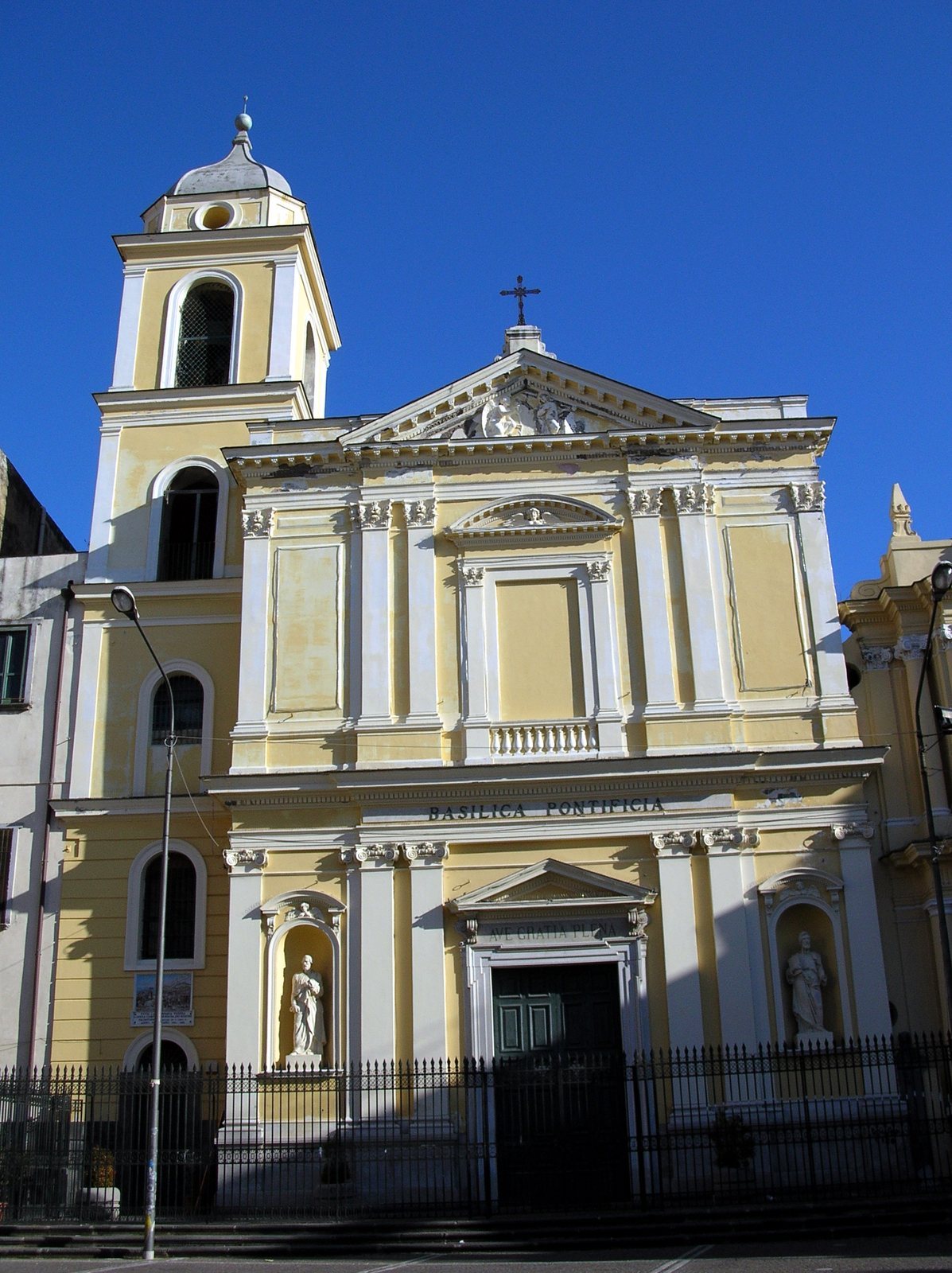
The church has a Latin-cross plan, with a long central nave crossed by a transept, the crosswise arm of the building. Its Baroque and late Renaissance features are arranged within a site bounded uphill by the convent and downhill by the chapel of the Archconfraternity of Suffrage, a Catholic lay association whose members prayed for the dead. The building also has a façade and bell tower.
Interior architecture and decoration
A major interior renewal directed by Celestine prior Father Brancone in 1741 introduced stucco decoration and marble revetments in the regional Baroque style associated with Naples. The later enlargement lengthened the nave, raised a central dome, and added three large chapels ending in apses, or projecting end spaces. These were dedicated to the High Altar, the Madonna della Neve, and the Immaculate Conception, the Catholic belief that Mary was preserved from original sin from conception. Achille Iovane painted decorative cycles on the vaulted ceilings and the apse walls. Later conservation work restored the vaults’ original colours, renovated the apse, the Chapel of the Blessed Sacrament, and the exterior façade, and added lighting.
The Marian image and furnishings
Image and silver shrine
The Madonna della Neve is a large terracotta bust of the Virgin holding the infant Jesus on her left arm, in a Greek style. Devotional descriptions traditionally say that the image’s face changes rapidly between brown, red, and pale tones. A monumental portable shrine of gilded silver holds the image. Neapolitan sculptor and metal chaser Vittorio Emmanuele Centonze made the shrine in 1907 after his design won a national competition organised by a commission chaired by parish priest Agnello Prisco. The people of Torre Annunziata paid for it.
During a restoration in October 1872, specialists found a protective cloth covering the terracotta. It may have been added during a restoration in 1743 or when the image was concealed for security; the wooden outer chest preserves the account of that history.
Altar and sacristy fragment
A marble altar-throne made to hold the silver shrine was donated by the firm of Salvatore Gallo and Felicio Fogliamanzillo. Bishop Egisto Domenico Melchiori consecrated it on 6 April 1933. In the sacristy, a fifteenth-century marble ciborium, an architectural canopy associated with an altar, was historically reused as a towel holder. It is regarded as the sole surviving architectural fragment of the original main altar from the d’Alagno period.
Organ and memorial sculpture
Pipe organ
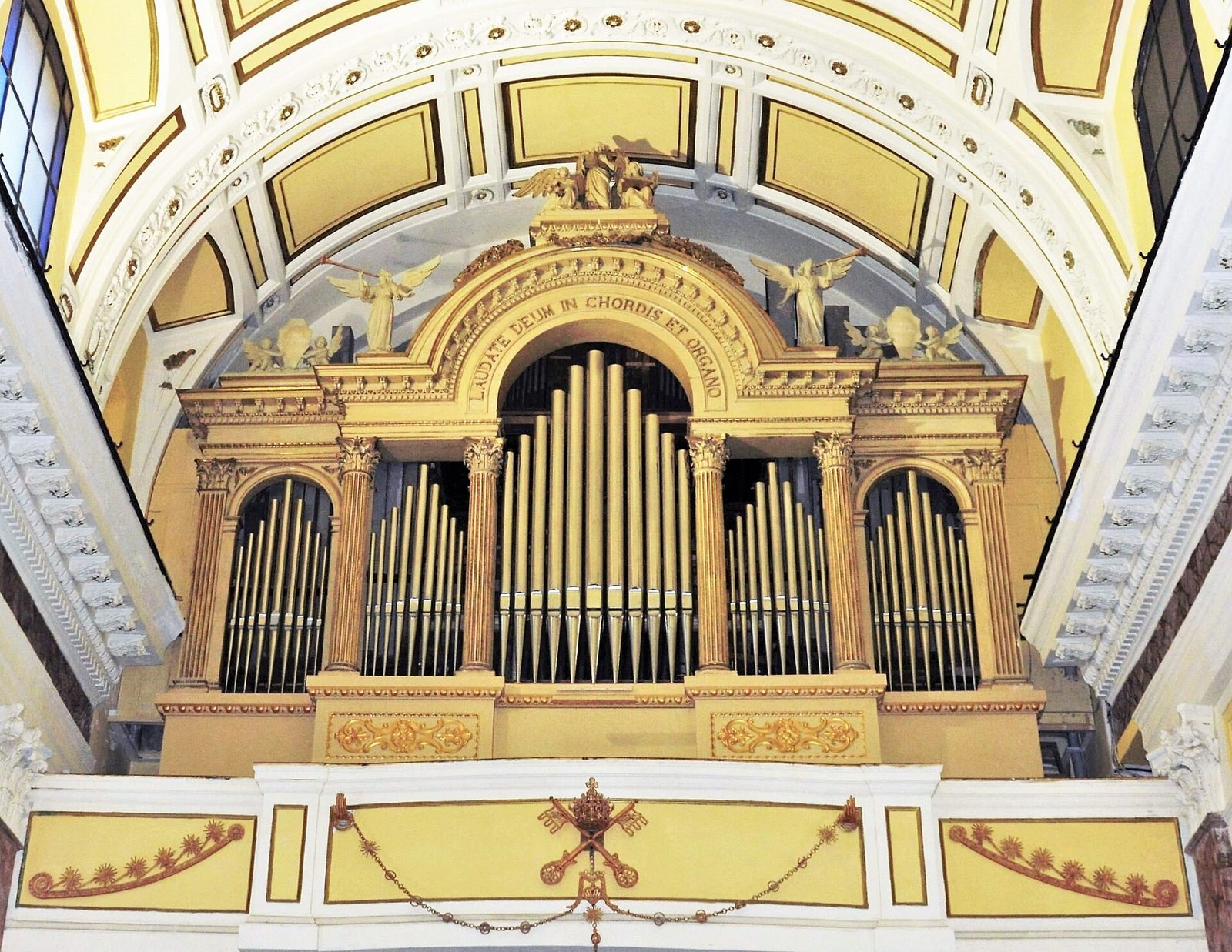
Giuseppe Rotelli built the basilica’s pipe organ between 1922 and 1929. Its two sections occupy different parts of the church: the main one, with its console, stands on the choir loft at the entrance end, while the second is in the left arm of the transept. Keys in the main section connect to the pipes through a system of air pressure; an electric system controls the second. The instrument has 33 stops, which select sets of pipes and sounds, three manuals, or hand-played keyboards, and a pedalboard played with the feet. It has 2,386 pipes. Rotelli’s instrument was the first three-manual organ built by the Cremonese organ builder. It retains its original tonal characteristics and is enclosed in a decorated wooden case whose motifs echo the nave’s Baroque decoration.
Tomb of Nicola I d’Alagno
A marble tomb for Nicola I d’Alagno, the town’s first feudal lord, was originally erected in the nave of the earlier Renaissance church. His nephew Nicola II commissioned it from Jacopo della Pila under a notarial contract dated 12 May 1494. The surviving stone components and recumbent effigy were moved to the portico of the adjoining Celestine convent during the 1741 alterations. Prince Gaetano Filangieri rescued them during nineteenth-century building work. The complete fifteenth-century monument is now preserved and displayed at the Gaetano Filangieri Civic Museum in Naples.