Lichfield Cathedral: The Seat of the Bishop of Lichfield
Site at a Glance
- Popularity
- Very High
- Country
- United Kingdom
- Primary era
- Medieval
- Eras represented
- Medieval, Modern
- Civilizations
- British, English
- Site type
- Religious
- Remains
- Cathedral
On this page21 sections
History
Lichfield Cathedral, in Lichfield, United Kingdom, is the Church of England cathedral dedicated to Saint Mary and Saint Chad. It is the principal church of the Diocese of Lichfield and the seat of its bishop. The present building is English Gothic, in the Decorated Gothic style, known for its elaborate window patterns and ornament. Rebuilding in this style began around 1200 and reached completion about 1340. The cathedral follows the High Church Anglican tradition, which places particular emphasis on formal worship and sacraments.
Early church and Mercian archbishopric
The Diocese of Mercia was established in 656. The 8th-century historian Bede associated Chad, a 7th-century Anglo-Saxon bishop and saint, with Lichfield. Chad moved the bishop’s seat there from Repton in 669. Around 700, Bishop Hedda built or consecrated a church at the present site to shelter Chad’s relics, physical remains or objects venerated because of their association with a saint. Chad’s burial place became a pilgrimage shrine. He had first been buried at the Church of Saint Mary, which later became part of the cathedral.
In 787, at the Council of Chelsea, Bishop Hygeberht was elevated to archbishop with the backing of Offa, king of Mercia. Offa sought an archbishopric that could rival Canterbury. The dioceses of Worcester, Hereford, Leicester, Lindsey, Dommoc, and Elmham were placed under Lichfield’s authority. Pope Adrian I supported Hygeberht’s new office by sending him a woollen vestment that signified senior church rank. Offa also promised an annual payment to Rome for charity and candles at St Peter’s. After Offa died in 796, Lichfield lost its archbishopric and the dioceses returned to Canterbury under Archbishop Æthelhard.
Medieval cathedral and diocesan changes
In 1075 the bishop’s seat moved from Lichfield to St John the Baptist’s Church in Chester, then to St Mary’s Priory in Coventry. Lichfield regained co-cathedral status in 1148, as one of two churches sharing cathedral status in a diocese. It became the Diocese of Lichfield’s sole cathedral after the priory was dissolved in 1539 and the Diocese of Chester was established in 1541.
The present cathedral replaced a stone church built in the Norman tradition, a medieval style associated with the Norman period in England. That building took shape from about 1085 through the late 12th century, replacing an earlier wooden church from the Anglo-Saxon period. Gothic rebuilding began around the turn of the 13th century, with work probably progressing from the eastern end towards the west.
Reformation and Civil War
Chad’s relics remained at Lichfield until 1538, when they were removed during the English Reformation. Some were later transferred to St Chad’s Cathedral in Birmingham.
The English Civil War was a series of conflicts between supporters of the monarchy and Parliament. Lichfield’s cathedral close, the precinct around the church, was besieged three times between 1643 and 1646. Cathedral clergy supported Charles I, while many townspeople backed Parliament. The close’s walls and moat made it a defensive position. On 2 March 1643, Parliamentarian commander Robert Greville, 2nd Baron Brooke, was killed during an assault. He was reportedly shot by John Dyott, who was on the battlements with his brother Richard. John Gell took command after Greville, and the garrison surrendered to him two days later.
In April 1643, Royalist commander Prince Rupert led a force from Oxford to retake Lichfield. His engineers set off an underground explosive charge, thought to be the first explosive mine used in England, to break through the defences. Colonel Russell, the Parliamentarian commander, surrendered the close to Rupert on terms on 21 April. Parliamentarian forces regained Lichfield in 1646. The cathedral lost its central spire and roofs, its stained glass was destroyed, and many monuments were lost.
Restoration and later history
Bishop John Hacket began repairs in the 1660s, aided financially by the monarchy restored under Charles II. The Civil War damage was not fully repaired until the 19th century. The cathedral’s 15th-century library was demolished in 1798, and its books were transferred to rooms above the Chapter House. Late in the 18th century, architect James Wyatt made major alterations, removing the High Altar and reorganising the worship space. In the Victorian period, George Gilbert Scott led extensive work on the west front, including renewed or recreated sculpture. New figures were added to empty niches between 1877 and 1884.
A new shrine to Chad was consecrated at Lichfield on 7 and 8 November 2022. A relic was transferred from St Chad’s Cathedral in Birmingham during separate services. Lichfield Cathedral is a Grade I listed building.
Remains
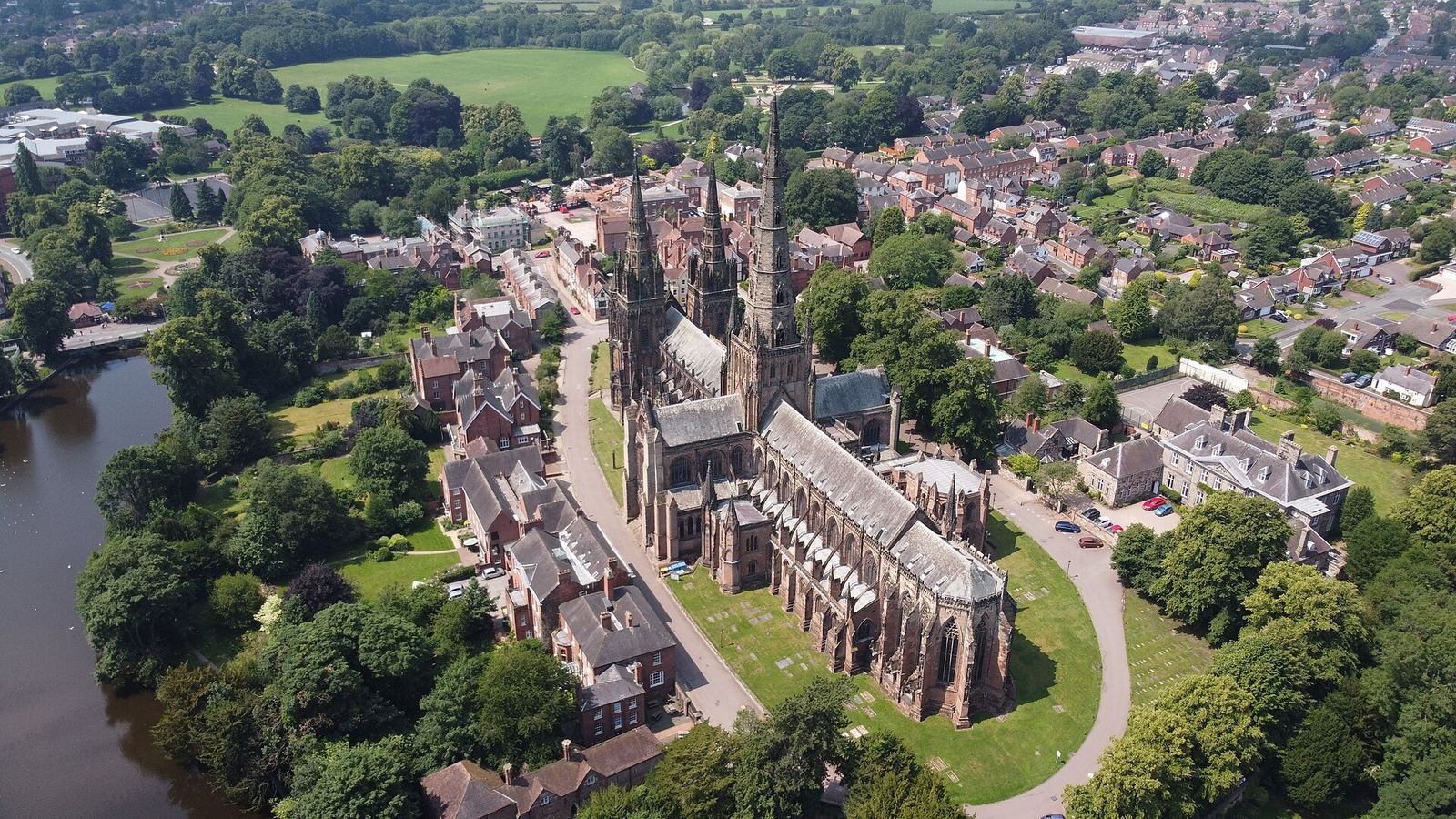
Built of Mercian red sandstone quarried near Lichfield, including south of the city, the cathedral measures 113 m internally. Its nave is 21 m wide and its crosswise transept, the arm extending across the church, is 50 m wide. The building’s stone vaults and three spires define its surviving form, while the surrounding close retains a group of medieval features.
Exterior and cathedral close
The spires
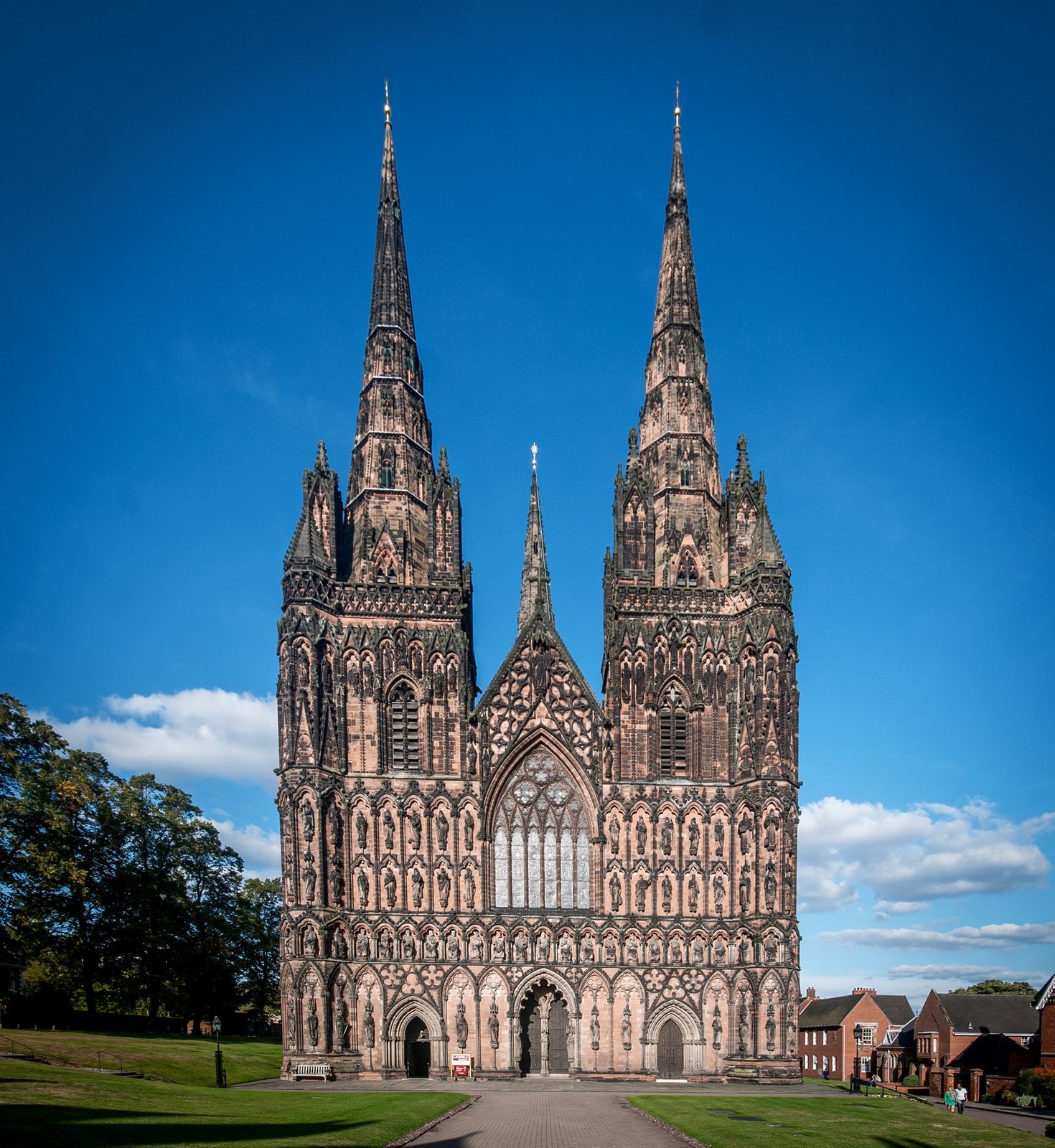
The central spire rises about 76.8 to 77 m, while the two western spires are about 58 m tall. The southern western spire is slightly higher than the northern one. The three are often called the Ladies of the Vale. Lichfield is the only medieval English cathedral to retain three spires.
West front and sculpture
The west front carries carved figures of kings, queens, and saints. Robert Bridgeman carved most of the new figures; Princess Louise carved the statue of Queen Victoria beside the central window. Seven figures above the south doorway are made of Roman cement, a historic fast-setting building material. They represent Augustine of Hippo, Jerome, Ambrose of Milan, Gregory the Great, John Chrysostom, Athanasius, and Basil. A statue of Charles II by William Wilson, once placed on the decorated gable between the western spires, now stands outside the south doors.
The cathedral close
The close includes a medieval courtyard that once provided accommodation for the choir men, as well as defensive walls and a moat. These features formed part of the precinct that served as a stronghold during the Civil War.
Interior architecture
Nave, choir, and sanctuary
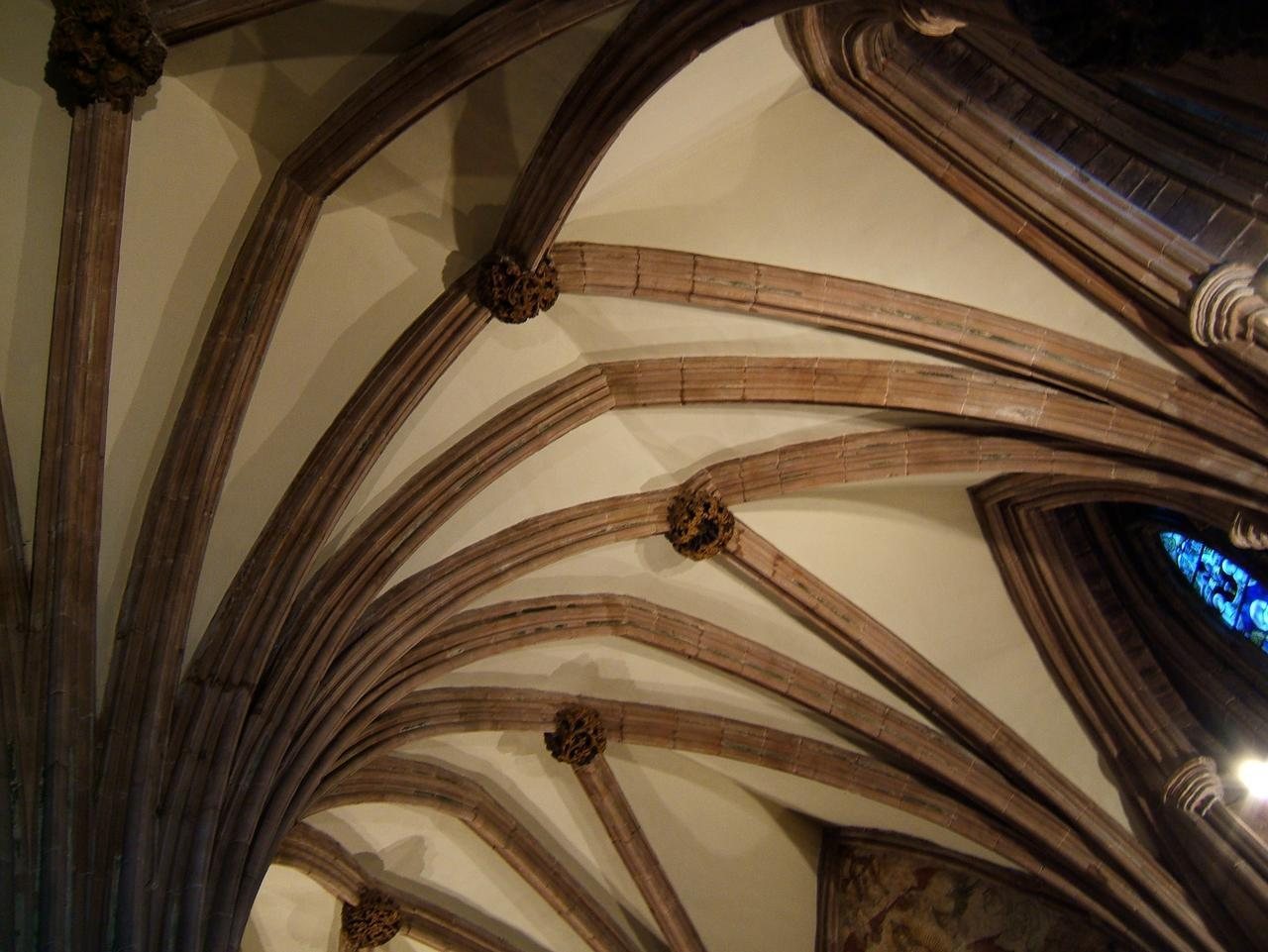
The choir dates to about 1200, the transepts to 1220–1240, and construction of the nave began around 1260. The Lady Chapel was completed in the 1330s. The nave walls lean slightly outward under the weight of the stone ceiling vaults. In 1788, workers removed about 200 to 300 tons of stone from the vaulting to limit further movement. Medieval floor tiles found in the choir foundations inspired the Mintons tiles in the choir; original medieval tiles are displayed in the Library. Stonework from Wyatt’s choir screen was reused by Scott to make the sedilia, or clergy seats near the altar. The later choir screen is metalwork made by Francis Skidmore and John Birnie Philip to Scott’s design.
Chapter House
Completed in 1249, the Chapter House is an octagonal meeting room for the cathedral’s governing clergy, with carved stone decoration. The Lichfield Gospels are displayed there.
Windows and painted glass
The Lady Chapel contains painted Flemish glass made in the 1530s for Herkenrode Abbey in Belgium. After the abbey’s dissolution, Sir Brooke Boothby bought the glass and later sold it to the cathedral for the same price he had paid. It was brought to Lichfield in the early 19th century and rededicated in 2015 following a five-year restoration. Other windows include work by Betton and Evans dating to 1819, later 19th-century glass, including windows by Charles Eamer Kempe, and an east window painted by Francis Eginton.
Burial place, manuscripts, and sculpture
Chad’s grave and the Lichfield Angel
Excavation in 2003 revealed a grave beneath the eastern end of the nave, attributed to Chad. It is cut into sandstone bedrock within the foundation of a tower-like building measuring seven metres square. Nearby, an 8th-century carved panel depicting the Archangel Gabriel was found beneath the nave in February 2003. Known as the Lichfield Angel, it is about 600 mm high and made from Ancaster limestone from Lincolnshire. The broken panel survives in three pieces and formed part of a stone chest or sarcophagus thought to have held Chad’s relics. Traces of red, black, yellow, and white pigment remain; the colours closely match those found in the Lichfield Gospels. After examination in Birmingham, the panel was placed on display in the cathedral.
The Lichfield Gospels
Also called the St Chad’s Gospels, this illuminated manuscript, a book decorated with painted imagery and ornament, dates to about 720–740. Written in Latin, it contains the Gospels of Matthew and Mark and the beginning of Luke, with some marginal notes in Old Welsh. Originally made up of two volumes, it lost one during the Civil War. The surviving volume has 236 pages, including eight illustrated pages, and shares stylistic features with the Lindisfarne Gospels.
Sculpture and burials
The cathedral contains Francis Chantrey’s 1817 sculpture The Sleeping Children, showing sisters Ellen-Jane and Marianne, who died in 1812. Notable burials include bishops William de Cornhill, Alexander de Stavenby, Hugh de Pateshull, Roger Weseham, and Walter Langton. Also buried here are Henry Paget, 1st Marquess of Anglesey, a cavalry officer at Waterloo, and George Augustus Selwyn, Bishop of Lichfield and the first Anglican Bishop of New Zealand.
Organ, bells, and clock
Organs
Robert Dallam’s organ, installed in 1636, was destroyed during the Commonwealth, England’s period of republican government. A replacement acquired in 1667 was damaged in 1745 by government forces pursuing Bonnie Prince Charlie, a Jacobite claimant to the British throne. It was sold in 1832 to St Michael and All Angels, Hamstall Ridware. A Samuel Green organ obtained in 1790 was later moved to St John the Baptist’s Church, Armitage; a George Holdich instrument followed in 1860 as a gift from Josiah Spode.
William Hill supplied the instrument that became the present organ in 1884, with 55 stops, controls for sets of pipes or particular sounds. It was enlarged by eight stops and relocated in 1908. John Oldrid Scott designed its case, carved by Bridgeman and given as a memorial to Arthur Heywood-Lonsdale. A separate solo-organ case, donated earlier by the same family, was moved to the transept. After rebuilding in 1974 the organ had 66 stops, and 13 more were added in 2000. It is tuned to C=540 Hz, nearly a semitone above modern concert pitch.
Bells and clock
After a fire, Dean Thomas Heywood presented the Jesus Bell in 1477. Cast in London, it was destroyed during the Civil War. Bishop Hacket began arranging a six-bell installation in 1670, though only the tenor had been installed by his death. A subscription in 1687 paid for recasting and an expansion to ten bells, with Henry Bagley contracted to finish the work by 1691. Three bells were later recast by Rudhall of Gloucester and Mears of London. John Taylor of Loughborough recast the ten-bell peal, a group of bells arranged for ringing, in 1947. Its tenor weighs 3,537 lb (1,604 kg).
A clock made by J. B. Joyce & Co. was installed in 1891. Its horizontal cast-iron frame measures 1.8 m long, 0.53 m wide, and 0.30 m deep. The quarter and striking trains have main wheels 46 cm in diameter. The clock uses Lord Grimthorpe’s gravity escapement, a gravity-driven mechanism that sustains a pendulum. Its zinc-and-iron pendulum was designed to counter thermal expansion, has a 1¼-second beat, and carries a 2 cwt bob. The clock strikes the hour on the tenor bell and sounds quarter-hour chimes on bells 1, 2, 3, and 6. Time appears on a dial in the belfry and another in an ornamental case in the south aisle of the nave.