Tamworth Castle: A Mercian Royal Residence and Norman Motte-and-Bailey Castle


Site at a Glance
- Rating
- 4.6
- Popularity
- Medium
- Country
- United Kingdom
- Primary era
- Medieval
- External website
- Open
- Eras represented
- Medieval, Early Modern, Modern
- Civilizations
- British, English, Norman
- Site type
- Military
- Remains
- Castle
On this page14 sections
History
Tamworth Castle is a historic castle in England, built on the site of a Mercian royal residence and Anglo-Saxon fortified settlement. During the Anglo-Saxon period, Tamworth was a residence of the kings of Mercia, the kingdom that covered much of the English Midlands. When Offa made it the chief residence of his expanding kingdom, he built a palace there, and royal charters were issued from it. The earliest surviving charter associated with the palace dates from 781.
Mercian stronghold and Viking invasions
A Viking attack in 874 left Tamworth largely ruined, and the site fell into disuse during the invasions. In 913, Aethelflaed, Lady of the Mercians, rebuilt Tamworth and fortified it with an earthen burh, an Anglo-Saxon defended settlement protected by earthworks, timber, or later masonry. The settlement was sacked again by the Danes in 943.
Tamworth later possessed a mint that produced coins for Anglo-Saxon kings and eventually for William the Conqueror. This continuity connected the settlement’s earlier Mercian and Anglo-Saxon roles with the political changes that followed the Norman Conquest, the takeover of England by the Normans beginning in 1066.
Norman and Marmion ownership
After the conquest, William granted Tamworth to his steward Robert Despenser. In the 1080s, Despenser built a wooden motte-and-bailey castle on the southwestern part of the earlier burh. A motte-and-bailey castle combined a raised mound carrying a stronghold with an adjoining enclosed courtyard, or bailey.
Robert Despenser died without children, and the castle passed to his nieces. One of them, Matilda, married Robert Marmion. The Marmion family held Tamworth Castle for six generations, from about 1100 until 1294. As hereditary champions of the dukes of Normandy and later the kings of England, the Marmions performed a ceremonial role at royal coronations. During their ownership, the castle was remodelled in stone.
In 1215, Robert Marmion, 3rd Baron Marmion of Tamworth, abandoned King John during the political turmoil of John’s reign and supported the French king. John ordered Marmion’s son Geoffrey to be imprisoned, confiscated the Marmion lands, and ordered Tamworth Castle to be destroyed or slighted. Slighting meant partly demolishing or disabling a castle so that it could not continue to serve as a military stronghold. The castle was at least partly destroyed, although the extent to which the order was carried out is uncertain. After John’s death in 1216, Marmion’s sons recovered their father’s lands.
Philip Marmion was the last male Marmion owner. He died around 1291 without a legitimate son, and after his daughter died without an heir in 1294, the castle passed to her niece Joan, the wife of Sir Alexander Freville.
Freville, Ferrers, and later families
The Freville family held the castle until 1423. When Baldwin de Freville’s son died as a minor, ownership passed to Baldwin’s eldest daughter Elizabeth and her husband, Thomas Ferrers of Groby. The castle underwent many additions in the following centuries, particularly during the Jacobean period, the English architectural style associated with the reign of James I in the early seventeenth century.
From 1668, Tamworth Castle passed to the Shirley family of Chartley. In 1715, Elizabeth Ferrers’s marriage to the 5th Earl of Northampton transferred it to the Comptons. The castle fell into disrepair under the Comptons, but was refurbished after Charlotte Compton married George Townshend. The Townshends carried out extensive renovations in 1781.
War, royal visits, and public ownership
Parliamentary forces captured the castle after a two-day siege on 25 June 1643, during the English Civil War, the conflict between the supporters of Parliament and those of King Charles I. The Parliamentarians used it as a garrison. In July 1645, the garrison comprised ten officers and 77 soldiers under the military governor Waldyve Willington. Its continued military use allowed the castle to escape the widespread slighting ordered for many other castles during the war.
The castle received royal visitors after the Norman Conquest. Henry I visited between 1109 and 1115, Henry II in 1158, Henry III in 1257, Edward II in 1325, Edward III in 1330, and James I in 1619. James was accompanied by his son, Prince Charles. Anne, Princess Royal, visited in 1988.
During the nineteenth century, the castle was frequently leased to tenants, including Robert Peel and, from 1869 to 1891, Thomas Cooke. In 1891, the Marquess Townshend offered it for auction. Tamworth Corporation bought the castle for £3,000 in 1897 to commemorate Queen Victoria’s diamond jubilee, and opened it as a museum in 1899. The corporation is now Tamworth Borough Council, which owns the castle.
Before the boundary changes of 1889, the castle stood at the edge of Warwickshire, while most of Tamworth lay in Staffordshire. It is now in Tamworth, Staffordshire. The castle is a Grade I listed building, a designation for structures of exceptional architectural or historic interest that receive England’s highest level of statutory listing protection. It is also regarded as one of the best-preserved motte-and-bailey castles in England.
Literary and artistic representations
Tamworth Castle appears briefly in Walter Scott’s narrative poem Marmion: A Tale of Flodden Field, published in 1808. The poem’s Tudor-period setting refers anachronistically to the “Lord of … Tamworth tower and town.” J. M. W. Turner, the English Romantic landscape painter, included the castle in a panoramic watercolour of 1832.
Remains
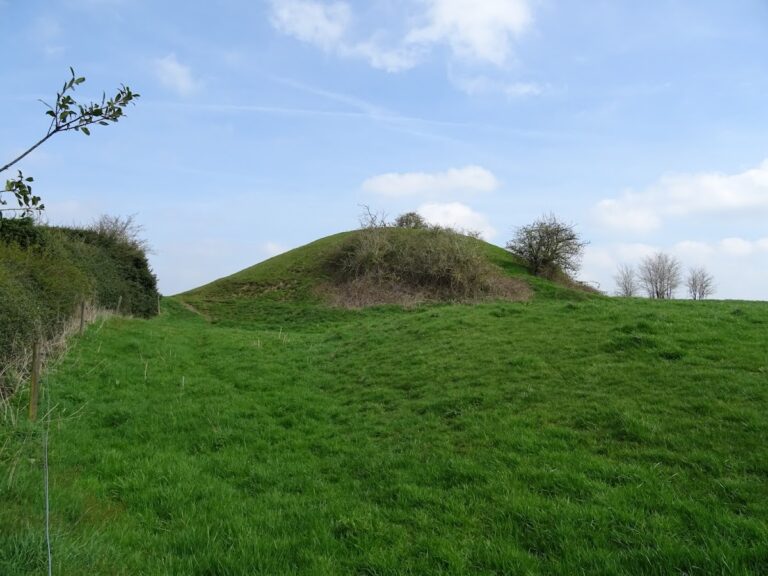
Tamworth Castle occupies the southwestern part of the earlier Anglo-Saxon burh, overlooking the mouth of the River Anker where it enters the River Tame. Its principal form is a motte-and-bailey complex, with a large raised mound carrying the castle and an adjoining enclosed area. The mound is described as the second-largest castle mound in England after Windsor Castle.
Keep and residential ranges
Shell keep and gate tower
The present castle includes a shell keep, a stone defensive enclosure built around the edge of an earlier mound. Within it is a twelfth-century gate tower, together with later residential accommodation. An early exterior feature survives at the base of the causeway leading to the gate tower, where the masonry is laid diagonally in a herringbone pattern.
Northern and southern ranges
The residential buildings form an H-shaped plan. A three-storey northern range dates from the thirteenth century, while a three-storey southern range belongs to the seventeenth-century Jacobean period. The two ranges are joined by a fifteenth-century Great Hall, whose oak timbering and interior decoration are associated with the Ferrers family and with families into which the Ferrers married.
Entrances, defences, and grounds
Town gateway and mound
The original entrance to the castle grounds was through a gateway facing the town’s market-place, of which little survives. In 1539–43, the outworks were described as decayed and the wall as fallen. At that time, the mound still carried a large round stone tower, occupied and undergoing repairs by Humphrey Ferrers.
Moat and Holloway gatehouse
The moat on the town side had fallen out of use, and from the fifteenth century onward parts of it were leased to houses along the town side of Market Street. A new gatehouse was built in 1810 at the foot of the Holloway, where the road ran south along Lady Bridge. From this gatehouse, a carriageway wound through the grounds to the castle entrance.
River setting
The castle mill stood farther along the River Anker. Turner’s 1832 view from the southeast included the mill, Lady Bridge, and the square tower of St Editha’s Church as well as the castle. These elements form part of the recorded physical setting through which the castle’s position beside the rivers and the town can be understood.