Polesworth Abbey: A Benedictine Nunnery and Parish Church in England


Site at a Glance
- Rating
- 4.8
- Popularity
- Low
- Country
- United Kingdom
- Primary era
- Medieval
- External website
- Open
- Eras represented
- Medieval
- Civilizations
- English
- Site type
- Religious
- Remains
- Monastery
On this page10 sections
History
Early Christian traditions
Polesworth Abbey is a former Benedictine nunnery in Polesworth, England, near the River Anker. Its surviving church dates from the twelfth century and reflects the medieval religious community that developed around the site. The earliest history of Polesworth and the identity of Saint Editha remain uncertain, although an early tradition connects a saint called Eadgyth with the settlement.
Modern scholarship has linked Saint Editha of Polesworth with the early Christian history of Mercia, one of the major Anglo-Saxon kingdoms of England, whose conversion to Christianity began during the early medieval period. Nigel Tringham suggested that she may have been a seventh-century Mercian princess, but her precise identity cannot be established with certainty. John Blair examined the early evidence for her cult, or organized veneration, at Polesworth in his study of Anglo-Saxon saints.
Medieval traditions describe Eadgyth, Osgyth, and other holy women living religious lives in the area. Geoffrey, Abbot of Burton, incorporated these stories into the twelfth-century Life and Miracles of Saint Modwenna, a hagiographical work describing the life and miracles of a saint. Some of its material may preserve older traditions associated with the veneration of Eadgyth at Polesworth.
One story tells how Eadgyth sent Osgyth with a book to another holy woman. Osgyth fell into the River Anker and was believed to have drowned, but prayer later restored her to life. Andrew Sargent argued that this account may originally have belonged to the traditions surrounding Eadgyth of Polesworth before it became associated with Saint Modwenna.
Medieval abbey and disputed royal identity
A later tradition identified Saint Editha of Polesworth with a tenth-century royal woman connected with Sihtric, a ruler of Northumbria. That identification remains disputed. The Anglo-Saxon Chronicle, a collection of annalistic records covering English history from the Anglo-Saxon period into the medieval era, records the marriage of a sister of Æthelstan, a tenth-century king of the English, to Sihtric. Identifying that woman with the Polesworth saint was a later development rather than a fact established by the chronicle itself.
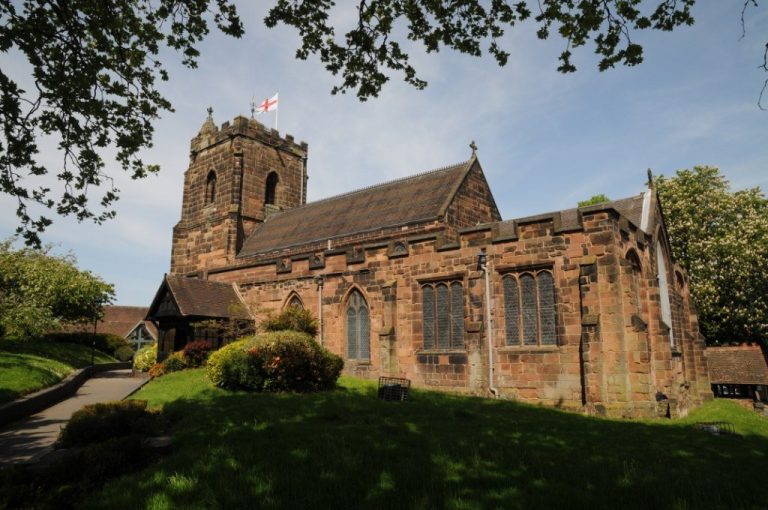
The twelfth-century abbey church remains in use as the parish church of St Editha. The community was dissolved in 1536 during the Dissolution of the Monasteries, the closures and confiscations of English religious houses carried out under Henry VIII. In 1544, Henry VIII granted the abbey to Francis Goodere of St Albans. Goodere dismantled many of the monastic buildings and reused their stone in Polesworth Hall, a new manor house built on the former abbey site.
Later changes and parish use
Sir Henry Goodere later became a patron of the arts and led the Polesworth Group of poets, which included his protégé Michael Drayton. Polesworth Hall was demolished before 1868, after which a vicarage was built on its site. The church continued as the Church of England parish church of Polesworth and now belongs to the Anglican Diocese of Birmingham, Aston Archdeaconry, and Polesworth Deanery.
The abbey site is protected as a Scheduled Monument, a nationally important archaeological or historic site protected under English law. St Editha’s Church is a Grade II* listed building, a designation for a building of particular importance and more than special interest, awarded on 25 March 1968. The fourteenth-century gatehouse is also Grade II* listed and a Scheduled Monument.
Remains
The surviving physical remains of Polesworth Abbey comprise the twelfth-century church, the restored fourteenth-century gatehouse, and the ruinous remains of the cloister. These elements represent the principal visible parts of the former religious complex, while stone from dismantled abbey buildings was later incorporated into Polesworth Hall.
Church and monastic structures
St Editha’s Church
The abbey church dates from the twelfth century and survives as the parish church of St Editha. Its continuing use preserves the principal church building of the former Benedictine nunnery within the life of the Church of England. The church contains a three-manual pipe organ made by Taylor of Leicester. The instrument was installed originally in 1912 at St Michael and All Angels’ Church in Leicester before being transferred to Polesworth.
Fourteenth-century gatehouse
The gatehouse dates from the fourteenth century and has been restored and renovated for use as apartments available for rent. It survives as one of the principal standing structures associated with the former abbey.
Restored cloister ruins
The cloister survives in restored ruinous form. A cloister is a covered walkway generally arranged around an open courtyard, linking or serving the buildings of a religious community. The restored remains therefore preserve part of the circulation and communal arrangement of the former nunnery.
Reused abbey fabric
Polesworth Hall was constructed on the abbey site with stone taken from buildings dismantled after the Dissolution. The hall itself was demolished before 1868, and a vicarage was subsequently built in its place. This sequence left the surviving church, gatehouse, and cloister ruins as the principal visible remains of the abbey complex.