Wall Roman Site: The Roman Settlement of Letocetum in England


Site at a Glance
- Rating
- 4.5
- Popularity
- Low
- Country
- United Kingdom
- Primary era
- Classical
- External website
- Open
- Eras represented
- Classical
- Civilizations
- Roman
- Site type
- City
On this page18 sections
History
Wall Roman Site in the United Kingdom preserves Letocetum, a Roman settlement built at Wall in Staffordshire at the junction of Watling Street and Ryknild Street. The site developed during the Roman conquest and occupation of Britain, beginning with military camps and forts in the first century AD before becoming an official posting station and civilian settlement. Its ancient name appears in forms including Etocetum and probably derives from a Latinized Brittonic expression meaning “grey wood,” perhaps referring to ash or elm trees.
Before and during the Roman conquest
A small native settlement probably occupied the location before the Roman arrival. It may have functioned as a trading station near the boundary between the Corieltauvi and Cornovii, two British tribal communities whose territories met in this area. Both offered little resistance to Roman rule.
After the invasion of Britain, the Roman army established at least two temporary marching camps on high ground east of the present village. Their position overlooked Watling Street and the surrounding landscape. Around AD 50, a large timber fortress was built on flatter ground west of the camps for part of the XIV Legion, a Roman legion involved in the conquest and occupation of Britain. The troops were probably transferred to Wroxeter around AD 58.
A further fort was built north of Watling Street after the Boudiccan rebellion of AD 60–61, an uprising against Roman rule led by the British queen Boudica. That fort was later levelled, and another was constructed on the same site before being demolished. The final fort probably supported the Roman campaign against the Brigantes in the 70s. Letocetum’s position allowed the army to watch and draw resources from both neighbouring tribal territories.
Roads and the posting station
Watling Street connected the settlement with London, Wroxeter, and Chester, while Ryknild Street led towards Cirencester and Yorkshire. Watling Street was surfaced with stone around AD 70, strengthening Letocetum’s role within the Roman road network.
As the military presence declined, Letocetum developed into an official posting station. A mansio, a state-run station providing lodging, food, and fresh horses for imperial officials and couriers, existed by about AD 80, and a bath house was added soon afterwards. The settlement’s civilian population supported this system by gathering fuel, caring for animals, and repairing vehicles.
The settlement expanded during the Flavian period, the era of the emperors Vespasian, Titus, and Domitian, and reached its greatest extent during the second and third centuries. It covered approximately 8.1–12 hectares. Its population and economy depended on the posting station, local industries, and the continuing needs of official travellers.
Rebuilding and civilian administration
The earliest mansio was built around AD 54–60 and probably burned near the beginning of the second century. A second building followed, but it was deliberately dismantled around AD 140–150 to make room for a third. At about the same time, the second hilltop fort was abandoned, and Letocetum ceased to be a military site.
The earliest bath house probably dates from around AD 100. The third mansio and a later bath house were built around AD 130, after the army had withdrawn. Letocetum then probably came under the authority of the civitas of the Cornovii. A civitas was a Roman administrative territory often based on a pre-Roman tribal community, and the Cornovii’s principal centre was Viroconium.
The third mansio was demolished around AD 250, when political instability on the Continent reduced official travel. The bath house, which had been enlarged several times, continued until around AD 300. Both buildings were later abandoned, probably for economic reasons, and the posting service may have been reorganized in a less expensive form.
Late Roman defence and decline
A fortified settlement was established around AD 300 across Watling Street, about 150 metres east of the mansio. Its construction may have followed an uprising by the Ordovices and Silures, peoples associated with Wales. Letocetum formed part of a chain of strongholds along Watling Street intended to guard against further disturbances.
The population appears to have moved inside the new defences, where the fourth-century settlement was concentrated. The enclosure probably continued to serve as a market and a place for tax collection, but the settlement had greatly declined by the end of the fourth century. The latest coin found at Letocetum was minted during the reign of Gratian in AD 381.
Roman administration collapsed in the early fifth century, and the settlement subsequently declined. The late Roman defences may have remained in use, while a later British outpost, possibly connected with Powys, may have occupied the site. Letocetum appears as a strategic city in the ninth-century Historia Brittonum, although the period immediately after the Roman departure is otherwise unclear.
Later landscape and archaeological investigation
Letocetum lost regional importance as nearby Lichfield became a centre of power and a bishop’s seat during the seventh century. The later name Wall referred to the surviving Roman walls, parts of which still stood in the early nineteenth century. The modern village subsequently developed over part of the former settlement.
Investigation of the bath house and mansio began in 1912–14 after earlier local efforts to present the site to visitors. The exposed underfloor-heating system deteriorated and was reburied until the mid-twentieth century, when the complex was placed in state care. Graham Webster later directed small excavations that clarified the bath house’s construction history before the remains were consolidated and displayed.
Excavation expanded from the 1960s to the 1980s and examined the baths, mansio, forts, farmsteads, industrial areas, and cemeteries. Wall Roman Site is owned by the National Trust and held in the guardianship of English Heritage. The excavated bath house, mansio, and associated museum form the principal publicly presented remains.
Remains
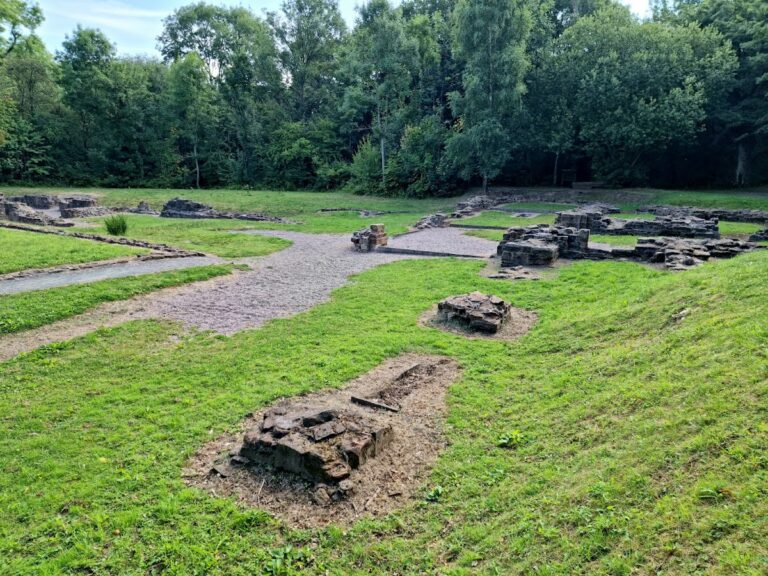
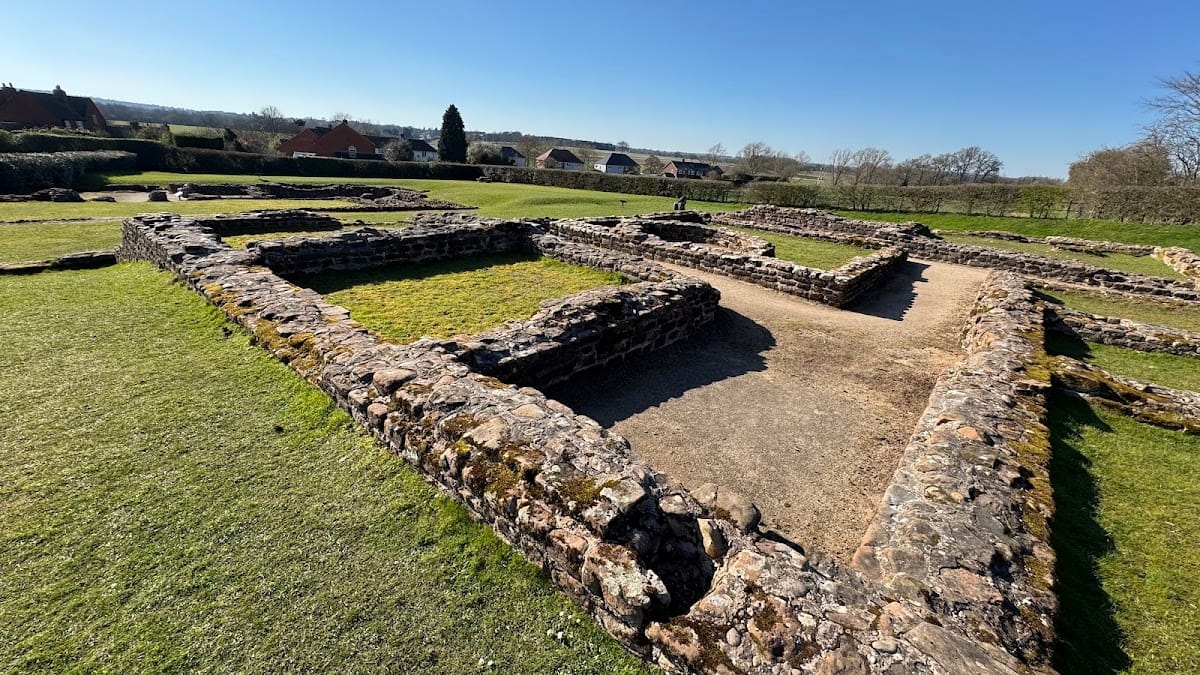
The visible remains are centred on a stone bath house and the third mansio, both built around AD 130. They formed part of a much larger settlement whose archaeological evidence includes forts, domestic and industrial areas, farmsteads, cemeteries, and possible religious and entertainment buildings. The late Roman enclosure lay across Watling Street, approximately 150 metres east of the posting station.
The posting station
Earlier courtyard buildings
The first mansio stood on a terraced hillside platform. Its sleeper-beam construction supported wattle-and-daub walls, some covered with plaster and some painted with simple linear decoration. Rooms surrounded a square courtyard measuring approximately 19 by 19 metres. Later buildings overlay parts of the plan, and the roof was probably thatched before the structure was destroyed by fire.
The second mansio was also arranged around a courtyard. Vertical timber posts stood in foundation trenches, and the plaster-and-daub walls included rooms painted in vivid colours. A well in the courtyard measured 2.29 by 2.44 metres and reached 6.1 metres into the underlying sandstone. It was filled when the building was dismantled around AD 140–150.
Third mansio
The third mansio stood on a stone base and was at least two storeys high. A long front colonnade carried a tiled roof, probably supported by wooden columns, while a large central doorway opened into the building. Timber posts around the colonnade supported an upper balcony.
Inside the entrance was a colonnaded atrium or courtyard with a plastered floor. Its central area was probably open to the sky and may have contained a herb garden. Large rooms flanked the entrance hall. The western room had washing facilities and a gutter leading to a soak-away, while the eastern room may have served as a guardroom.
Three smaller rooms opened onto the central colonnade on the western side of the courtyard. They were probably private accommodation for people using the posting station. The largest room, in the north-east corner, was later equipped with a channelled hypocaust, a Roman heating system that circulated hot gases beneath a raised floor and through wall channels.
Bath house
Early bath house
The first bath house used finely dressed stone and had walls approximately 1.2 metres thick. Its surviving masonry was of high quality for a building probably constructed during the military period.
Later bath house
The public bath house stood west of the mansio, separated from it by a cobbled road between 2.4 and 3 metres wide. A paved area connected the street with a colonnade along the eastern and northern sides of the complex. Large doors in the eastern colonnade opened into a substantial covered courtyard. This may have been a basilica, a large public or administrative hall, and is the only proposed location for such a building at Letocetum.
At the northern end of the complex was a praefurnium, or furnace room, containing wood-fired furnaces. The heating system served the tepidarium, caldarium, and laconicum, which were progressively hotter bathing rooms. Their floors rested on tile pillars, allowing hot gases to circulate beneath them. Box tiles carried heat through the walls before the gases escaped through vents in the barrel-vaulted roof.
The bath house interiors were repeatedly enlarged and redecorated. Painted wall plaster found there includes scenes from Classical mythology, and part of this decoration has been reconstructed for display.
Defences and wider settlement
Late Roman enclosure
The late Roman defensive enclosure covered about 2.1 hectares. It comprised a stone wall approximately 2.7 metres thick, three external ditches, and a turf rampart along the inner side. The wall probably dates from approximately AD 275–325. Its northern and western sides were identified and sectioned in 1964, and part of the western wall survived 1.5 metres above shallow foundations beneath the ploughed soil.
Fort and road-side evidence
The “Punic ditch” associated with the final small hilltop fort was filled before secondary silt accumulated. Its fill contained a coin from the reign of Trajan, minted between AD 98 and 117, together with pottery suggesting a date during Hadrian’s reign or the early part of Antoninus Pius’s reign.
Roman burials containing first- and second-century pottery were found beside Watling Street in 1927, with further discoveries in 1966. A circular depression between the mansio and Watling Street may mark an amphitheatre or a circular enclosure used for training horses. A rectangular crop mark north-west of the bath house may indicate another temple.
Religious remains and carved stones
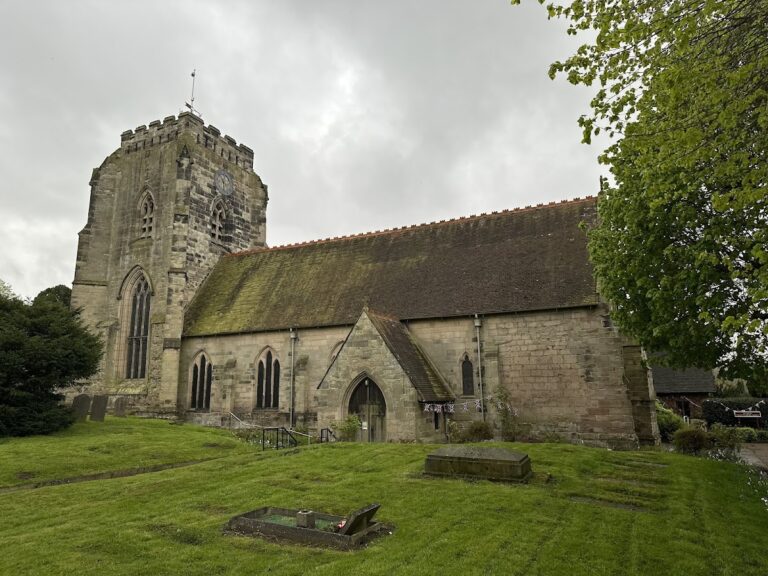
A large earthenware vessel resembling Minerva was found near the modern church. It suggests that the church area may occupy the site of a temple dedicated to Minerva, although that identification remains provisional.
Nine carved building stones found during the 1912–14 excavations carry pre-Roman religious imagery, including horned warriors, Celtic heads, and local deities. They were reused in the final phase of the mansio, dated to the 170s. Some images were placed face down or within the wall core, perhaps to contain or redirect their power. The stones are interpreted as material from a Celtic shrine built in the later first century and demolished in the mid-second century.
Most of the carved stones are held by Birmingham City Museum and Art Gallery. One stone displayed in the Wall museum shows two horned warriors facing each other, with a shield to their right.
Museum collections
The site museum occupies a small nineteenth-century agricultural building. It first housed a temporary archaeological display during the 1912–14 excavations and was later converted into a permanent museum. Its collections include objects from the bath house, mansio, and the cemetery west of Wall.
Displayed objects include part of a Roman milestone, a lead figurine of an African warrior, painted bath-house plaster, jewellery, ceramics, and a large group of querns, stone tools used for grinding grain. A glass unguent bottle, once used for perfumed oil in Roman funerary ceremonies, came from the cemetery west of Wall. English Heritage also holds a reserve collection from several later twentieth-century excavations.