St. Mark’s Church in Zagreb: A Roman Catholic Parish Church
Site at a Glance
- Popularity
- Very High
- Country
- Croatia
- Primary era
- Medieval
- Eras represented
- Medieval, Early Modern, Modern
- Civilizations
- Austria-Hungary, Austrian Empire, Habsburg, Hungarian
- Site type
- Religious
- Remains
- Church
On this page17 sections
History
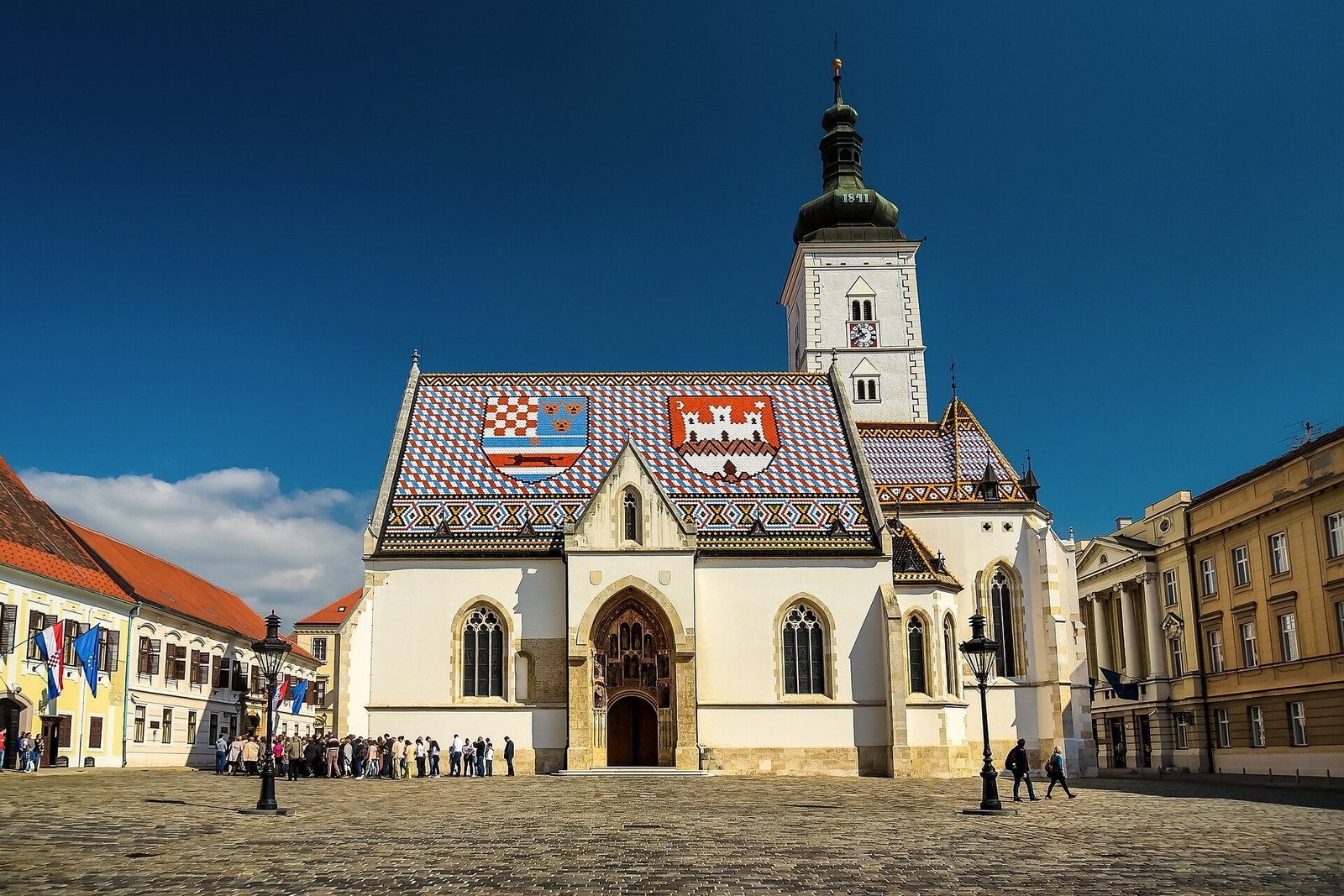
St. Mark’s Church in Zagreb is a Roman Catholic parish church in Croatia, dedicated to St. Mark the Evangelist and part of the Archdiocese of Zagreb. It stands on St. Mark’s Square in the city’s Upper Town, beside the Croatian Parliament. Originating in the mid-13th century, it took a predominantly Late Gothic form, with pointed forms and vaults supported by stone ribs. Its other features include Romanesque elements, characterized by rounded forms and heavy masonry, Baroque ornament, and Neo-Gothic features that revive Gothic design.
Origins and Gothic rebuilding
Gradec, the fortified medieval settlement in Zagreb’s Upper Town, became a free royal town in 1242. Its parish church remained St. Margaret’s, under episcopal jurisdiction. The parish of St. Mark was established in 1261, when Queen Maria, with Bishop Filip’s consent, assigned the church’s patronage to the town.
The church probably began in the mid-13th century. A fair held for St. Mark’s feast in 1256 suggests a church stood nearby, as does a Romanesque window later uncovered in the building. Excavations in 2005–06 revealed a cemetery dating from the 11th to the 16th century. A record from 1334 places the church within Gradec’s fortified settlement. Radical rebuilding followed in the second half of the 14th century, with extensive Gothic renewal during the 14th and 15th centuries. The church had acquired its present form by 1423.
King Béla IV authorized fairs on the square, and an annual fair for St. Mark was recorded in 1256. In 1573, Matija Gubec, leader of a major peasant revolt in the region, was crowned with a red-hot iron crown outside the church.
The church also has a long organ tradition. In 1359, an organist named Nikola was recorded there, the earliest written mention of an organ and organist in Croatia. A new instrument with 22 stops was acquired in 1740. Ferdo Heferer installed an organ in 1890, but August Faullend-Heferer substantially replaced it in 1936 using a design by organist and composer Franjo Dugan. Specialists regarded the later instrument as effectively new, with most of the 1890 material removed. In 2010 the parish commissioned another organ, built by the Eisenbarth workshop in Passau and presented in 2011.
Fires, repairs, and changing interiors
An earthquake toppled the bell tower in 1502. Its rebuilding was completed in the late 1580s, alongside repairs to the church roof, and a clock was installed on the new belfry in 1588. Fire in March 1645 destroyed the wooden roof, damaged or brought down vaults, and partly damaged the tower. Repairs began soon afterward; tower work started in 1659 and continued into the following year.
A second major fire, in 1674, badly damaged the church and brought down about half the tower. Repairs to the facade in the 1680s included replacing damaged pointed windows with segmental-headed ones and repainting the sculptures on the south portal. Work to rebuild the tower began in the 1690s and was completed in the first decade of the 18th century. A fire in 1707 burned the roof and main altar and damaged the bells and clock. The tower received an onion-shaped cap in 1725, and an inscription indicates further work in 1775.
The church’s interior was repeatedly refurnished in the 17th and 18th centuries, gaining a masonry pulpit, a choir, new paving, and successive sets of altars and furnishings. It had eight altars during this period. The church crypts are first mentioned in 1700, and burials continued there into the first half of the 19th century.
Proposals to demolish the church emerged from 1771, partly to make way for a larger building. Joseph II, the Habsburg emperor, intervened to preserve it as a solidly built monument. Further proposals in 1805 met opposition from Bishop Maksimilijan Vrhovac and the parish priest; similar debates recurred in the 1840s and 1860s, when restoration was chosen. A new dome was installed on the tower in 1841, followed by roof repairs in 1842.
Restoration and modern conservation
A major restoration began in 1876 under Friedrich von Schmidt and continued under Hermann Bollé. It gave the church its Neo-Gothic character and removed its Baroque furnishings, as well as the chapel of St. Fabian and Sebastian. The 1880 Zagreb earthquake damaged the building during the work. Medieval wall paintings discovered in 1881 were removed, and new decorative and figurative paintings were added. The restoration was completed in 1882, and the church was consecrated on 29 October. It was the first comprehensive Historicist restoration in the territory then known as Ban’s Croatia.
From the 1920s to 1940, another major programme combined building repairs with new artistic decoration. The chapel of St. Fabian and Sebastian was re-established at the former sacristy location. Archbishop Alojzije Stepinac consecrated the church on 21 December 1937 while the work was still underway. Jozo Kljaković painted the interior in three phases, and Ljubo Babić contributed oil paintings. Sculptor Ivan Meštrović created stone and bronze furnishings and sculpture for the church and its chapels.
Conservation from 1967 to 1976 repaired deteriorated fabric, chiefly on the exterior, and brought to light fragments from earlier phases. Treatment of damp-damaged interior paintings followed from 1980 to 1988, while tower and portal conservation continued intermittently over later decades. Banski Dvori, the historic government building in Zagreb, was struck by rockets in October 1991, damaging the church. Roofing and structural repairs were completed in 2002. The broader renewal was formally declared complete on 29 March 2009, although facade work continued from 2008 to 2010. In 2009, facsimiles were installed on the south portal while its original sculptures were kept in the chapel during conservation.
The earthquakes of 22 March and December 2020 damaged the church, with the later earthquake centered near Petrinja causing more severe harm. Structural and comprehensive renovation followed, and worship resumed with a Mass on 3 December 2023. The church is protected as a cultural property of Croatia.
Remains
The church is a three-aisled building measuring 35 m long and 16 m wide, with an eastern end formed in three lobes. Its entrances are on the west and south sides. A square-plan bell tower stands to the northeast; the sacristy is west of the tower, with the chapel of St. Fabian and Sebastian beside it and accessible from outside.
Plan and exterior
Structure and masonry
Four massive round columns divide the interior into aisles and support heavy stone vaults with projecting ribs. Romanesque masonry survives in a window on the south facade and early buttresses on the west. The church’s architectural fabric also includes work from its later restorations, visible in its altered openings, portals, and roof.
South portal
The south portal is the church’s most richly sculpted Gothic entrance. Its 15 figures occupy 11 niches: 11 are Gothic stone sculptures and four are wooden Baroque figures. They include Joseph and Mary with the infant Jesus at the top, Christ, St. Mark with the lion, and apostles. The portal is often attributed to the Prague workshop of the Parler family, a prominent Central European family of medieval builders and sculptors, or to artists influenced by that workshop. Several layers of paint survive, including Gothic and Renaissance work. Facsimiles now occupy the portal; the original sculptures are kept in the chapel of St. Fabian and Sebastian.
West portal and windows
The west portal follows a Classicist design by Bartol Felbinger, though its construction during the Schmidt–Bollé restoration used a simplified version of his proposal. Neo-Gothic windows with painted glass also date from that restoration. Later facade work emphasized older elements uncovered during conservation and exposed brick in one area to show how the wall was built.
Roof, tower, and exterior sculpture
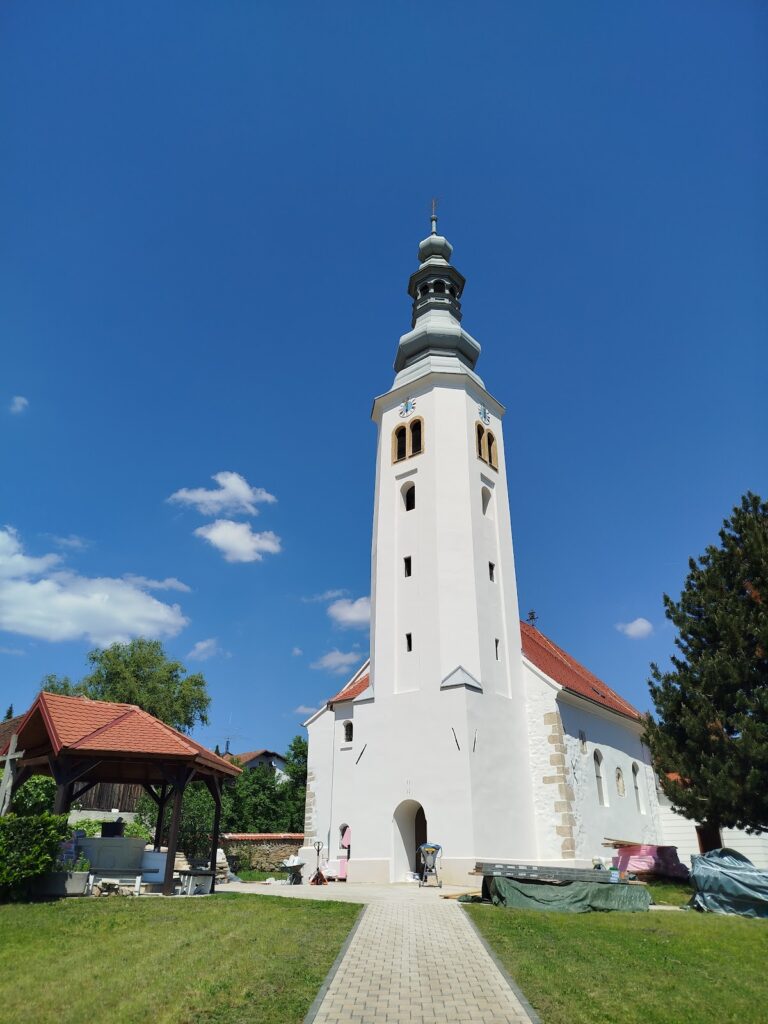
Glazed roof tiles installed during the 19th-century restoration form the arms of Zagreb and of the Triune Kingdom of Croatia, Slavonia, and Dalmatia, as well as a Croatian folk-embroidery motif. The tower is multicolored and carries a Baroque onion-shaped cap. A stone version of Zagreb’s coat of arms, dated 1499, is set into the church’s northwest exterior; the original is held by the Zagreb City Museum.
Interior, paintings, and furnishings
Floor, tombs, and altars
During the 1920s and 1930s, workers lowered and repaved the floor, clad lower wall sections in stone, and cleaned and excavated tombs. The church’s earlier Baroque furnishings were removed during the 19th-century restoration. Parts of 18th-century altars are now in the Zagreb City Museum, while the complete Altar of the Conversion of St. Paul is in the Croatian History Museum.
Wall paintings
Kljaković’s wall paintings were made in three phases. Works from 1922–24 include The Baptism of Christ, The Sermon on the Mount, and The Raising of Lazarus on the north nave wall, as well as Moses Receiving the Commandments above the south portal. His 1936–37 work includes four Old Testament prophets on the south wall and scenes in the apses, the rounded or lobed sanctuary ends: The Annunciation, The Adoration of the Shepherds, The Flagellation, The Entombment, The Resurrection of Christ, and The Triumph of the Holy Eucharist. Other wall paintings depict Zvonimir’s Oath, the Council of Split, and the Christianization of the Croats under Prince Višeslav.
The 1881 decorative scheme included work by Franz Schäffer and figurative scenes and medallions by E. Novak and F. Quiquerez. Babić’s oil paintings include The Crucifixion of Christ, The Deposition from the Cross, and Croatian Christmas. He discarded earlier works with which he was dissatisfied before contributing these paintings.
Meštrović’s sculpture and furnishings
In the main apse, Meštrović’s work includes a large Crucifix, a communion rail decorated with Croatian interlace, a stone chair, reliefs of Zagreb’s coat of arms and St. Mark, and a pulpit with an eagle relief. The north apse contains a bronze Pietà, showing Mary mourning the dead Christ, a stone altar with a Dead Christ relief, and a small crucifix. In the south apse, a bronze Throne of Wisdom, also called the Croatian Madonna, stands with an altar bearing a relief of musical angels.
Chapel of St. Fabian and Sebastian
The chapel measures 12 by 6 m. Its 1940 decoration by Kljaković includes a Crucifixion with the four Evangelists and Saints Fabian, Sebastian, Florian, and Roch, as well as Bishop Kažotić. Its furnishings include a baptismal font depicting Christ’s baptism and altars with reliefs of the Annunciation, Nativity, and Presentation in the Temple.
Organ
The present Eisenbarth organ has three hand-operated keyboards, a foot keyboard, and 41 stops, which control sets of pipes. Its mechanical action connects the keys to the instrument’s pipes, and its specification follows a French style. The older organ case was retained and restored for the new instrument.
Earthquake repairs
The 2020 earthquakes damaged vaults and Gothic ribs, separated portions of the ceiling from the walls, and caused the capstone above the south portal to fall. The chapel sustained minor damage. Structural and comprehensive renovation repaired the church before worship resumed in December 2023.