Abbey of Saint Peter in the Black Forest: A Zähringer Monastery and Burial Place
Site at a Glance
- Popularity
- High
- Country
- Germany
- Primary era
- Early Modern
- Eras represented
- Early Modern, Modern
- Civilizations
- German, Habsburg, Holy Roman Empire
- Site type
- Religious
- Remains
- Monastery
On this page19 sections
History
From Weilheim to the Black Forest
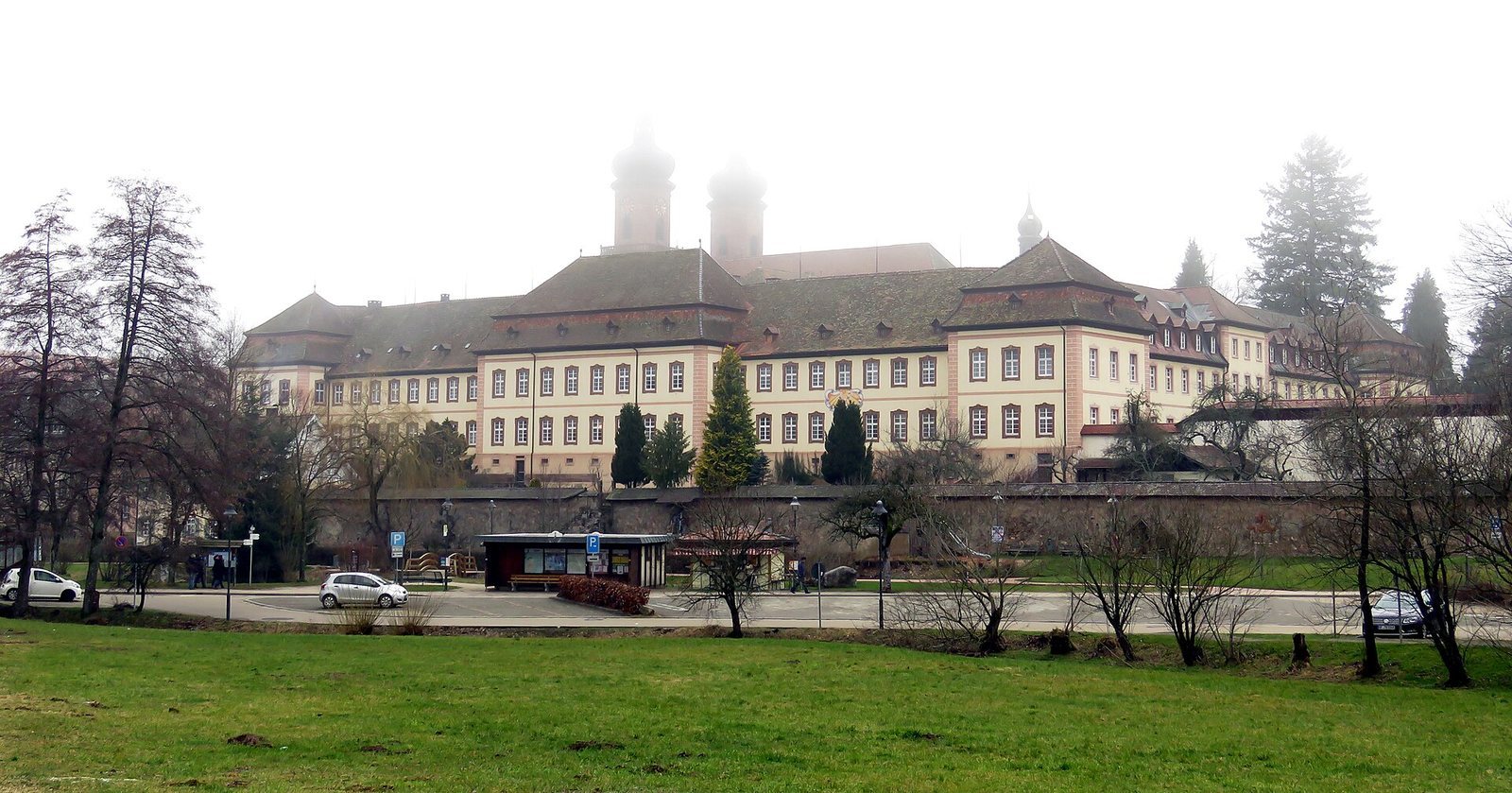
The Abbey of Saint Peter in the Black Forest is a former Benedictine abbey in St. Peter, Germany. Its community moved to this site by 1093, where it became the family monastery and burial place of the Zähringer dukes. The abbey also developed into a regional political and cultural center during the twelfth century. Its buildings were rebuilt in Baroque style, an ornate European architectural tradition, during the seventeenth and eighteenth centuries.
The community began at Weilheim, where a monastery or collegiate church had been established in or before 1073. Military unrest after 1078, during the Investiture Controversy, a prolonged conflict between church and secular powers over appointments to church offices, forced the community to move to Hirsau. In or after 1085, it came under Duke Berthold II of Zähringen, who first intended to establish his family monastery at Hirsau. Around 1090 he changed course, and the community was transferred to the Black Forest site by 1093. His wife, Agnes of Rheinfelden, endowed the new foundation with inherited estates at Buchsee in Burgundy.
St. Peter soon became a reformed Benedictine abbey, following the Rule of Saint Benedict, a guide to communal monastic life, and subject to the Roman Church. A privilege issued by Pope Urban II on 10 March 1095 reflects that relationship. Gifts from the Zähringer dukes and their ministeriales, members of the service nobility who performed administrative and military duties, helped the community prosper.
Ducal protection and monastic lands
The Zähringer dukes initially acted as the abbey’s lay protectors, exercising legal or administrative authority over the monastery and its property. A legal act of 27 December 1111 regulated the family’s renunciation of hereditary claims to the abbey and its estates, while helping to establish its ducal protectorship. Zähringer control of this office remained undisputed until 1218. After Duke Berthold V died without a son, disputes led to the transfer of the protectorship to his nephew, Count Egino the Younger of Urach, in 1221/26. The counts of Freiburg later held the office, and some asserted control over monastic property and rights in 1284 and 1314.
Facing mounting pressure from its protectors, the abbey obtained imperial protection from Emperor Charles IV in 1361, possibly drawing on earlier connections with Emperor Frederick II. The privilege was confirmed in 1443 and cited by King Maximilian I in 1498. The protectorship, pledged from 1371, passed in 1441 to Margrave Wilhelm of Hachberg-Sausenberg, a territorial ruler. The Habsburgs took it over in 1526.
Donations, particularly from the founding family, gave St. Peter estates in the surrounding area, the Breisgau, the Baar, near Weilheim, and central Switzerland. The monastery’s core district, including the village, had special jurisdictional privileges, while its holdings extended into nearby valleys. In the Breisgau, land was organized into estates for collecting rents and managing property. In the Black Forest, peasants held hereditary farms on cleared land. Sales and divisions fragmented these holdings during the thirteenth and fourteenth centuries.
Late-medieval pressures and reform
Population losses in the fourteenth century left some settlements deserted and reduced income from the abbey’s lordship. Court rolls from 1416 and 1456 describe disputes with the protector and distinguish among court and tenant farms, lands managed directly as part of the core estate, and peasant holdings. Fires damaged the monastery in 1238 and again in 1437. In 1436 Abbot Johannes Tüffer received insignia and liturgical privileges associated with episcopal functions.
The abbey’s influence declined in the later Middle Ages, and fifteenth-century monastic reforms did not take hold there. Its property, however, remained largely intact through the Reformation, the sixteenth-century movement that led to the establishment of Protestant churches in Europe.
Gremmelsbach, Sattler, and change
Abbot Peter Gremmelsbach (1496–1512) revived traditions connected with the Zähringer founders and their commemorations. In 1507 he acquired a house in Freiburg that became the abbots’ residence there, known as the Peterhof.
During Gremmelsbach’s abbacy, Michael Sattler served as prior and took part in negotiations with rebellious peasants. He left the monastery in 1523 and married Margaretha, a Beguine, or lay religious woman living in a community without formal monastic vows. In spring 1525 he joined the Anabaptist movement, which emphasized adult baptism. Sattler became an initiator and author of the Schleitheim Articles, an early statement of Anabaptist belief. For his religious convictions, he was burned at the stake in Rottenburg am Neckar on 21 May 1527.
Baroque rebuilding and learning
The monastery buildings were rebuilt in Baroque style during the seventeenth and eighteenth centuries. Under Abbot Ignatius Speckle, St. Peter again flourished as a center of learning. Speckle maintained close ties with scholars such as Martin Gerbert, abbot of St. Blasien. Benedictines from St. Peter taught at the University of Freiburg, and Thaddäus Rinderle became known for his inventions.
The abbey’s library catalog of 1774 listed about 13,000 titles in approximately 14,000 volumes. By the time the monastery was dissolved, the collection had grown to around 20,000 books.
Dissolution and later use
Secularization, the suppression of a religious institution and transfer of its property to secular authority, dissolved the abbey in 1806. Most of its library went to the Baden court library; some books passed to the University Library of Freiburg, and some stayed at St. Peter for the priest seminary established there in 1842. Other volumes went to private owners or were lost.
The former monastery housed the pastoral seminary for the Archdiocese of Freiburg from 1842 to 2006. Its first rector, Joseph Kössing, served for many years and later joined the cathedral chapter. In 2006 the seminary merged with the Freiburg institution that became the Collegium Borromaeum. Since 19 November that year, the former monastery has served as a spiritual center. Its former abbey church is now the parish church of the Catholic parish of St. Peter im Hochschwarzwald.
St. Peter belonged to the Diocese of Constance throughout the abbey’s existence. After that diocese was dissolved in 1821, it came under the newly established Archdiocese of Freiburg. In 2008, the discovery that books from the original library remained on the shelves prompted renewed work to identify and reunite the dispersed collection. Since 2009, the University Library of Freiburg, the Baden State Library, the Baden-Württemberg State Archives, and the General State Archives in Karlsruhe have worked to reconstruct and digitize the holdings and enter them into a library database.
Remains
Abbey church
Form and decoration
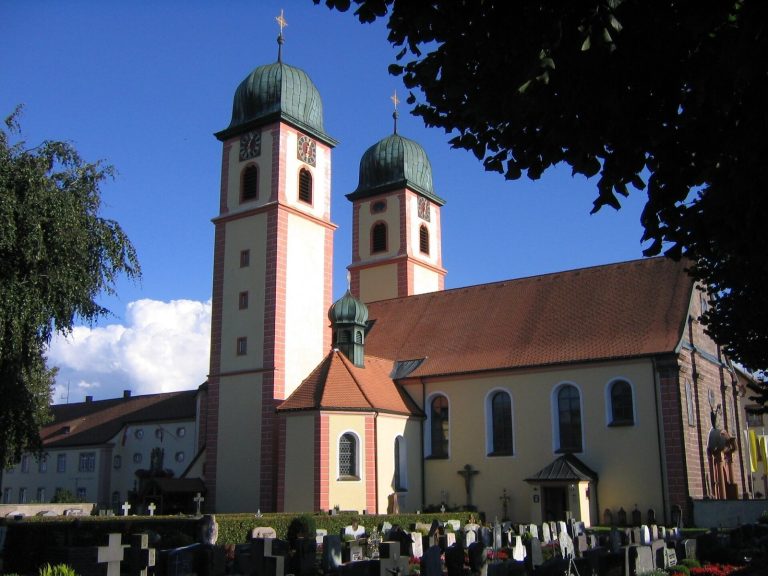
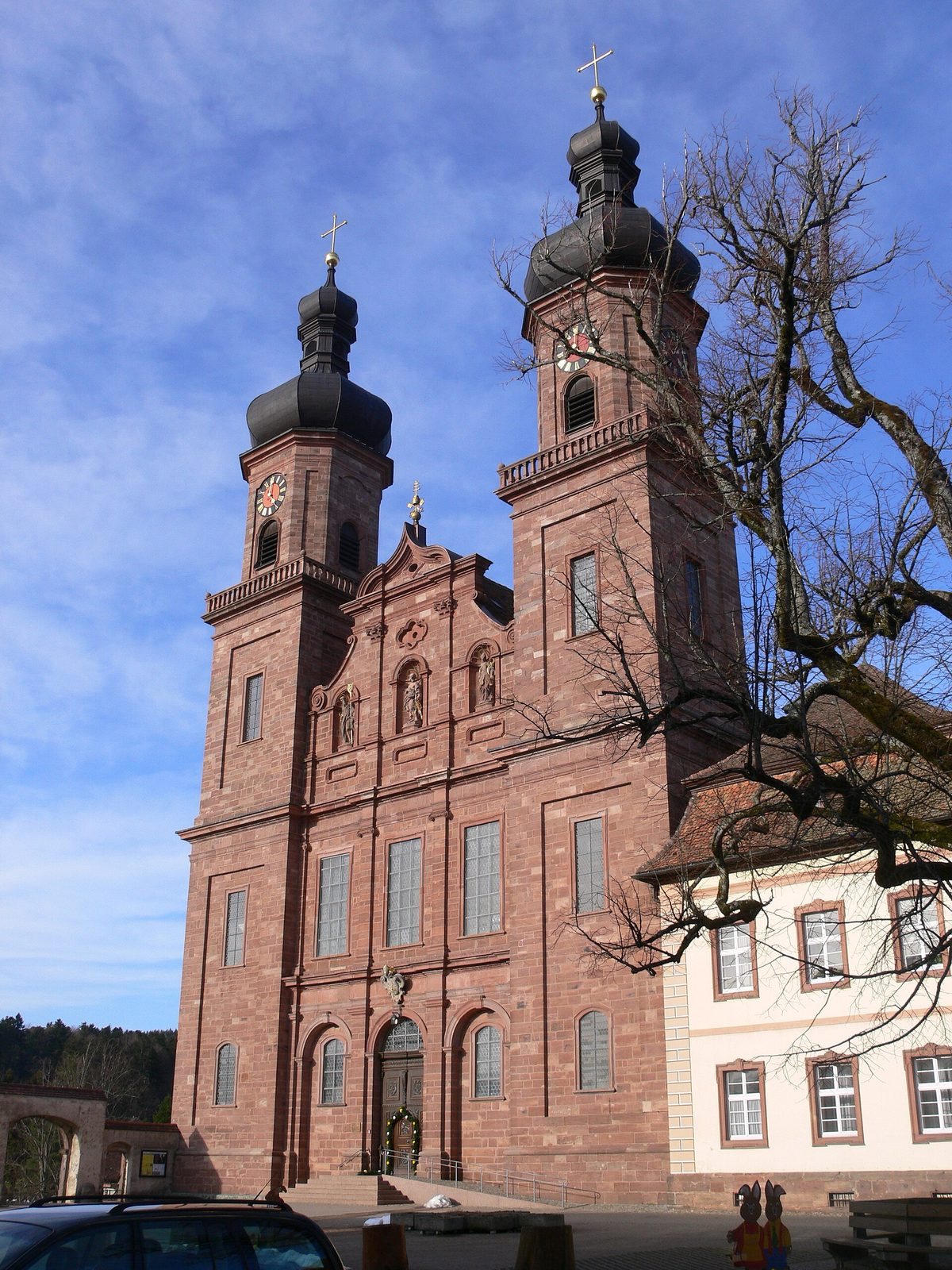
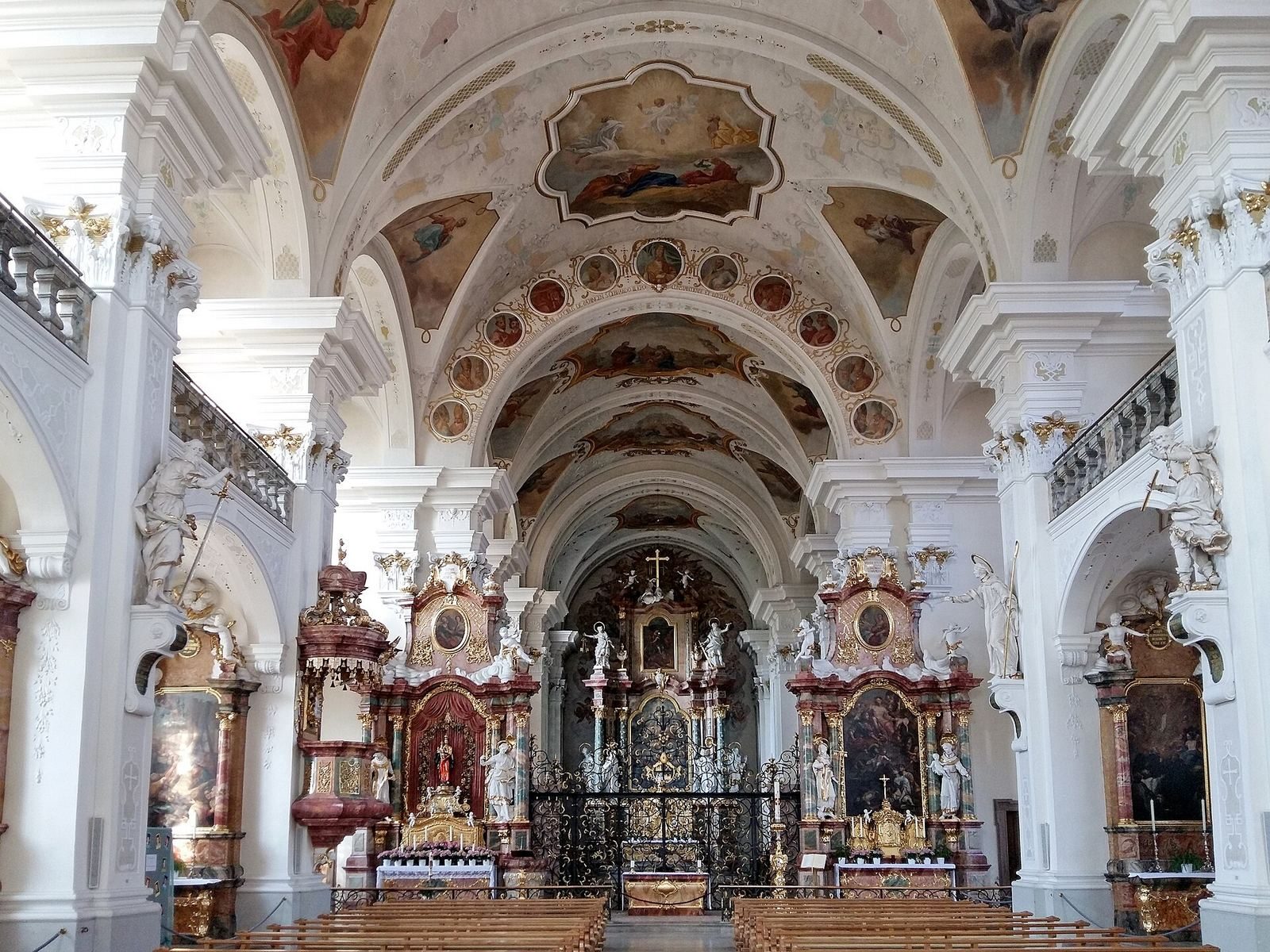
The present Baroque church was built in the 1720s under Abbot Ulrich Bürgi, to a design by Peter Thumb. Its red-sandstone façade is framed by two towers with onion-shaped domes. The interior includes 55 frescoes painted by Franz Joseph Spiegler in 1727, as well as sculptures by Joseph Anton Feuchtmayer.
High altar
Dating from 1727, the high altar has a gilded Baroque frame designed to hold interchangeable paintings. Eight images are used in turn for different seasons of the church year. They show the Coronation of Mary by the Holy Trinity, painted by Johann Christoph Storer in 1661; the Annunciation, painted by Hans Michael Saur in 1727; the Nativity, painted by Franz Joseph Spiegler in 1727; and the Last Supper, Crucifixion, Resurrection, Ascension, and Pentecost, all painted by Saur in 1727. The images were once changed by hand; a sliding mechanism now inserts and secures them from behind.
Organ arrangement
The church has a main organ in the gallery above the entrance and a choir organ on the south side of the choir. Consoles in the gallery and choir allow the instruments to be played separately or together.
Main organ
The main organ, Klais Opus 1349, was installed in 1966–67, replacing a Walcker instrument from 1880. It was fitted into an existing Baroque organ case, probably made by Johann Georg Fischer. The organ has three keyboards, a pedal division played by foot, and 46 stops, controls for sets of pipes. It was renovated in 2014.
Choir organ
Rieger built the present choir organ in 2015. It replaced a Späth organ installed in 1964 on the north side of the choir. That instrument had two keyboards, a pedal division, and 19 stops, and had itself replaced an earlier organ by Blasius Bernauer. An assessment in 2013 recommended work on the organs because of technical defects. Severe mold damage made repair of the Späth instrument disproportionately costly, so it was replaced. The south-side position was chosen for better climatic conditions and to help prevent further mold damage. The new instrument has two keyboards, including a volume-controlling swell division, a pedal division, and 20 stops. A dummy organ front on the north side balances its appearance within the choir.
Bells
The church’s five-bell bronze peal was cast at the Hamm foundry in Frankenthal in 1949 and 1952. Two bells hang in the north tower and three in the south tower. All carry the inscription Meister Hamm goß mich 1949, meaning that Master Hamm cast them in 1949. Bells two through five were recast in 1952 because of defects and were consecrated that year. All five connect to the clock mechanism: the two largest sound the hours, and the three smaller bells mark the quarter hours. A separate baptismal bell, cast by Matthäus Edel of Strasbourg in 1770, hangs in the wooden roof turret above the choir, called the Hahnenturm.
Library and collections
Library building
Peter Thumb also designed the library building. Under Abbot Ulrich Bürgi, construction reached the vaults, then stopped for eleven years during the abbacy of his successor, Benedikt II Wülberz. Abbot Philipp Jakob Steyrer resumed work after the war and gave the building the form it retains today. Its decoration involved stucco artist Johann Georg Gigl, painters Benedikt Gambs and Franz Ludwig Herrmann, artist Johann Christian Wentzinger, and sculptor Matthias Faller.
The Rotulus Sanpetrinus
The Rotulus Sanpetrinus, a parchment roll produced in the monastery’s writing room mainly during the twelfth century, includes notices of property transfers. Its records trace the growth of the abbey’s landed holdings.
Surviving books
About 1,000 books from the original collection remain at St. Peter and are now kept in the monastery treasury. They include a German Koberger Bible printed in 1483, a first Basel edition of Thomas More’s Utopia, 120 books printed in Europe before 1501, and several manuscripts. Among the best-known manuscripts is a leaf from the end of the tenth century associated with the Egbert Codex.