Rök Runestone: An Early Ninth-Century Runic Memorial in Sweden
Site at a Glance
- Popularity
- Very High
- Country
- Sweden
- Primary era
- Medieval
- Eras represented
- Medieval, Modern
- Civilizations
- Norse
- Site type
- Civic
- Remains
- Monument
On this page8 sections
History
The Rök Runestone is a runic memorial in the village of Rök, Sweden, probably erected around AD 800. Its inscription names Vämod as Varinn’s dead son and identifies Varinn as the person who carved or wrote the runes.
A memorial and its riddles
The stone is usually dated to the first half of the ninth century. Its archaic language and distinctive rune forms set it apart from inscriptions of the eleventh century. A passage concerning someone who died nine generations earlier has also been used to support this early date.
In a commonly adopted reading, the text begins with references to war-booties taken from different people, then recounts a death among the Hreidgoths nine generations earlier. Hreidgoths is a poetic name often associated with the Ostrogoths. The inscription continues with a passage frequently understood to concern Theodoric the Great, an Ostrogothic ruler in Italy, followed by riddles about Gunnr’s horse and twenty kings. Gunnr’s horse may be an indirect poetic reference to a wolf.
Another passage describes twenty kings at Sjólund over four winters. They are grouped as four sets of five brothers, each set sharing a name, with all four groups descended from four brothers. The place-name Sjólund has been variously connected with Zealand, with the Swedish coastal region of Roslagen, or with meanings such as “sea grove” and “grove near Sya.” Later passages have been read as referring to Ingold’s descendants and a wife’s sacrifice, a kinsman born to a valiant man, and Vélinn, a figure said to be able to crush a giant. The text also includes an unresolved word, a reference to the Norse god Thor, and Sibbi, who is associated with a sanctuary and fathering a child at the age of ninety.
The inscription’s purpose and many of its readings remain contested. Elias Wessén understood it as a memorial for Varinn’s son, with mythological passages added in tribute; Otto von Friesen proposed that it called for vengeance over the son’s death. Other interpretations treat the text as a record of tribal myths or ancestry, or as a way to strengthen a leader’s standing. These remain proposals, rather than settled explanations.
Some readings treat the inscription as an intentionally difficult display of the carver’s knowledge of runes, myths, and poetry, perhaps with an additional ritual purpose. Its composition has also been divided into three broadly balanced parts, each containing questions and poetic answers, in a form compared with greppaminni, a poetic riddle-game described in Snorri Sturluson’s Prose Edda.
The passage often called the Theodoric Strophe has prompted a separate debate. Sophus Bugge proposed that its bold ruler was Theodoric the Great and that the passage referred to an equestrian statue of him. In Bugge’s explanation, Charlemagne, the Frankish ruler who became emperor in AD 800, moved the statue from Ravenna to Aachen in 801, and Scandinavians learned of it after Aachen was raided in the 880s. Linguist Bo Ralph later argued that the passage instead describes a bold warrior riding a horse.
A further interpretation presents the inscription as nine riddles, four answered by Odin and five by the Sun, and links them with Ragnarök, the prophesied destruction in Norse mythology, and possibly the Fimbulwinter, a legendary severe winter preceding it. One version of this proposal connects the riddles with extreme weather in 535–536, a solar event in 774–775, and a near-total eclipse in 810. These links are interpretive, not established explanations of the inscription.
Rediscovery and relocation
The stone’s original position is uncertain, although it was probably close to where it stands today. It may have occupied a central place in the local community; a church was built there about three centuries later. The village’s name is associated with the stone, though the village may instead have given its name to it. One proposed origin is the Old Norse word raukr, meaning a stack or pointed object; another connects the name with water or mist.
Before its modern relocation, the stone was set into the wall of a tithe storehouse beside Rök’s medieval church, with its front facing outward. A tithe storehouse held payments used to support the church. In the early seventeenth century, antiquarian Johannes Bureus recognized the inscription and made a record of it; his drawing appeared in a work published in 1624. Johan Hadorph visited in the 1670s and made a woodcut, published in 1750. A description from the 1760s called the inscription incomprehensible and unreadable.
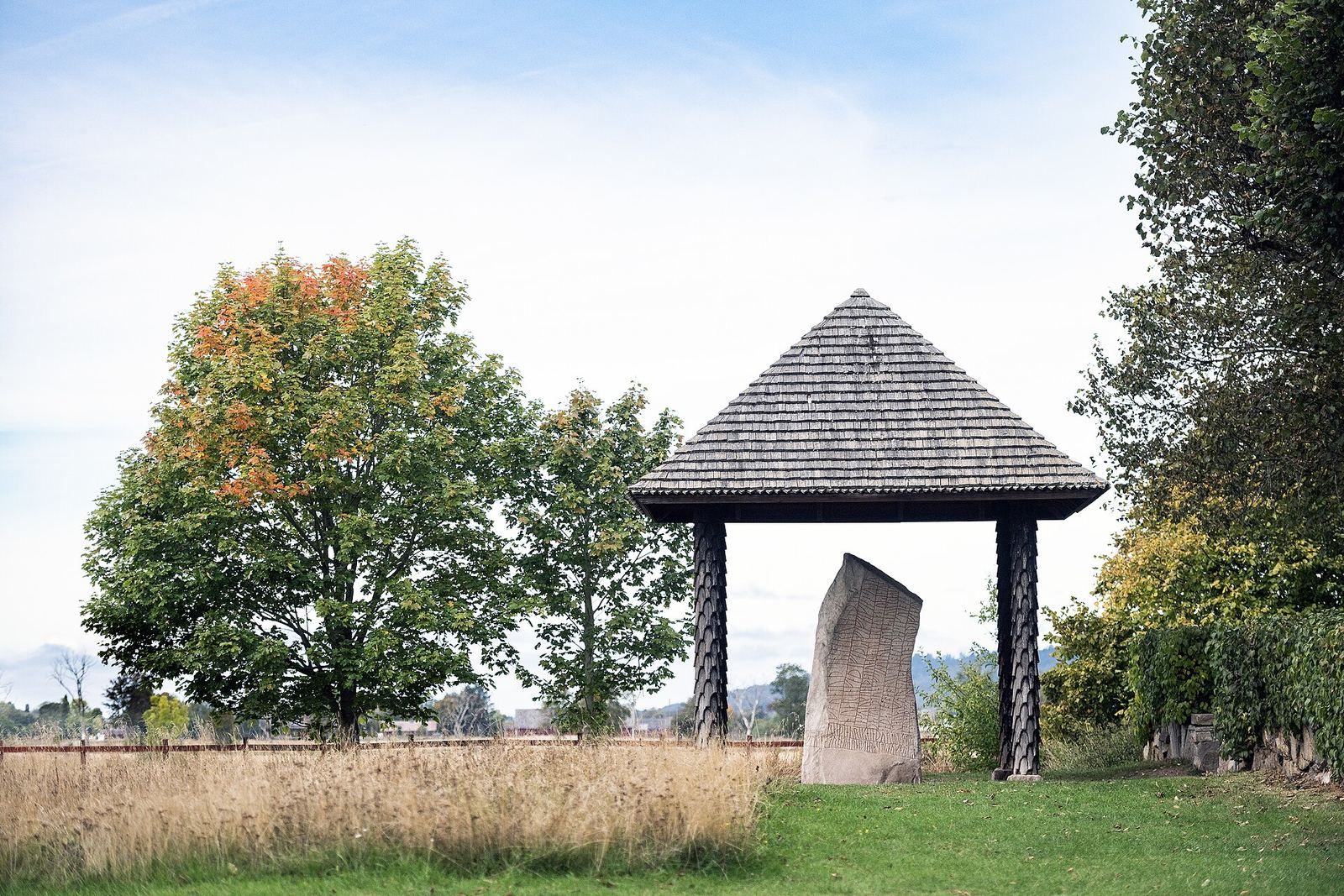
When the old church and storehouse were demolished in 1843, runes on the stone’s other faces came to light. The local provost, Hedmark, copied these surfaces, and the stone was then placed in the porch wall of the new church. At the Academy of Antiquities’ request, it was removed in 1862 and set beside the western cemetery wall. In 1933 it was moved outside the cemetery to its present location and placed under a protective roof.
The inscription is regarded as the longest known runic inscription carved on stone. It is sometimes described as the earliest surviving literary work in Swedish and as a starting point for Swedish literary history. The Norwegian scholar Sophus Bugge produced its first translation in 1878.
Remains
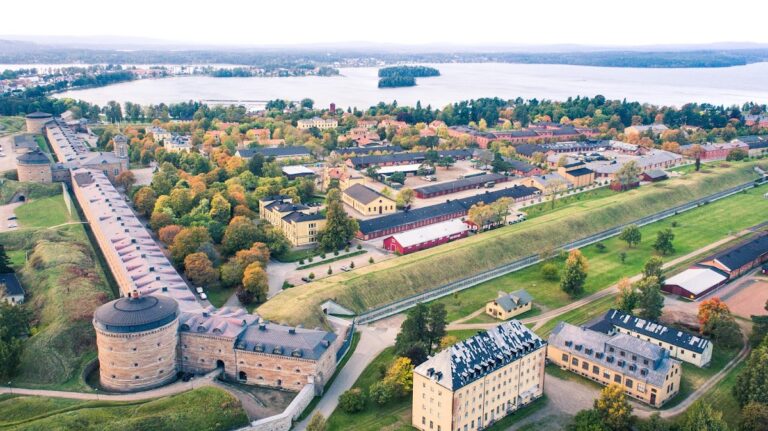
The monument is a single carved block now standing outside the cemetery beside Rök’s church, near the eastern shore of Lake Vättern. A protective roof shelters it, and its inscribed surfaces include the top of the stone as well as its upright faces.
Stone and carved surfaces
Block and position
The light-gray granite is fine-grained and was probably obtained nearby. The block measures about 382 centimetres in total height, including 125 centimetres below ground. It is 138 centimetres wide, between 19 and 43 centimetres thick, and weighs about 5.1 tonnes. Its present angle may differ from its earlier stance: if the vertical carvings were made upright, the lower rows would lie horizontally.
Damage marks the right edge of the back and may have resulted from removing the stone from the storehouse wall. The left narrow face is also damaged, but its weathering suggests that this damage predates the church.
Inscription and runes
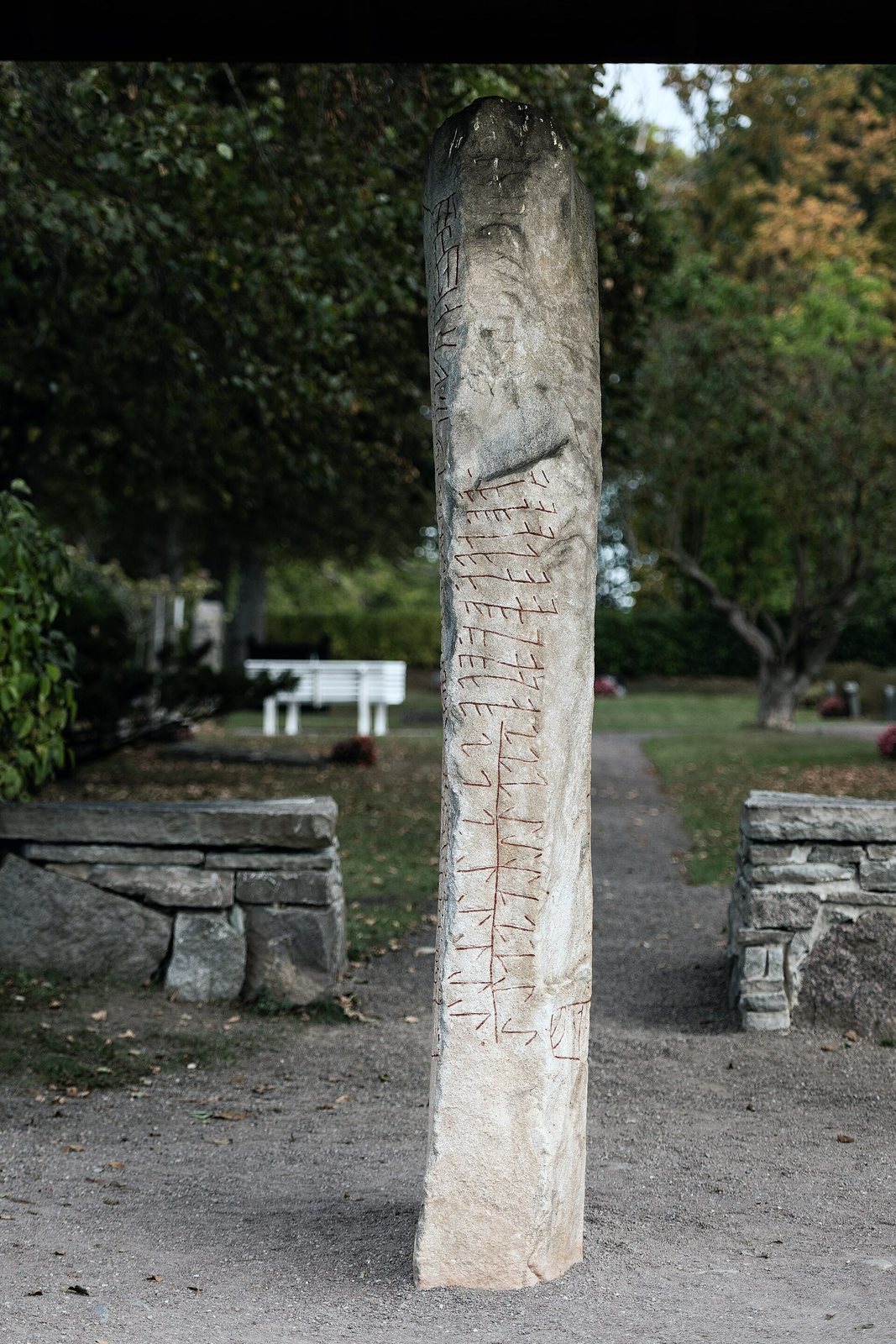
Runes cover five faces of the block, including the upward-facing top. The inscription contains about 760 characters, with approximately 280 on the front and 450 on the back; damage affects parts of the sides. The carving is even and fine, and makes careful use of the available surface. The text may have been laid out while the block was lying on the ground, before the runes were cut.
Most of the inscription uses the Younger Futhark, a historical runic alphabet with 16 characters, chiefly in short-twig forms with shortened branches. Lines 21–22 use the 24-character Elder Futhark. A small number of separators divide larger sections rather than individual words, so the continuous writing leaves some word divisions uncertain.
Encoded passages
Parts of lines 23–28 use codes. Line 23 is interpreted as a displacement cipher, a code based on a fixed shift, and another such cipher has been proposed for line 24. A coded sequence at the end of line 25 is read as “NIT.” Line 26 uses branch-rune and number ciphers, which encode runes through branch positions or numerical values. In lines 27–28, six slanted crosses, three on the back and three on the top, form a cross cipher, a code based on strokes arranged around a cross.