Balliol College: An Oxford College Founded Around 1263
Site at a Glance
- Popularity
- Very High
- Country
- United Kingdom
- Primary era
- Modern
- Eras represented
- Medieval, Early Modern, Modern
- Civilizations
- British, English
- Site type
- Civic
- Remains
- University
On this page20 sections
History
Balliol College in Oxford, United Kingdom, was founded around 1263 by the Norman-Scottish nobleman John I de Balliol as a residence for scholars. Walter of Kirkham, Bishop of Durham, guided its establishment. A tradition links the foundation to a land dispute: de Balliol supposedly abducted the bishop and, as penance, was publicly beaten and required to support scholars at Oxford. The college has remained on its present site since its foundation.
Foundation and medieval statutes
After de Balliol died in 1268, his widow, Dervorguilla of Galloway, secured the college’s future with financial support and statutes issued in 1282. Those statutes survive. Their son later became King of Scotland.
Balliol claims to be Oxford’s oldest college, though the claim depends on what counts as a college’s foundation. Balliol’s case rests on the scholars’ residence established around 1263. Merton received the first official college statute in 1274, while University College’s provisional foundation dates to a will made in 1249 and its official establishment to around 1280. Balliol recognizes that each has a valid claim under its own criteria.
Institutional changes and academic life
An 1881 statute enabled the medieval New Inn Hall to merge with Balliol in 1887. Balliol received New Inn Hall’s admissions and other records for 1831-1887, along with its library, largely made up of eighteenth-century law books. The former New Inn Hall site was later sold and is now part of St Peter’s College.
Balliol pioneered the Philosophy, Politics and Economics degree, known as PPE, in the 1920s. The degree combines philosophy, politics and economics. In 2000-01, Balliol and its former master Andrew Graham played a major role in establishing the Oxford Internet Institute, which examines the Internet’s effects on society.
The college is governed by a master, its head, and approximately 80 fellows, senior academic members. Its religious patron is Saint Catherine of Alexandria, a Christian saint traditionally venerated as a martyr. A formal dinner for final-year students on her feast day, 25 November, had been established by 1550. The annual Snell Dinner honours John Snell’s support for students from the University of Glasgow at Balliol. The first Snell scholarship students arrived in 1699; Adam Smith was among them. The dinner brings together fellows, scholarship students and representatives of Glasgow and St John’s College, Cambridge.
Changing membership
Balliol’s move to admit women took place in stages. In 1964, a decision was made to create a coeducational graduate institution. The Balliol-St Anne’s Graduate Institution opened at Holywell Manor in 1967, admitting men and women, and closed by mutual agreement in 1984. At Balliol, a 1971 vote supported admitting women, pending a change to the college statutes. The university gave permission in 1977, and Balliol admitted its first women undergraduates in 1979. Elena Ceva-Valla arrived on 16 September, alongside Cressida Dick, Katy Koralek and Penny Phillips that term.
Carol Clark’s appointment to a modern-languages tutorial fellowship in 1973 had already made Balliol the first of Oxford’s ancient all-male colleges to appoint a female fellow. In 2018, Helen Ghosh succeeded Sir Drummond Bone as Balliol’s first female master.
Writing, celebrations and rivalry
In 1880, seven undergraduates produced The Masque of B-ll–l, a broadsheet of 40 four-line stanzas mocking the master, fellows, scholars, other students and the writers themselves. College authorities suppressed it. The best-known poem, about Benjamin Jowett, and 18 others are attributed to Henry Charles Beeching. William Tuckwell printed 18 stanzas in his 1900 memoirs; Walter George Hiscock published the complete collection in 1939 and a second edition in 1955. Verses of this kind became known as “Balliol rhymes.”
Balliol’s long-running rivalry with neighbouring Trinity College, Oxford, has involved sports, songs shouted across the dividing wall and raids. A traditional story traces the feud to Trinity president Ralph Bathurst, who supposedly threw stones at Balliol’s windows in the late seventeenth century. Its recognizable modern form seems to date from the late 1890s, when Balliol students began singing the “Gordouli” chant. The name came from a nickname for Trinity student Arthur Galletti; the lyrics also mentioned Bobby Johnson, then an undergraduate at New College. The chant is said to have been sung by Balliol and Trinity men in the trenches of Mesopotamia during the First World War. The rivalry also recalled the one between Trinity College, Cambridge, and Balliol’s sister college, St John’s College, Cambridge.
In the twentieth century, Balliol students’ political radicalism sharpened the contrast they drew with Trinity, whose students they portrayed as socially exclusive and conservative. In the 1960s, students took over Balliol in an abortive coup and proclaimed a “People’s Republic of Balliol.” Balliol’s admission of Indian and other Asian students was met with racist taunts from some Trinity students, who used the slur “Basutos.” In 1962 or 1963, a Balliol raid covered Trinity’s Junior Common Room with turf and daffodils. The last incident suspected of being connected to the feud was vandalism of Trinity’s Senior Common Room pond, in which all but one fish died.
Remains
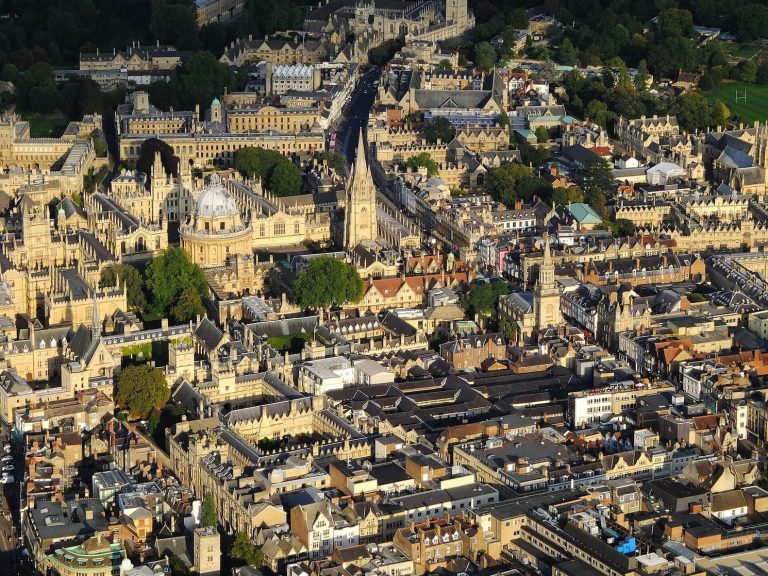
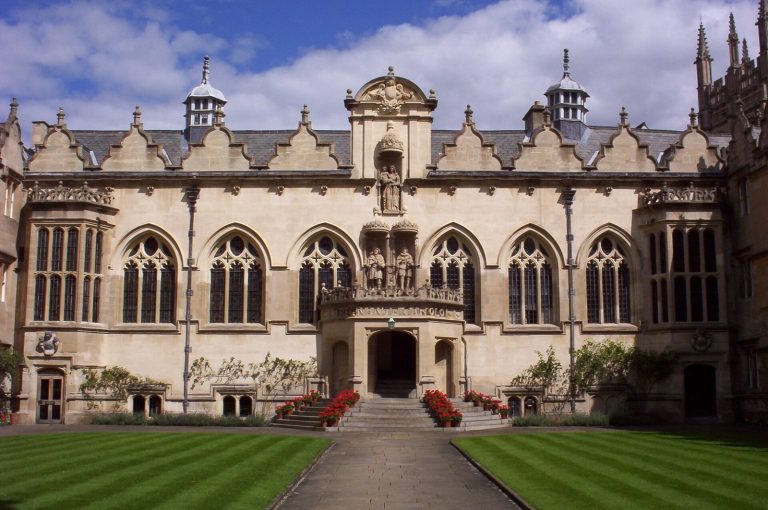
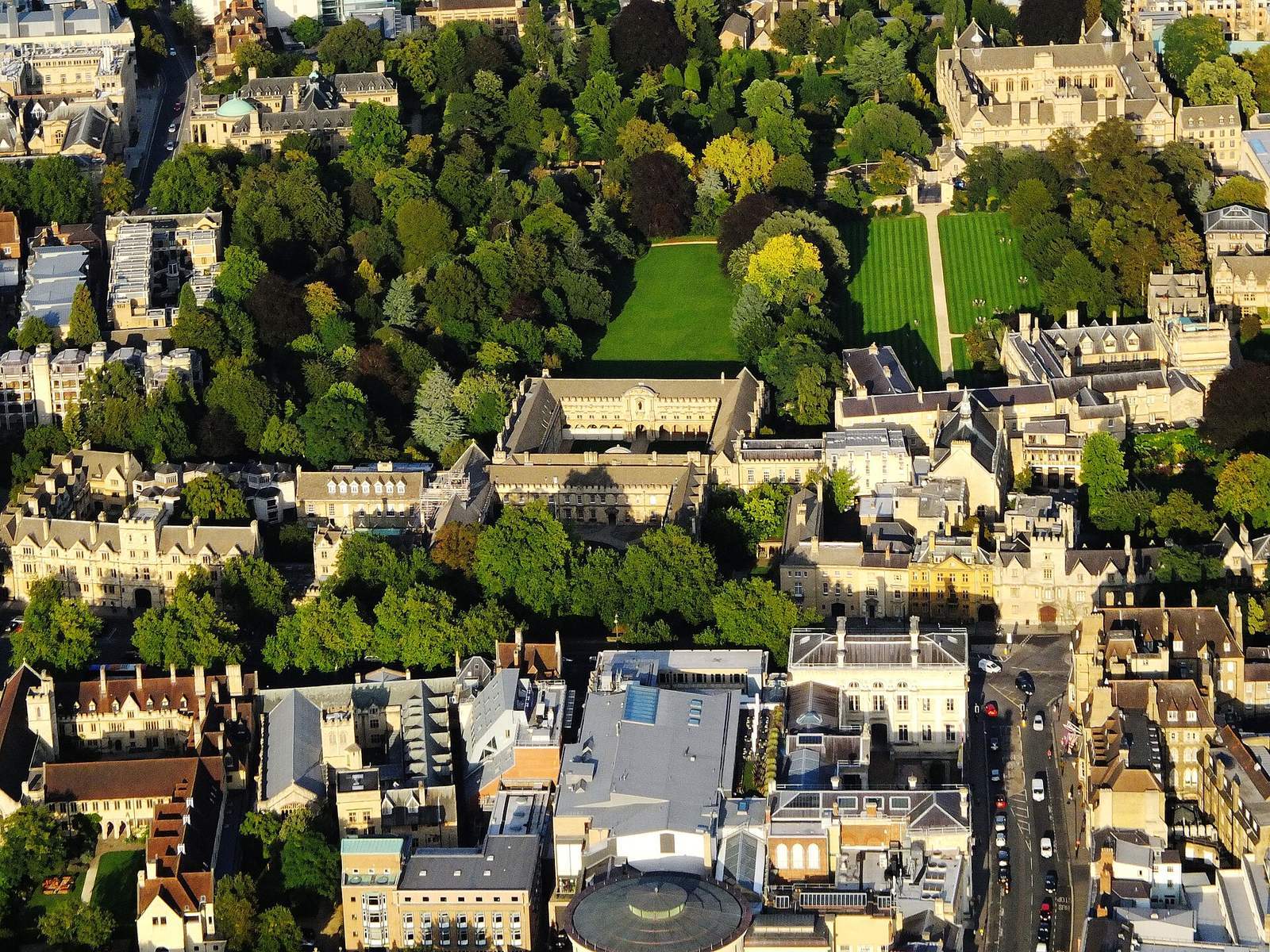
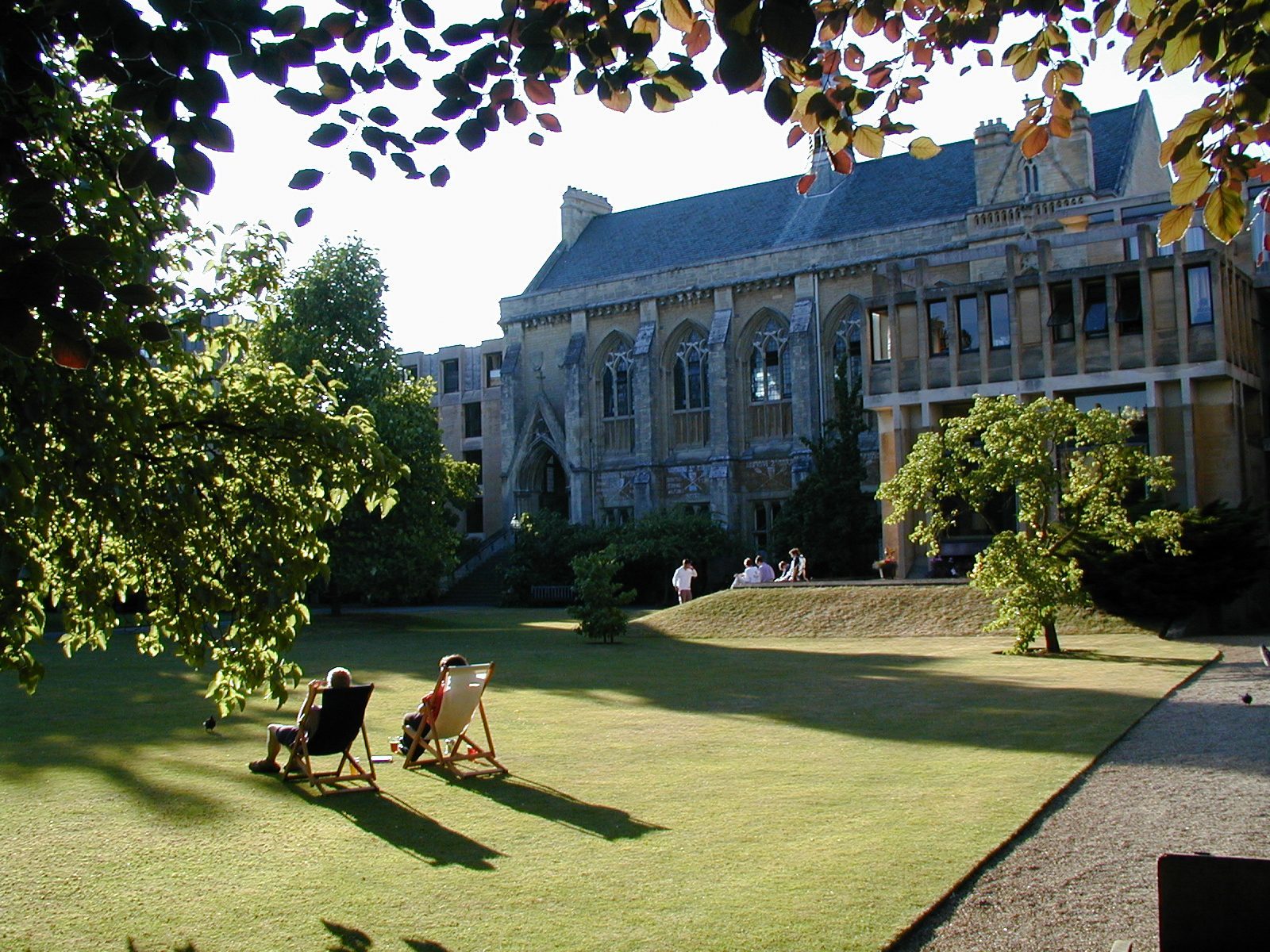
Balliol’s historic core is arranged around the Front and Garden Quadrangles, courtyards edged by buildings from several periods. Its main buildings occupy Broad Street, with additional groups at Jowett Walk and Holywell Manor. The surviving complex includes medieval ranges, later stone buildings and modern additions.
The Front Quadrangle
Medieval ranges and libraries
The north and west ranges date from 1431. The medieval hall on the west side now houses the New Library. The Old Library occupies the first floor of the north range, above the Old Senior Common Room. Balliol’s second library predates the introduction of printed books in Europe. William Grey, Bishop of Ely, contributed to the library, the master’s lodgings, the old buttery and the hall. He assembled manuscripts, arranged for scribes to copy books, and commissioned an artist working for him in Florence to add miniature paintings and ornate initial letters. The library project was completed around 1477 under master Robert Abdy, and Grey gave the college about 200 manuscripts.
Many of Grey’s manuscripts were destroyed during Edward VI’s reign and the English Civil War in the mid-seventeenth century. By the time of Oxford antiquary Anthony Wood, few surviving miniature paintings had escaped damage. At least 152 of Grey’s books remained in the college’s possession in 1890, and they formed a substantial part of Roger Mynors’s 1963 catalogue of Balliol manuscripts.
Master’s Chamber
The original Master’s Chamber, on the quadrangle’s southwest side, may predate the 1431 ranges. Its projecting oriel window extends outward from the wall. The room now serves as the Master’s Dining Room, and the Master’s Lodgings on the south side of the Garden Quadrangle incorporate it. Grey’s coat of arms, a red shield with a rearing silver lion and a silver inward-curving border, appears in two Old Library windows and on panels below the dining room window.
Chapel and Broad Street frontage
Chapel
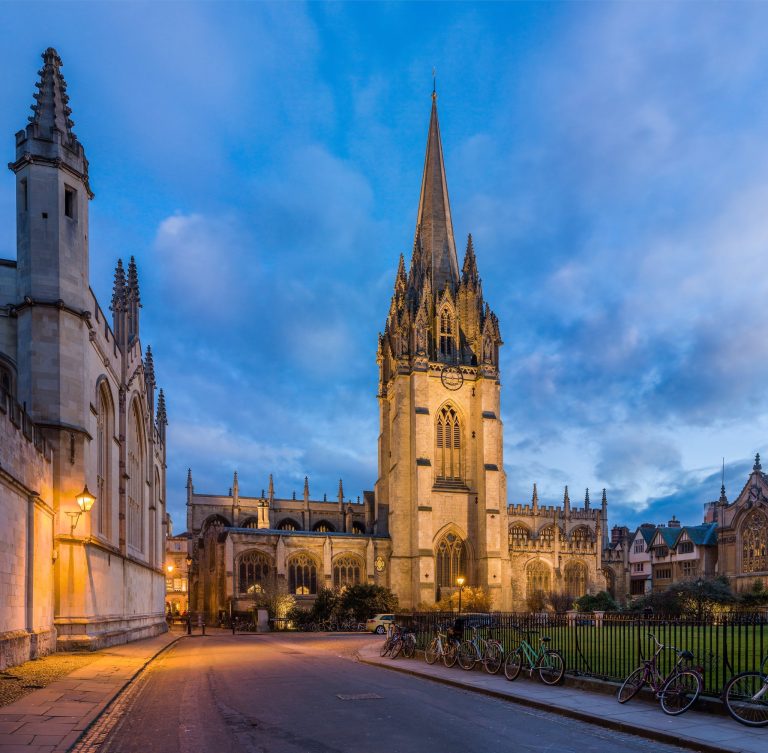
The present chapel, the third or possibly fourth on the site, was designed by William Butterfield in 1857.
Brackenbury Buildings
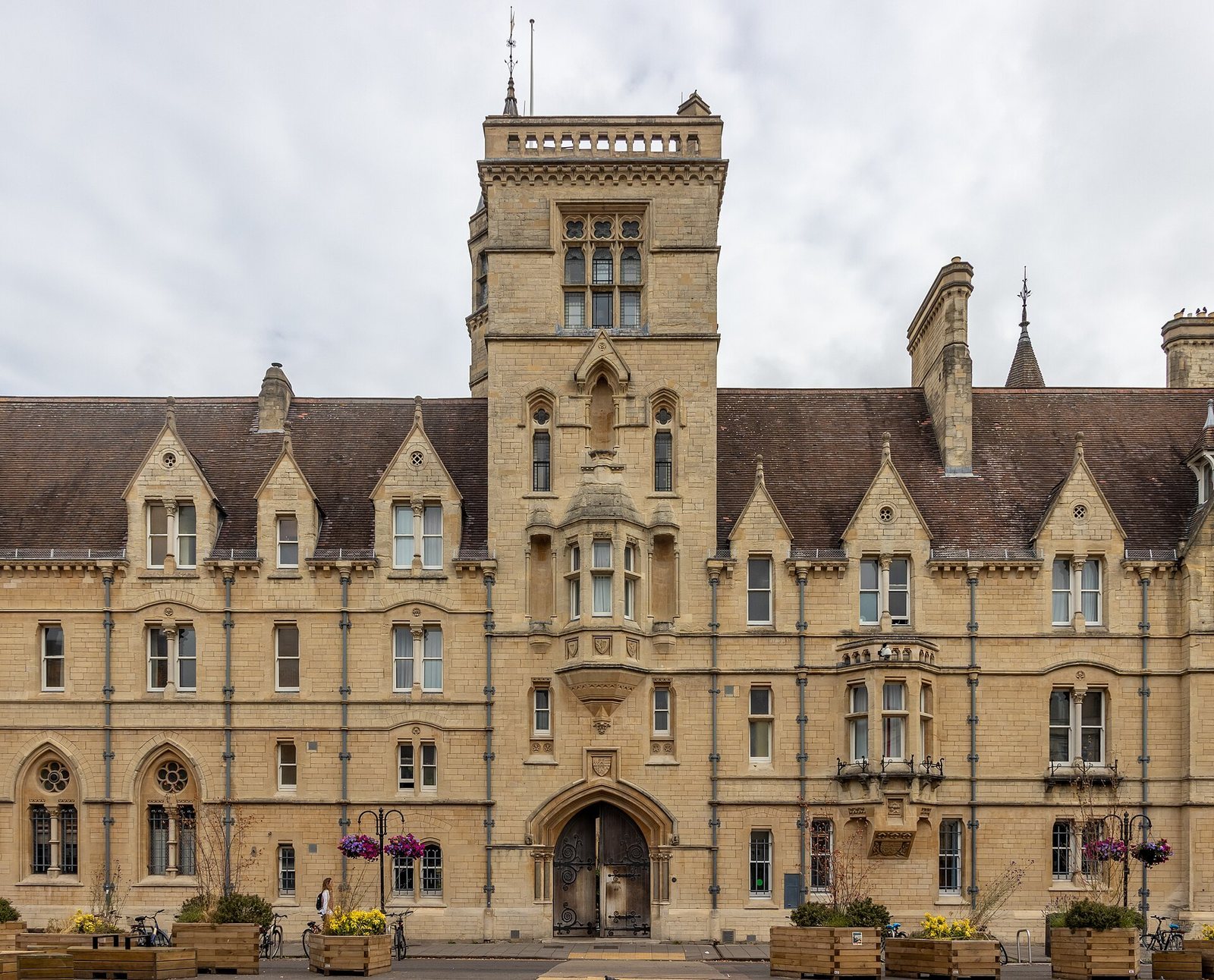
Alfred Waterhouse designed Balliol’s main Broad Street frontage, gateway and tower in 1867-68. Known as the Brackenbury Buildings after benefactor Hannah Brackenbury, they replaced earlier structures identified as Staircases I-VII. The first staircase beside the chapel contains the organ scholar’s lodgings.
Dining hall and Garden Quadrangle
Dining hall
Balliol’s present dining hall was built in 1877, replacing an older Front Quadrangle hall that had become too small. Master Benjamin Jowett bought and donated the land. Waterhouse designed the hall in a geometric style, using Bath and Tisbury stone, with an oak roof and woodwork. A Willis organ was installed at Jowett’s initiative for secular concerts.
Garden Quadrangle ranges
On the south side, the front part of the Master’s Lodgings dates from Waterhouse’s 1860s improvements. The adjoining Fisher Building dates to 1759. The quadrangle’s oldest building, intended to house scholars from Bristol, dates from 1720. On the west side, George Basevi’s buildings of 1826 provided additional space as applications from students who were neither scholars nor fellows increased. Warren’s 1912 building filled the last gap in the quadrangle; its ground floor and basement contain the principal undergraduate common room.
Salvin-designed buildings, including a tower, date from 1853. Beard’s 1968 building replaced a Victorian structure and obscures a formal gateway similar to the Broad Street entrance. A room known as the Massey Room occupies the gap between buildings on this side. Warren’s 1906 building forms the west and north sides of the quadrangle and includes the Back Gate. Nearby, the college-owned building at 1 St Giles’ houses the Oxford Internet Institute. Beard’s later building replaced Victorian rooms provided through the Vivian Bulkeley-Johnson benefaction. Accommodation called Snell Bridge connects the two Beard buildings at third-floor level and was provided through the University of Glasgow’s Snell benefaction.
Gardens, common rooms and laboratories
The ground floor on the Garden Quadrangle’s west side contains the Buttery, a college bar and shop; the east side has the Senior Common Room lunchroom. A 1966 range occupies the north and east sides, with smaller rooms and the main lounge for senior college members. A lecture room lies beneath it. At the south end, the Master’s Garden is in front of the chapel, while the Fellows’ Garden is in front of the Old Senior Common Room. A Salvin tower at the corner between the Old Hall and Old Library dates from 1853 and balances the tower among the Salvin buildings on the west side.
The Balliol-Trinity Laboratories lay beneath part of the Garden Quadrangle and extended into Trinity College. In the late nineteenth and early twentieth centuries, they served as physical and chemical laboratories. Henry Moseley, a pioneer of the concept of atomic number, and Nobel laureate Cyril Hinshelwood worked there. The laboratories are now disused, following the construction of the university’s Physical and Theoretical Chemistry Laboratory on South Parks Road.
Holywell Manor and other college sites
Holywell Manor and St Cross Church
Balliol acquired Holywell Manor in 1932 under master Kenneth Norman Bell’s direction, and it now houses research and postgraduate students. The manor has an extensive garden, music practice rooms, a graduate common room and a leisure room known as the Cockpit. Its student-run Megaron bar is also there. Alumni artworks include a mural by Gilbert Spencer depicting the college’s foundation. The Martin Building, constructed on Manor Road in 1966, is nicknamed “Holywell Minor,” a reference to the manor across the road. The Dellal Building, completed in 1986, also provides postgraduate accommodation.
St Cross Church, beside Holywell Manor, dates from the eleventh or twelfth century. Since 2010, it has served as Balliol’s Historic Collections Centre and an extension of the college’s library services.
Jowett Walk and associated facilities
Jowett Walk was developed in phases between 1996 and 2004, with phases completed in September 1996 and July 2004. Its buildings provide accommodation, a small theatre and the Michael Pilch Studio. Under an arrangement between the colleges, some rooms have also housed students from Wadham College. The nearby Master’s Field contains Balliol’s sports ground and pavilion facilities; a boathouse is also associated with the college.
Objects and commemorative features
A sundial installed in the Garden Quadrangle in 2010 marks the thirtieth anniversary of women’s admission and bears the inscription “About Time.” A portrait of benefactor Stephanie Shirley was unveiled in the hall in 2012, the first portrait of a woman there since Dervorguilla of Galloway. Portraits of Carol Clark and mathematician Frances Kirwan were added later. Three copies of The Masque of B-ll–l entered the college library over time, and another entered the Bodleian Library. Poet Robert Browning donated a portrait and other memorabilia to Balliol, forming the basis of a substantial collection relating to him.