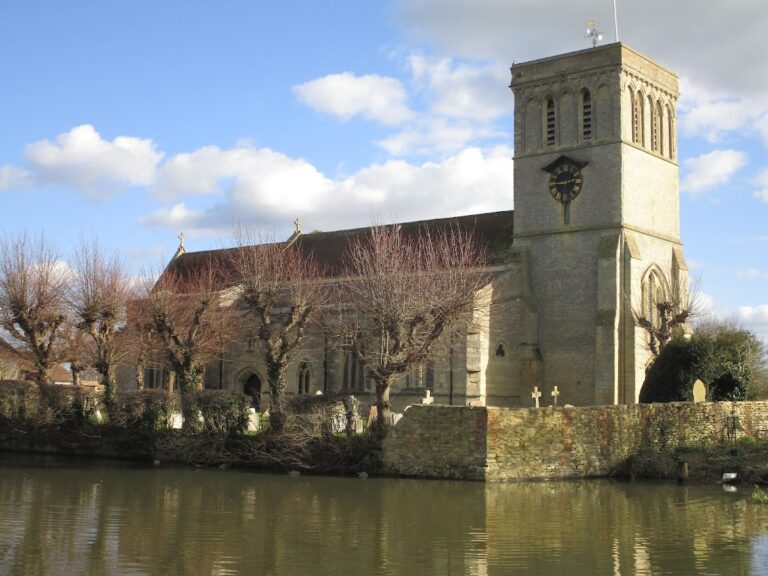
Christ Church Cathedral, Oxford: A Cathedral and College Chapel


Site at a Glance
- Rating
- 4.6
- Popularity
- Medium
- Country
- United Kingdom
- Primary era
- Medieval
- External website
- Open
- Eras represented
- Medieval, Early Modern, Modern
- Civilizations
- Norman
- Site type
- Religious
- Remains
- Cathedral
On this page18 sections
History
Christ Church Cathedral, Oxford, is an Anglican cathedral in the United Kingdom, developed in the later twelfth century as a Norman and Romanesque pilgrimage church. It is the seat of the Bishop of Oxford, the principal church of the Diocese of Oxford, and the chapel of Christ Church, a college of the University of Oxford. This combined cathedral-and-college-chapel role is unique in the Church of England.
Saint Frideswide and the Augustinian priory
The site was traditionally linked with a nunnery founded by Saint Frideswide, Oxford’s patron saint, probably in the eighth century. Saint Frideswide is associated with a medieval foundation tradition centred on a religious community and the preservation of her relics. The nunnery and its parish church were burned during the St Brice’s Day massacre in 1002.
By 1122, the institution had been re-established as a priory of Augustinian canons dedicated to Saint Frideswide. Augustinian canons were members of religious communities following the Rule of Saint Augustine, while a priory was a religious house governed by a prior. The priory continued until its suppression in the sixteenth century.
A pilgrimage church
The church was rebuilt during the later twelfth century, probably between 1160 and 1200, to serve pilgrims visiting Saint Frideswide’s relics. A shrine is a sacred monument associated with a saint’s relics and pilgrimage. Pilgrimage continued from at least the twelfth century until the early sixteenth century, and offerings helped pay for later enlargement and embellishment. Catherine of Aragon was among the prominent pilgrims, visiting in 1518.
The relics had been translated to the shrine during rebuilding in 1180. The shrine was desecrated during the Reformation in 1538. The Reformation was the sixteenth-century religious transformation that separated the English Church from papal authority and led to the destruction or alteration of many shrines and religious images. During Mary I’s reign, the relics were returned, but after her death Protestant reformers desecrated them again, buried them beneath the church floor, and broke the shrine.
From priory to cathedral and college
In 1522 or 1524, the priory was surrendered to Cardinal Thomas Wolsey, an English cardinal and senior Tudor churchman. Wolsey intended to replace it with a college for the University of Oxford, later known as Cardinal College. He demolished the western part of the nave and planned to demolish the church, but his fall from favour in 1529 stopped the project.
Henry VIII took over the foundation and refounded the college in June 1532. Henry’s break with papal authority led to the establishment of the Church of England. He preserved the church, and in 1546 transferred the newly created See of Oxford from Osney Abbey to it. The Diocese of Oxford had been created in 1542, so the church became both its cathedral and the chapel of the newly established Christ Church college. Henry VIII’s foundation charter gave it the name Ecclesia Christi Cathedralis Oxoniensis.
The cathedral is now a Church of England institution in the Diocese of Oxford and the Province of Canterbury. It was formerly Roman Catholic and remained associated with the Augustinian order until 1524. Its Grade I listed status, granted in 1954, reflects the importance of its historic fabric. In the nineteenth century, the architect George Gilbert Scott directed a restoration that materially altered parts of the building. The cathedral remains one of the smallest in the Church of England.
Music, worship, and institutional change
A choir has existed at the cathedral since 1526, when John Taverner was appointed organist and master of the choristers. Taverner was an important English Renaissance composer and organist, and his work helped make the cathedral an important centre of choral and organ music. Wolsey’s original college statutes provided for 16 choristers and 30 singing priests.
John Wesley and Charles Wesley were ordained there as Anglicans. The brothers were Anglican clergymen whose preaching and hymnody helped initiate the Methodist revival. John Henry Newman received Anglican priestly ordination at the cathedral in 1825.
The main cathedral choir was all male until 2019, when Elizabeth Nurse became its first female clerk. That year, Frideswide Voices was re-founded as a permanently endowed part of the cathedral’s choral foundation, giving girls opportunities to sing in the liturgy. The group sings Evensong weekly with cathedral choir clerks and sometimes performs with the boys’ choir.
The cathedral’s continuing musical institutions include the main cathedral choir, the volunteer Cathedral Singers, the College Choir, and Frideswide Voices. The main choir sings during university terms and at Christmas and Easter. The volunteer choir generally serves outside university term, while the College Choir sings approximately every one to two weeks during term. The main choir also maintains touring and recording activities. On 19 September 2023, Christ Church’s governing body voted to separate the ecclesiastical office of dean from the position of head of the college.
Several historically significant people are buried or commemorated in the cathedral. They include John Bankes, George Berkeley, Robert Burton, Thomas Byron, John Fell, Henry Gage, Richard Gardiner, Henry Liddell, John Locke, Elizabeth Montacute, Edward Bouverie Pusey, George Stewart, Thomas Strong, John Underhill, John Urry, and Peter Wyche. John Locke is commemorated by an engraved floor plaque rather than a burial, while George Berkeley has a memorial in the nave.
Remains
The cathedral is built principally of yellow Cotswold stone and preserves architectural forms ranging from Norman and Romanesque work through Early English Gothic to the Perpendicular style. The surviving complex includes a three-aisled, four-bay nave, a similarly arranged choir, a narrow transept, several side chapels, a cloister, and a chapter house. Its interior is marked by late Gothic net vaulting and a large ten-part botanical-type rose window in the east wall.
Medieval plan and stone fabric
Nave, choir, and transepts
The nave, choir, main tower, and transepts are late Norman. The nave and choir each have three aisles and four bays, with the narrow transept separating the two principal spaces. Side chapels, the cloister, and the chapter house are attached to the cathedral, creating a connected medieval complex. Later architectural work introduced Early English Gothic and Perpendicular elements into the building’s form and interior.
Crossing tower and spire
A substantial square crossing tower rises above the meeting point of the nave, choir, and transept. Its lower stages remain Norman, while a spire was added in 1230. Together, these elements record the cathedral’s development from its late twelfth-century rebuilding into later medieval construction.
Saint Frideswide’s chapel and memorials
Latin Chapel
The Latin Chapel was built in 1338 and contains Saint Frideswide’s shrine. The shrine originally held relics translated during the rebuilding of 1180. After the medieval shrine was broken and the relics were buried beneath the church floor during the Reformation, the shrine was restored in the Latin Chapel in 2002 and again became a focus for pilgrimage.
Tombs and commemorations
The cathedral contains tombs and memorials from different periods. Henry Gage is buried in the Lucy Chapel, which lies off the south transept. George Berkeley’s memorial stands in the nave, and John Locke’s engraved memorial plaque is set into the floor. These features form part of the building’s continuing record of religious, academic, and public figures.
Stained glass
Medieval and early modern windows
The oldest stained glass is the fourteenth-century Becket Window in the Lucy Chapel. It preserves one of the few surviving images of Thomas Becket to have come through the Reformation. Two further windows were made by the seventeenth-century Dutch artist Abraham van Linge. One depicts Jonah, while the other is dedicated to Bishop King.
Nineteenth- and twentieth-century additions
The St Michael Window in the north transept was made by Clayton and Bell in 1870. Five other windows from the same period were produced by Morris & Co. to designs by Edward Burne-Jones. A memorial window unveiled in 2023 commemorates E. H. Burn and depicts Francis of Assisi. John Reyntiens made the window.
Organ and bells
Organ
The cathedral’s present organ has 43 ranks, four manuals, and pedals. The Austrian firm Rieger Orgelbau built it in 1979, and it stands at the west end. Its case incorporates substantial seventeenth-century material from an organ case of 1680. The Positive case came from a nineteenth-century choir organ designed by George Gilbert Scott, while the Swell division is housed in a newer case.
An earlier organ was built by Dallam in 1624 but disappeared during the English Revolution and the Protectorate of Oliver Cromwell. An organ attributed to Father Smith was made around 1680, although its identification remains uncertain. Gray and Davison repaired and enlarged the organ to 21 stops in 1848 and expanded it to 30 stops in 1870.
Ringing and service bells
Twelve bells are hung for full-circle ringing. The tenor, cast in 1589, weighs 3,495 pounds, measures 56 inches in diameter, and is tuned to D. Bells numbered 10 and 9, both cast around 1410, weigh approximately 1,850 and 1,300 pounds and are tuned to F-sharp and G respectively.
The cathedral also has a litany bell from around 1410, weighing approximately 170 pounds and sounding G. The Bourdon bell, Great Tom, dates from 1680, weighs approximately 13,940 pounds, measures 85 inches in diameter, and sounds A. Great Tom is swung only on rare occasions but is sounded nightly. The bells and service times traditionally follow Cathedral Time, approximately five minutes behind official time. This practice reflects Oxford’s former local mean time, used before the national adoption of Railway Time, or Greenwich Mean Time, during the nineteenth century.
Nearby sites