Church of Saint Stephen in Bar-le-Duc: A Former Collegiate Church
Site at a Glance
- Popularity
- Medium
- Country
- France
- Primary era
- Medieval
- Eras represented
- Medieval, Early Modern, Modern
- Civilizations
- French
- Site type
- Religious
- Remains
- Church
On this page25 sections
History
The Church of Saint Stephen is a Roman Catholic church in the Upper Town of Bar-le-Duc, France, established in 1315 as the collegiate church of Saint-Pierre. Built in stages, it combines Flamboyant Gothic, a late Gothic style marked by flame-like tracery, with Renaissance elements. Before the French Revolution, it served a chapter of clergy; it is now the parish church of Saint Stephen and belongs to the Diocese of Verdun.
Foundation and medieval construction
Édouard I, count of Bar, founded the collegiate church on the site of a thirteenth-century chapel dedicated to Saint Peter, which had also served officials of the Upper Town. In 1318, Jean d’Arzillières, bishop of Toul, approved the foundation and placed the church under the shared patronage of the Virgin Mary, the apostles Peter and Paul, and Saint Stephen. Its chapter was to include a senior dignitary called a princier, a dean, a provost, and sixteen canons.
Construction advanced quickly, and by the end of the fourteenth century the church was nearly complete. The Hundred Years’ War, the long conflict between England and France, brought disruption to the region from around 1420 and hindered the work. By 1438 the building was close to ruin. The canons sought papal indulgences, while the chapter, René I of Anjou, duke of Bar, and officials of the Barrois supported renewed construction.
Completion and later medieval phases
The eastern part of the church was nearly finished around 1470. Work stopped again from 1480 to 1484 during the occupation of the county by Louis XI of France. Construction then continued under René II, duke of Lorraine and Bar, whose rule saw the church’s vault built. In the early sixteenth century, Dean Louis Guyot oversaw the façade and two western bays; work continued until 1537. The north tower was built between 1589 and 1630, while a planned south tower was not completed.
Collegiate church, parish, and Revolution
In 1782, the town’s other collegiate church, Saint-Maxe at the ducal castle, became a parish church. After Saint-Maxe was destroyed late in the eighteenth century, its chapter and that of Saint-Pierre were combined under the title Noble Royal Collegiate Church, Holy Chapel, Principal Church and Parish of the King. Saint-Pierre received Saint-Maxe’s treasury and relics, as well as the remains of the rulers of Bar.
Revolutionary pillaging damaged the church’s façade statues and stained glass, erased coats of arms, and destroyed some furnishings. The church closed in 1790 and reopened the following year as the parish church of Saint-Étienne. It stopped serving as a place of worship from 1793 to 1795, and in 1794 briefly sheltered a convoy of prisoners. In 1839, Father Claude Rollet transferred relics of Saint-Maxe that had been saved during the Revolution.
Restoration and local devotion
Nineteenth-century changes included removal of the central pier of the west portal in 1809 and demolition of a chapel beside the south arm of the transept in 1854. In 1889, the church was designated a French historic monument. Jean-François de Boufflers, a marquis who died accidentally in January 1752, is thought to have been buried there. He was married to a favorite of Stanislas, duke of Lorraine and king of Poland.
In September 1914, as German forces approached during the First World War, residents prayed to Notre-Dame du Guet, a local title meaning Our Lady of the Watch. The German offensive was halted. In 1919, Bishop Charles Ginisty encouraged the decision to crown the Virgin and Child statue in gratitude. Residents gave jewelry and gemstones for crowns made by the Paris goldsmith Biais. The crowns, of gold and silver, were placed on the statue on 4 July 1920. They include 197 pearls, 82 diamonds, 13 rubies, 27 turquoises, 10 amethysts, lapis lazuli, and citrines, and are now held at the Musée Barrois. A feast for Notre-Dame du Guet is held at the church on the Sunday after the Feast of the Presentation of Mary in the Temple, observed on 21 November.
Remains
Plan and exterior
Plan and interior volume
The church measures 43 metres long, 20 metres wide, and 12 metres high. Its basilican plan has a central nave and side aisles, a shallow choir, and a transept, the crosswise part of a church, that projects only slightly. The nave and aisles are approximately equal in height, forming a hall church, a layout in which these spaces rise to much the same level. The south aisle is somewhat wider than the north, and the interior receives considerable light. This was among the earliest buildings of this type in the Diocese of Toul. Beneath the entrance area, a crypt, or underground chamber, preserves remains of the former Chapel of Saint Nicholas. Franck Mourot carried out archaeological work there in 2016.
West façade and tower
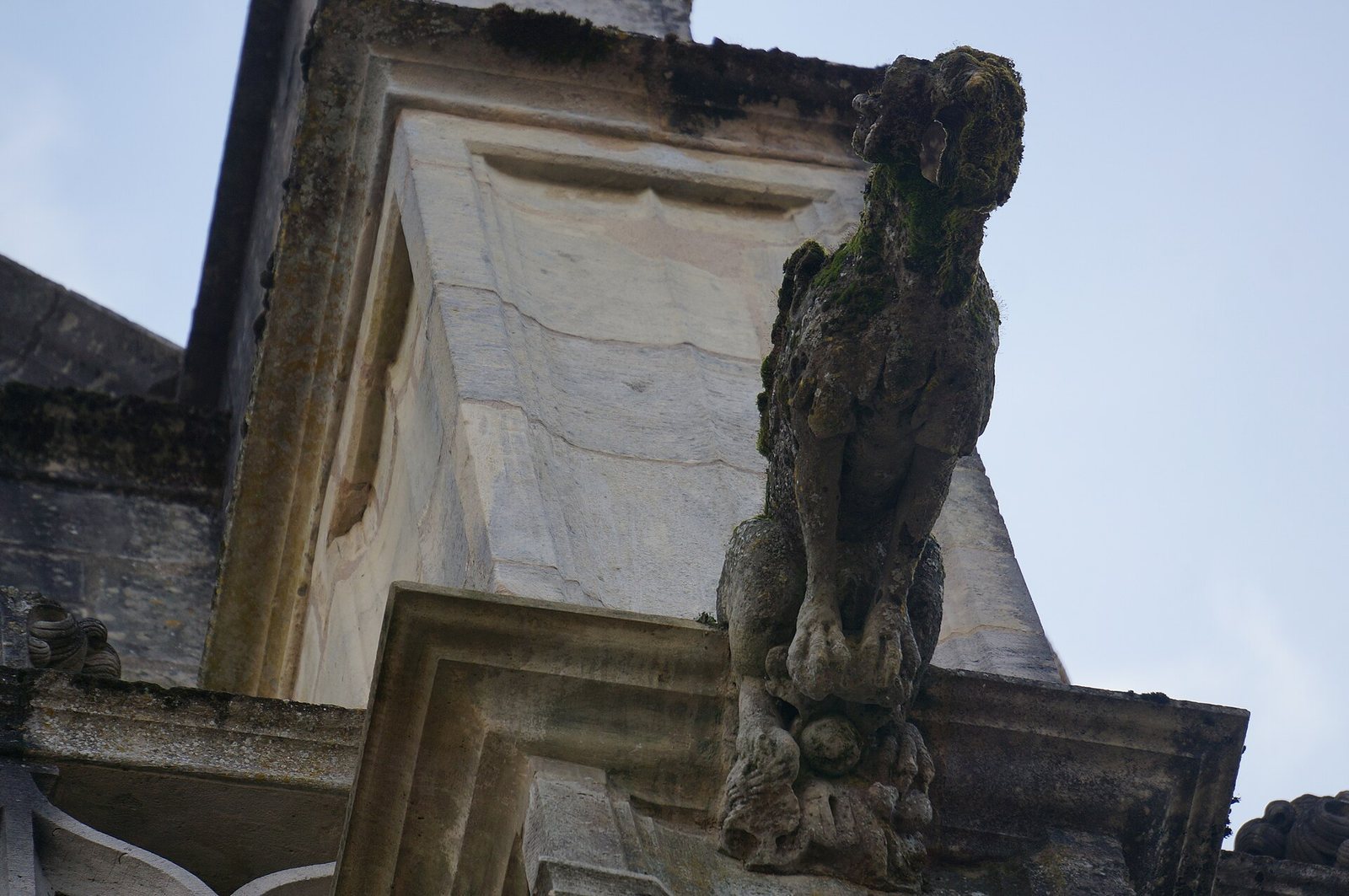
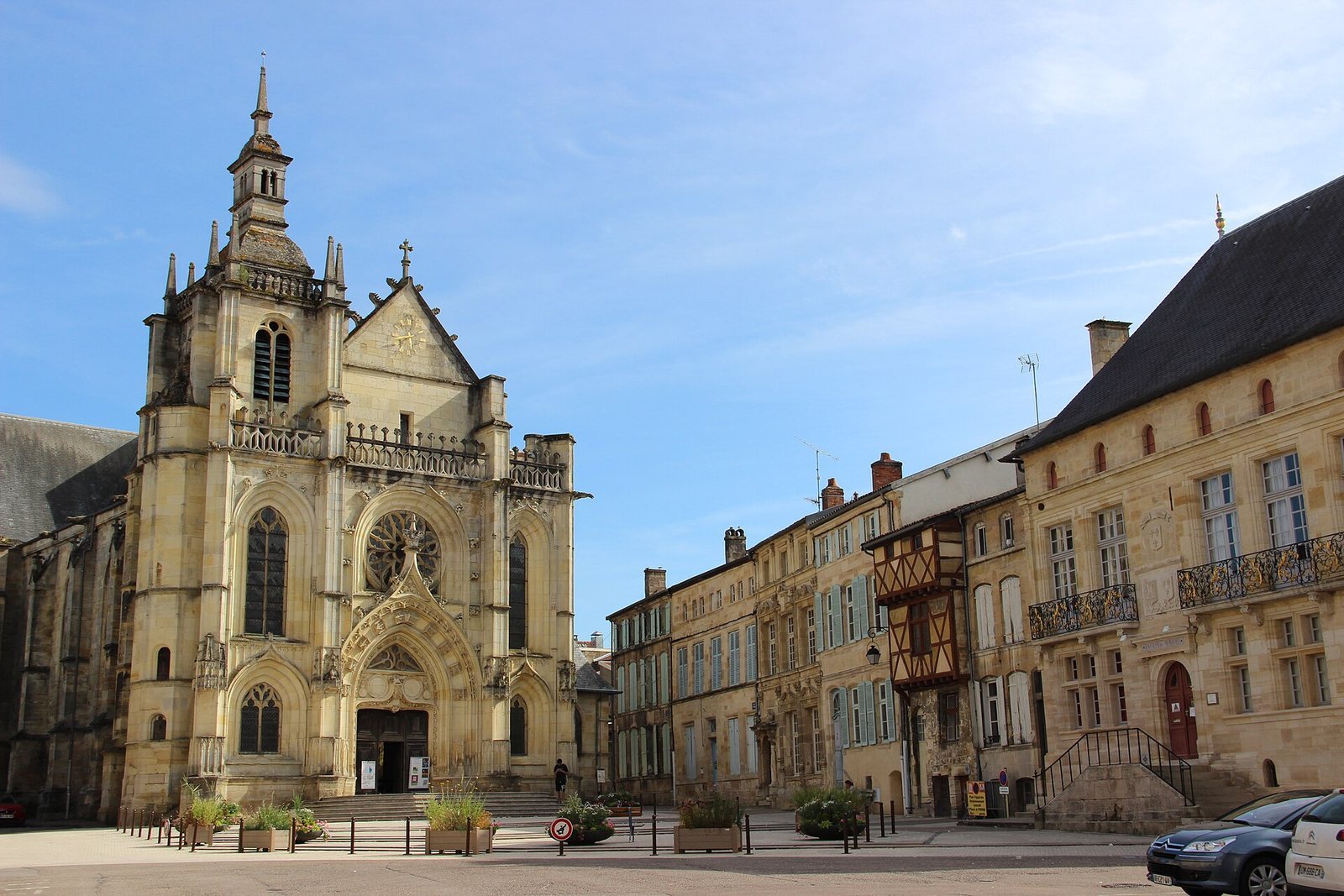
The west façade combines vertical Gothic features with a gallery and balustrade that interrupt their upward lines. A shallow arch frames the portal; above it, a triangular central gable contains a clock, while a rose window sits behind the upper façade decoration. Medallions on the portal arch portray the church’s patrons and Dean Louis Guyot in antique dress. The openwork panel above the doorway depicts the Last Judgment. The archangel Michael stands on skulls and weighs souls, while a small figure holding a cornucopia represents Paradise. Medieval arcades, consoles, and carved ornament remain around the portal. Small grotesque figures appear among vine leaves, curled cabbage leaves, and acorns. The north tower has a stone spire and an open lantern.
Chapels
Four chapels occupy the church: three on the south side of the nave and one north of the choir. Their carved enclosures, grilles, and sculpted decoration reflect the building’s successive Gothic and Renaissance phases.
Sainte-Marguerite Chapel
The Sainte-Marguerite Chapel lies north of the choir. Chapter dean François Brulé founded it around 1503.
Stainville Chapel
Founded by the Stainville family in the sixteenth century and probably begun in 1524, this is the church’s largest chapel. Its carved stone enclosure combines Flamboyant Gothic and Renaissance designs. Crossed stone ribs and subsidiary ribs support its vault.
Baptismal chapel
The Baudinais family founded the sixteenth-century baptismal chapel. Its openwork pediment has Renaissance ornament, and a double-leaf iron grille was added in the early seventeenth century. The chapel also contains a group of three sixteenth-century limestone statues and a separate relief, described below.
Sainte-Anne Chapel
The small Sainte-Anne Chapel, associated with the Font family, adjoins the Stainville Chapel to the east. Its openwork gable carries Renaissance motifs. The window uses sixteenth-century grisaille, a stained-glass technique chiefly using monochrome glass with painted detail. The grille dates from the late sixteenth or early seventeenth century.
Sculpture and memorials
Notre-Dame du Guet
The church holds a fourteenth-century limestone statue of the Virgin and Child known as Notre-Dame du Guet. From the Middle Ages until 1670, it stood on the Porte-aux-Bois in the southwest fortifications of the Upper Town. Local tradition says that in 1440 it warned the ducal town of an attack by Antoine de Vaudémont. As the attackers approached, the Virgin supposedly caught a stone thrown by a soldier and passed it to the Child; the soldier fell dead and the attackers fled. After the ramparts were dismantled in 1670, the statue was kept in a chapel. It was broken on 20 July 1794, then reassembled from its pieces and transferred to Saint-Étienne in 1806.
Transi of René de Chalon
In the south transept, above a vault containing the remains of the dukes of Bar, stands Ligier Richier’s sixteenth-century Transi of René de Chalon, also called The Skeleton. A transi is a funerary sculpture showing a dead person as a decomposing body or skeleton. Carved from Sorcy limestone, the figure represents a standing skeleton extending its own heart toward the sky.
Christ on the Cross between the Two Thieves
This group of three polychrome wooden sculptures, meaning the figures are painted in several colors, was made around 1531 and stands in the choir behind the altar. Christ is 3.42 metres high; the two thieves are each 2.10 metres high. The figures may once have belonged to a larger Calvary, an ensemble representing Christ’s crucifixion with accompanying figures. Attribution to Richier remains uncertain, though the Italianate modeling, anatomy, and other stylistic features support it.
Saints Roch and Adrian
Two limestone statues in the Stainville Chapel, each about 1.20 metres high, were made around the turn of the sixteenth century by Jean Crocq. Saint Roch wears a pilgrim’s clothing and points to a plague swelling on his thigh; Saint Adrian wears armor and carries an anvil, with a lion of Flanders at his feet. Their sturdy bodies, expressive faces, full lips, and strongly waved hair characterize their style.
Figures in the baptismal chapel
The chapel’s group of three sixteenth-century limestone statues shows Saint Stephen holding the stones of his stoning in his tunic, Saint John, and the Education of the Virgin, in which Saint Anne teaches Mary. A separate sixteenth-century relief depicts Saint John with Saint Mary Magdalene.
François Brulé epitaph
A 1513 bas-relief, a shallow sculpted scene, commemorates François Brulé. It shows Saint Francis of Assisi with Saints Peter and Maxe, each holding a scroll. Its inscription gives Brulé’s death as 18 July 1513 and states that he was buried before the altar of the chapel he had built and endowed.
Stained glass and paintings
Stained-glass windows
Most of the church’s stained glass dates from the nineteenth century. The central choir window by Victor Höner depicts the stoning of Saint Stephen. Its flanking windows, arranged in paired panels, show Saints Anthony, Vincent de Paul, Peter, and Paul. Fragments of a sixteenth-century window in the baptismal chapel show an angel carrying the crown of thorns, Saint Maxe, and Saint Christopher. Another nineteenth-century window depicts the miracle associated with Notre-Dame du Guet.
In the south transept, Charles-François Champigneulle’s 1880 window, The Procession of the Relics of Saint Maxe, shows Rollet’s transfer of the relics, with the church in the background. It uses photographic stained glass, which incorporates photographic imagery into glass, a technique developed in workshops in Metz in the late nineteenth century. Champigneulle also made windows depicting the Annunciation and the Death of Saint Joseph.
Paintings
An anonymous oil painting of the Crucifixion from the early seventeenth century replaces Jerusalem in its background with Bar-le-Duc. It shows the ducal castle before its demolition in 1670. A seventeenth-century wall painting, The Entombment, depicts the Virgin supported by Saint John, Mary Magdalene, Joseph of Arimathea, Nicodemus, and the holy women around Christ’s body. Jerusalem and Mount Calvary, with three crosses, appear behind them.
Organ
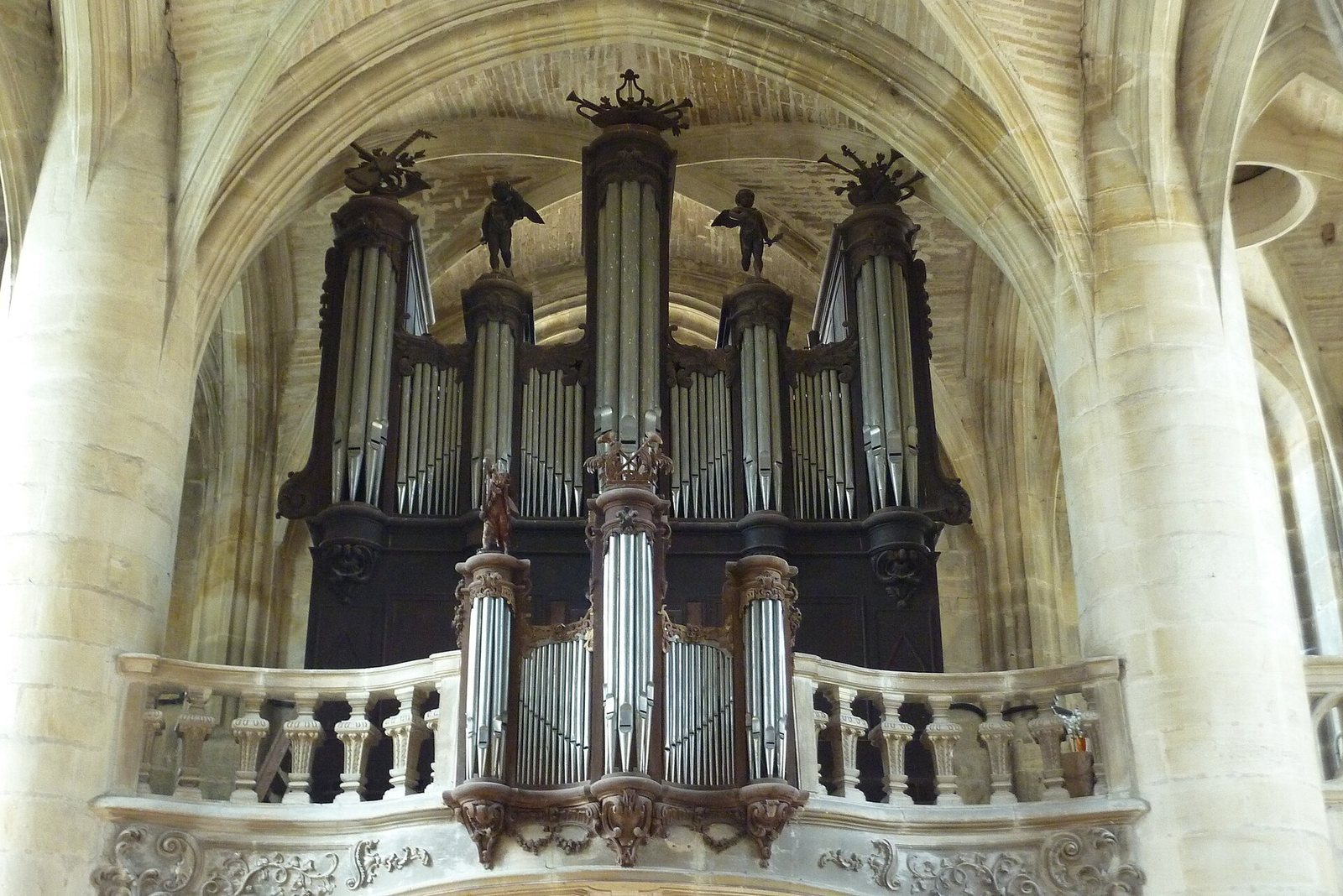
A gallery organ has been present since at least the seventeenth century. Nicolas Dupont built a new instrument in 1770–1771; the Revolution badly damaged it, leaving the positive organ case as a surviving component. Jean-François Vautrin and his apprentice Antoine François Brice Didelot built the present instrument between 1809 and 1828, reusing some older parts. Alexandre and Henri Jacquet separated the console from the rest of the instrument in 1892. The oak and limewood case has a main body of five towers and a positive case of three. The independent console faces the choir and has two manuals, Grand Orgue and Récit, and a straight pedalboard.