Castle of the Counts and Dukes of Bar: A Medieval Fortress and Ducal Residence in France


Site at a Glance
- Rating
- 4.3
- Popularity
- Very Low
- Country
- France
- Primary era
- Early Modern
- Eras represented
- Medieval, Early Modern, Modern
- Civilizations
- French
- Site type
- Domestic
- Remains
- Palace
On this page16 sections
History
The Castle of the Counts and Dukes of Bar is a medieval fortress and ducal residence at Bar-le-Duc in France, founded in the late tenth century by Frederick I, Duke of Upper Lorraine. Built on a rocky spur above the Ornain Valley, it protected his territory from the Champenois, the political and military forces associated with the neighboring region of Champagne. The castle later became the principal court of the Counts of Bar and developed into an important center of ducal government.
Foundation and the Counts of Bar
The castle’s position at the end of the Ville Haute gave it natural protection from two ravines, while the approach from the plateau could be fortified. By the thirteenth century, the Counts of Bar had established their court there, replacing Mousson and Saint-Mihiel as their principal centers. The castle enclosure consequently served more than a military purpose. It contained the ducal residence, the collegiate church of Saint-Maxe, buildings for the canons, a garrison, an arsenal, and stores of provisions intended to sustain a siege.
In 1354, the Lords of Bar established the Duchy of Bar. The castle remained associated with the ruling house through later changes of succession. After Louis of Bar, the last Duke of Bar, died in 1430, the duchy passed to his great-nephew René I of Anjou. It then passed through René I’s daughter Yolande to her son René II of the House of Châtenois. René II required Bar and Lorraine to remain united, and the two duchies subsequently shared a ruler in a personal union, an arrangement in which separate territories retain their institutional identities while sharing the same dynasty or ruler.
René II and the Ducal Residence
During the fifteenth century, René II enlarged the castle and transformed it into a richly furnished residence. He lived at Bar-le-Duc from 1491 until his death in 1509 while his ducal castle at Nancy was being built, and he restored the older castle during this period. These works gave the medieval stronghold a more residential character while preserving its political role as a seat of the Barrois court.
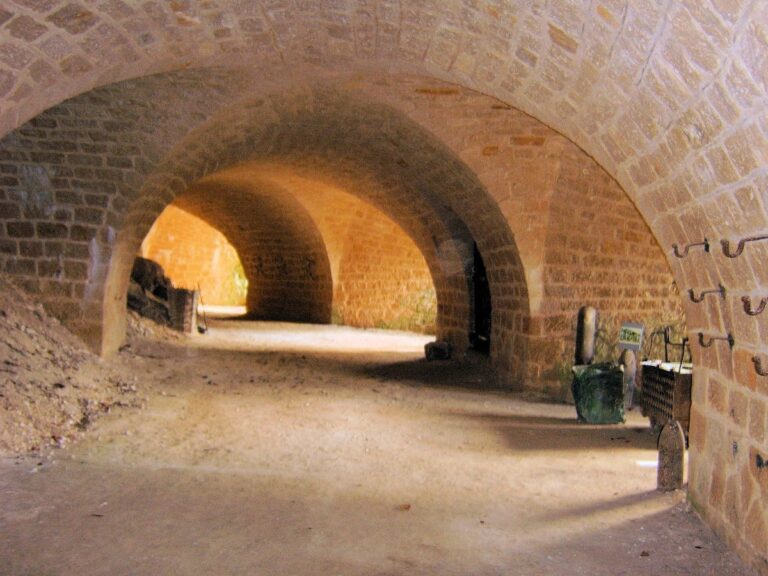
René II’s wife, Philippe of Gueldre, laid out an Italian-style garden near the castle on the site of the first defensive line. In 1499, René II commissioned a vaulted stone room beside the Romanesque Belle Porte to house the Treasury of the Charters of Lorraine. The room was intended for the duchy’s important charter records and remains one of the protected historic components of the complex.
Sixteenth-Century Government
The castle continued to accommodate the institutions of the duchy. In 1523, Duke Antoine added an audience chamber. In 1567, Duke Charles III built the Neuf-Castel in the inner courtyard, and the Chamber of Accounts moved into the new building. This princely financial institution supervised revenues, expenditure, and official accounts, giving the castle a continuing administrative function as well as its residential and ceremonial roles.
War, Occupation, and Dismantling
During the seventeenth century, the Dukes of Bar and Lorraine increasingly neglected Bar-le-Duc and its castle. The complex was damaged by a major fire in 1649. French troops occupied the town and castle from 1632 to 1661 after Duke Henri II adopted an anti-French position. The occupation formed part of the wider political and military pressure exerted by France on the duchies.
In 1670, Louis XIV, king of France, ordered the dismantling of the castle and the town’s fortifications. The Neuf-Castel was spared because it was regarded as militarily harmless. The Clock Tower, which served a timekeeping function, and the Heyblot Tower also survived. The former collegiate church of Saint-Maxe was demolished after the town was secularized during the French Revolution, when the seven medieval religious communities disappeared.
Later Reuse and Preservation
In 1768, small surviving buildings below the main castle plateau were adapted for a lace factory. The factory operated until 1832, when a two-storey building was converted into a Dominican girls’ school. The school continued until Catholic schools were prohibited in 1904. From 1832, a Dominican convent was built on the site of the former ducal residence. Its Saint-Louis Chapel was constructed from 1859 in a thirteenth-century Gothic style. A four-metre-high statue of Notre-Dame de la Protection, made by the Verdun sculptor Schmirdlin, was installed above the chapel on 27 September 1960.
The Barrois Museum was installed in the Neuf-Castel in 1970 after the building had served as a school. Structural work preceded its opening to the public in 1974. The museum has held recognition as a Musée de France since 1 February 2003, while its administration passed to the intercommunal authority in 2013 and ownership of the collections remained with the municipality. The museum has been closed to the public since October 2020 for structural works and collection inventory. The site was classified in 1911, and the Neuf-Castel, the vaulted Treasury of the Charters room, and the Belle Porte received monument protection in 1981.
Remains
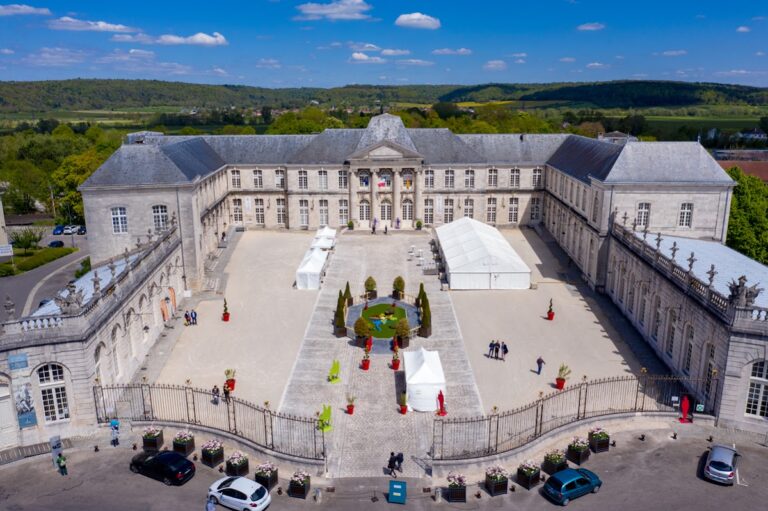
The surviving complex occupies a rocky spur at the end of the Ville Haute, above the Ornain Valley and the Ville Basse. Two ravines protected the spur, while its open side faced the plateau corresponding to the present Ville Haute. In the medieval period, a double defensive wall enclosed the castle and its associated buildings. The enclosure brought together the ducal residence, Saint-Maxe, canonical buildings, military facilities, and stores of provisions. The surviving remains combine later residential and administrative buildings with fragments of the earlier fortified enclosure.
Fortifications and Medieval Entrances
Belle Porte and Treasury Room
The Romanesque Belle Porte formed an entrance near the vaulted stone room commissioned in 1499 for the Treasury of the Charters of Lorraine. The doorway belongs to the earlier medieval fabric, while the adjacent room reflects René II’s late fifteenth-century restoration of the castle. The Treasury room survives as a protected component of the site and now houses Lorraine sculptures dating from the thirteenth to the seventeenth centuries. Among them are a thirteenth-century effigy of Guy de Sailly, a fourteenth-century apostle, a fifteenth-century Adoration of the Magi, a Captive attributed to Gérard Richier and dated about 1575 to 1580, a Dormition of the Virgin, and a plaster cast of a Transi after Ligier Richier.
Clock Tower and Heyblot Tower
The Clock Tower and Heyblot Tower are surviving elements of the castle’s defensive complex. The Clock Tower retained its timekeeping function, while both towers were spared when Louis XIV ordered the dismantling of the fortifications in 1670. Fragments of the wider defensive walls also remain, preserving parts of the enclosure that once protected the castle, the collegiate church, the military installations, and the stores supporting the garrison.
Ducal and Administrative Buildings
Neuf-Castel
The Neuf-Castel is the principal surviving building. Constructed in the sixteenth century, it consists of a main residential block with two wings set at right angles. The buildings were erected in different periods, yet the surviving parts form a relatively unified ensemble with broadly flamboyant Gothic characteristics. This late Gothic style is associated with elaborate tracery and complex decorative forms. The building housed the Chamber of Accounts after its construction in 1567 and later accommodated a school before becoming the home of the Barrois Museum.
Former Ducal Residence and Saint-Louis Chapel
The site of the former ducal residence was later occupied by a Dominican convent. Its Saint-Louis Chapel, begun in 1859, was built in a thirteenth-century Gothic style. Above the chapel stands the four-metre-high statue of Notre-Dame de la Protection, installed in 1960 and made by Schmirdlin of Verdun. These later religious structures occupy part of the former residential area and reflect the site’s reuse after the medieval ducal complex had lost its political function.
Museum Collections
Barrois Museum Collections
The Neuf-Castel houses the Barrois Museum, whose local-history collections include portraits of the Dukes of Bar and Lorraine, architectural elements from buildings in Bar-le-Duc, decorative arts illustrating historical life, a small cabinet of curiosities, and weapons and armor associated with the Thirty Years’ War. The museum also preserves paintings from French and foreign schools ranging from Mannerism to Neoclassicism, together with furniture, decorative arts, and Argonne faience. Its nineteenth-century holdings include works associated with Ingrism, the Neo-Greek movement, academic art, the Barbizon School, and Post-Impressionism, as well as nineteenth-century bronze sculpture.
Archaeology and Ethnography
The archaeological section contains material from the ancient site of Nasium and excavations in Bar-le-Duc. Its objects include Gallo-Roman material, finds from the necropolis at Gondrecourt, an intaglio, a second-century deity head, a first-century mother goddess, a second-century pilaster from Montiers-sur-Saulx, fibulae, and remains of public architecture. A fibula is an ancient brooch used to fasten clothing, while an intaglio is a design carved into a hard material. Ethnographic holdings document life in Africa, the Americas, Oceania, and the Far East, including a Japanese suit of armor and other arms, ritual objects, and decorative works.