Wieliczka Salt Mine: A Historic Royal Rock-Salt Mine in Poland
Site at a Glance
- Popularity
- Very High
- Country
- Poland
- Primary era
- Medieval
- Eras represented
- Medieval, Early Modern, Modern
- Civilizations
- Austria-Hungary, Austrian Empire, Habsburg, Kingdom of Poland, Polish–Lithuanian Commonwealth
- Site type
- Economic
- Remains
- Mine
On this page33 sections
History
The Wieliczka Salt Mine is a historic rock-salt mine in Wieliczka, Poland, where underground extraction began in the 1280s after a much older tradition of salt production from brine springs. For centuries it belonged to the Polish kings and formed part of the Kraków Saltworks with the mine at Bochnia. Income from the royal mines contributed substantially to the Polish state treasury.
From brine springs to a medieval mine
People in the Wieliczka area produced salt by evaporating brine as early as the middle Neolithic, around 3500–3000 BCE. They collected the salty water from natural springs, cleaned it and boiled it in clay vessels. This practice continued for roughly three to four millennia, until the springs stopped flowing. Archaeological investigations after the Second World War uncovered prehistoric installations used to heat the brine.
A document from 1044 records a salt privilege granted by Casimir I, and monks collected salt in the area around that time. This early industry still depended on brine. Wells were deepened around the turn of the twelfth and thirteenth centuries; after rock salt was reached at Bochnia, deposits were discovered at Wieliczka. Miners began extracting rock salt underground in the 1280s. The mine became known as Magnum Sal, meaning “Great Salt,” a name associated with the origin of Wieliczka. The settlement received town rights in 1290.
Royal administration and mining rules
In the fourteenth century, about 60 operators held separate working areas and hereditary mining rights. They hired miners and sold their salt at a fixed price to a royal official. A supervisor at each shaft directed underground work and oversaw machinery and safety. Alongside mechanical extraction, workers also dissolved salt with water and brought the resulting brine to the surface. The mine’s income was substantial: revenue from the Kraków Saltworks exceeded 30 percent of state treasury income at the time.
In 1368, King Casimir III the Great issued a statute regulating the Kraków salt mines. It set out arrangements for administration, miners’ and officials’ rights, annual production and trade. A żupnik, an official acting for the king, administered the saltworks.
The mine also had an early role in care for workers and local people. In 1289, Duke Henry IV Probus ordered a bathhouse that provided a workplace for barber-surgeons, basic surgery and assistance to injured miners and the families of miners who had died. Casimir III established a hospital beside the mine in 1363, under the care of the Order of the Holy Spirit, a Catholic order involved in hospital and charitable work. In 1697, Magdalena Bendzisławska became the first woman in Poland to hold a mine barber-surgeon’s post.
Expansion, setbacks and technical change
By the late fifteenth century, a king in debt had pledged the Kraków salt mines to wealthy townspeople. Management during this period depleted Wieliczka’s resources. Jan Boner bought the mine out of pledge in 1507 and restored its former importance. Mining, which had initially been seasonal, became continuous during the sixteenth century. The mine then employed an estimated 1,000–1,500 miners and produced as much as 7,000–8,000 tonnes of salt a year.
Under Stephen Báthory, the mines were again leased to private operators. Poor management, epidemics, fires and miners’ revolts, followed by the suppression of those revolts, contributed to falling production. Output recovered under Sigismund III, who encouraged skilled labour and recruited technical specialists from abroad. Annual production reached an estimated 20,000–40,000 tonnes.
Saxon entrepreneurs took over management in 1718. From 1743, engineer J. G. Borlach directed technical work, prepared new plans, introduced engineering measures and a new mining statute, and extended workings to the third level. He also promoted the introduction of artworks into the chambers. Powder blasting was introduced in 1743 and became common from 1772. Steam-powered water removal began in the early nineteenth century; mechanical cutting machines were used from 1876, and machine drills and blasting were in use by the end of that century.
Habsburg rule and industrial production
Wieliczka and Bochnia remained a joint enterprise until 1772, when the First Partition of Poland, the first of three divisions of Polish territory among neighbouring powers, placed Wieliczka under Habsburg rule. The mine underwent modernization during the nineteenth century. From 1867, its administration answered to the Galician authorities in Lviv; Galicia was a crown land within the Habsburg monarchy. By the 1870s, production had reached as much as 500,000 tonnes a year. Commercial rock-salt extraction continued until 30 June 1996, when falling prices and flooding contributed to its end.
The Wieliczka operation also included the Barycz borehole salt mine, which worked from 1924 to 1998. After its closure, a municipal waste landfill occupied the former site.
War, conservation and heritage
During the Second World War, German occupiers considered using the Staszic Chamber for aircraft assembly, but abandoned the plan as Soviet forces advanced. In March and April 1944, they established an underground armaments factory and brought Jewish forced labourers from the Płaszów and Mielec camps to work there. The mine’s labour camp in St Kinga Park held about 1,700 prisoners. Production did not begin before the approaching Soviet offensive. Some equipment, including an electric hoist from the Regis Shaft, was dismantled and sent to Liebenau; some machinery was returned in autumn 1945. Jewish prisoners were transported to factories in Litoměřice and Linz.
The Kraków Saltworks Museum was founded in the mine in 1951 by Alfons Długosz, who directed it for many years. After commercial mining ended in 1996, mine staff turned to restoring old workings, stabilizing chambers and conserving historic machinery. A rehabilitation and treatment centre opened in the Wessel Chamber in 1997, and underground air has also been used for treatment of upper respiratory conditions.
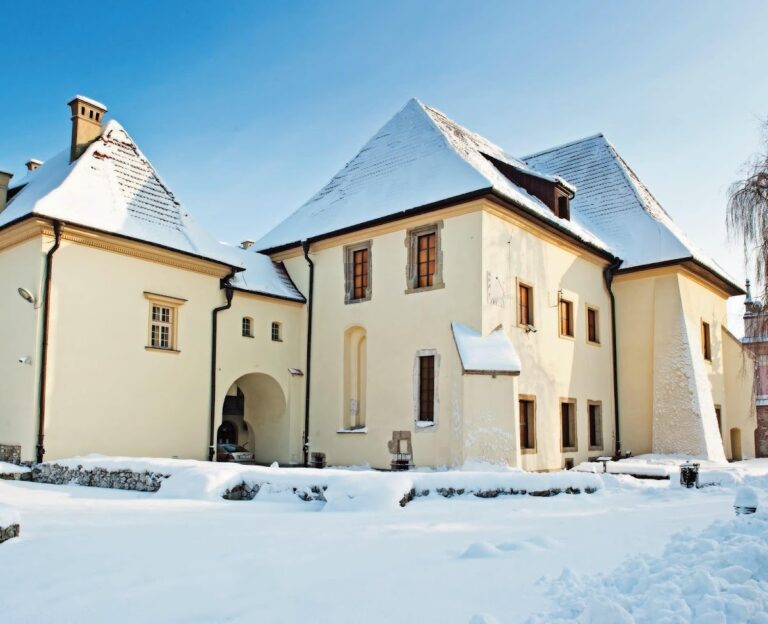
Wieliczka entered Poland’s national register of monuments in 1976 and became part of the Wieliczka and Bochnia Royal Salt Mines inscription on the UNESCO World Heritage List in 1978. It remained on UNESCO’s List of World Heritage in Danger from 1989 to 1998 because humidity linked to artificial ventilation threatened sculptures. The mine became a Polish Historic Monument in 1994. The World Heritage property was extended in 2008 and 2013; the later extension included the Saltworks Castle.
Remains
The mine is an extensive system of shafts, sloping passages, galleries and extraction chambers cut through a deep salt deposit. Its surviving spaces reflect the changing geology of the rock and the methods used to remove it, support underground openings and move salt and water.
Salt deposit and underground plan
Geological formation
The salt formed about 14 million years ago during the Miocene, a geological epoch, as the Paratethys, a large inland sea, evaporated in a hot, dry climate. Later movements associated with the formation of the Carpathians folded and displaced the deposits. The salt-bearing body extends about 10 kilometres from east to west, measures 600–1,500 metres across and reaches roughly 400 metres in thickness.
Its southern part contains massive blocks of salt, while the northern and central parts have layered deposits. In the upper deposit, rock-salt blocks lie within greenish, salt-bearing mud. Some blocks exceeded 20,000 cubic metres, and a few reached 100,000 cubic metres. The lower deposit consists of layered beds folded into three main structures that slope steeply south. Muddy and gypsum-bearing strata separate the salt from water-bearing layers; breaches caused flooding on several occasions.
Levels, galleries and supports
The mine descends through nine levels, from the Bono level at 64 metres below ground to a deepest level at 327 metres. A level is a set of horizontal workings at a particular depth. Shafts, vertical passages, connect the levels, while galleries extend horizontally. The connected system includes galleries, sloping passages, chambers and smaller workings, extending for more than 300 kilometres and linking about 3,000 excavations. Their combined volume is about 7.5 million cubic metres; a post-mining inventory lists 194 kilometres of workings and 2,040 chambers.
The salt varies naturally from grey to greenish shades and differs in hardness and other physical properties. Miners recognized green salt, an opaque type containing about 6–7 percent clay; crystalline spiza salt mixed with sand; and the clear, high-quality salt known as szybik, found in large crystals. Coarse-grained green salt formed in the upper deposit, while finer-grained salt occurred in the lower beds.
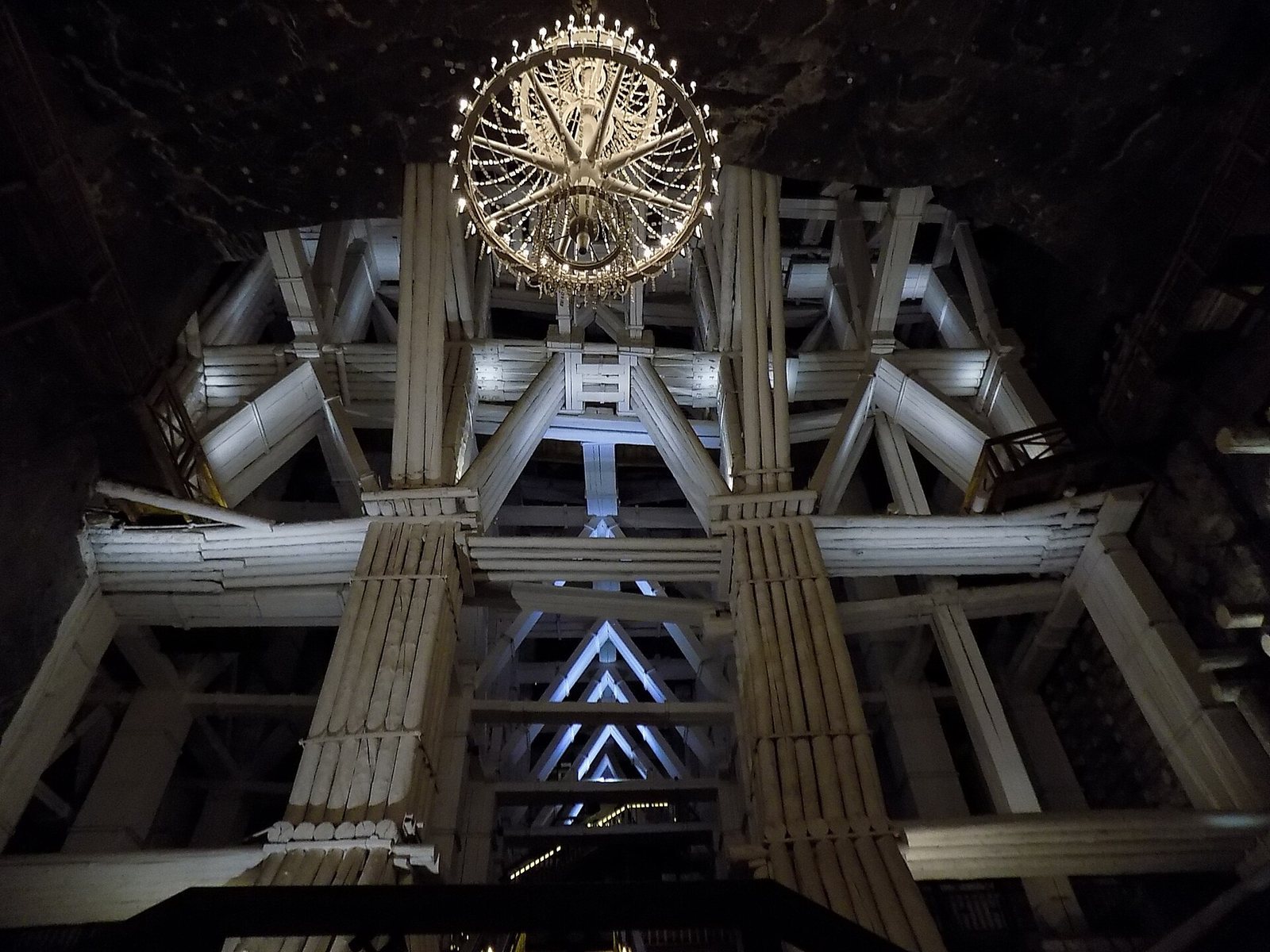
Extraction left chambers of different forms and sizes. Miners often retained a shell of salt around a chamber for support. From the fourteenth century, timber props and cribbing, timber frameworks used to stabilize chambers, supplemented this method; from the fifteenth century, some workings were supported by pillars left in the salt. Surviving timber structures include elaborate cribbing and bundled supports with an organ-like arrangement.
Shafts and extraction areas
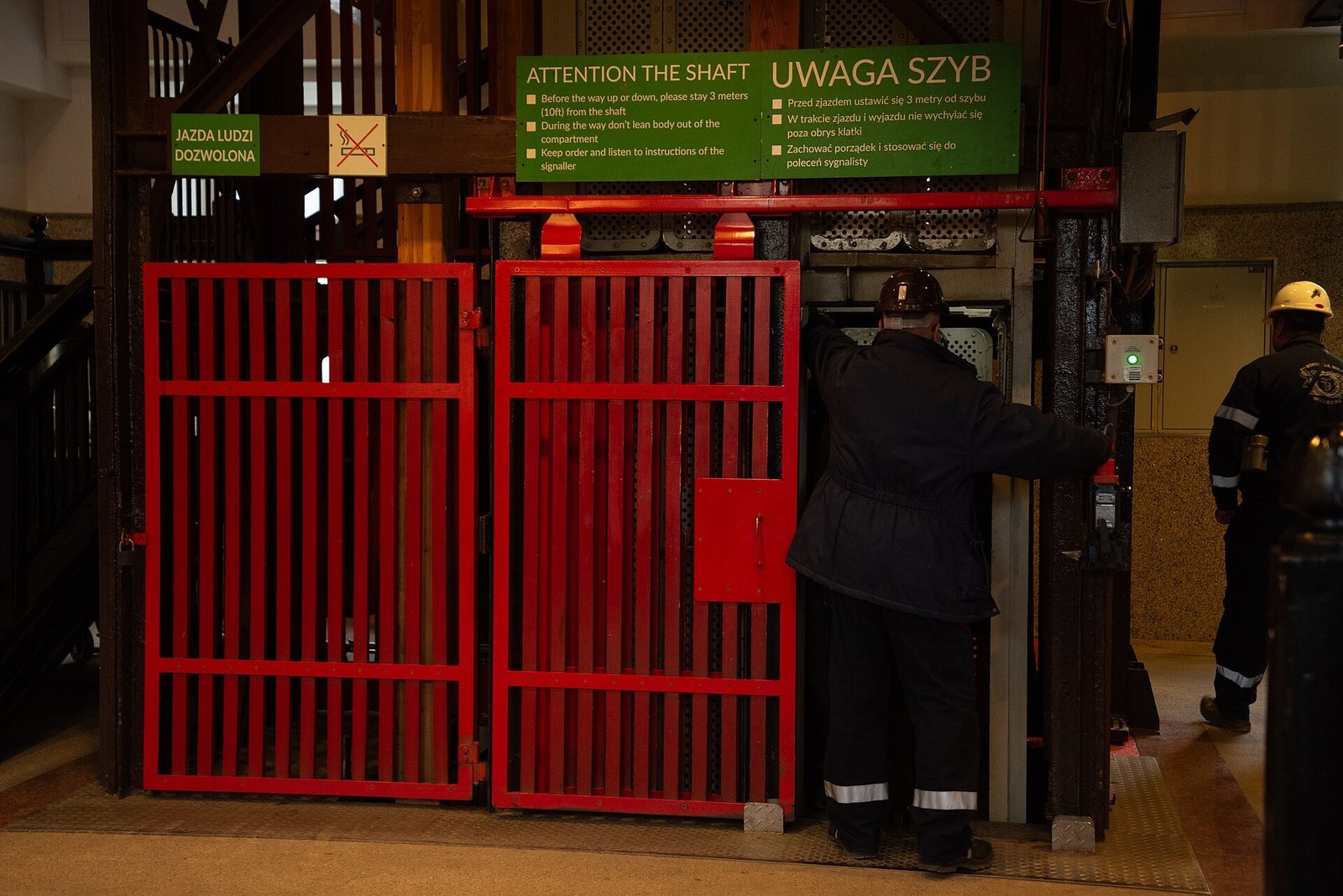
The oldest identified area of mechanical rock-salt extraction lies around the Goryszowski Shaft and dates to the second half of the thirteenth century. The Regis Shaft is another named shaft. Four additional shafts served the mine in the fourteenth century, including the Water Mountain Shaft, which was used to raise brine. At one stage, 14 shafts were active; 26 were used over the mine’s history. Connections between shafts began in the second half of the fifteenth century. Under Austrian administration in the late eighteenth century, miners introduced a more regular arrangement of lengthwise and crosswise galleries. A crosscut is a passage connecting workings.
Route and transport workings
Underground route
The underground route took shape around the turn of the eighteenth and nineteenth centuries. It extends about three kilometres through 20 chambers on levels I–III, at depths of 64–135 metres, and includes about 800 steps. Part of the route can accommodate wheelchair users. Its present course passes through workings created for mining rather than a single purpose-built structure.
Hoisting, drainage and haulage
The Sielec Chamber contains reconstructed equipment for moving salt horizontally, including a cart known as the Hungarian dog and sledges called szlafy. The Kazimierz III the Great Chamber holds an original eighteenth-century Saxon horse treadmill, a horse-powered hoisting machine, with a model illustrating its operation. A salt bust of Casimir III, made by miner-sculptor Władysław Hapek in 1968, commemorates the 600th anniversary of the mining statute.
The Pieskowa Skała Chamber, formed around 1669, links level I to level II, the Brothers Markowski level, at a depth of 90 metres. It contains a hand-operated cross hoist, a device for raising loads vertically, and remnants of stairs cut into the salt floor that salt carriers once used. Three small figures made by miner-sculptor Józef Markowski in the early twentieth century remain there. In the Kunegunda crosscut, drainage gutters accompany a reconstructed sixteenth-century pump whose chain carried leather buckets through a wooden pipe. The associated shaft-bottom chamber, created around 1829, connects the Kazimierz Chamber with upper level II and contains salt stalactites, stalagmites and small figures of miners.
Chambers and mining features
Copernicus and Janowice chambers
The Copernicus Chamber was excavated in a block of green salt in the late seventeenth century. Originally rounded, it contained a horse-powered hoisting machine. A salt sculpture of Nicolaus Copernicus by Władysław Hapek was installed in 1973 for the 500th anniversary of the astronomer’s birth.
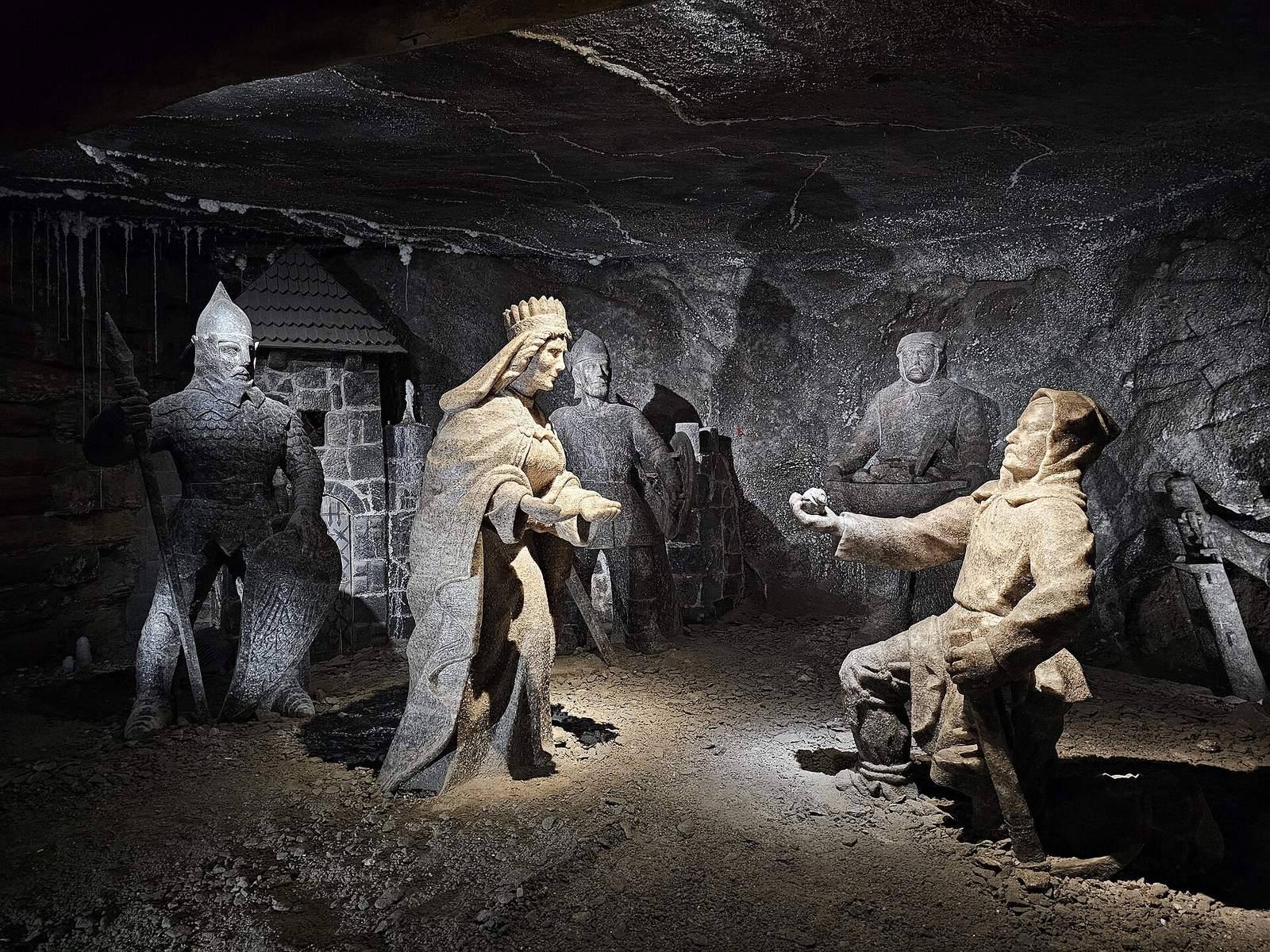
The Janowice Chamber began in the seventeenth century as a widened gallery. Its sculptural group depicts the legend that Princess Kinga brought salt to Poland. The present composition, made by M. Kluzek, was installed in 1967.
Weimar Chamber
The Weimar Chamber was created in the early twentieth century after miners mechanically removed a block of green salt from above, using blasting powder and then trimming the sides. It is bell-shaped, exceeds 10,000 cubic metres and has no supporting framework. An opening beneath its roof forms part of a ventilation route. Brine flooded its floor in the 1960s and formed a lake, after which wooden stairs, platforms and galleries were added. A statue of Goethe stands at the entrance; inside are a figure of Skarbnik, the mine’s protective spirit, and a salt wagon, both once included in the mine’s display at Expo 2000 in Hanover.
Michałowice and Drozdowice chambers
The Michałowice Chamber is 35 metres high and was worked for nearly a century. Its size required timber cribbing and walls built from salt blocks, with two bundled pillars added in the 1870s. The neighbouring Drozdowice Chamber dates from around the turn of the seventeenth and eighteenth centuries and is only slightly smaller. Early in the twentieth century, miners secured it with timber cribbing and a two-storey support structure.
Józef Piłsudski Chamber
This nineteenth-century chamber consists of two workings joined by a tunnel. When brine covered the floor, visitors crossed through the tunnel by raft. A nineteenth-century statue of St John of Nepomuk once stood beside the lake. A monument to Józef Piłsudski, made by Stanisław Anioł, was installed in 1997.
Staszic and Skarbnik workings
The Staszic Chamber, created around the turn of the nineteenth and twentieth centuries, is the mine’s highest chamber at 50 metres. A bust of Stanisław Staszic is displayed there. The Skarbnik working was formed in 1968 by widening the Poniatowski crosscut. A figure of the mine’s protective spirit depicts it shielding a collapsing gallery.
Witold Budryk and Warsaw chambers
The Witold Budryk Chamber was excavated in spiza salt during the Austrian period by hand undercutting and blasting. Timber cribbing and organ-like supports reinforce it. The Warsaw Chamber took shape around the turn of the nineteenth and twentieth centuries through the extraction of about 20,000 tonnes of spiza salt. It measures 54 by 17 metres and is 9 metres high. A monument made from salt blocks and depicting miners dates to 1961; glass chandeliers were installed in 2003.
Wisła and Prinzinger workings
The Wisła Chamber was formed in the nineteenth century by widening the Wisła lengthwise gallery to extract spiza salt. The Prinzinger incline, a sloping passage between workings, was constructed in the late nineteenth century to connect the Wisła gallery on the Kazanów intermediate level with the Antonia gallery on level III. Wooden stairs were added during the First World War. A plaque on level III commemorates the transfer of poet Juliusz Słowacki’s remains to Wawel; that level is named for him.
Haluszki, Izabela and Wessel chambers
The Haluszki Chamber occupies an area where green salt was extracted, and traces of mining remain visible. In the central deposit, the walls of the Izabela Chamber expose beds that slope south, illustrating the effects of tectonic movement associated with the Carpathians. The Wessel Chamber lies on level III, 135 metres underground, and houses the mine’s rehabilitation and treatment centre.
Saurau and Alfons Długosz chambers
The Saurau Chamber was excavated from a large green-salt block between 1820 and 1870 and is among the largest workings by volume. It opened to visitors in 1877. A moving model of miners descending underground was reconstructed from seventeenth-century engravings. The chamber named for Alfons Długosz was cut around the turn of the nineteenth and twentieth centuries in the largest identified green-salt block. Named in 1976, it now serves as an auditorium.
Chapels and religious sculpture
St Anthony Chapel
First used for a solemn service in 1698, St Anthony Chapel is the oldest fully preserved chapel in the mine. Its Baroque interior measures about 7.5 by 6 metres and stands 5.5 metres high. A presbytery, or sanctuary end, has a barrel-shaped vaulted ceiling; the nave has a cross-shaped vault, and a narrow vestibule has a flat ceiling. A column-supported arch separates the vestibule and nave, while an arcade with a horseshoe-patterned arch divides the nave from the presbytery.
A wooden, three-part altarpiece fills much of the presbytery. Its central niche once held a statue of St Anthony and now contains a wooden crucifix, with later figures of the Madonna and Child and St Anthony placed in front. Two salt-carved kneeling monks stand at the altar’s foot. The wings include St Stanislaus and Pope St Clement alongside a carved Passion scene with Mary Magdalene and John. A statue of Augustus II, made from especially pure spiza salt, occupied a side niche for two centuries but has almost entirely dissolved. The nave has side altars dedicated to St Peter of Alcántara and St Casimir. Figures of St Francis and St Dominic stand in the vestibule, while figures of Peter and Paul flank the pulpit, which is topped by a dove.
Holy Cross chapels
Two distinct chapels are associated with the Holy Cross. One is a nineteenth-century chamber chapel whose furnishings miners could move closer to their workplaces. It contains two seventeenth-century Baroque wooden figures, a crucified Christ in the main altar, a figure of the Victorious Madonna opposite and two badly damaged monk figures near the altar.
The other chapel, also called the Holy Cross Chapel, is the St John Chapel, originally located in the Lipowiec Chamber on level I. Its painted wooden furnishings include a barrel-vaulted niche with an altar and crucifix set against a many-coloured view of Jerusalem. The ceiling depicts the Trinity, and an eighteenth-century figure of the crucified Christ forms part of the chapel’s furnishings.
St Kinga Chapel
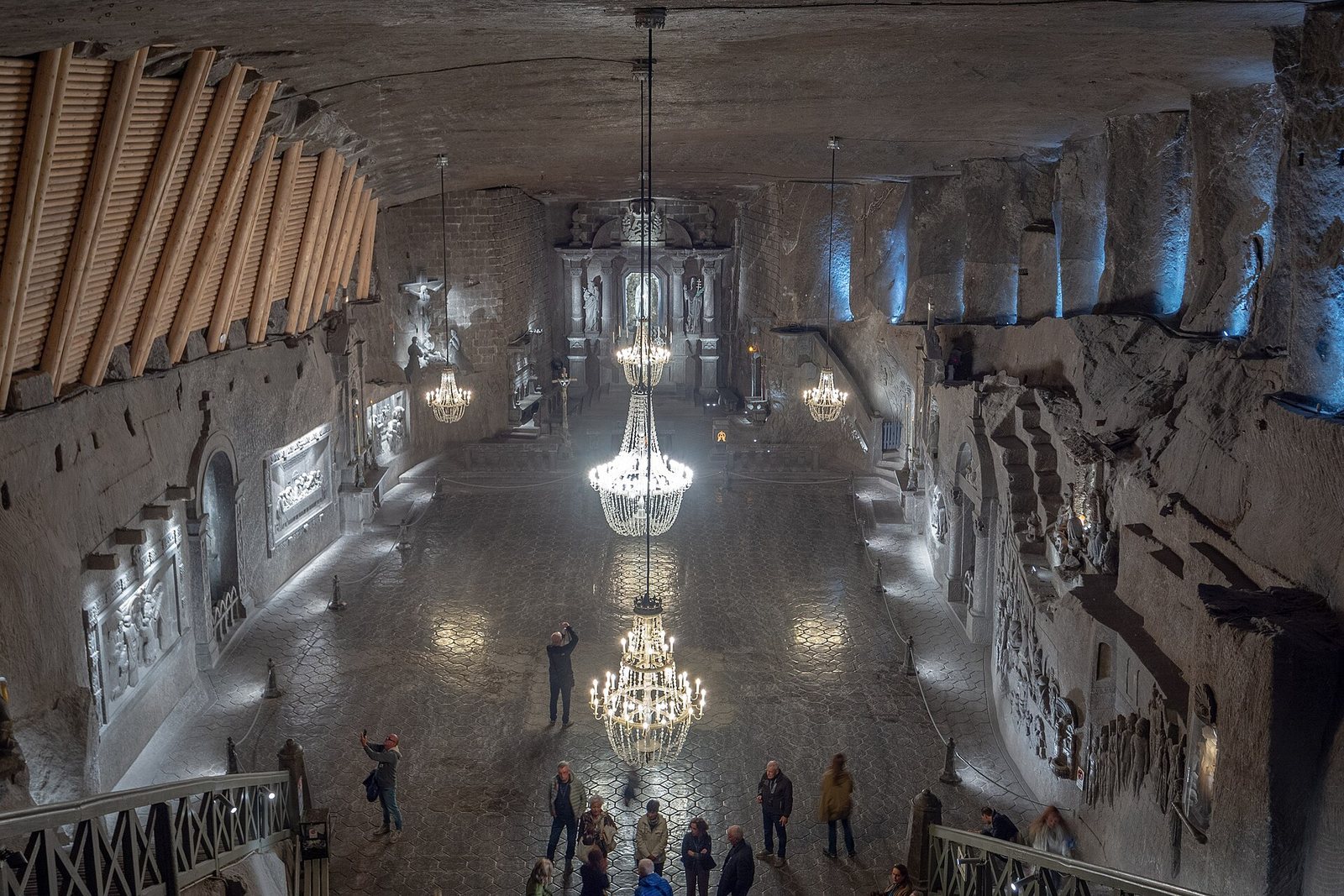
At a depth of 101 metres, St Kinga Chapel measures about 54 metres long, 18 metres wide and 12 metres high. The chamber was excavated between 1870 and 1880 and fitted out as a chapel in 1896. Miner Józef Markowski carried out sculptural work from 1895 to 1920. The floor is carved from a single mass of salt, and the chandeliers are made of salt crystals.
Salt reliefs portray New Testament scenes, including the Flight into Egypt, Christ teaching in the Temple as a child and the Last Supper; the chapel also contains a Nativity scene. Markowski carved the main altar, which includes figures of St Kinga, St Joseph and St Clement. The chapel holds relics of St Kinga and, since 1999, a salt statue of Pope John Paul II by miner-sculptor Stanisław Anioł. Masses have been held there for the feast days of St Kinga and St Barbara and at Christmas midnight; the space has also hosted concerts.
Kraków Saltworks Museum collections
The museum’s underground exhibition occupies 14 chambers on level III, 135 metres below ground. Its displays bring together the geology of the deposit, the history of salt production and transport, religious objects and material relating to Wieliczka itself.
Geology and early salt production
Russegger VI presents salt geology and mineral specimens, including large transparent crystals, branching halite formations known as salt trees, fossil cones and corals, and grass fibres trapped in salt. Wooden objects left by miners, such as a watering can and broom, later became crystallized. Russegger III combines salt-making and drainage equipment with a reconstruction of early medieval brine installations from the tenth and eleventh centuries. It includes a model brine well with a sweep and settling tanks, an early twentieth-century iron pneumatic pump, and evidence of Neolithic production, including conical clay vessels used to form salt briquettes.
Maria Teresa III, an exhibition established in 1966, explains the origin and structure of the Carpathian Miocene salt formation, including its massive and layered parts. Samples show green block salt and pure shaft salt. The display also includes salt stalactites, stalagmites, columns, sponge-like crusts, salt trees and crystals.
Mining tools and transport machinery
Russegger IV displays equipment for lifting materials vertically, dominated by an eighteenth-century Saxon horse treadmill. Four pairs of horses powered the machine, which could raise loads of 1.5–2 tonnes at a time. Shaft cages, boxes, carts for horizontal transport, technical drawings, linden-bark ropes and drawings by Alfons Długosz are also exhibited. Russegger II brings together mining and firefighting equipment, including a wooden fire extinguisher, a water bucket and J. G. Borlach’s 1747 fire-safety instruction. Its displays include hand-powered hoists, iron picks, hammers, wedges and salt blocks known as bałwany, which weighed from 1,100 to over 2,000 kilograms and were made until the late nineteenth century. Miners’ lamps show the succession of clay, iron and non-ferrous metal forms; tallow fuel gave way to cheaper rapeseed oil in the early nineteenth century, and carbide lamps arrived in the twentieth.
The Szerzyzna exhibit traces horizontal and sloping transport equipment from the wheelbarrow to the locomotive; two twentieth-century statues of St Barbara and St Kinga stand outside its entrance. Maria Teresa II presents the adoption of blasting for salt extraction in the 1870s, hand drills late in the nineteenth century, compressed-air drills from 1914 and electric drills during the interwar period. It also displays equipment for transport on slopes and portraits of visitors including Stanisław Staszic, Johann Wolfgang von Goethe, Frédéric Chopin and Karol Wojtyła.
The museum’s other machinery displays include a Siemens electric locomotive from 1950 and a passenger carriage in the Karol Chamber. Electric transport began replacing horse haulage in 1925 and also carried mine workers. Maria Teresa IV contains a horse-powered cross mechanism, an early type of treadmill, with nineteenth-century explanatory drawings and a painting by Długosz. The Modena Chamber holds the oldest and largest preserved Polish-type horse treadmill in the museum. Polish-type machines were installed at Wieliczka and Bochnia in the fifteenth century and underground from the eighteenth century; more efficient Saxon and Hungarian types replaced them during the nineteenth. In the Kraj Chamber, a Hungarian treadmill, an improved Saxon design, illustrates equipment capable of lifting loads over two tonnes from depths greater than 300 metres. Other pieces include a brake wheel, a cart for an inclined shaft and a brake drum for lowering smaller loads.
Historical, religious and town displays
Russegger V exhibits a 1534 early Renaissance horn belonging to the Miners’ Brotherhood, an association of miners, and donated by saltworks administrator Seweryn Boner. A painting by Jan Matejko depicts St Kinga. The chamber also displays documents concerning the Benedictines of Tyniec’s thirteenth-century right to collect boiled salt without charge and a marginal note dated 1251 reporting the discovery of hard salt at Bochnia. Copperplate engravings show maps of three mine levels and Wieliczka.
Russegger VII presents objects connected with miners’ religious life from the seventeenth to twentieth centuries, including wooden figures of Christ, Mary Magdalene and angels, as well as Nativity figures transferred from underground chapels. Prints, drawings and photographs show chapels, chambers and the historic underground route. The Miejska Chamber traces Wieliczka’s history from the late Palaeolithic into modern times through flint tools, pottery, axes, quern stones and candlesticks depicting a miner and a smelter. A central model of the town at a scale of 1:100 is based on a plan made by M. German in 1631–1638.
Crystal Caves
The Crystal Caves nature reserve contains exceptionally large halite crystals. Most of the caves remain intact. In the nineteenth century, specimens from the reserve entered major museum collections, including Vienna’s Natural History Museum. Two displays of salt slabs, each more than a metre square and containing dozens of crystals with edges several to more than ten centimetres long, are held in a geology-faculty building in Kraków.