Jerzmanowski Park: A Historic Palace-and-Park Estate in Kraków


Site at a Glance
- Rating
- 4.7
- Popularity
- Medium
- Country
- Poland
- Primary era
- Modern
- Eras represented
- Modern
- Civilizations
- Habsburg
- Site type
- Domestic
- Remains
- Park
On this page15 sections
History
Jerzmanowski Park is a historic palace-and-park estate in Kraków, Poland, whose origins lie in the transformation of the former village of Prokocim. Prokocim was probably founded by Kraków Bishop Prokop around 1295. By the sixteenth century, the village had a manor farm, while the area now occupied by the park contained ponds and orchards.
The Wodzicki Estate
Prokocim became the property of the Wodzicki family in the mid-eighteenth century. Canon Michał Wodzicki built a half-timbered manor on the former central village square and created an Italian-style garden. This garden is regarded as the beginning of the present park. Around 1780, his nephew Eliasz Wodzicki replaced the earlier residence with a masonry manor.
In 1810, Józef Wodzicki established an English-style park beside the residence. This form of landscape design used informal planting, curving paths, and naturalistic scenery rather than the geometric arrangement of an Italian garden. Several decades later, a Neoclassical palace was built on the foundations of the earlier residence. The park was enlarged with more trees and walking avenues.
The Grodzicki and Jerzmanowski Periods
Between 1891 and 1895, the architect Karol Knaus rebuilt the palace in the Eclectic style, combining elements drawn from several historical traditions. Count Józef Grodzicki sold the estate to Erazm Jerzmanowski on 25 June 1895.
Jerzmanowski expanded and landscaped the grounds. An orangery, a glazed building used for plants requiring protection from cold weather, was added, along with a watercourse fed by the Drwinka River, three fishponds, bridges, and sculptures. After Jerzmanowski died on 7 February 1909, his widow Anna sold the estate to the Augustinian Order in 1910. Father Grzegorz Uth initiated the purchase and became the first administrator.
The Augustinian Estate and Wartime Use
The Augustinians, Catholic religious communities following the Rule of Saint Augustine, converted a former manor stable into a chapel. It was consecrated on 13 February 1911. The former servants’ quarters became a parish house, while the palace housed the boys’ school known as the “New School.” The literary historian Stanisław Pigoń served there as a teacher and educator. A new parish was established in Prokocim on 7 January 1917.
During the First World War, the palace served as the headquarters of the Austrian military command of the Kraków Fortress. German forces occupied it during the Second World War.
State Ownership and Later Recovery
In 1950, the Augustinian Order in Poland was dissolved and the state took over the estate. The palace became an orphanage, which continued operating until 2003, while the grounds were converted into a municipal park. A municipal decision in 1966 led to the filling of the streams and ponds and the dismantling of the bridges. From 1966 to 1970, a sports stadium was built on the site of the largest pond for KS Kolejarz, now KKS Prokocim.
The Anna and Erazm Jerzmanowski Society of Prokocim Friends was founded in 1989 to promote the history of Prokocim and seek protection for the palace-and-park complex. The park received the name Jerzmanowski Park in 1991. The Augustinians recovered the estate in 1993, and after the orphanage closed in 2003 they established a monastery in the palace. Mass resumed in the park chapel on 1 January 2001.
The palace-and-park complex was entered in Kraków’s register of monuments as A-639 on 22 March 1983. The Kraków Social Committee for the Restoration of Monuments joined conservation work in 2002, and the historic water tower, built in 1894, was renovated in 2003. A storm in May 1997 uprooted or overturned twelve historic trees. New trees were later planted on land added to the park in 2002, while the historic tree stock awaited inventory and partial recreation during the first two decades of the twenty-first century.
The park was closed in August 2019 for conservation-supervised revitalization, completed in September 2020. The work renewed historic landscape elements, paths, fencing, lighting, bridges, and plantings. On 6 February 2010, Kraków Mayor Jacek Majchrowski unveiled a monument to Erazm Jerzmanowski in the park. Made by Stefan Dousa, it was consecrated by Florian Kosek, parish priest of Our Lady of Good Counsel Parish in Prokocim. The palace also houses the Kraków branch of the Polish Society of Astronomy Enthusiasts and the Regulus Astronomical Club, which periodically organize popular-science lectures.
Remains
Jerzmanowski Park forms the landscaped part of the Anna and Erazm Jerzmanowski palace-and-park complex in Kraków’s Bieżanów-Prokocim district. Its area is estimated at approximately 5.56 hectares in a 2016 municipal estimate and at 7 hectares in other descriptions. Paths and avenues organize the grounds around the palace, surviving historic trees, the water tower, fountains, and later park facilities. The present landscape combines remnants of the former estate with reconstructed and newly planted elements.
Palace and Estate Buildings
Palace
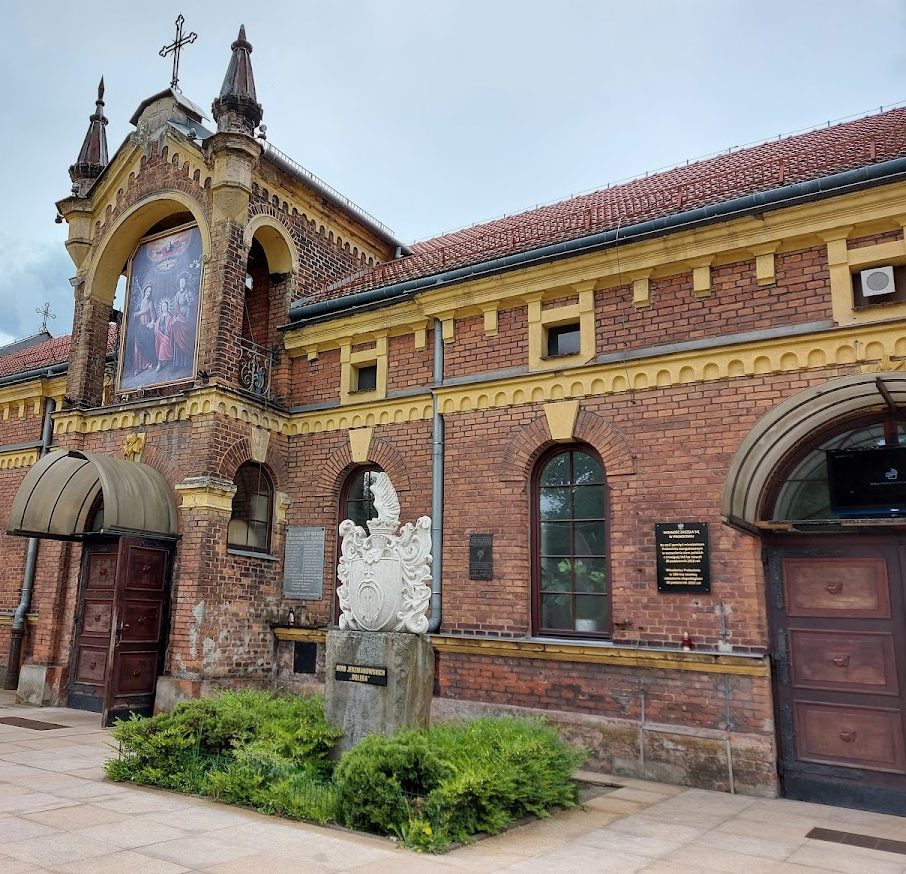
The palace is a masonry building whose present appearance comes from Karol Knaus’s Eclectic reconstruction of 1891 to 1895. Beneath this phase is the earlier Neoclassical palace built several decades after 1810 on the foundations of the preceding residence. The building later served the “New School,” became an orphanage after the state takeover, and has housed an Augustinian monastery since 2003.
Chapel and Parish House
A former manor stable survives as the park chapel, while the former servants’ quarters serve as the parish house. These conversions belong to the Augustinian period of the estate and preserve the connection between the park, the palace, and the religious institutions established there.
Water Tower
The historic water tower dates from 1894 and was built in the Eclectic style. It was renovated in 2003 and remains one of the documented structures associated with the late nineteenth-century estate.
Landscape and Water Features
Planting and Avenues
The early landscape contained ponds, orchards, and a group of pedunculate oaks beside the manor. One earlier oak survived into recent decades near the palace, where part of its trunk remains. Other oaks planted by the Zasławski princely family in the mid-seventeenth century are described as the oldest trees now growing in the park. The former Wodzicki estate also had a lime-lined approach avenue from the direction of Kraków. Beech, ash, oak, maple, poplar, and other trees were later added along the walking avenues.
Four pedunculate oaks, a red beech, and a London plane tree are listed as natural monuments. The 2019 to 2020 revitalization added 220 trees, including limes, field maples, ash, Swedish whitebeams, pedunculate oaks, horse chestnuts, elms, hornbeams, beeches, magnolias, and Japanese katsuras. Around 8,000 shrubs and more than 29,000 perennial plants were also planted in informal beds, including a special bed marking the course of the former millrace.
Former Water System
During Erazm Jerzmanowski’s ownership, a channel from the Drwinka River carried water through the park to three fishponds. Bridges crossed the waterways, and sculptures stood among the flower beds. The water system and ponds were filled during the twentieth century. Their former locations remain visible as depressions in the terrain, while the sports stadium occupies the site of the largest pond.
Fountains
Two fountains are major elements of the renewed park composition. One is a circular fountain made during the Jerzmanowski period. The other was designed in the 1960s by Professor Wiktor Zin for Kraków’s Main Market Square. After being dismantled and stored, it was renovated and returned to public space in Jerzmanowski Park.
Renewed Park Infrastructure
The revitalization renovated the surfaces of the park paths and installed new fencing and lighting. It also added bridges, children’s playgrounds, and an outdoor gym. The park contains the monument to Erazm Jerzmanowski within the palace-and-manor complex, linking the present public landscape with the owner whose late nineteenth-century improvements shaped much of its historic form.
Nearby sites