Megalithic Sanctuary below Tsarev Peak: A High-Mountain Ritual Site in Bulgaria
Site at a Glance
- Popularity
- Low
- Country
- Bulgaria
- Primary era
- Bronze Age
- Eras represented
- Bronze Age, Classical
- Civilizations
- Thracian
- Site type
- Religious
- Remains
- Sanctuary
On this page14 sections
History
Ancient dating and ritual interpretations
The Megalithic Sanctuary below Tsarev Peak is a high-altitude ritual site in the Rila Mountains of Bulgaria, generally classified as Late Bronze Age, around the 12th to 10th centuries BCE. Its chronology remains uncertain: finds also indicate activity in the pre-Roman period and Late Antiquity, while a highly tentative archaeoastronomical estimate places activity between the second half of the first millennium BCE and the 4th century CE. The installations may be older still, perhaps dating to the Chalcolithic, or Copper Age.
Vasil Markov interpreted the wider sacred area as a cult center for ancient Thracian peoples, who lived in the region during the Iron Age and Antiquity. He proposed that ceremonies there renewed a ruler’s authority. In one interpretation, Zalmoxis, a religious figure associated with Thracian belief, conveyed rules of government to a king. Markov also suggested that the site served a royal cult concerned with the immortalization of rulers.
A more speculative interpretation by Markov connected the arch, an egg-shaped stone and hand-like carvings with an Orphic creation story. Orphism was an ancient religious tradition associated with creation and ritual transformation; in some of its accounts, the creator figure Phanes emerged from a cosmic egg. Markov read the arch as an image of the Earth and the egg as part of this symbolism. He further hypothesized that a ruler’s passage through the arch, accompanied by liquid offerings and timed to a solar calendar, could enact symbolic rebirth and renew political authority.
Markov considered a summer festival plausible, reasoning that the high mountain setting could be used during the warmest months. He connected his proposed timing with the Bulgarian midsummer observance known as the Hot Days, St Elijah’s Day and the period associated with the Christian celebration of the birth of St John of Rila. These ritual interpretations remain proposals rather than established accounts of the sanctuary’s use.
Medieval traditions and sacred routes
The Life of Patriarch Euthymius and folk traditions tell of the Bulgarian ruler Peter I meeting St John of Rila at Tsarev Peak. Scholars disagreed over the story’s date and historical basis. Ivan Duichev connected it with the medieval ruler, while Ivan Fekeldzhiev questioned whether the meeting belonged to the 10th century and suggested that the tale might instead reflect a story about Philip V of Macedon ascending Mount Haemus. Markov interpreted the tradition more broadly as a possible memory of ancient royal rites.
Yordan Trifonov and Fekeldzhiev proposed a continuity between a Christian cult of St Elijah at the site and the later tradition of St John of Rila. In their interpretation, Elijah succeeded storm and solar deities in earlier Thracian religion. Markov also regarded the sanctuary as a possible pagan predecessor to Rila Monastery, an Eastern Orthodox monastic complex several kilometres to the east.
Markov interpreted carvings extending between Markov Peak and Dobro Pole as markers of a sacred route between cult places. He suggested that it might have been used for ritual circuits associated with a Thracian king, priest and god, or with traditions about Dionysus and Orpheus. The proposed line also follows a later pilgrimage way toward Rila Monastery from Athos, the Aegean coast and the Mesta valley. Markov suggested, speculatively, that the route might have been used by the Triballi, an ancient Balkan people, on a campaign against the Aegean city of Abdera, and by Alexander the Great on his return from campaigning against the Triballi in 335 BCE.
Field surveys
The sanctuary was located and registered during field surveys between 2001 and 2006. A team led by Professor Vasil Markov began partial work near the sources of the Blagoevgradska Bistritsa in spring 2001, prompted by local legends of Krali Marko, a hero of Balkan folk tradition. The team returned to the mountain ridge in 2005 and 2006. The research formed part of a program studying Thracian sanctuaries in the Western Rhodopes, Pirin and Rila, organized with Southwestern University Neofit Rilski, the National Archaeological Institute with Museum at the Bulgarian Academy of Sciences, and the Regional Ethnographic Museum in Plovdiv.
Remains
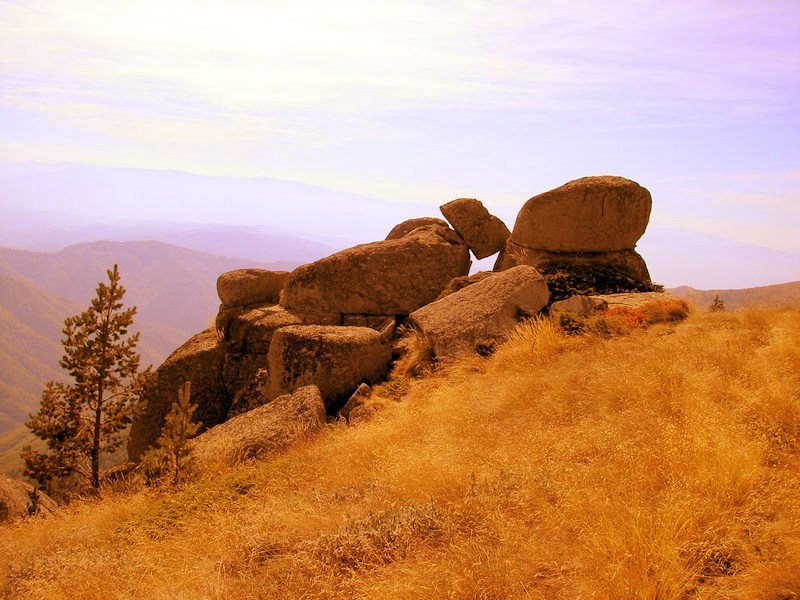
The sacred area follows a Rila mountain ridge at about 2,000 to 2,200 metres above sea level, extending for roughly five kilometres between Markov Peak and the western foothills of Tsarev Peak. Its main complex covers about 2,000 square metres in the northwestern part of Dobro Pole, at the western foot of Tsarev Peak. Numerous large stones carry small cut basins and channels, and the rocky ground descends steeply south toward the Blagoevgradska Bistritsa valley.
The site lies within the Bogutev Formation, made chiefly of gray to dark-gray gneiss, a banded metamorphic rock. Its parallel bands and mica- and quartz-bearing composition form part of a complex geological setting. Across the hill, geological processes have produced many rock faces running approximately northeast to southwest.
The central complex
The megalithic arch
The central feature is a rough trilithon, a structure in which a third stone rests on two supports. Here, a large slab appears to lie across two adjacent bedrock outcrops. The arch faces east and is aligned toward the summer-solstice sunrise. Two large hands with spread fingers are carved into the rock above it. Many hollows mark the top slab; the largest resembles a footprint, and channels lead from it toward the opening beneath the arch.
Stones and horizon alignments
An egg-shaped boulder lies along the path of early morning sunlight entering through the arch. Markov interpreted it as a possible means of identifying the summer-solstice date in antiquity. Two rock platforms have views toward the eastern and western horizons, while two mushroom-shaped formations in the sanctuary’s eastern part have been associated with sunrise. A marked stone west of the arch is aligned with the cardinal directions. Hollows on the highest northern rock of the trilithon have been proposed as a pattern representing the Pleiades.
Carved areas and other rock groups
Altars and carvings below Tsarev Peak
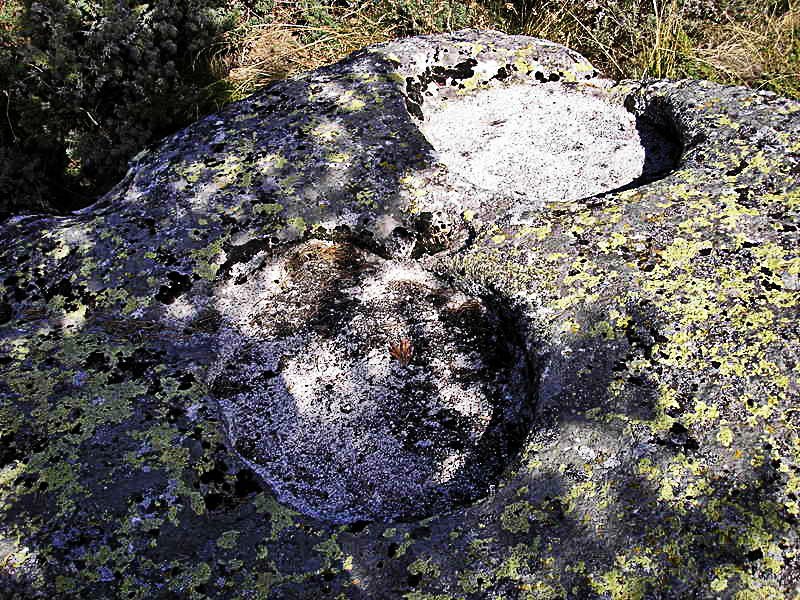
Rock outcrops on the western and southern foothills of Tsarev Peak bear numerous cut marks, especially circular hollows. Some carvings resemble large human footprints or horse hoofprints, and groups combine these forms with hollows and channels. The densest concentration lies on the western foothills near springs feeding a small stream that joins the Blagoevgradska Bistritsa. Survey teams recorded dozens of rock-cut altars near springs and the upper reaches of tributaries. One substantial basin has carefully cut circular hollows linked to a drainage channel. A shallow, niche-like cave lies in sacred rock on the southern side, above a mountain stream.
Markova Skala
Incised arrows and oak leaves on Markova Skala are interpreted as signs connected with lightning and the sacred tree of a storm deity. These carvings also informed proposals linking Christian traditions at the sanctuary with earlier religious practices.
The formation west of Markov Peak
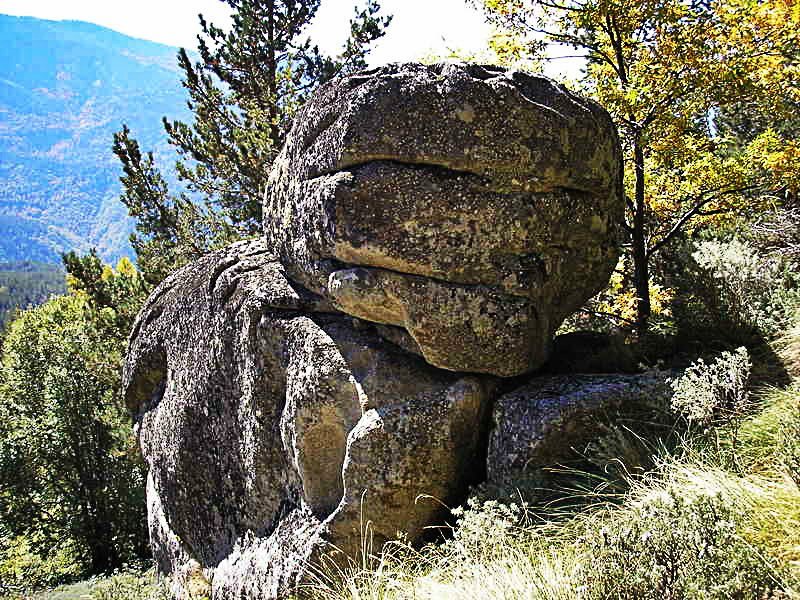
At the western foot of Markov Peak, a group of altars marks a mushroom-shaped rock formation. A large slab rests on bedrock to create the form, which may have been constructed by people. Its upper surface carries a complex arrangement of hollows. The largest resembles a footprint, and channels cut into the stone carry liquid away from it.
Dobro Pole menhirs
Dobro Pole is a broad, relatively flat area of the ridge, about five kilometres north of Markov Peak and at the western foot of Tsarev Peak. Much of it is strewn with boulders. Several menhirs, or large upright stones, are cylindrical blocks reaching about two metres high. Hollows at their tops connect to channels running down the stones. A flint arrowhead was found beside one of the rock carvings.
Archaeological material
Ceramic fragments were found around the rock-cut monument, and traces of human activity occur across the natural rocky ground. Together with the flint arrowhead beside a carving at Dobro Pole, these finds add material evidence to the varied periods of activity associated with the sanctuary.