Chauvet Cave: A Paleolithic Cave-Art Site in France
Site at a Glance
- Popularity
- Very High
- Country
- France
- Primary era
- Stone Age
- Eras represented
- Stone Age
- Civilizations
- Unclassified
- Site type
- Civic
- Remains
- Rock Art
On this page14 sections
History
Discovery and early exploration
Chauvet Cave is a limestone cave near Vallon-Pont-d’Arc in the Ardèche region of France, known for its Upper Paleolithic paintings and engravings. The art was made mainly during the Aurignacian, about 37,000–33,500 years ago, with evidence of human presence again in the Gravettian, about 31,000–28,000 years ago. Its images show that early artists already used sophisticated ways to create volume, perspective and movement, challenging the idea that prehistoric art advanced through a simple, steadily improving sequence.
Michel Rosa noticed a small opening, later called Baba’s Hole, about six months before the cave was found. On 18 December 1994, Jean-Marie Chauvet, Éliette Brunel and Christian Hillaire entered during a private caving trip and discovered marked walls and decorated chambers. The find was announced publicly on 18 January 1995. First known as the decorated cave of Combe d’Arc, after its locality, it later took Chauvet’s name.
During a subsequent exploration, Michel Chabaud and two other cavers reached the Gallery of the Lions and the End Chamber. On 24 December 1994, the group returned to make topographic surveys and record the cave in 300 photographs and a video.
Paleolithic use and closure
Evidence points to two periods of human activity: the Aurignacian and, later, the Gravettian. Most of the cave’s art belongs to the earlier period. A 2016 study assigned all but two of the dated black drawings to the Aurignacian, while a 2020 estimate placed the oldest painting at about 36,500 years ago. Although stylistic interpretations have proposed later dates for some images, radiometric and geological evidence supports an early Aurignacian date for most of the art.
Rockfalls began to obstruct the entrance around 29,000 years ago. Successive collapses eventually sealed it, with final closure estimated to have occurred at least 21,500 years ago. The rock barriers kept later people and large animals from entering until the cave’s rediscovery.
Research, conservation and recognition
Multidisciplinary fieldwork began in 1998 and has continued twice a year. Researchers have used radiocarbon dating, which estimates the age of once-living material, alongside methods for dating calcite deposits, fire traces and geological surfaces near the entrance. Jean Clottes directed research until 2006, followed by Jean-Michel Geneste. Regional dating work led by Julien Monney began in 2008 and was still under way in 2020.
After a three-year environmental study, instruments were installed in 1997 to monitor the cave’s climate and condition and to set limits for safe entry. The entrance was enlarged, a working base was added and removable stainless-steel walkways replaced plastic strips. A dedicated conservation service followed in 2000, first led by Dominique Baffier and, from 2014, by Marie Bardisa. The original cave has remained closed to the general public, with entry restricted to small supervised groups, chiefly researchers, to protect its environment and contents.
Protected as a French historic monument in 1995, the cave became state property in 1997. UNESCO added it to the World Heritage List on 22 June 2014, under criteria recognizing exceptional creative achievement and testimony to a cultural tradition. The listed property covers 9 hectares, with a 1,353-hectare buffer zone. UNESCO used the name Decorated Cave of Pont d’Arc, known as Chauvet-Pont-d’Arc Cave. Disputes over naming and rights to photographs and video were settled in an agreement that took effect in 2018, allowing the managing syndicate to use the name Chauvet Cave.
A detailed replica, Grotte Chauvet 2, was built at Vallon-Pont-d’Arc from 2012 and opened in 2015, making a reproduction available to the public while the original remained closed. A complete digital model was also created from a survey recording 16 billion points.
Remains
Setting and interior layout
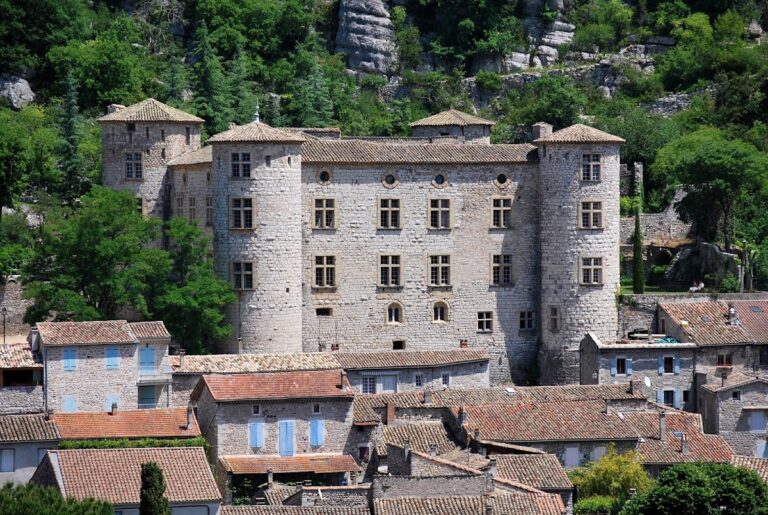
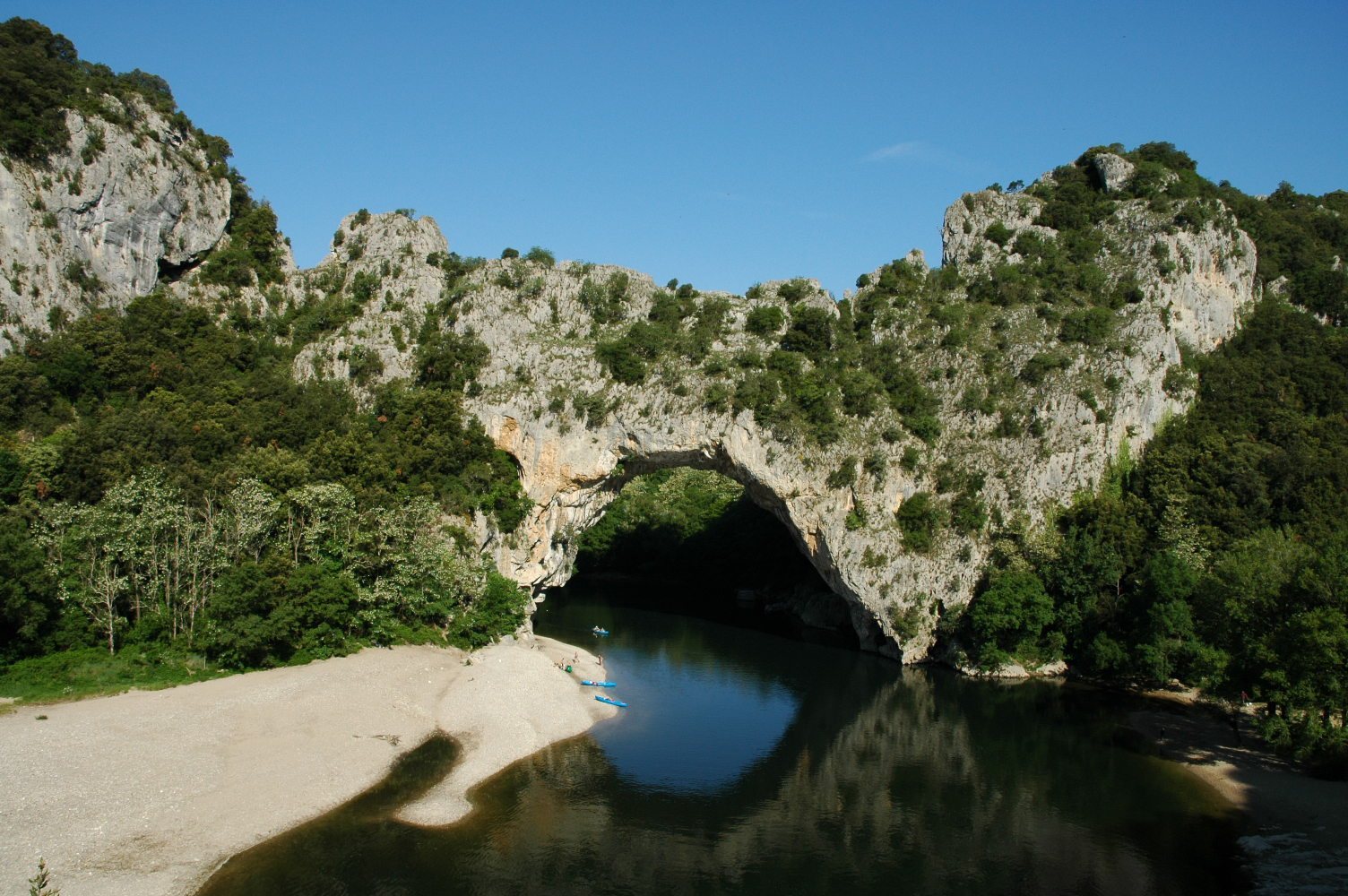
The cave lies at Combe d’Arc, also called the Cirque d’Estre, about 25 metres beneath the plateau and at an elevation of approximately 185–198 metres. Formed in limestone, it extends about 500 metres. Combe d’Arc occupies an abandoned bend of the Ardèche River. The river’s former course cut through a limestone spur, helping to form the natural arch of Pont d’Arc; erosion and abrasive material also shaped the gorge and surrounding limestone landforms.
Inside, nine rooms include four principal decorated chambers arranged in succession. Their ceilings rise about 15 to 30 metres. Brunel Hall and the Hall of the Bauges have predominantly white calcite formations, while the wetter, deeper areas, including Hillaire Chamber and the End Chamber, contain formations in coppery red and orange tones. Decorated surfaces also extend into side galleries and entrance vestibules.
The prehistoric entrance
The original entrance lies beneath Abraham Rock. Collapses accumulated at its foot into a rock mass estimated at 4,500 cubic metres. Near the entrance, large blocks from fallen ceilings and toppled stalagmites, mineral formations that rise from cave floors, cover part of the ground. The prehistoric entrance has been reconstructed.
Paintings and decorated areas
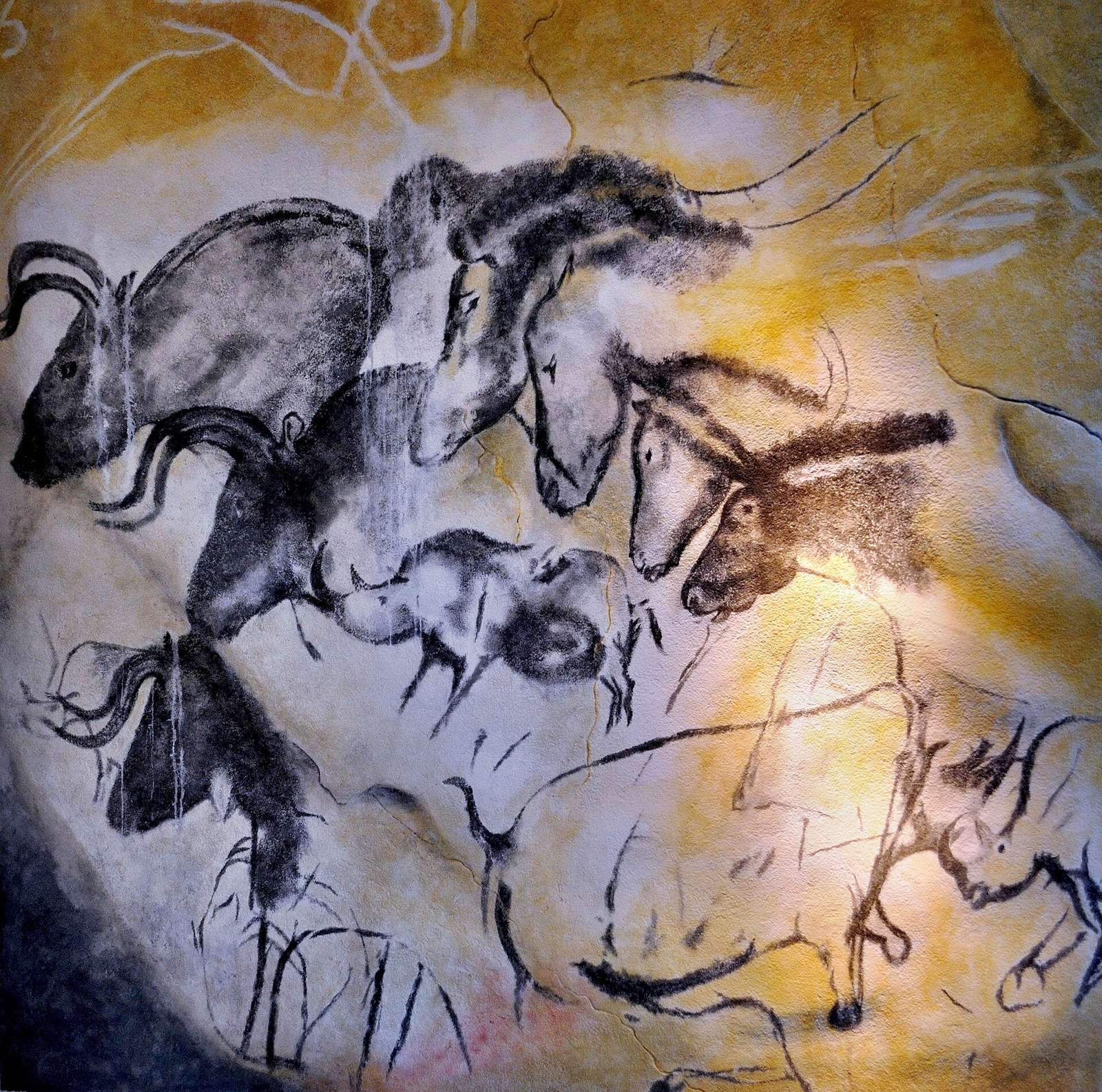
About 1,000 paintings and engravings include 447 animal images assigned to 14 species, of which 355 are confidently identifiable. Felines make up 21 percent of the identified animals; mammoths and woolly rhinoceroses account for 19 percent each, horses 14 percent, bison 9 percent, ibex and bears 5 percent each, reindeer 4 percent, aurochs 3 percent and giant deer 1 percent. Felines, rhinoceroses and mammoths together form more than two-thirds of the identified animal imagery. The artists depicted cave lions, leopards, bears and cave hyenas as well as horses, bison, mammoths, ibex, reindeer, aurochs and giant deer. Predators and other formidable animals feature especially prominently beside the more commonly depicted prey.
Artists used red ochre near the entrance and charcoal-based pigments in deeper, wetter parts of the cave. They engraved and scraped surfaces, traced forms with fingers and palms, and made both positive handprints and negative hand stencils, images created by applying pigment around a hand. Smudging, overlapping figures and cut-in outlines helped create effects of volume and movement.
Animal scenes
Some images gather several animals into scenes of interaction. Two lions appear together in different encounters; elsewhere, two rhinoceroses butt horns, and two lions face a bison. In one of the latter images, a lion seems to press its head against the bison. Repeated and overlapping forms give these compositions a sense of motion.
The End Chamber composition
On a rocky projection in the End Chamber, a complex image combines part of a female figure, often called a Venus in prehistoric art, with a figure whose human limbs are joined to a bison’s head. The pairing is known as the Sorcerer and the Venus; some interpreters have likened the bison-headed figure to the Minotaur, a mythical human-bull being. A separate partial female figure is also described in a niche or vestibule. Other End Chamber images include a dancing reindeer, rhinoceroses, groups of lions, a horse alcove and a pendant bearing a Venus figure.
Panels, signs and uncertain images
Other decorated areas include the Red Cervid Alcove and the side passage toward the bears and ibex. Brunel Hall has panels of a black feline, a positive handprint, domino-like marks, yellow horses, dots and palm prints. The Hall of the Bauges includes a Panther panel and an abbreviated Rhinoceros panel; the Cactus Gallery has a red bear and a mammoth with black felines. Skull Chamber contains a reindeer pendant. Dots, crosses, lines, hatching and finger-traced marks appear across the cave, alongside numerous positive and negative hand images. Five pubic-triangle motifs may have helped organize the arrangement of images on the walls. Two other figures have been tentatively described as resembling a butterfly or a bird.
A drawing later overlain by a deer or giant-deer image resembles a volcano sending out lava. Its identification as an eruption is uncertain; if correct, it would be the earliest known depiction of one.
Fossils, archaeological traces and footprints
Bone deposits and animal remains
A bear skull rests on a block of rock, with other skulls on the ground nearby. Cave-bear bones and skulls are abundant, and horned ibex skulls also occur. Cave-bear bones from Megaloceros Chamber date to about 31,140 BC, while remains from Morel Chamber date to about 19,105 BC. Analysis of fossilized animal dung places the bears’ disappearance from the cave at about 30,000 years ago.
At least nine kinds of carnivore are represented, including cave and brown bears, leopard, wildcat, wolf, red fox, pine and stone martens, and cave hyena. Hoofed-animal remains include cattle or bison, ibex, roe and red deer, and horse. Finds also include rodents, bats, and five kinds of bird, among them golden eagle, alpine chough, dipper and thrush, as well as a tentatively identified snake. Around 150 defined find-spots contain bones, either singly or in groups. Their distribution reflects bears changing den sites, people handling bones and water moving material through the cave.
Traces and tracks
Other traces of human activity include flint flakes, charcoal, hearths, torch marks and grinding stones. Tracks belong to bears, a canid and ibex. A rare human trackway is attributed to a child estimated to have been about eight years old and 1.30 metres tall. Individual prints measure about 21.4 by 9.2 centimetres; their proportions have been interpreted as possibly male. Tracks attributed to a child occur near those of a wolf or dog. One print dated to about 26,000 years ago has been identified as a dog track, though a wolf remains a possible alternative.
The soft, clay-like floor preserves bear paw prints and large rounded hollows believed to have served as sleeping places for bears.