Jewish Cemetery Battonnstraße: A Medieval Burial Ground in Frankfurt
Site at a Glance
- Popularity
- Medium
- Country
- Germany
- Primary era
- Medieval
- Eras represented
- Medieval, Early Modern, Modern
- Civilizations
- German, Holy Roman Empire
- Site type
- Burial
- Remains
- Necropolis
On this page14 sections
History
The Jewish cemetery Battonnstraße, also known as the Börneplatz Jewish Cemetery, is a medieval Jewish burial ground in Frankfurt am Main, Germany, first recorded in 1180. Established as the medieval city center grew crowded, it is considered the second-oldest surviving Jewish cemetery north of the Alps, after the Holy Sand cemetery at Worms. Frankfurt’s first Jewish settlement dates to around 1150. Before the cemetery opened, Jewish residents were buried at Garküchenplatz, east of Salvator Church, on land belonging to the monastery there. Large numbers of remains uncovered at that earlier burial place during postwar reconstruction were reburied beside a crucifixion group in the cemetery east of the Imperial Cathedral.
Foundation and medieval Frankfurt
At first, the cemetery stood beyond the city’s eastern edge, outside the Romanesque Staufenmauer, Frankfurt’s medieval city wall. The burial ground and wall were being established at about the same time. In 1333, Emperor Louis IV of Bavaria authorized a new wall around the Neustadt, bringing the cemetery inside the city’s defenses. Jewish residents living south of Salvator Church could reach it through the northeastern Bornheim Gate in the older wall.
The cemetery received those killed in the 1241 Frankfurt Jewish Battle, a pogrom in which many local Jews died. In 1424, regulations for Frankfurt’s Jewish community were gathered into a set of ordinances, which was subsequently read each year in the synagogue. By the sixteenth century, the cemetery served Jewish communities over a wide area, extending from Aschaffenburg to Wetzlar.
Violence, defense, and the Jewish quarter
The plague that began in 1348 was followed by anti-Jewish attacks across the region. In Frankfurt, these culminated on 24 July 1349 in the killing of the city’s Jews. Their property, including the cemetery, passed to the city. With no Jewish community left to maintain the burial ground, the victims’ remains were not interred there. Jews began returning around 1360, and the cemetery was restored to the community as its largest property.
The cemetery’s position on the southeastern edge of Frankfurt also drew it into the city’s military preparations. In 1349, after the city backed Günther von Schwarzburg in a royal election and feared an attack by his rival Charles IV, eleven projecting structures with loopholes served as watch posts around the old city and cemetery. Frankfurt also prepared the cemetery for defense during the Cities’ War of 1387–1389, a regional conflict between the Swabian League of cities and the Bavarian dukes.
From 1462, Frankfurt’s Jewish residents were required to leave the area around St. Bartholomew’s and move to the Judengasse, the city’s designated Jewish residential quarter. The authorities placed the quarter near the cemetery. The Judengasse remained in use from 1462 until 1796.
Hospitals and changing surroundings
From the sixteenth century, several Jewish hospitals occupied part of the cemetery grounds in the southwest, an area known as Völckerscher Bleichgarten. These included a hospital for people suffering illnesses marked by skin eruptions, a hospital serving local Jews from around 1600, and another for Jews arriving from elsewhere from around 1713. Some of the facilities were physically connected. In 1718, six joined houses were built for the latter hospital; a larger building followed in 1796 directly in front of the cemetery entrance. The hospital property then provided access to the burial ground.
The Jewish market had operated in the area since the sixteenth century, serving sellers from Frankfurt and nearby communities. In 1793, work began to drain Fischerfeld, the low-lying area between the cemetery and the Main, while the city’s fortifications were being removed. This opened a larger square at the cemetery’s southwestern end and expanded the space available for the market.
Burial ground after 1828
The cemetery’s last burial took place on 16 September 1828, when it had reached capacity. Frankfurt’s Jewish community then used the Rat-Beil-Straße cemetery, followed from 1929 by a new cemetery on Eckenheimer Landstraße. The older burial ground was retained according to the Jewish principle that the dead should rest undisturbed, which rules out removing graves and exhuming remains.
A large hospital serving Israelite health-insurance funds opened south of the cemetery in 1829. Around 1840, an Israelite community school was built in front of the southern wall on the former Jewish timber-yard site. From 1845, it housed both the Israelite elementary school and the Philanthropin, a Jewish educational institution that had moved from Kompostellhof. The hospital at the cemetery’s southwestern end was later demolished for the Horovitz Synagogue, built in 1881–1882 and known as the Börneplatz Synagogue from 1885. The synagogue and its long eastern annex blocked the former cemetery entrance, prompting the creation of a new entrance in the northern wall on Schnurgasse, now Battonnstraße.
Nazi persecution and destruction
After the Nazi seizure of power, Jakob Sprenger, the Nazi Party’s regional leader for Hesse-Nassau, demanded that the gravestones be removed and proposed converting the cemetery into a park or playground. Legal objections initially delayed the plan. Following the November pogroms of 1938, a wave of anti-Jewish violence under Nazi rule, the city pressured the Jewish community to sell the cemetery under the forced Jewish Contract of 3 April 1939. The city argued that the community could no longer meet its financial and social obligations and that its property should be secured and liquidated for welfare purposes.
In 1942, the municipal building authority considered leveling the site for a central rubble dump in the event that bombing destroyed the old town. That November, Mayor Friedrich Krebs ordered the cemetery and its graves destroyed. Machines smashed roughly two-thirds of the historic gravestones; fragments remained on the grounds and could be reused in rebuilding walls damaged by war. About fifty trees were felled, and parts of the grounds were leveled, permanently altering the cemetery’s original form. Scattered glass from windows of bomb-damaged old-town buildings remains as evidence of the site’s short use as a rubble dump.
During the war, the Historical Museum selected gravestones for safekeeping. Around 175 were transferred to the Rat-Beil-Straße cemetery and returned during initial repairs in the 1950s. A city-backed survey of surviving stones began in 1991, with assistance from the Jewish Museum Frankfurt. The work, completed in 1998 by the Salomon Ludwig Steinheim Institute, identified gravestones beyond those listed in Rabbi Markus Horovitz’s 1901 catalogue.
Recording and remembrance
The Neuer Börneplatz Memorial was inaugurated in 1996. Its name blocks commemorate Frankfurt Jews deported and presumed murdered during the Nazi era. Further research led to 823 blocks being added in 2010; the total was reported as 11,908 in 2023.
Remains
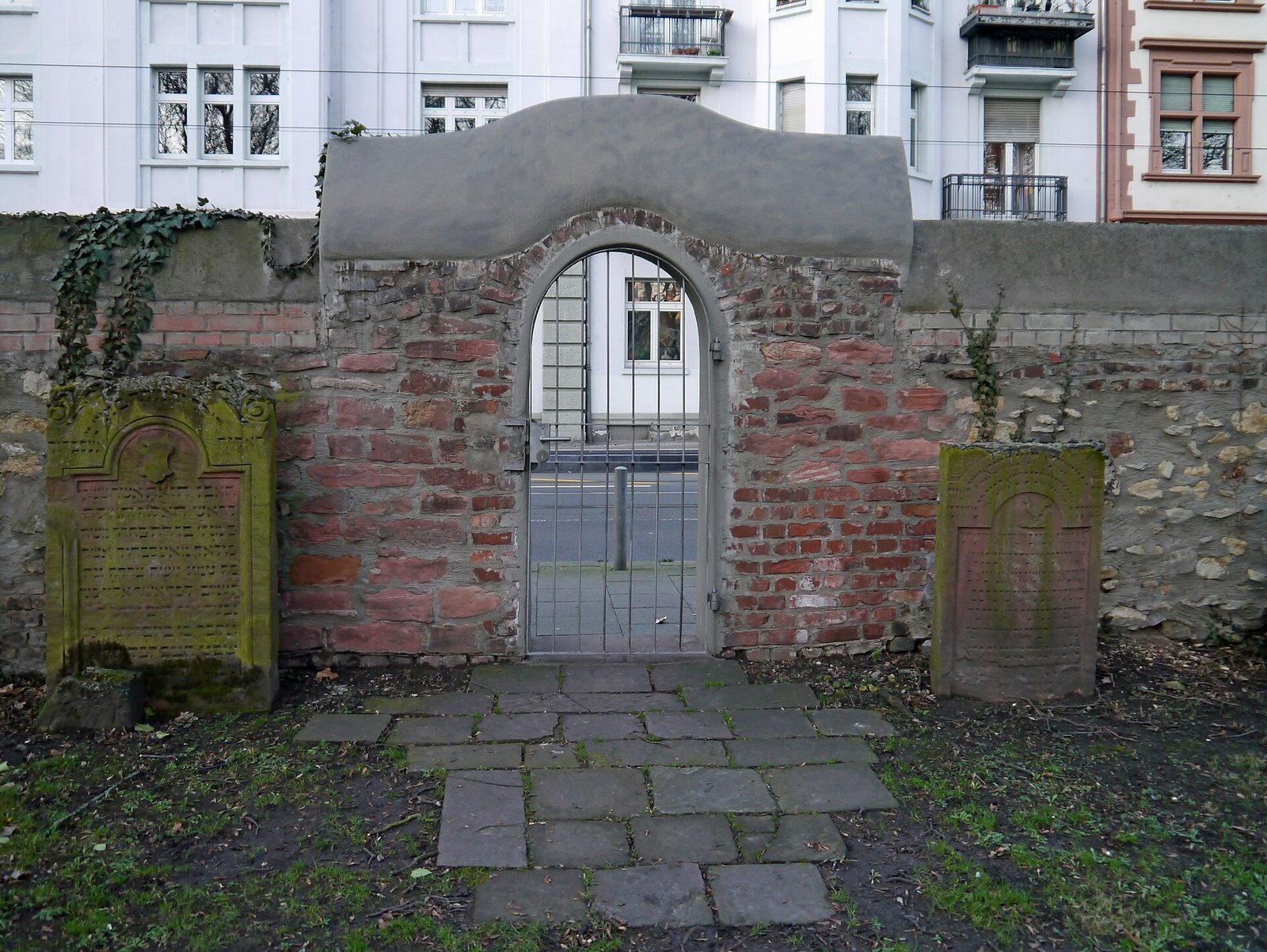
The cemetery occupies a city block bounded by Battonnstraße to the north, Rechneigrabenstraße to the south, Kurt-Schumacher-Straße to the west, and Lange Straße to the east. A perimeter wall encloses the burial ground, whose alignment has been altered most noticeably in the southwest. The cemetery lies on the northern bank of the Braubach, a silted branch of the Main whose former course later corresponded roughly to part of the city’s water-filled moat. The Judengasse Museum stands directly beside the cemetery, and Neuer Börneplatz adjoins it on the south. The present southwestern entrance has two metal gate leaves inscribed Beth HaChaim, meaning House of Life. A simpler barred metal gate marks the northern entrance on Battonnstraße.
Gravestones and burials
Arrangement and condition
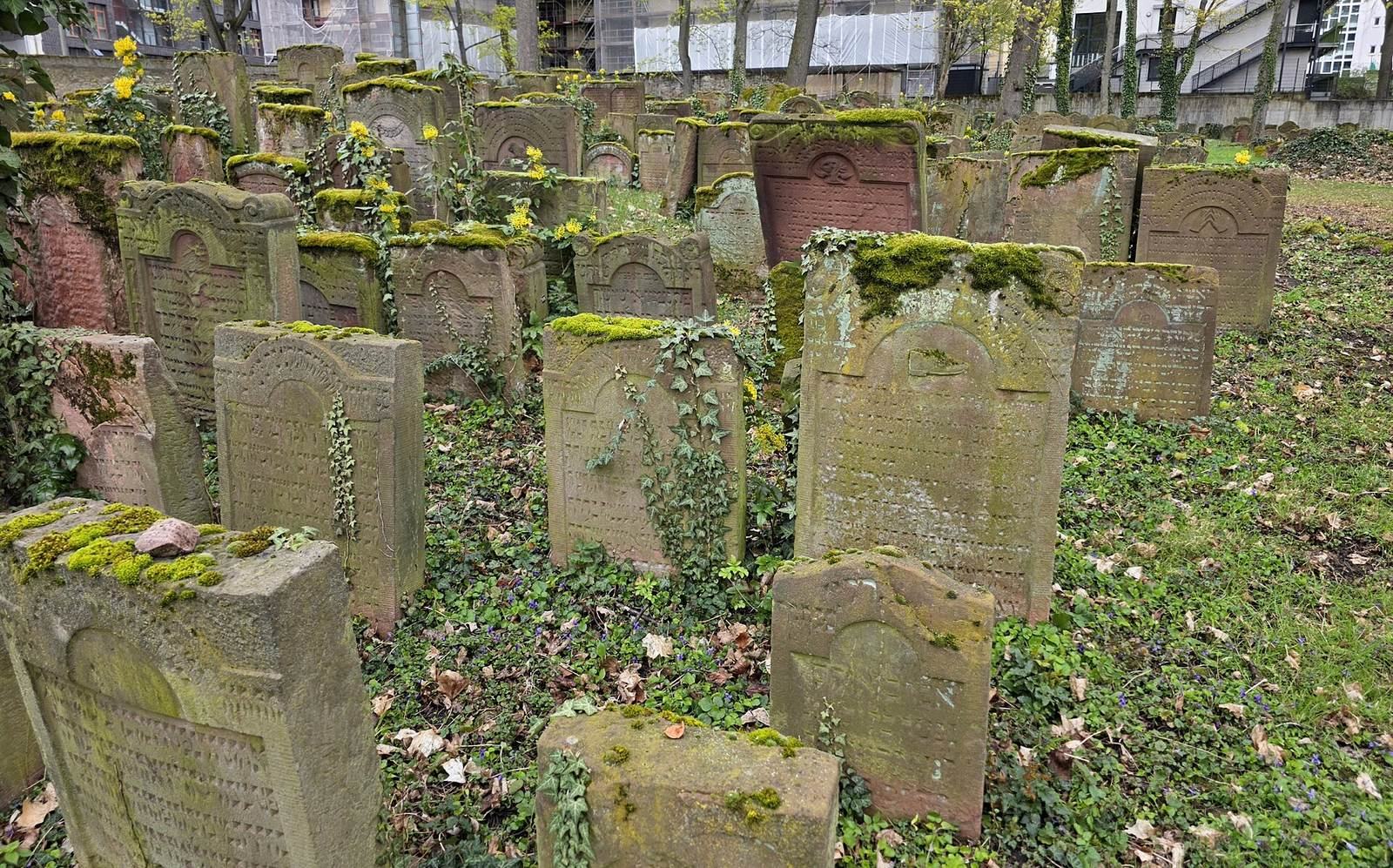
The eastern burial ground retains the crowded, irregular arrangement of a medieval Jewish cemetery. Graves were grouped by family, and women from Frankfurt were buried beside their fathers rather than their husbands. The graves face Jerusalem, associated with the hoped-for resurrection at the end of days. About 2,300 complete gravestones and 3,500 fragments survive. Some inscriptions have weathered until only a few Hebrew characters can be made out.
Stone forms and decoration
Most gravestones stand about 100 to 150 centimetres high and are made of red Main sandstone; the oldest surviving medieval examples are smaller. Early stones tend to have varied rounded tops. Those dating from the fifteenth century to the middle of the sixteenth century commonly have horizontal tops. In later centuries, inward-curving rounded tops became prevalent. Rosettes often decorate the shoulders of stones through the early eighteenth century, while scroll-shaped ornaments appear on later examples.
Inscriptions and symbols
Hebrew writing usually covers the front of a gravestone. Texts range from brief inscriptions to longer compositions using quotations, rhyme, acrostics, in which initial letters form a word or name, and chronograms, which encode dates through the numerical values of letters. From the mid-sixteenth century, most stones begin with the deceased person’s name and title. German inscriptions are uncommon here and became more usual in Frankfurt’s later Jewish cemeteries.
From the mid-seventeenth century, marks identifying the house where a person lived in the Judengasse appear frequently. Examples include a fish trap, a sign, a shoe, a pan, and a hare. Hands raised in the priestly blessing and a Levite’s ewer, a pitcher associated with the Levites’ ritual role, occur less often. The oldest legible gravestone belongs to Channa bat Alexander and gives her death date as 12 July 1272. It measures 73 by 63 by 27 centimetres and is now set into the inner cemetery wall, away from its original position.
Notable graves and reconstructed stones
A plot in the cemetery’s southwest contains gravestones for notable figures, including Meir Rothschild ben Anschel Rothschild, founder of the Rothschild banking house; Nathan ben Simeon ha-Kohen Adler and Jakob Jehoshua Falk, both chief rabbis of Frankfurt; and the rabbis and scholars Pinchas Ben Zwi Hirsch Ha-Levi and Meir ben Rabbi Yaakov Schiff. The roughly 175 stones removed during the war and later returned now stand along the inner face of the outer wall. By 2006, computer-assisted work had virtually reconstructed about 500 gravestones from inscribed fragments. Repeated phrases on the stones helped researchers restore parts of their texts.
Neuer Börneplatz Memorial
Metal name blocks are set in a horizontal band on the outside of the cemetery wall and project outward so that small stones can be placed on them according to Jewish custom. A block for Anne Frank is surrounded by blocks for her relatives. Another remembers Hans Helmut Michel, a Jewish boy from Frankfurt murdered during the Holocaust whose story was incorporated into Louis Malle’s French film Au revoir, les enfants. A separate block represents people whose fates remain forgotten, unnamed, or undocumented.