Tautra Abbey: A Medieval Cistercian Monastery in Norway
Site at a Glance
- Popularity
- Medium
- Country
- Norway
- Primary era
- Medieval
- Eras represented
- Medieval
- Civilizations
- Norwegian
- Site type
- Religious
- Remains
- Monastery
On this page13 sections
History
Before the abbey and its foundation
Tautra Abbey was a medieval Cistercian monastery on the island of Tautra in Norway. Archaeological finds from the island’s northern end, near the abbey ruins, date to 755–410 BC. Tautra appears to have been occupied intermittently around the transition from the Bronze Age to the Iron Age and was probably settled during the Viking Age. Traces of boat sheds and burial cairns have been found on southern Tautra. A stone church may also have stood on the island before the abbey.
The choice of Tautra’s location is uncertain. The island lies near the Frosta Peninsula, where Frostating, one of Norway’s regional law assemblies, met. The region became an important political center in the late tenth century. Across the fjord lay Nidaros, now Trondheim, which became an archbishopric in 1153 and was a major religious center in medieval Norway. Seclusion, access to water and conditions suitable for farming may also have informed the choice.
In 1205, Cistercian monks left Lyse Abbey to establish a monastery in Trøndelag. The Cistercians were a Catholic monastic order centered on communal religious life and observance of the order’s rule. Tautra Abbey was consecrated on 25 March 1207, the Feast of the Annunciation, and dedicated to the Virgin Mary. Its Latin name meant Monastery of Saint Mary on Tuta Island. It was the last-founded of the medieval Cistercian monasteries established in Norway from the mid-twelfth century onward.
Monastic life and influence
Munkeby Abbey, founded some decades before Tautra, closed shortly after the new house was established, and its estates passed to Tautra. The relationship between the monasteries remains uncertain. Munkeby may have been damaged by a fire in the late twelfth century and replaced by Tautra, or it may have come under the authority of Tautra’s abbot. The monastery itself may have suffered a fire in 1251, but religious life appears to have continued.
The monks supported the community through fishing, farming and craftwork, and kept substantial livestock, including sheep. A later tradition credited them with bringing Spanish and English sheep to the island, but the sheep were imported in the 1770s. The Tautersau sheep breed takes its name from Tautra. The monks probably also maintained a garden. In 1632, the clergyman and historian Peder Claussøn Friis described an apple orchard that he attributed to them.
By the early sixteenth century, Tautra had become a major landowner, holding 167 farms. Twenty-two were on nearby Frosta; the others were spread across Trøndelag and Nordmøre. The monastery had a carpentry shop, a smithy and tools for working glass, and sold surplus food and goods. Its library may have contained 75 volumes shortly before the Reformation.
Tautra’s abbots also took part in wider Church affairs. Abbot Sigurd was expelled from the Cistercian Order in 1218 and later readmitted. He attended the Bergen assembly in 1223 and was elected archbishop of Nidaros the following year. At the urging of King Håkon Håkonsson and Bishop Nikolas Arnesson of Oslo, Pope Honorius III appointed Peter of Husastad instead. In the 1220s, an abbot of Tautra was considered as a possible archbishop, and Pope Gregory IX assigned an abbot of the monastery, together with priors from Holms Abbey and the Dominican house in Nidaros, to investigate the life and miracles of former archbishop Øystein Erlendsson in connection with possible canonization. Tautra monks also served as judges and arbitrators.
Abbot Birger was elected archbishop in 1264, but Pope Clement IV refused to confirm his election on 18 March 1265, citing a defect of birth, probably because Birger was born outside marriage. Thorfinn the Holy was probably a monk at Tautra before becoming bishop of Hamar. After defending the concordat that regulated relations between the Norwegian king and the Church, he fled Norway. In 1285 he left Tautra 20 Norwegian marks; he was canonized in 1345. Brother Stefan later became abbot of Gudsberga Abbey in Dalarna. A later tradition credited Stefan with foretelling the Reformation, the construction of Steinvikholm and events surrounding the 1537 Church Ordinance.
Records also name Thorer, around 1280, and Kristian, who was abbot from at least 1300 to 1303. Kristian heard testimony about violence against Abbot Arne of Nidarholm and later excommunicated those accused, along with communities that withheld the rights of the Nidaros chapter. Abbot Audun attended a bishops’ meeting in Nidaros in 1313, while Jens appears in a fifteenth-century agreement with the archbishop. Christiern was recorded as abbot-elect in 1502. Peter, appointed by Archbishop Olav Engelbrektsson, became the monastery’s last leader.
Financial crisis and dissolution
Tautra ceased to function as an independent monastery in 1532, after a period of serious financial disorder under Abbot Matthias Henrikssøn. Appointed in 1510 by the abbots of Sorø and Herrevad, Henrikssøn took office when the house was close to collapse and had few monks. He mortgaged its lands, while church silver was pawned or taken away, and left as the monastery’s finances deteriorated. He may subsequently have become abbot of Hovedøya Abbey, where he was removed in 1525, although his Danish Cistercian brethren later renewed their confidence in him as Tautra’s abbot.
Henrikssøn was arrested at Tautra in 1530 and tried before an ecclesiastical court. The accusations included violence, breaches of church peace, neglect of priestly duties, failure to maintain the monastery and financial misconduct. On 11 April 1531, he mortgaged four farms to Niels Lykke, a member of Norway’s council of state, to raise money for the archbishop. He then transferred the monastery and its assets to Lykke in return for payment. King Frederick I confirmed the arrangement on 1 May 1532 and made Lykke steward of the monastery and its estates. In July 1535, Archbishop Olav Engelbrektsson recovered the property for the Crown after Lykke was prosecuted for an illicit relationship with his sister-in-law.
The Reformation under Christian III brought the final end of the monastery. The Reformation in Denmark and Norway ended Catholic monastic institutions and transferred many of their properties to the Crown. After Archbishop Olav went into exile on 1 April 1537, Tautra passed into Crown ownership. An unverified local tradition links the end of the church’s use for worship to a shipwreck during a crossing; the church may later have served as a private chapel. An accusation made in 1530 described it as leaking badly, and Friis wrote in 1632 that its walls were ruined.
The ruins and a new Cistercian house
The ruins and the island saw intermittent military use, and most of Tautra was privately owned from the 1660s. In 1846, Jacob von der Lippe Hansen bought the ruins for five speciedaler, a former Norwegian silver currency unit, and donated them to Fortidsminneforeningen, a Norwegian preservation society. The ruins became the society’s first property. Excavation began in 1851. Restoration work followed in 1879, 1884 and 1901, continued during the 1920s and resumed roughly every decade from 1950 to 1993. Work then paused; in autumn 2009, the ruins became part of the national heritage authority’s ruin project.
A separate community of Trappistine nuns was founded near the medieval ruins in 1999, the first permanent Cistercian settlement in Norway since the Reformation. Trappistines are women of a branch of the Cistercian tradition. Five American nuns from Our Lady of the Mississippi Abbey and two Norwegian nuns began the community in provisional buildings. It became an independent priory, a monastic house headed by a prior or prioress, in 2006, and its status was raised to a major priory in 2012. Queen Sonja laid the foundation stone for a new monastery in 2003.
Remains
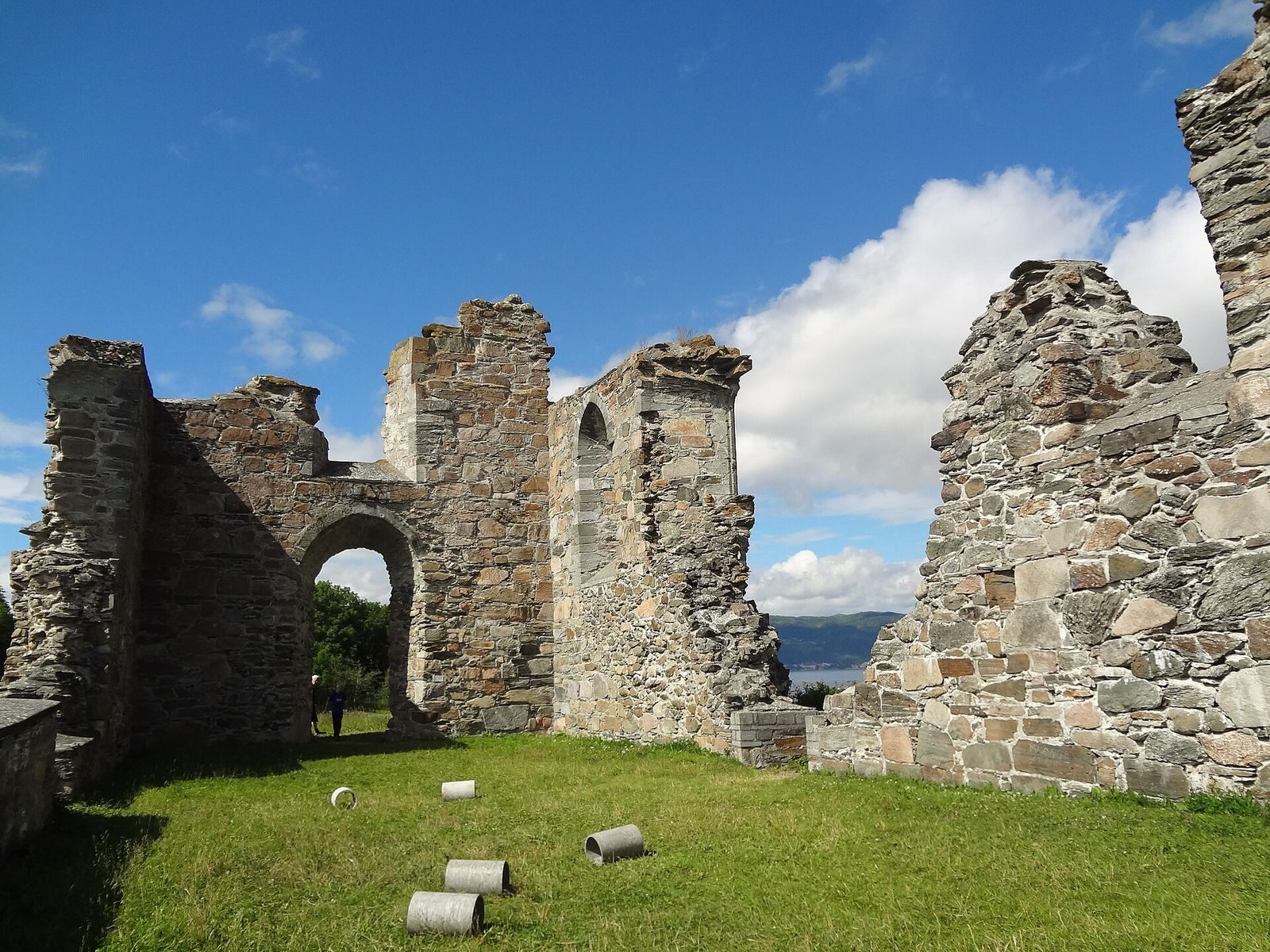
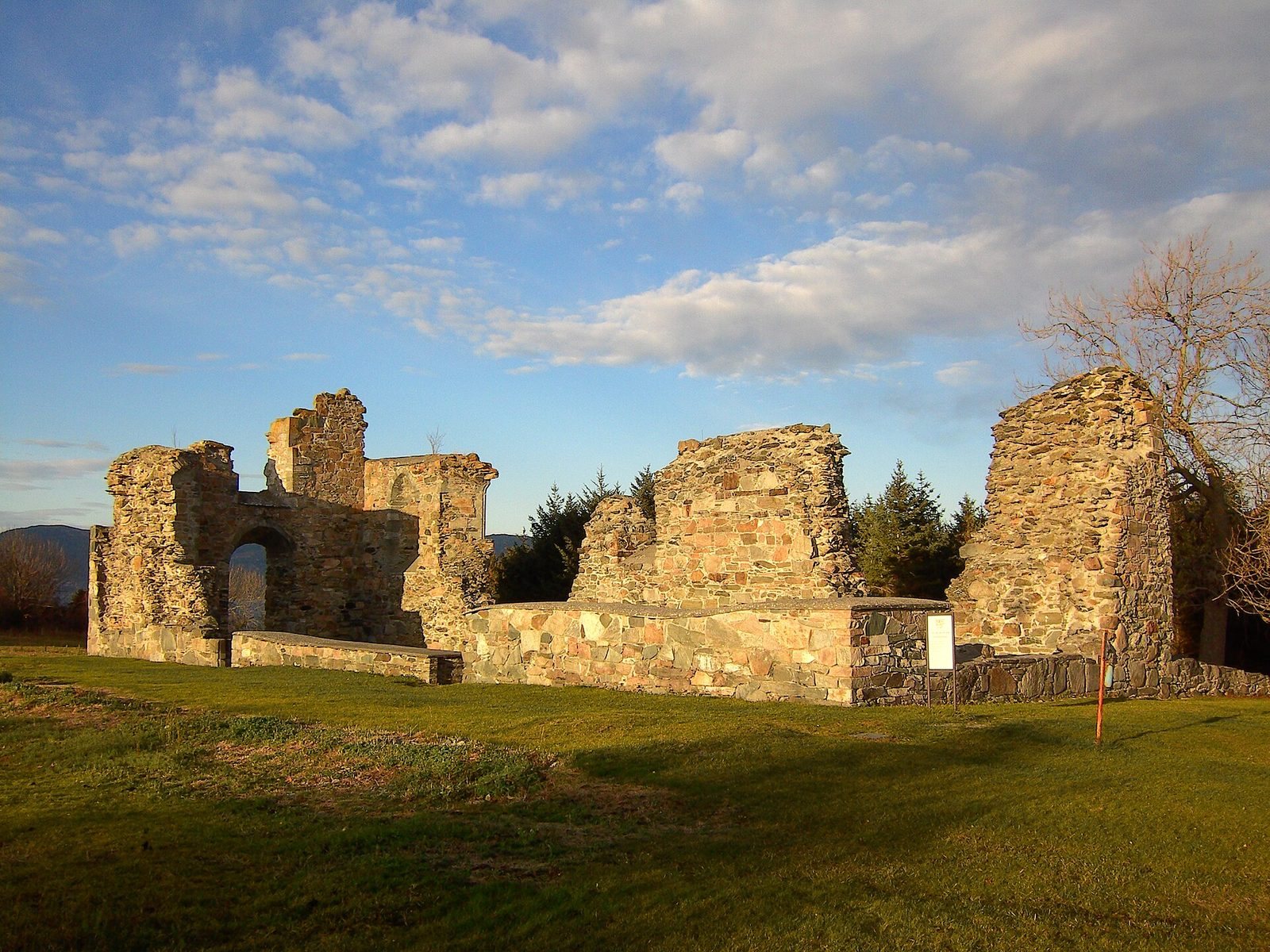
The medieval abbey’s surviving remains center on a rectangular church traditionally aligned east to west, with its choir, the area for monastic prayer, at the eastern end. Excavations have revealed traces of other buildings around it, including timber structures and the foundations of larger stone wings. The main building was constructed from quarried soapstone, with dressed stone reinforcing openings and corners.
The abbey church
The church measured 36.5 metres long and 13.5 metres wide on the exterior. Its roof and upper courses of stone have fallen, and its ridge height is estimated at 14 metres. The interior used an open timber roof framework rather than a stone vaulted ceiling. The many windows appear to have admitted substantial light. Surviving decorative features include rounded stone mouldings, recesses, columns and carved capitals, the shaped tops of columns.
Doors opened from the nave, the main body of the church, to both the north and south. A pointed arch survives at the western entrance. The openings and exterior corners were reinforced with dressed marble ashlar, squared stone blocks finished with smooth faces. The church’s decoration and construction suggest that a smaller stone church stood on Tautra earlier. Some stones from that building, including marble blocks, may have been reused in the larger abbey church.
Other monastic buildings
North-side building
Traces of a building on the church’s north side have been interpreted as a chapel or sacristy, a room for church furnishings. It had an entrance from the choir and an exit toward the cemetery, which lay east of the choir. The building may also have included a funeral doorway through which a body could be carried toward burial ground.
Timber structures and stone wings
Excavations uncovered remains of several buildings in the ground around the church, some set asymmetrically in relation to it. Work south of the church in 1879 revealed timber structures on stone foundations. They may belong to the monastery’s earliest phase, when the church took priority in construction. Foundations of larger stone wings were also found to the east and south.
Excavated altar, burials and objects
Excavation inside the church in 1851 uncovered an altar about 2.5 metres long and 1.26 metres wide, estimated to have stood 0.84 metres above the floor. In 1884, the remains of two people were found immediately in front of it. Excavations also recovered tools, small household objects and a stylus, a pointed implement for writing on wax tablets.
Garden remains
A monastic garden is associated with wild columbine and brooklime, plants that may descend from an herb garden. Cherry, rose hip, nut, oak, hawthorn and ash have also been recorded on the island. Ash grows there near the northern limit of its range; its cultivation at other Norwegian monasteries has prompted the suggestion that it may also have been planted at Tautra.
The modern monastery
The modern monastery stands on southern Tautra, less than a kilometre from the medieval ruins. Its buildings were completed in 2006, and its church was consecrated in 2007. Two long wings enclose the monastic precinct, with the church at the northern end. The complex also includes a covered walkway around a courtyard, called a cloister, and smaller buildings used by the community. In the church’s choir, the view across Trondheimsfjord serves as the altarpiece.