Stari Ras: A Serbian Medieval Political and Cultural Center
Site at a Glance
- Popularity
- High
- Country
- Serbia
- Primary era
- Medieval
- Eras represented
- Classical, Medieval, Early Modern
- Civilizations
- Byzantine, Ottoman, Roman, Serbian
- Site type
- Military
- Remains
- Castle
On this page21 sections
History
Stari Ras is an archaeological complex in the Sebečevo area of Serbia, associated with the medieval city of Ras and its surrounding fortresses, settlements, and monasteries. Ras became a major political and cultural center of the Serbian state in the late twelfth and thirteenth centuries, although the name refers to a wider center rather than proving that the fortress itself was a large, densely developed capital.
Early settlement and late antiquity
People settled in the area during the Early Bronze Age. A Roman military settlement followed in the third century CE. Its position at a crossroads and proximity to iron deposits helped make the area important. The name Ras is often connected with Arsa, a Roman fortification mentioned by Procopius, a sixth-century Byzantine historian, but the identification is uncertain. Another proposed origin links the name to the nearby Raška River and an Illyrian word meaning something like “that which falls.” The Serbian state name Raška derived from Ras and was later used as a name for Serbia.
The location of the medieval city remains disputed. It is commonly identified with Gradina-Pazarište and the settlement below it, but other interpretations place the city at Gradina-Postenje, associate it with modern Novi Pazar, or use Ras for a broader group of fortifications, churches, and monasteries. The Gradina-Postenje proposal has not been established conclusively.
A fortified settlement was in use by the fourth century. In the sixth century, the fortification at Podgrađe and a nearby basilica suffered damage. Slavic settlement and the retreat of Byzantine authority followed, and both fortifications were abandoned in the early seventh century.
Frontier fortress in the ninth to twelfth centuries
The fort was occupied again and partly restored in the ninth century. During the ninth and tenth centuries, Bulgarian, Serbian, and Byzantine control of the area shifted. Constantine VII, a tenth-century Byzantine emperor and writer, recounts that after a peace agreement the Bulgarian ruler Boris was escorted to the frontier at Ras by sons of the Serbian ruler Mutimir. Ras’s exact position in relation to that frontier is uncertain. Bulgarian control in the area is also associated with about 924.
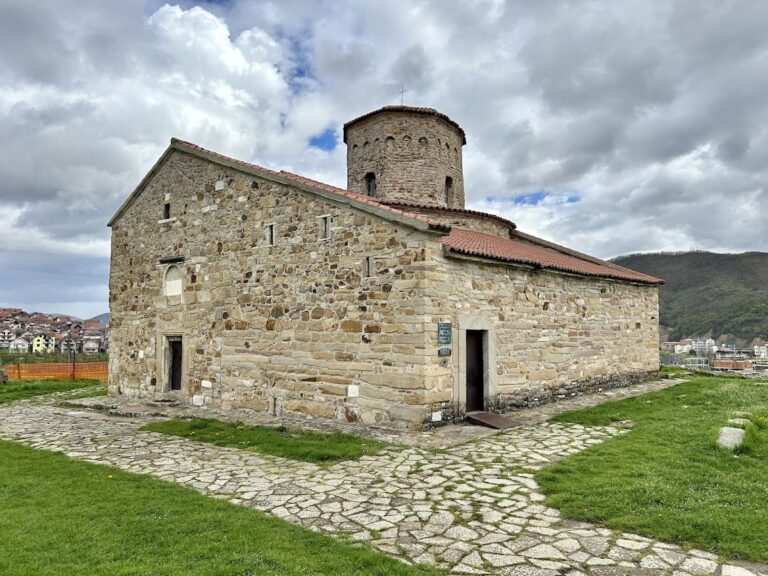
Byzantine rule returned in 971 under Emperor John Tzimiskes and was restored again by Emperor Basil II in 1016–1018, after Bulgarian rule had returned. Ras then formed part of the Byzantine Empire’s frontier defenses. The Raška bishopric, an area governed by a bishop, was associated with the Church of the Holy Apostles Peter and Paul and fell under the senior church jurisdiction of the Archbishopric of Ohrid.
The fortress was strengthened and repeatedly contested during the eleventh and twelfth centuries. Vukan is said to have held Ras from 1083, but the balance between Serbian and Byzantine authority in the late eleventh century is unclear. Their forces fought over the region in the 1090s, and Uroš I later recovered Ras. Serbian forces destroyed the fortress in 1127; the Byzantines rebuilt it during the 1130s. In 1149, Emperor Manuel I Komnenos destroyed it during a campaign against the Serbian grand prince Uroš II.
The Byzantines rebuilt the fortress after 1149 and left Serbian inhabitants there under Byzantine command. The Serbian grand prince Tihomir may have made it his residence. Byzantine authority ended as Stefan Nemanja rose to power and made Ras one of the principal strongholds of his rule.
Serbian political and cultural center
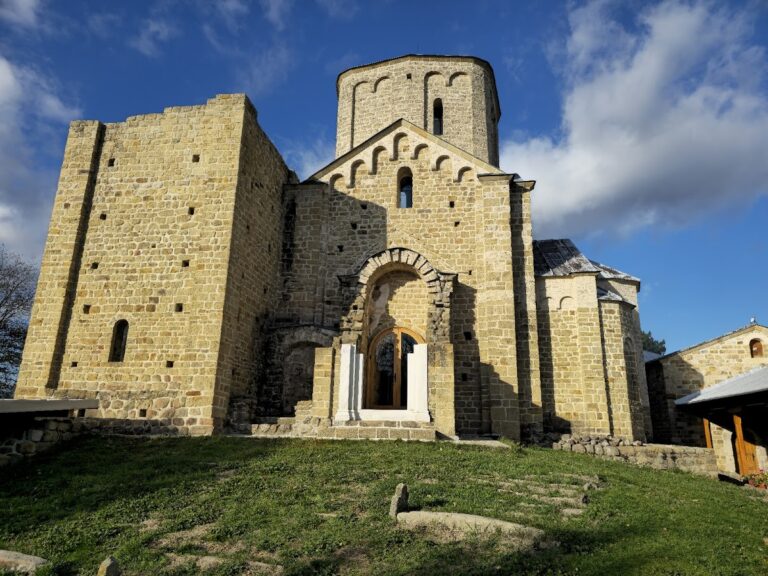
Stefan Nemanja was baptized again according to Greek rites at the Church of the Holy Apostles Peter and Paul. After defeating his brothers in 1170, he took control of Ras. In 1171, he founded the monastery of Đurđevi Stupovi in gratitude to Saint George, whom tradition credited with freeing him from imprisonment in a cave.
In the late twelfth and thirteenth centuries, Ras and its surrounding region became an important political and cultural center for the Serbian state and the early Nemanjić rulers. Around 1186, an assembly at the Church of the Holy Apostles Peter and Paul decided to suppress Bogomilism, a medieval Christian movement regarded as heretical by Serbian church authorities. On 25 March 1196, Nemanja handed the throne to Stefan the First-Crowned at the church. After they retired from public life, Nemanja and his wife Ana became monks. Ana took the monastic name Anastasija and spent the rest of her life in a women’s monastery dedicated to the Virgin Mary at Ras, whose location is uncertain.
Under Stefan the First-Crowned, the center of the Serbian Church moved from Ras to his foundation at Žiča. Ras continued to support political, cultural, and economic activity. A mint, where coins were made, operated there from about 1230. Mining and trade expanded under Stefan Uroš I, including commercial ties with Dubrovnik. Uroš I also founded the nearby monastery of Sopoćani in the 1250s, adding to the region’s religious and cultural landscape.
Market settlement and Ottoman rule
Ras’s military role diminished in the first half of the fourteenth century as trade and crafts grew. The fortress at Gradina was probably abandoned around mid-century, while activity shifted to the open market settlement of Trgovište below. Ras and Trgovište may for a time have named the same trading place, but Trgovište later became the established name. It served merchants from both the interior and the coast, trading ores and metal goods from the nearby mining center of Gluhavica. A caravan route between the Adriatic coast and the Balkan interior passed through the area, where merchants from Dubrovnik maintained a colony and a place of worship. Vuk Branković held the region from the 1360s until the end of the century.
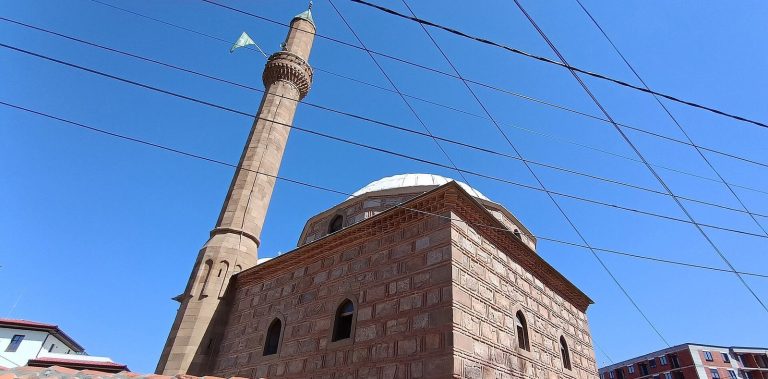
After 1427, the area belonged to Despot Đurađ Branković, a late medieval Serbian ruler. Ottoman forces captured Trgovište in 1455. It became an administrative center for the Ras area: a local Ottoman official was there in 1459 and a judge in 1461. After the Ottoman conquest of Bosnia in 1463, the region came under the Jeleč administrative province.
During the fifteenth century, the Ottoman commander Isa-beg Ishaković established a new market settlement nearby, later called Novi Pazar. Trade gradually shifted there, and older Trgovište declined, though people continued to live there for a time. The region suffered severe damage in the events preceding the Great Migration of the Serbs, a major movement of Serbian people from Ottoman-ruled lands in the late seventeenth century. Trgovište may have remained inhabited briefly afterward.
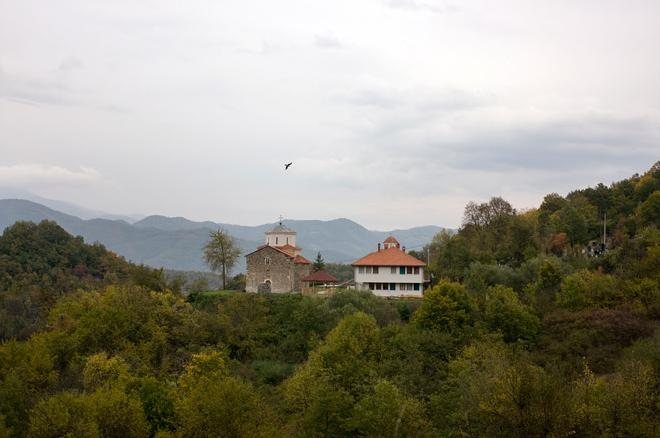
Archaeological investigations of the Ras complex began in the early 1970s, with systematic work at its main sites continuing intermittently into the early 1990s. Later investigations resumed at Gradina-Postenje. Stari Ras and Sopoćani were inscribed together on the UNESCO World Heritage List in 1979. The protected complex includes Gradina and lower-town Trgovište, Sopoćani Monastery, the Church of the Holy Apostles Peter and Paul, and Đurđevi Stupovi. Stari Ras also holds Serbia’s status of Monument of Culture of Exceptional Importance and is protected by the Republic of Serbia.
Remains
The remains extend across a plateau, its slopes, and settlements beside the rivers. The commonly identified fortress at Gradina-Pazarište stands about 11 km west of Novi Pazar, above the confluence of the Sebečevska and Raška rivers. Podgrađe, the lower settlement, occupies Gradina’s eastern slopes. Trgovište lies below the fortress, across the Raška and near its confluence with the Sebečevska. Gradina-Postenje, another fortification associated with Ras, is about 2 km from Novi Pazar. Their development was interconnected, and the two forts may have formed one defensive system.
Prehistoric remains
Finds at Gradina-Pazarište indicate Early Bronze Age occupation as well as later settlement in the seventh and sixth centuries BCE. The area was abandoned after the beginning of the fifth century BCE and remained uninhabited for more than eight centuries before Roman-period resettlement. Pottery includes material from the Hallstatt tradition, an Early Iron Age tradition in Europe, and the Glasinac IV and V phases of a prehistoric culture in the western Balkans. Other finds include Greek imports from the seventh and sixth centuries BCE, occasional pottery in the southeastern European Basarabi tradition, and a small number of metal objects, including Scythian-style horse equipment. Sparse sixth-century BCE finds point to a wider settlement. Velika Gradina, about 500 m south of Pazarište, has a small quantity of Hallstatt-period pottery and may have served as a lookout for the prehistoric settlement at Podgrađe.
Roman and late antique remains
Roman occupation and Tower VII
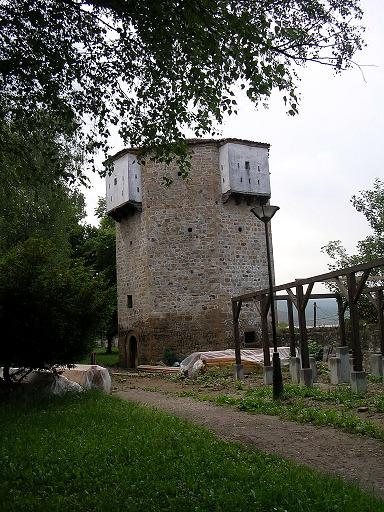
Third-century coins and other objects mark Roman-period activity at Gradina-Pazarište. House 17 dates to the fourth century. Tower VII, built around the transition from the third to the fourth century, stood independently as a watchtower and was used only temporarily.
Late antique defenses
In late antiquity, defensive walls enclosed Podgrađe and part of the Gradina plateau. A tower strengthened the defenses. The walls had faces of partly dressed and roughly broken stone laid in irregular courses, with rubble and lime mortar filling the interior. This type of fortification was also used elsewhere in the Roman Empire.
Churches and burial remains
A Roman basilica, built in the late fourth or early fifth century, stood near the Sebečevska–Raška confluence on the right bank of the Raška. Across the river, on its left bank at Trgovište, a late antique cemetery included an early Byzantine, single-nave church dating to the fifth or sixth century. A built tomb lay beneath the floor near the center of the church.
Medieval fortress and religious sites
Fortress and interior buildings
The medieval fortress was rebuilt repeatedly. During the 1130s, the Byzantines constructed stone ramparts and a gate defended by two towers. After the fortress’s destruction in 1149, its former entrance was blocked and a new entrance opened beside the strengthened main tower. A palace occupied the northern part of the fortress, while several timber buildings stood within it.
Podgrađe and its finds
Houses began to spread beyond the fortress walls onto Gradina’s slopes in the late twelfth century. Finds from the fortress and settlement include everyday pottery, fragments of bone weapons, and wooden and iron tools. Evidence of goldsmithing includes a small vessel holding gold droplets and a mold for casting medallions showing the Virgin Mary and Christ. A coin of King Stefan Radoslav and a coin-making mold support the presence of a mint from about 1230. A large granary was also found, and the fortress may have contained a royal treasury.
Cave monastery and manuscript
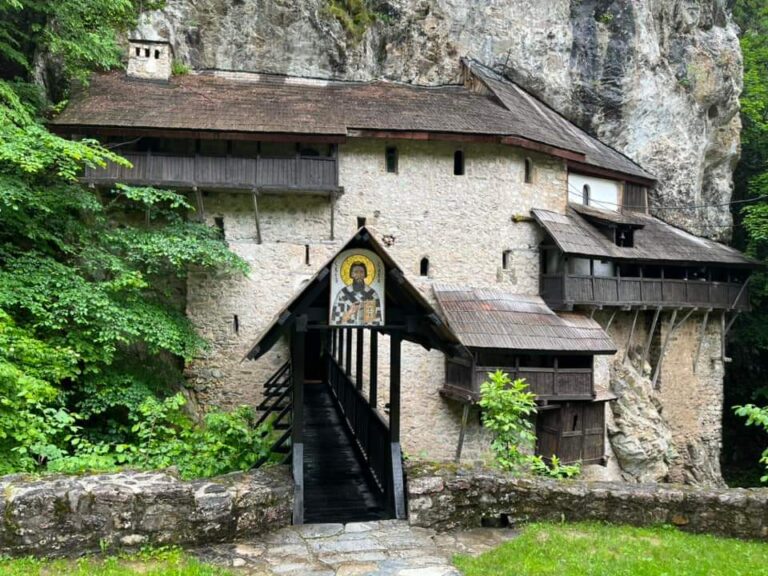
A cave on Gradina’s southeastern slope is tentatively identified as the place where Stefan Nemanja was imprisoned around 1166–1167. Beneath it, a rock shelter contains a monastery complex dedicated to the Archangel Michael, probably built in the late twelfth or early thirteenth century. Its church was small and nearly square. Monks who copied manuscripts used hermitages in the surrounding rocks. In 1202, the monk Simeon wrote the Vukan Gospel at the cave monastery; a note in the manuscript identifies its place of production as a cave in the city of Ras. The manuscript is now held in Saint Petersburg.
Trgovište
Settlement and houses
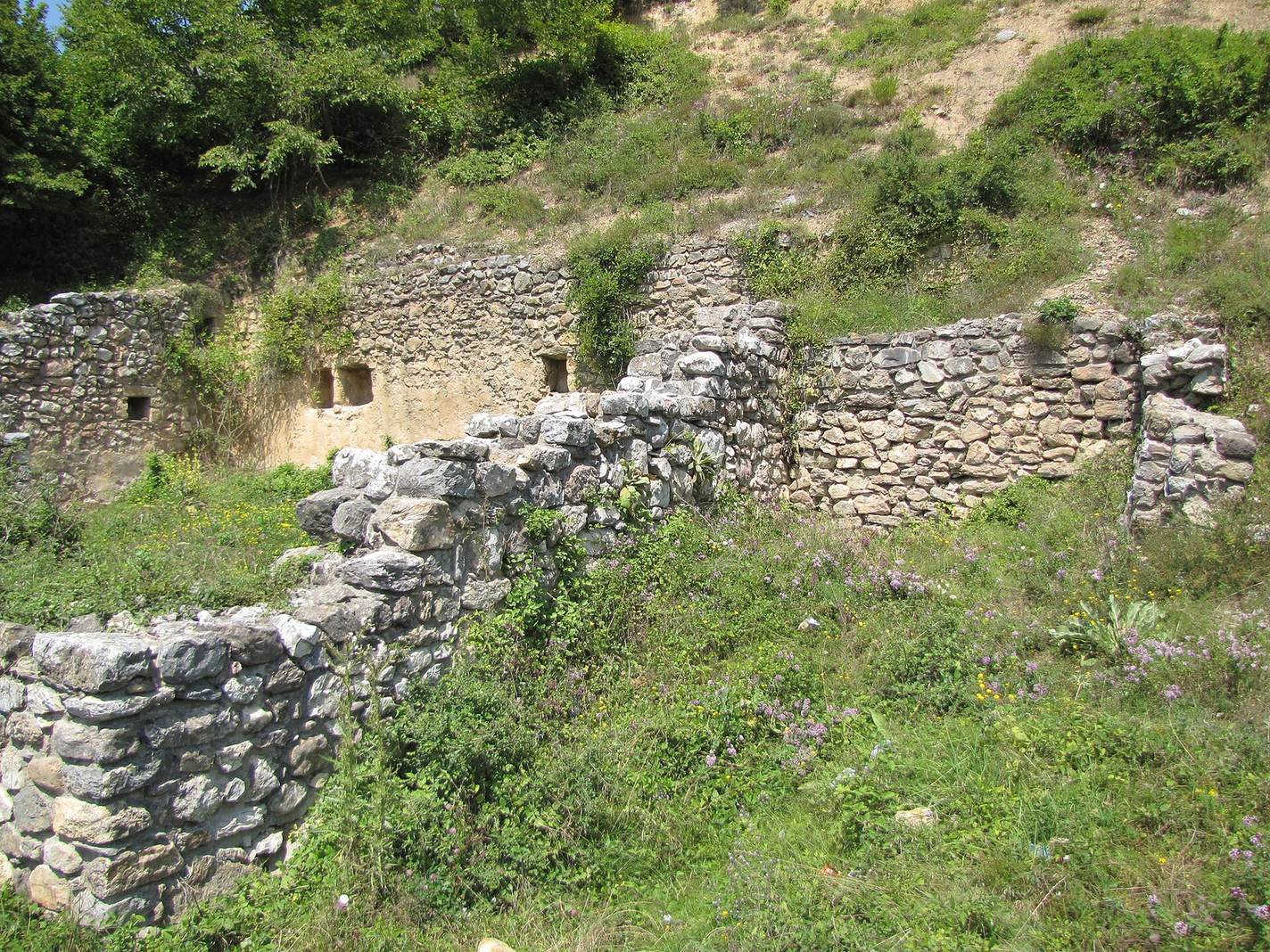
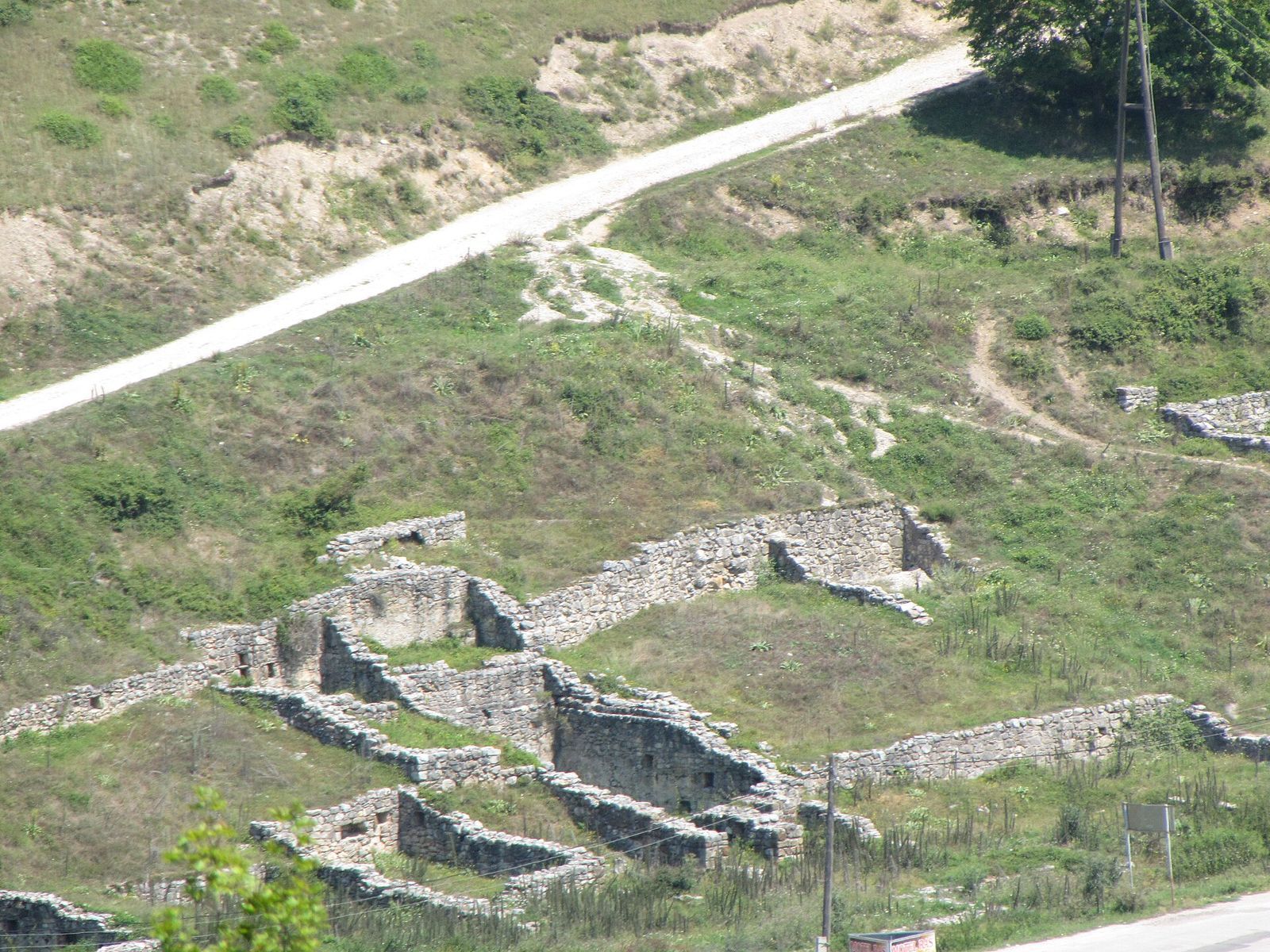
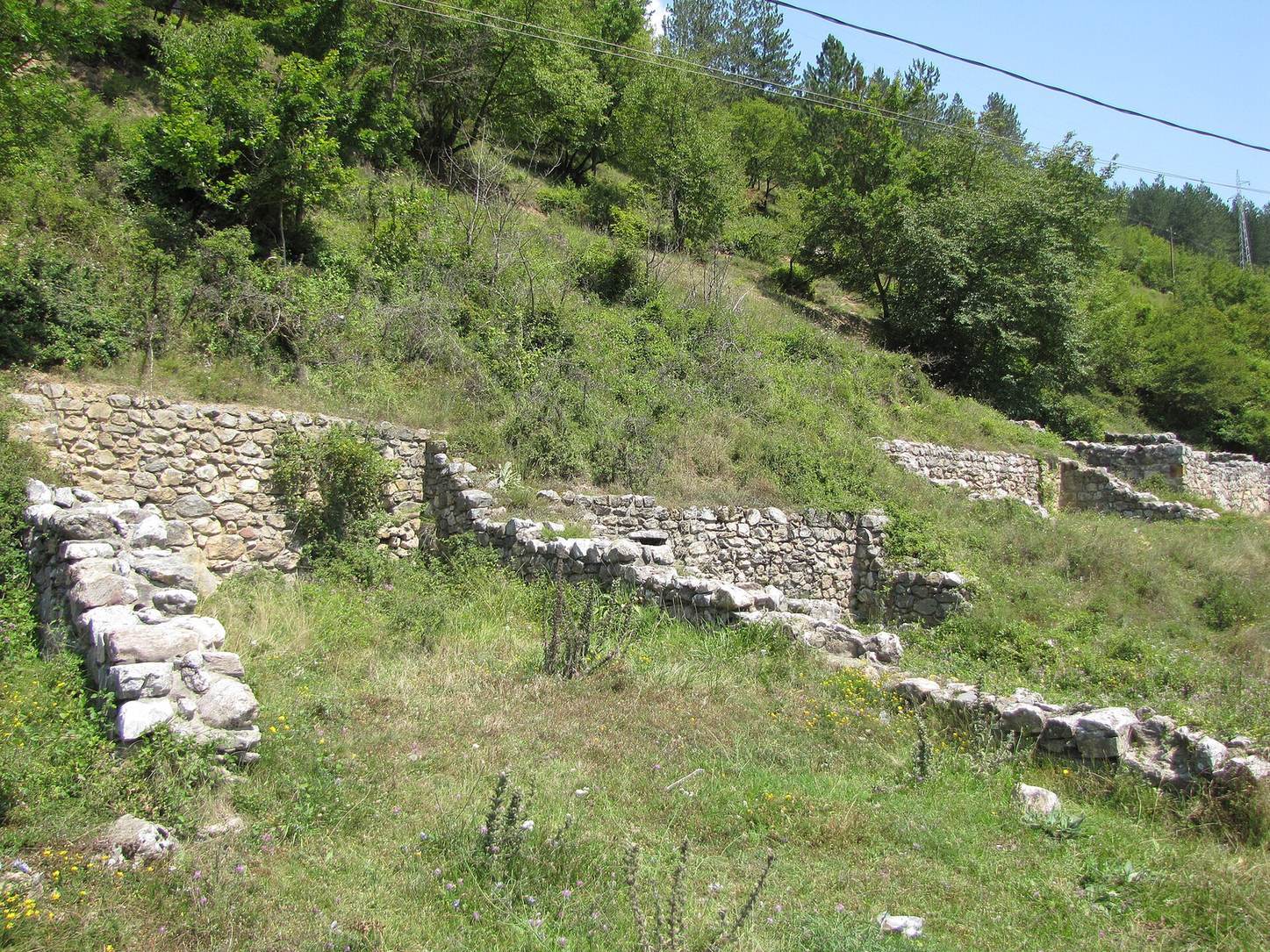
Trgovište developed as an elongated, unfortified settlement over two phases. Its earliest houses used wooden logs set alongside upright posts. From the first half of the fifteenth century, two-storey stone houses replaced the timber buildings. Shops and possibly workshops occupied their ground floors, with living space above. Excavations identified 64 houses arranged closely and regularly; remains of the settlement span the fourteenth to seventeenth centuries.
Churches and cemetery
Five churches with associated cemeteries have been identified at Trgovište. The principal church, built in the first half of the fifteenth century, occupied raised ground above the settlement’s middle section. A separate single-nave church on the left bank of the Raška dates to the second half of the twelfth century, when the fortress was occupied. Older graves and an urn dating to the eighth century BCE also form part of the cemetery remains.
Other sites in the Ras complex
Gradina-Postenje
At Gradina-Postenje, the fort was renovated in the second half of the ninth century, and part of an earlier settlement was reused. Finds range from the Early Iron Age and late antiquity to material associated with the reigns of Justinian and the Komnenoi. Ceramics used in the ninth- and tenth-century rebuilding were imported from either the Black Sea coast or Macedonia. Some urns bear runic characters and resemble finds from Bulgaria. Decorated bronze objects from Podgrađe belong to a broadly nomadic type, with parallels among Bulgar-Turkic and Magyar finds.
Reljina Gradina and nearby churches
Reljina Gradina, about 2 km east of Pazarište, may have been functionally connected to it. It contains the remains of the Monastery of Saint Barbara, where the metropolitans of Raška, senior bishops leading an ecclesiastical province, were seated in the sixteenth and seventeenth centuries. Other religious sites in the wider region include an old church at Naprelje, the Latin Church at Postenje, a basilica near Pope, and churches within the boundaries of Novi Pazar and Novopazarska Banja, at Gradina-Postenje, and at Zlatni Kamen. Their concentration may point to an early bishopric, possibly connected with the ancient bishopric of Ulpiana.