Baptistery of San Giovanni alle Fonti: Milan’s Early Christian Baptistery
Site at a Glance
- Rating
- 4.8
- Popularity
- Very Low
- Country
- Italy
- Primary era
- Classical
- External website
- Open
- Eras represented
- Classical, Medieval
- Civilizations
- Roman
- Site type
- Religious
- Remains
- Church
On this page9 sections
History
The Baptistery of San Giovanni alle Fonti is an Early Christian baptistery in Milan, Italy, built between 378 and 397 during the late Roman imperial period. Its construction was commissioned by Saint Ambrose, the fourth-century bishop of Milan, when Mediolanum, the Roman name for Milan, served as the capital of the Western Roman Empire from 286 to 402. Dedicated to John the Baptist, the building was one of Milan’s earliest baptisteries and formed part of the city’s episcopal complex.
The episcopal complex
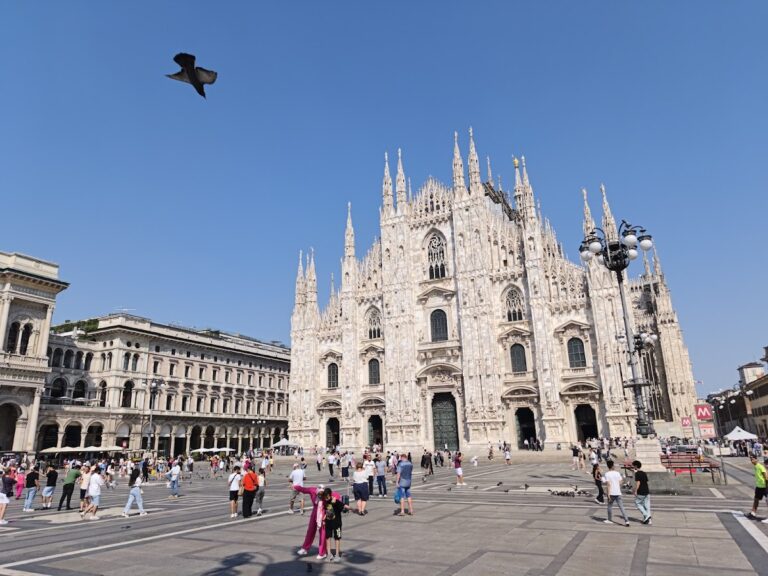
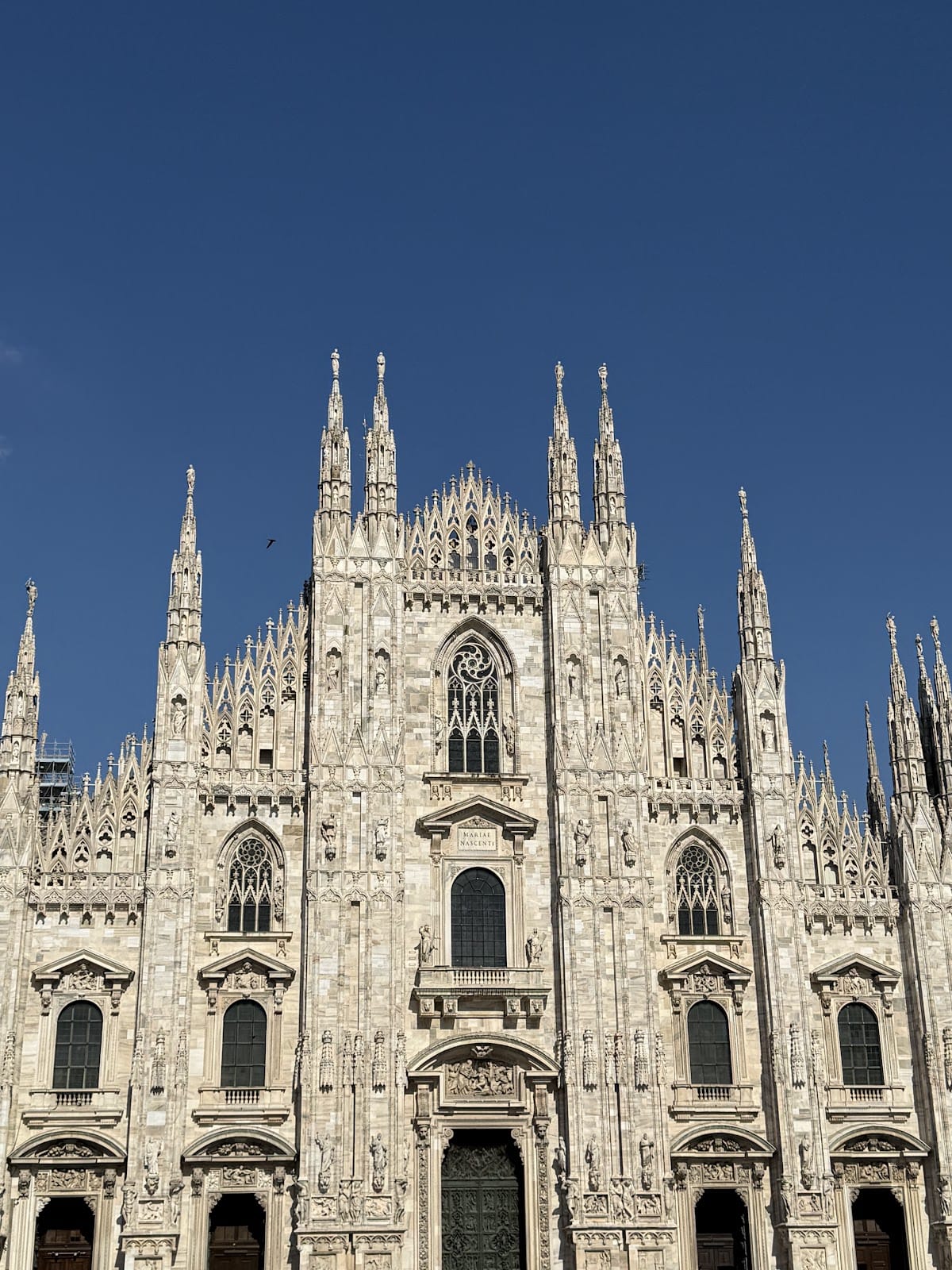
San Giovanni alle Fonti stood between two major basilicas beneath the present Piazza del Duomo. The complex included the basilica vetus, later renamed the Cathedral of Santa Maria Maggiore, and the basilica maior, later renamed the Basilica of Santa Tecla. A second baptistery, Santo Stefano alle Fonti, completed the group. The close pairing of two basilicas was characteristic of episcopal cities in northern Italy during the Constantinian period.
The two baptisteries originally served different groups. San Giovanni alle Fonti was used for the baptism of men, while women were baptized at Santo Stefano alle Fonti. This division gradually became less distinct as infant baptism grew more common. Both buildings were subsequently restored and modernized during rebuilding work on the basilica vetus.
Ambrose and Augustine
The baptistery’s most famous ceremony took place at Easter in 387, when Saint Ambrose baptized Augustine of Hippo, Augustine’s son Adeodatus, and several of Augustine’s companions. Augustine was a Christian theologian who later became a bishop, and his baptism by Ambrose marked his Christian initiation. The event links the building to the religious and intellectual history of late Roman Milan.
Renovation, demolition, and rediscovery
In the sixth century, Bishop Lawrence I of Milan renovated the baptistery. The work introduced new marble coverings and extensive decorative changes. Saint Ambrose’s original polychrome wall coverings were later replaced by frescoed surfaces, while the marble floor remained and the vault retained a mosaic made with gold-leaf-covered tesserae.
After construction began on the new cathedral, San Giovanni alle Fonti was reduced to use as a storage building. It was demolished in May 1388 to make room for a service building. Before the demolition, reusable or saleable materials were removed, and large machines fitted with metal hooks were used to pull down the structure.
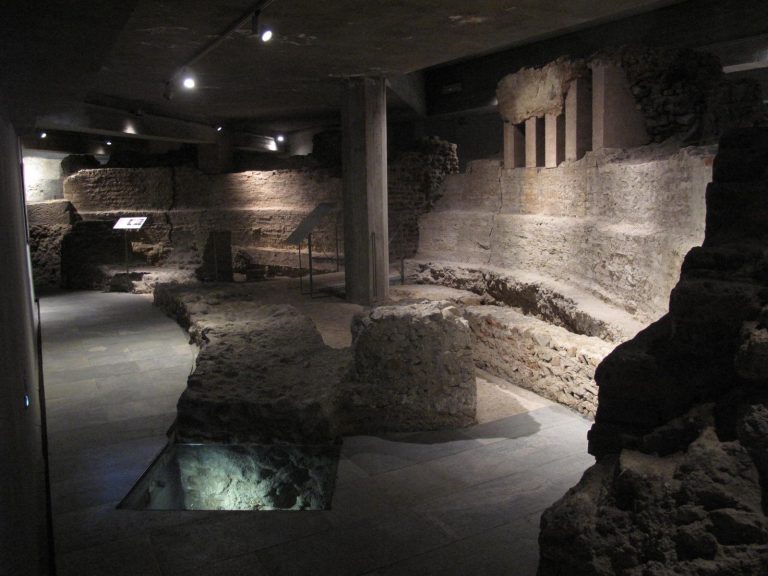
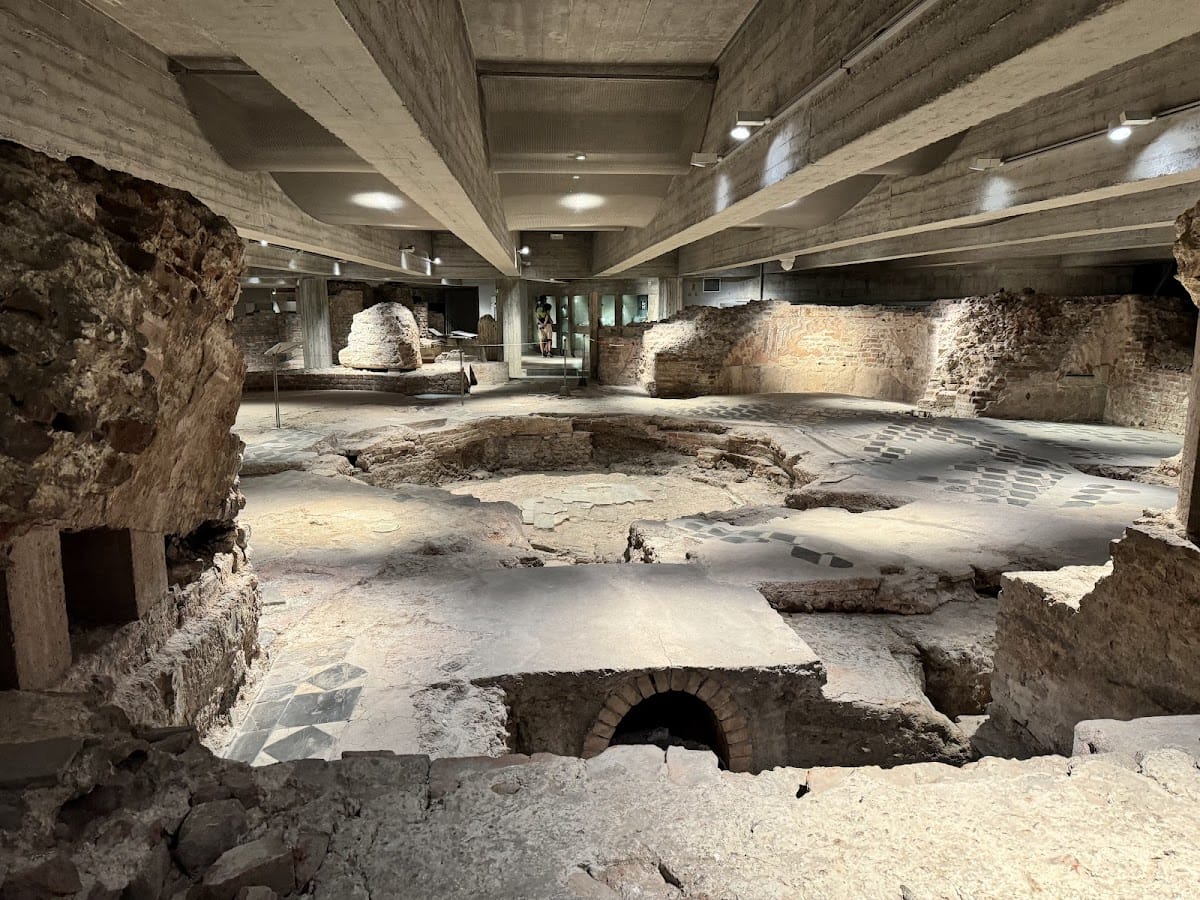
The remains came to light between 1961 and 1963 during excavations for Milan’s M1 underground railway. Further archaeological investigation in 1997 confirmed the baptistery’s late fourth-century construction date. The surviving remains now form an archaeological site beneath Piazza del Duomo and below the modern Cathedral of Milan. They are recognized as Italian national heritage and are associated with the Roman Catholic Archdiocese of Milan and the Ambrosian rite, the distinctive Catholic liturgical tradition of the Milanese church.
Remains
The surviving remains lie 3.8 metres below the floor of the modern Cathedral of Milan. They preserve parts of an Early Christian building with an octagonal plan, including sections of the perimeter wall and the rectangular and semicircular niches that opened around its interior. The octagon was associated with regeneration and resurrection, ideas that suited a building devoted to baptism.
Octagonal plan and wall structure
The baptistery measured 19.3 metres across its diagonals, with sides 7.4 metres long and exterior walls 2.8 metres thick. Eight niches were arranged around the perimeter. Each niche measured 3.5 metres in diameter, with four rectangular and four semicircular forms. Red porphyry columns, each 3.6 metres high and 0.45 metres in diameter, separated the niches inside. Their surfaces carried checkerboard and hexagonal patterns, while buttresses strengthened the niches externally. The outer walls were divided into two architectural orders.
The octagonal design drew on the fourth-century imperial mausoleum of San Vittore al Corpo in Milan, which had the same form. The baptistery also resembled the Chapel of Sant’Aquilino at the Basilica of San Lorenzo in Milan. Its original polychrome materials included limestone, breccia, ophicalcite, porphyry, granite, and marble brought from locations around the Mediterranean.
Baptismal basin and interior surfaces
Baptismal basin
The baptismal basin occupied the centre of the ritual arrangement. It measured 5.5 metres in length and 0.8 metres in depth, was lined with white marble slabs, and was reached by three steps. The bottom of the basin lies 4.5 metres below the baptistery floor. Traces of the marble lining survive, together with a central hole connected to a water conduit or pipe known as a fistula acquaria.
The baptismal route was oriented eastward toward the light of dawn. After immersion in the basin, the candidate received baptism from the bishop of Milan. The arrangement expressed baptism as a passage from an old life through death and into a new life.
Marble floor and mosaic vault
Extensive portions of the marble floor survive. They belong to the sixth-century renovation under Lawrence I and use opus sectile, a technique in which cut pieces of stone or marble are fitted together to create geometric patterns. Limestone slabs formed black squares, lozenges, and hexagons, combined with white rectangular and triangular motifs.
The interior decoration changed over the baptistery’s history. Frescoed surfaces replaced the earlier polychrome wall coverings, while the marble floor continued to serve as part of the interior finish. Above it, the vault preserved a mosaic made from tesserae covered with gold leaf, linking the ritual space with the richly decorated tradition of late Roman Christian architecture.