National Archaeological Museum of the Marches: Regional Archaeology in Ancona, Italy


Site at a Glance
- Rating
- 4.5
- Popularity
- Low
- Country
- Italy
- Primary era
- Iron Age
- External website
- Open
- Eras represented
- Stone Age, Bronze Age, Iron Age, Classical, Medieval
- Civilizations
- Ancient Greek, Celtic, Etruscan, Lombard, Mycenaean, Ostrogothic, Roman
- Site type
- Museum
On this page25 sections
History
The National Archaeological Museum of the Marches is an archaeological museum in Ancona, Italy, created in the nineteenth century to preserve the prehistoric and later antiquities of the Marches. Its origins followed the region’s annexation to the Kingdom of Italy on 2 October 1860, during the Risorgimento, the movement that unified the Italian states. A royal decree issued on 3 November 1860 by Lorenzo Valerio, Extraordinary Governor of the Marches, provided the foundation for the institution, which was established in 1863 as the Gabinetto Paleoetnografico ed Archeologico delle Marche.
Foundation and early development
The museum was promoted by Count Carlo Rinaldini, an epigraphist and secretary of the archaeological commission, and by Carisio Ciavarini, a teacher of Italian literature. Both supported Italian unification and wanted the new institution to preserve monuments and objects discovered throughout the region. This aim also responded to the active antiquities market, which threatened to remove archaeological material from its local setting. The museum’s early program reflected an empirical, classificatory approach associated with Positivism, emphasizing the collection and study of evidence from the Marches.
The museum opened in 1868 in the building of the Royal Technical Schools on Via San Martino. Its first holdings consisted mainly of inscriptions collected by Rinaldini, together with objects acquired or donated by private owners. From May 1876, Ciavarini served as inspector of excavations and monuments for the Royal Commissariat for Museums and Excavations of Antiquities in Emilia and the Marches. His fieldwork greatly increased the collections before the museum moved in 1877 to rooms in the Palazzo degli Anziani.
Further growth brought another relocation in 1884, to the former convent of San Domenico, and then in 1898 to the former convent of the Scalzi at Via Duomo 12. The museum remained there until 1923. In 1906, the breadth and regional character of the collections led to state recognition and the adoption of its present name, the National Archaeological Museum of the Marches. Its holdings were formed chiefly through more than 150 years of archaeological research in the region, rather than through the inheritance of an earlier aristocratic collection.
Excavation and the San Francesco alle Scale period
Innocenzo Dall’Osso, director and superintendent, expanded the museum through intensive excavations across the Marches. He also prepared its first detailed guide, published in 1915. In 1923, the institution moved to the former convent of San Francesco alle Scale. It was inaugurated there on 9 October 1927 in the presence of King Victor Emmanuel III, who cut the ribbon with a Bronze Age dagger.
Director Giuseppe Moretti organized the collections and supervised the careful restoration of the eighteenth-century building, while architect Arnolfo Bizzarri designed the exhibition arrangement. The new museum included Picene and Gallic sections, a numismatic collection, and major finds from the Picene necropolis of Numana and the Hellenistic necropolis of Ancona. The Ancona Civic Picture Gallery was temporarily incorporated into the museum and became independent again after the Second World War. A prehistoric section opened in 1932.
War damage and recovery
During the Second World War, the director refused to transfer the collections to the storage depots organized by superintendent Pasquale Rotondi at Sassocorvaro. Smaller objects were placed in crates in the adjoining church bell tower, while larger pieces remained in the galleries. Bombing in Ancona in 1943 caused the bell tower to collapse onto the museum. The building and collections suffered heavy damage, and the museum could not reopen immediately after the war.
Director and superintendent Giovanni Annibaldi led the recovery and restoration of the damaged objects. In 1946, Nereo Alfieri recovered the Cartoceto gilded bronzes on behalf of the state and secured additional fragments that had been concealed. Bruno Bearzi restored the group, which was exhibited from 1959. The museum reopened on 25 June 1958 in Palazzo Ferretti, acquired by the state for this purpose. At first, only the Picene section and the room of the Cartoceto bronzes were open.
The Roman and early medieval sections reopened in 1969 under superintendent Liliana Mercando. Annibaldi also supported excavations that supplied important material for the museum, including the Lower Paleolithic deposit on Monte Conero, Neolithic finds, Proto-Villanovan objects, Villanovan material from Fermo, the Picene necropolis of Numana, the Senone princely tomb, the Roman sanctuary of Monte Rinaldo, and the Temple of Venus at Ancona.
Reopening and continuing research
An earthquake in Ancona in 1972 forced another prolonged closure. Under director and superintendent Delia Lollini, the Protohistoric section reopened in 1988. The prehistoric, Copper Age, and Bronze Age sections followed between 1990 and 1997. The Hellenistic and Roman sections devoted to Ancona reopened progressively between 2010 and 2015, while the Roman section covering the rest of the Marches reopened in 2023 after 51 years of closure.
The collections trace the history of the region from the Paleolithic and Neolithic periods through the Copper and Bronze Ages, the Picene and Gallic cultures, Greek and Hellenistic Ancona, the Roman period, and the early Middle Ages. The Picene collection, dating mainly from the ninth to the fourth or third century BC, is described as the most complete existing collection of Picene civilization. The museum’s research also reveals long-distance connections, including Greek and Etruscan exchange with the Picenes, contacts between Greek navigators and the Marches during the Mycenaean period, and later links between Hellenistic Ancona and the Greek world, especially Alexandria.
The Picenes occupied much of the Marches from the ninth to the third century BC. In their final phase, their culture gradually interacted and merged with traditions introduced by the Senones and with the Greek foundation of Ankón, the Greek name for Ancona, creating a shared Celto-Greco-Italic cultural formation. The Battle of Sentinum is treated as the conventional end of Picene civilization and the beginning of Romanization in the region. The Senones, a Celtic people, settled in northern Picene territory around 400 BC, reaching the Esino River and advancing farther south in some areas. Their culture later merged with Picene and Greek communities, although Celtic characteristics remained especially visible in weaponry.
Since December 2014, the museum has been managed through the Regional Museums Directorate of the Marches. A major project begun in 2023 and scheduled for completion by 2026 concerns both Palazzo Ferretti and the exhibition arrangements, while the museum has remained open during the work. In 2025, the storage areas were opened for public observation and study. They contain approximately 180,000 objects accumulated over more than 160 years, including mosaics and part of the epigraphic stone collection. Objects not displayed on the shelves can be consulted by request in study rooms. As of 2026, the early medieval and numismatic collections were still being prepared for display, and the Metal Ages section was temporarily closed.
Palazzo Ferretti
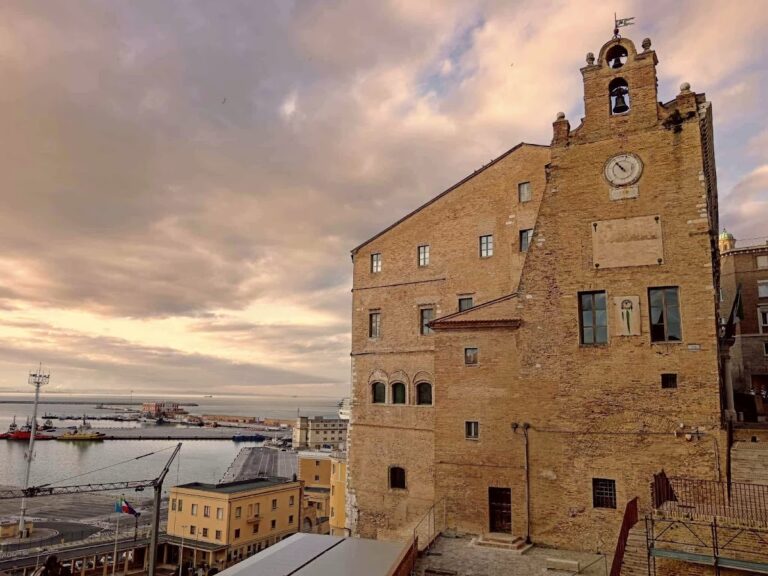
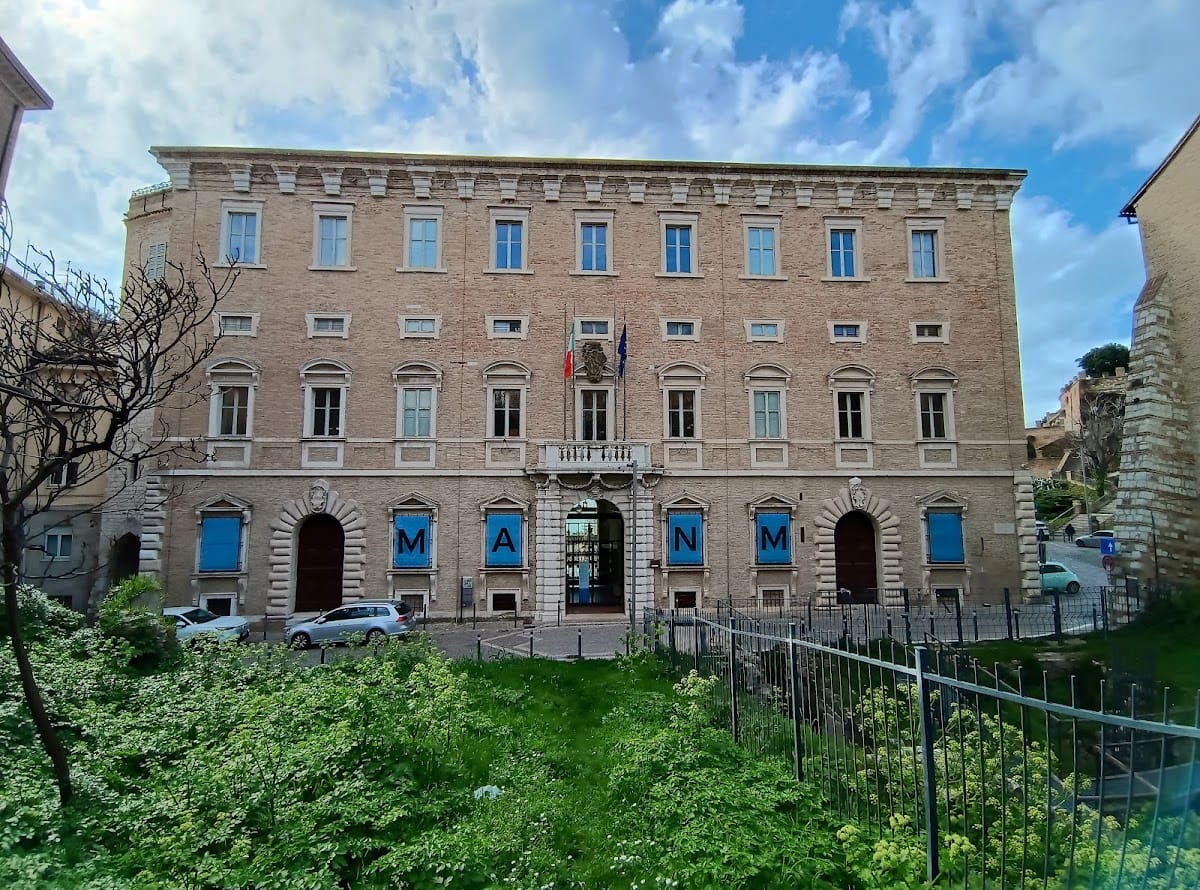
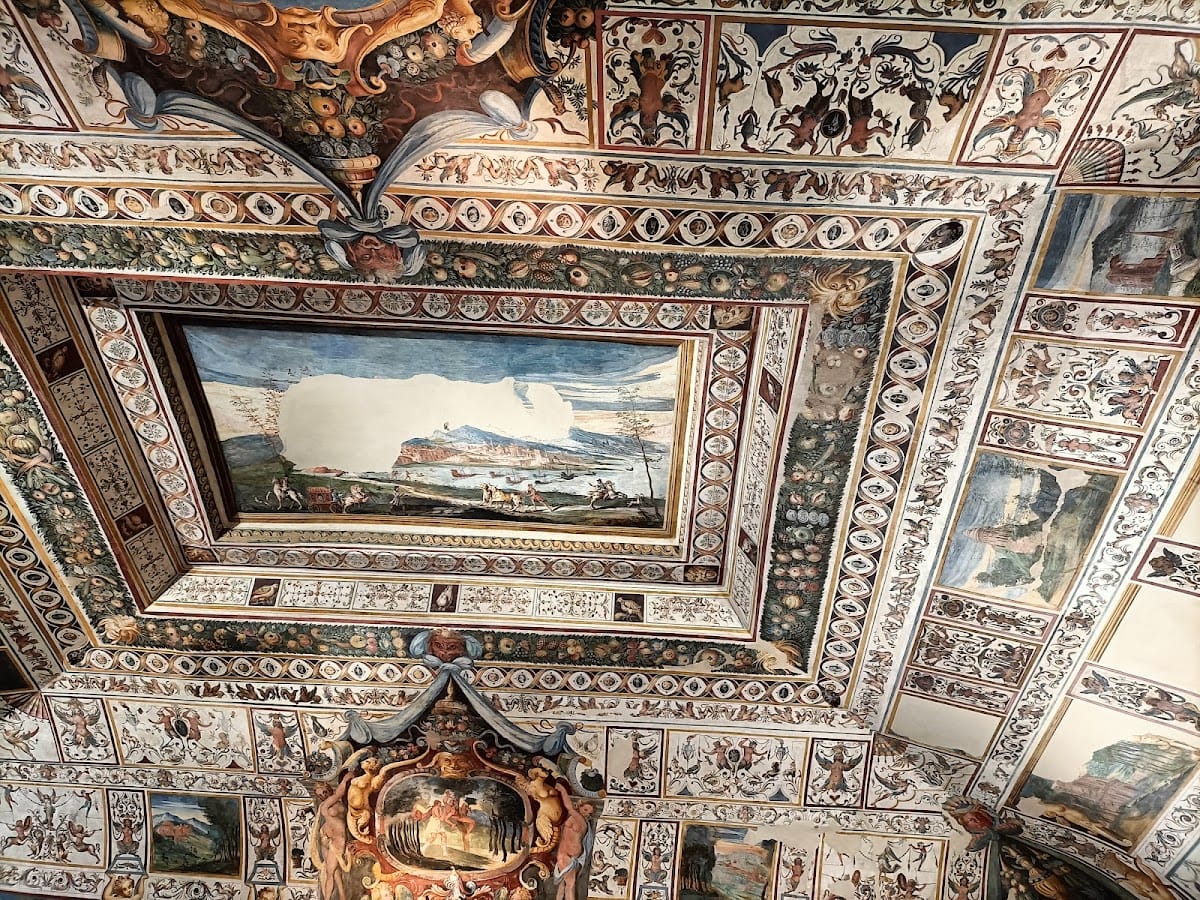
Palazzo Ferretti has housed the museum since 1958. The palace was built between 1540 and 1543 for the Ferretti counts during Ancona’s recovery after the loss of its republican independence and within the Papal States. Its construction has been interpreted as an expression of renewed civic peace. From 1560, the Ferretti family commissioned frescoes and decorated wooden ceilings from Pellegrino Tibaldi and his workshop. Other frescoes on the third floor are attributed to Federico and Taddeo Zuccari.
In 1759, Luigi Vanvitelli enlarged the palace, incorporating a medieval tower on the south side and extending it westward to the former church of the Scalzi. He also designed the facade balcony, monumental staircase, and roof terrace. Statues by Gioacchino Varlè and his school were added to the building. Restoration campaigns took place in 1928 to 1931, after the Second World War, and after the 1972 earthquake. During the works begun in 2023, investigation of the staircase recovered its original bright wall colours and ivory-white stucco and statues by Varlè.
Remains
Palace and exhibition layout
The museum occupies Palazzo Ferretti and provides approximately 3,500 square metres of exhibition space. Its collections contain about 190,000 objects, with approximately 10,000 on the visitor route in 2023. The exhibition is arranged chronologically across several levels. The prehistoric section occupies the mezzanine level of the second floor, while the protohistoric material is mainly on the third and first floors. Rooms 24 and 25 contain Greek, Hellenistic, and Roman material from Ancona, and rooms 26 and 27 present the general Roman collection on the ground and basement levels.
The former noble palace retains frescoes, decorated wooden ceilings, a medieval tower incorporated into the eighteenth-century enlargement, a monumental staircase, a balcony, and a roof terrace. Several interiors were formerly reception rooms, a banqueting hall, and other aristocratic spaces. The redevelopment begun in 2023 includes a revision of Franco Minissi’s exhibition design, six temporary-exhibition rooms, public access to the storage areas, and the reopening of the roof terrace. Copies of the Cartoceto gilded bronzes are intended for the terrace, which also has views toward the Gulf of Ancona, the port, and the historic districts along it.
Prehistoric collections
Paleolithic evidence
The prehistoric sequence begins with Paleolithic material, including the Monte Conero assemblage, which dates to approximately 300,000 years ago. It contains choppers, chopping tools, bifaces or hand axes, Acheulean flake tools, and later Levallois implements. The deposit was identified in 1963 during construction work for a radio antenna.
The Frasassi Venus is a female figure made from a stalactite. Found in 2007 inside the Grotta della Beata Vergine di Frasassi, it has folded forearms, joined hands, and a pregnant belly. It dates to approximately 20,000 years ago, in the Upper Paleolithic, probably the Gravettian or early Epigravettian. The displays also include geometric microliths, such as triangles, trapezes, and crescents, mounted on supports with resins and other binders to economize on flint.
Neolithic to Bronze Age material
A decorated pebble from Tolentino depicts a female figure with a wolf’s head and, on its reverse, a possibly bovine animal protome. Aristide Gentiloni Silverj found it in 1884. Luigi Pigorini initially rejected it as inauthentic, but it was reconsidered in 1997 as a possible ritual-religious or shamanic work.
Neolithic objects illustrate agriculture through querns and grinders, animal domestication through bones of domestic animals, and textile production through pottery spindles and whorls. Obsidian from the Aeolian Islands and steatite from Scandinavia show long-distance exchange. Plaster and domestic hearth remains relate to village construction, while early polished-stone tools show changes in technology.
Copper Age material includes polished stone axe-hammers and early evidence for metalworking. Bronze Age objects include finds from the earliest settlement in the Ancona area, excavated at Campo della Mostra, and locally produced bronze daggers from hoards dating to the beginning of the second millennium BC. Apennine pottery has incised and cut decoration with plastic handles. Fragments of Mycenaean pottery from Ancona, Tolentino, and Monsampolo del Tronto are thinner and made from finer, purified clay than the local pottery, and are painted rather than incised. Their presence records early contact between Greek navigators and the Marches coast, particularly the area later occupied by Ankón.
Picene and Gallic collections
Settlements, graves, and daily activities
The protohistoric section presents Picene and Gallic material. The Picene displays cover phases Piceno I to VI, from the ninth to the third century BC, and include thematic rooms for inscriptions and votive deposits. Rooms 20 and 21 are located within the medieval tower of the palace.
Objects from the Proto-Villanovan and Picene settlement of Ancona illustrate fishing through hooks, a harpoon, a trident, and Glycymeris shells. Deer-antler objects relate to hunting, domestic-animal bones to animal husbandry, and spindles and whorls to weaving. Deer-antler hoes represent agriculture. Male graves contain rich weapon assemblages, while bronze breastplates depict an ornithomorphic solar boat with wild-duck protomes.
The Fermo room contains finds from a Villanovan cultural enclave active in the ninth and eighth centuries BC. It was absorbed into the surrounding Picene culture during the seventh century BC. Its characteristic objects include crested helmets decorated with rows of studs and projecting cylindrical elements.
Luxury objects and religious imagery
Orientalizing Picene material includes a bronze breastplate from Numana with linked human figures and pendants, perforated stola disks, breastplate disks decorated with fantastic animals and human figures, and a bronze situla lid dating to approximately 620 to 600 BC. The lid shows pairs of nude warriors, including hoplites and archers, dancing around a totem pole topped with wolf heads.
A rare oinochoe, or wine jug, has a body made from an ostrich egg engraved with vegetal borders and animals including griffins. Its trefoil mouth is an ivory female head with gold inlays. The neck and foot were made from perishable organic material and have not survived. The vessel is an eastern product dating from approximately 620 to 580 BC. Other Picene objects include a statuette of the Egyptian god Bes, a large limestone warrior’s head from Numana dating to the mid-seventh century BC, and an ivory statuette of the goddess Cupra whose amber face was lost during wartime bombing.
Large six-knotted bronze rings have an uncertain meaning and may relate to solar, feminine, or fertility symbolism. The votive-deposit room contains local bronze figures of attacking and standing Mars, miniature ceramic vessels, a small bronze Hercules, and elongated bronze-sheet figures known as “evening shadows.” It also includes an Etruscan bronze head of Mars and a small bronze kouros, an Archaic Greek male figure. The “evening shadows” form a group of roughly twenty figures found in sacred offering deposits in Tuscany, the Po Valley, Umbria, and the Marches.
Greek influence and Picene inscriptions
Two breastplate disks from Rapagnano, dating to the mid-sixth century BC, show increasing Greek influence. One depicts a battle with mounted warriors and is a 1914 galvanoplastic reproduction of an original later lost from private ownership. The other shows a duel between two kneeling soldiers. A collar with sirens and sea horses is displayed with related material.
The Picene inscription room contains twenty-seven known inscriptions dating from the late seventh to the early third century BC. Written in the Picene alphabet, they provide evidence for the Picene language. The room also includes an inscription in the language and alphabet of Novilara. The Picene alphabet was fully deciphered only in the 1980s. It uses points for certain letter forms, and the language has seven vowels and sixteen consonants.
The Piceno IVb displays contain Attic black-figure and red-figure vessels acquired through Greek maritime trade. They include a calyx krater with scenes of the marriage of Bacchus and Ariadne and of Oedipus and the Sphinx, a Panathenaic-type amphora, a three-register volute krater, a high-foot dish showing the young Heracles, bell kraters with satyrs and maenads, and a dinos showing Prometheus giving fire to a satyr. Greek bronze vessels include a dinos on a lion-legged tripod and two hydriai, or water jars, with gorgon and sphinx protomes.
Later Picene objects include a rhyton with Dionysiac scenes and a white-ground pyxis depicting the birth of Aphrodite in the presence of Eros. The final Picene phase includes Alto-Adriatic pottery whose highly stylized figures and hairstyles approach abstraction.
Senone material
The Gallic section contains Celtic weapons and objects associated with the Senone settlement of northern Picene territory, alongside objects produced by Etruscan and Greek workshops. Gold objects include three refined floral crowns, earrings, collars, torques, and bracelets. The section also contains the handles of an Etruscan pan depicting pairs of fighting warriors, Celtic helmets with iron crests and cheek and ear guards, and Celtic swords in the Waldalgesheim style.
Greek, Hellenistic, and Roman Ancona
Hellenistic Ancona
Rooms 24 and 25 contain material from Greek, Hellenistic, and Roman Ancona. Room 24 includes two locally made sphinxes from the second or first century BC, originally used to guard funerary areas. One holds a severed head between its paws. The room also contains one of the six Greek coins of Ancona preserved by the museum, Greek-inscribed funerary stelae from the late second to early first century BC, coloured glass vessels, gold jewellery, silver domestic services, and other objects from the Hellenistic necropolis of Ankón.
The stelae are decorated with reliefs and inscriptions and follow Cycladic artistic models unusually closely. Their funerary setting, together with the luxury goods from the necropolis, reflects strong connections between Ancona, the wider Greek world, and Alexandria.
Roman Ancona
A marble portrait of Augustus with a veiled head shows him performing a religious offering as pontifex maximus, the chief religious office of the Roman state. Found in 1863 beneath Palazzo Ferretti in the area of the Roman forum, it is in almost perfect condition and is attributed to a high-quality local workshop. A cast was made for the Augustus room of the Museum of Roman Civilization in Rome.
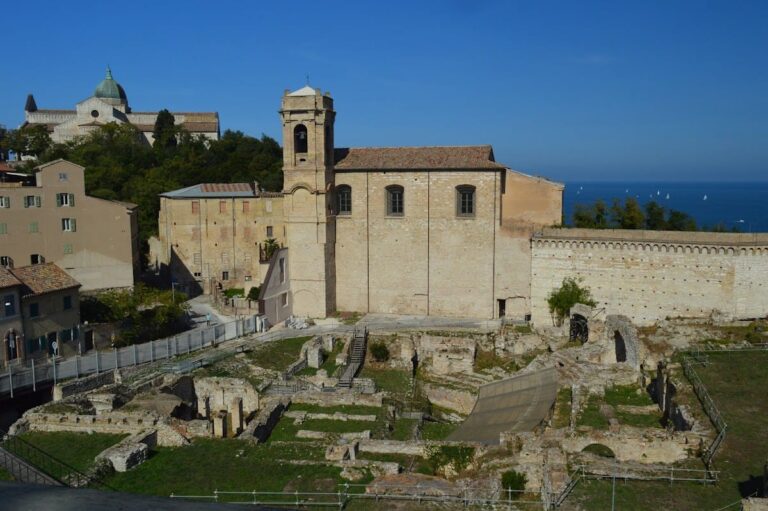
Room 24 also contains second-style Roman frescoes from a domus, or Roman town house, on Via Fanti. Their illusionistic arches frame Nilotic scenes with ducks, a crocodile, lotus leaves, and pygmies in boats. A Greek-made Pentelic-marble cinerary situla, a bucket-shaped vessel associated with cremated remains, dates to the beginning of the first century AD and depicts Dionysus. It was found in a burial still visible along Corso Matteotti. A reconstruction model presents the Roman phase of the Temple of Venus at Ancona, whose remains lie in the archaeological area beneath the cathedral.
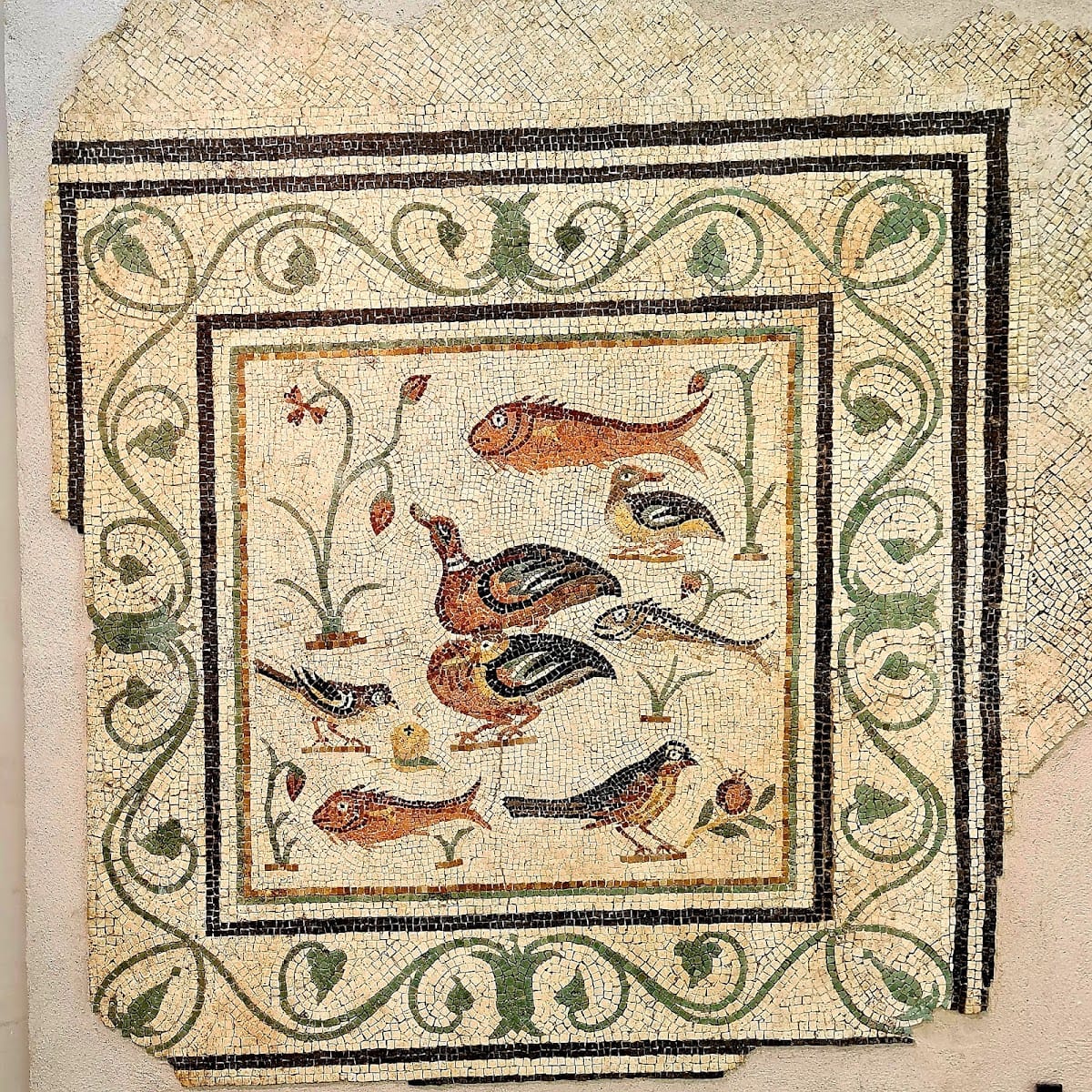
Room 25 contains a mosaic from Helvia Recina with coloured-marble inlays and two polychrome mosaics from the domus of Valle degli Orti. Other objects include a relief of a dancing cithara player, ivory and bronze fittings from three funerary beds, a marble trapezophoros, or decorated table support, with winged female busts and vegetal ornament, the Roman Vintner’s Sarcophagus, and three small headless statues of Venus.
Trajanic monuments and the harbour
A cast of scenes 58 and 59 of Trajan’s Column reconstructs the departure of the emperor and his army from Ancona for Dacia. It shows the Temple of Venus on the acropolis, the Guasco hill and its switchback road, the Temple of Diomedes, Trajan’s Arch, the portico of the forum, port warehouses, warships, spectators, and a bull sacrifice.
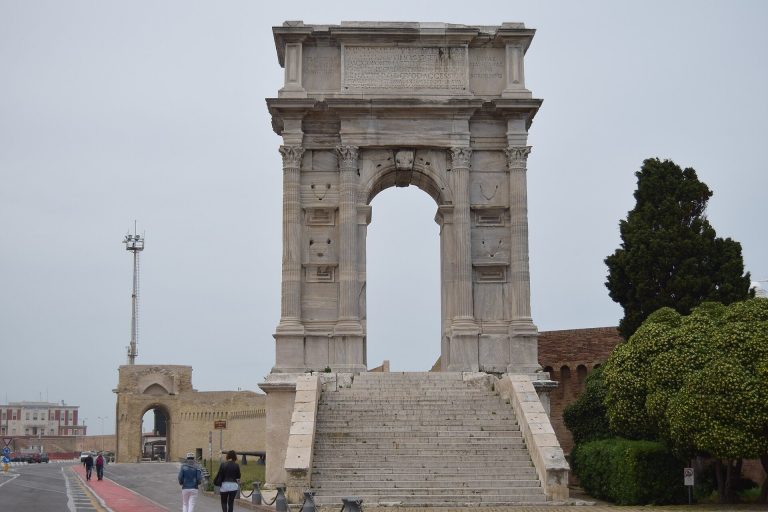
A reconstruction model of Trajan’s Arch shows the monument with fourteen ship prows and statues of Trajan, Plotina, Marciana, Mercury, Neptune, and Portunus. The family statues faced inland, while the three deities faced the sea and could be seen from the harbour entrance. Finds from the Trajanic harbour include fragments of gilded bronze statues traditionally attributed to the attic statues of the arch before its sack by the Saracens in 839. The same area produced a bowl fragment depicting a bear attacking a man tied to a post.
Roman collections from the Marches
The general Roman section is arranged thematically and includes sculptures, glass, amphorae, mosaics, and inscriptions. Portraits range from the Republican to the Late Imperial periods and include a head of Emperor Claudius and a portrait type identified as Agrippina Minor. Other works include a first-century AD marble lynx-headed trapezophoros, an oscillum, or suspended decorative disk, with a Capricorn and crescent moon, and an opus vermiculatum mosaic emblem, made with very small tesserae, showing a boar hunt and dating to the second or first century BC.
The Globe of Matelica is a spherical stone sundial dating from the first or second century AD. Its Greek-numbered markings served astronomical, astrological, and chronological observations, including the hours, solstices, equinoxes, zodiacal positions, and changing lengths of day and night.
Other Roman objects include a sarcophagus with scenes from the myth of Medea dating to approximately AD 150 to 160, a second-century sarcophagus with tritons and Nereids, and a sarcophagus with a lead tube for offerings to the deceased. The displays also contain a first-century AD imperial torso in a muscular cuirass decorated with griffins and a gorgoneion, a protective image of the Gorgon’s head, a grey-marble torso of Hercules, blown-glass vessels, a stele of the sevir Sextus Titius Primus, and a small reddish opaque amber pendant in the form of a rodent, probably a squirrel, dating to the first or second century AD.
Cartoceto bronzes, early medieval objects, and other collections
Cartoceto gilded bronzes
The Cartoceto gilded bronzes are represented by four reconstructed copies: a rider, an equid, a woman, and the lower part of a draped figure. Like the originals, the copies are made in gilded bronze. They are displayed on the roof terrace as a representation of Marches archaeology. The original fragments were shown as separate pieces from 1959 to 1972 and as a single reconstructed group in 1988.
Early medieval and numismatic material
The early medieval section is intended to contain weapons, dress accessories, and jewellery associated chiefly with Ostrogothic communities from the late fifth to early sixth century and Lombard communities from the late sixth through the seventh century. As of 2026, this section was still being prepared for display.
The numismatic collection contains approximately 90,000 items, although it is not fully open. Sixty-five Roman coins were displayed in the Roman rooms. Among the material not displayed is a Syracusan coin issued during the reign of Dionysius I. Found at Ancona, it dates to the period of the city’s foundation by Syracusan Greeks.
Paleontological material
The museum also displays a paleontological skeleton of a young brown bear that died in a karst cavity near the Frasassi caves during the last phase of the Wurm glaciation, more than 10,000 years ago. A cast represents the approximately three-metre-long Late Jurassic ichthyosaur Gengasaurus nicosiai, found near San Vittore di Genga during construction of a road tunnel. The original is held by the Speleo-Paleontological and Archaeological Museum of Genga.