Teatro Romano Spoleto: A Roman Theatre in Italy


Site at a Glance
- Rating
- 4.3
- Popularity
- Low
- Country
- Italy
- Primary era
- Classical
- Eras represented
- Classical, Medieval, Early Modern
- Civilizations
- Roman
- Site type
- Entertainment
- Remains
- Theatre
On this page8 sections
History
Teatro Romano Spoleto is a Roman theatre in Spoleto, Italy, built during the Roman period for the colony of Spoletium, the Roman name for the city. Its exact construction date is uncertain. The colony stood on the Via Flaminia, a major Roman road linking Rome with central and northern Italy, and the theatre formed part of the city’s public architecture.
Roman public life
The building hosted theatrical and musical performances as well as political assemblies. Its artificial supporting platform later subsided, perhaps because of an earthquake or a landslide. The resulting damage was followed by restoration, allowing the theatre to continue its public role in antiquity.
Medieval and post-classical reuse
After the fall of the Western Roman Empire in the fifth century, the theatre ceased to function and began to decay. Much of its stone was dismantled and reused in the tower of Spoleto Cathedral and in Spoleto Castle. In the post-classical period, the remains also served as a quarry for building material.
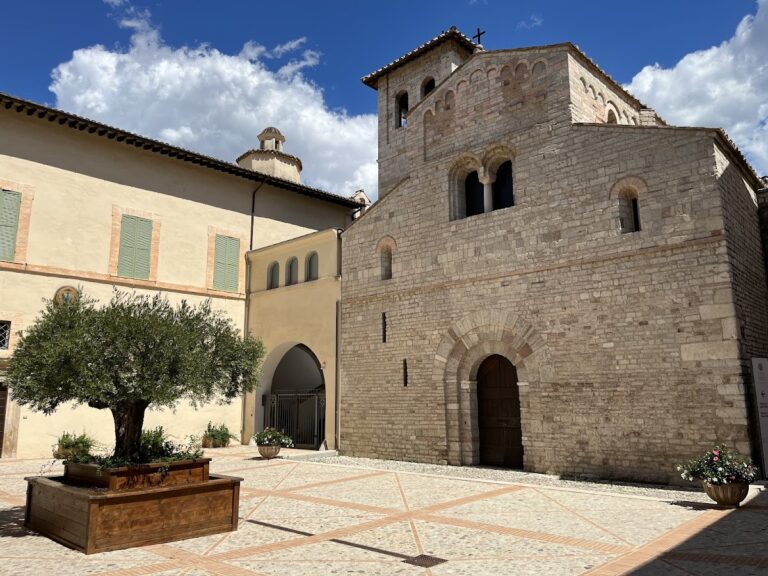
During the twelfth century, the church of Sant’Agata was built over part of the former stage. Houses belonging to the Corvi family were added beside it in the thirteenth and fourteenth centuries. At the end of the fourteenth century, Benedictine nuns from the Abbey of San Paolo inter vineas established a monastery in the complex after inheriting the Corvi palace. The monastery was enlarged in the sixteenth century with a cloister supported by octagonal pillars, and in 1870 the complex was converted into a women’s prison.
Identification and restoration
Baldassarre Peruzzi, an Italian Renaissance architect and painter, depicted the surviving ruins in the sixteenth century. Their identity as a Roman theatre was established only in 1891, when the archaeologist Giuseppe Sordini recognized the site. Systematic excavations followed in 1933 and 1938, with the most extensive campaigns taking place from 1954 to 1960.
The prison closed in 1954, after which excavation and restoration focused on recovering the theatre. A new foundation was installed, and the lower part of the seating area was restored. The former monastery of Sant’Agata now contains the National Archaeological Museum of Spoleto, while the theatre is used for concerts and performances, including events associated with the Festival dei Due Mondi. It is an Italian national heritage site within the monumental complex of Sant’Agata.
Remains
Auditorium and circulation
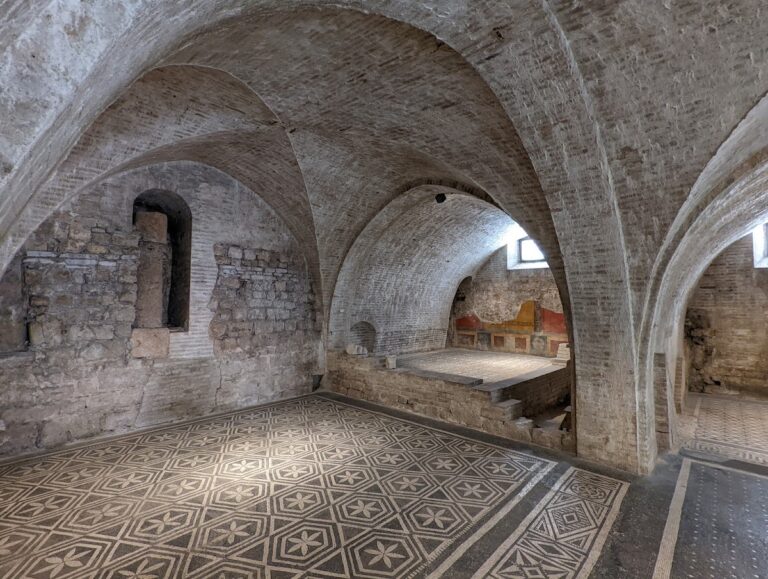
The theatre lies within Spoleto’s city walls and measures 114.40 metres across overall. Its semicircular cavea, the auditorium containing the seats, is approximately 70 metres in diameter. Part of the cavea rests on a semicircular ambulacrum, a circulation passage covered by a barrel vault. Three vomitoria, or entrances leading into the seating area, connected this passage with the auditorium. The ends of the cavea led to places reserved for magistrates and other eminent citizens.
Orchestra and stage area
The orchestra, the space between the audience and the stage, retains its original pavement of polychrome marble slabs. Holes for the poles that supported the theatre curtain remain visible in the proscenium, the architectural zone immediately in front of the stage building. The outer facade was formed by arcades framed with half-columns of the Tuscan order, a simplified Roman order with plain columns and restrained decoration.
Later buildings and archaeological material
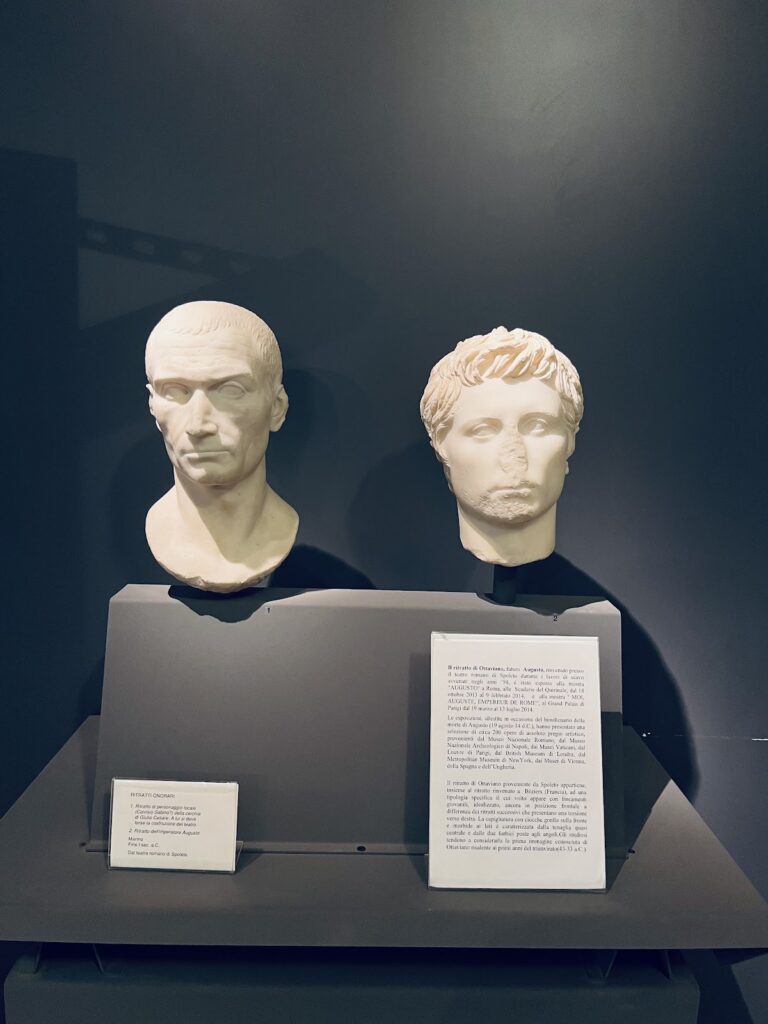
The stage building itself has disappeared, and the church of Sant’Agata occupies its former position. Statues, inscriptions, and other fragments from the theatre are displayed in the former church, which now serves as an archaeological museum. These objects form part of the material preserved within the wider complex alongside the surviving theatre structure.