Cumalıkızık Village: An Early Ottoman Vakıf Settlement in Türkiye


Site at a Glance
- Rating
- 4.4
- Popularity
- Medium
- Country
- Turkey
- Primary era
- Medieval
- Eras represented
- Medieval
- Civilizations
- Byzantine, Ottoman
- Site type
- City
On this page10 sections
History
Cumalıkızık Village is an early Ottoman settlement in Türkiye, located near Bursa at the northern foothills of Uludağ. Established in the early fourteenth century, possibly in 1325, it began as a vakıf settlement, whose revenues and goods supported a charitable religious or public foundation. Its preserved rural character forms part of the UNESCO World Heritage property Bursa and Cumalıkızık: Birth of the Ottoman Empire, inscribed in 2014.
Foundation and Ottoman rural life
Cumalıkızık developed during the early formation of the Ottoman state as a small agricultural settlement. It is described as one of seven settlements along the Silk Road and supplied varied farm products to caravanserais and külliyes, Ottoman building complexes organized around a religious foundation. Agriculture remains central to the village setting, which includes citrus fruits, walnuts, chestnuts, and other cultivated products.
The village belongs to a group of Kızık settlements associated with the Oghuz, a major grouping of Turkic tribes whose branches contributed to the formation of several Turkic states, including the Ottoman polity. Cumalıkızık is one of five surviving Kızık villages, alongside Değirmenlikızık, Fidyekızık, Hamamlıkızık, and Derekızık. The name joins “Kızık,” linked with one of the 24 Oghuz clans, and “Cuma,” the Turkish word for Friday. One tradition connects it with Friday prayers attended by people from neighboring Kızık villages. Another says that Osman Bey, founder and first ruler of the Ottoman dynasty, gave the village its name because its foundation took place on a Friday.
Survival and modern recognition
During the Greek occupation of 1920 to 1922, Cumalıkızık maintained its existence while other villages in the area did not. This continuity helped preserve its Ottoman cultural and historical fabric. Byzantine-period traces also survive in nearby settlements, and a church ruin was found southeast of Cumalıkızık in the foothills of Uludağ in 1969. Some archaeological remains from the surrounding area are displayed in the Bursa Archaeological Museum.
The village was placed on the UNESCO Tentative List in 2000 before becoming part of the World Heritage property in 2014. The Cumalıkızık Conservation and Revitalization Project sought to protect its historic character and natural history. In the same year, the Cumalıkızık Ethnography Museum opened with support from the metropolitan municipality and local residents, presenting objects and aspects of traditional village life and customs. Since 2015, a raspberry festival held in June, with folk-dance performances, has formed part of the village’s continuing cultural identity.
Remains
Historic houses and streets
Cumalıkızık retains 270 historic houses, including 180 still used as residences, while other buildings are undergoing restoration. The houses generally rise to three storeys and combine rubble or river stone, timber, and adobe. Their roofs and construction materials preserve features associated with early Ottoman rural settlements. Upper-storey windows commonly have decorative grilles or form part of projecting bay windows. Principal entrance doors retain forged-iron handles and knockers, while exterior colors include yellow, white, blue, and purple.
The houses are arranged along very narrow, stone-paved streets without sidewalks. A central channel runs through the streets to drain rainwater. Together with the projecting upper storeys, varied materials, and surviving domestic use, this layout preserves a high degree of architectural authenticity, although individual buildings are in different conditions.
Religious and communal buildings
Village mosque and Zekiye Hatun Fountain
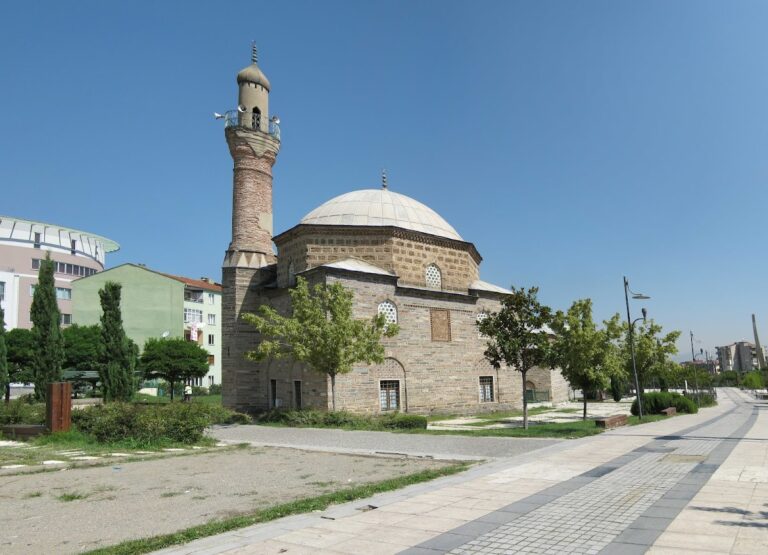
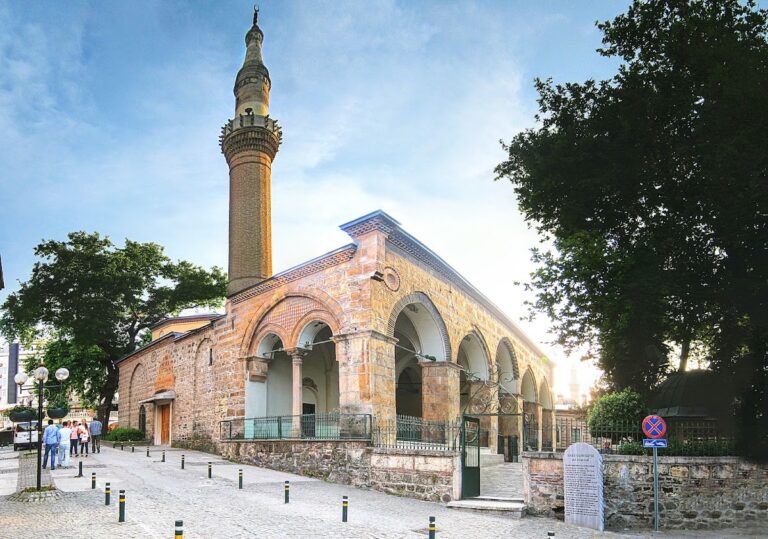
The village mosque dates from the Ottoman period. Beside it stands the Zekiye Hatun Fountain, also Ottoman in date, forming a surviving religious and communal group within the historic settlement.
Single-domed bathhouse
A single-domed bathhouse is another Ottoman-period building in Cumalıkızık. Its surviving form contributes to the group of historic structures that define the village’s early Ottoman character.
Byzantine church ruins
Ruins of a Byzantine-period church remain within the village. They provide physical evidence of an earlier phase of settlement in the area before Cumalıkızık’s establishment as an Ottoman village.
Ethnography Museum
The village square contains the Cumalıkızık Ethnography Museum. Its exhibits include objects connected with the village’s past and illustrate elements of traditional local life and customs.